Tag Archives: iambic hexameter

Iambic hexameter: Martin Parker, ‘Man of the Match’

You swore at me and hurled your ring into the pond
then drove off back to London “for some bloody fun”
with friends whose Chelsea coven held you in its bond.
I was next in, scored twelve and hit the winning run.

The beers were long and cool, the Captain shook my hand.
Dusk shaded in, a final liquid blackbird sang.
A coughing tractor crawled a strip of fading land.
An owl flew low across the pitch, a church bell rang.

Two muddy urchins with a shrimp-net dredged the pond
their hopeful piping rippling in the cooling air
while you choked on exhaust at Guildford or beyond
along your golden road to Knightsbridge and Sloane Square.

Another world and just two perfect hours away
your eyes had been bright green. Or brown. Or were they blue?
I still recall the details of that Summer day
so much more clearly than I now remember you.

*****

Martin Parker writes: “The only point I might add is my hope that if the muddy urchins’ dredging efforts were rewarded they were not too disappointed to learn that the ring’s diamond might not have been a real one! The intervening sixty-five-plus years have, mercifully, erased the fact that I may have been nothing but a cheapskate!”

‘Man of the Match’ was first published in Snakeskin.

Martin Parker is a writer of mainly light and humorous verse much of which has appeared in national publications including The Spectator, The Oldie and The Literary Review. In 2008 Martin founded the quarterly light verse webzine, Lighten Up Online at www.lightenup-online.co.uk, now edited by Jerome Betts. His website at www.martinparker-verse.co.uk gives details and excerpts from his two “hopefully humorous and only occasionally wrily depressing books”.

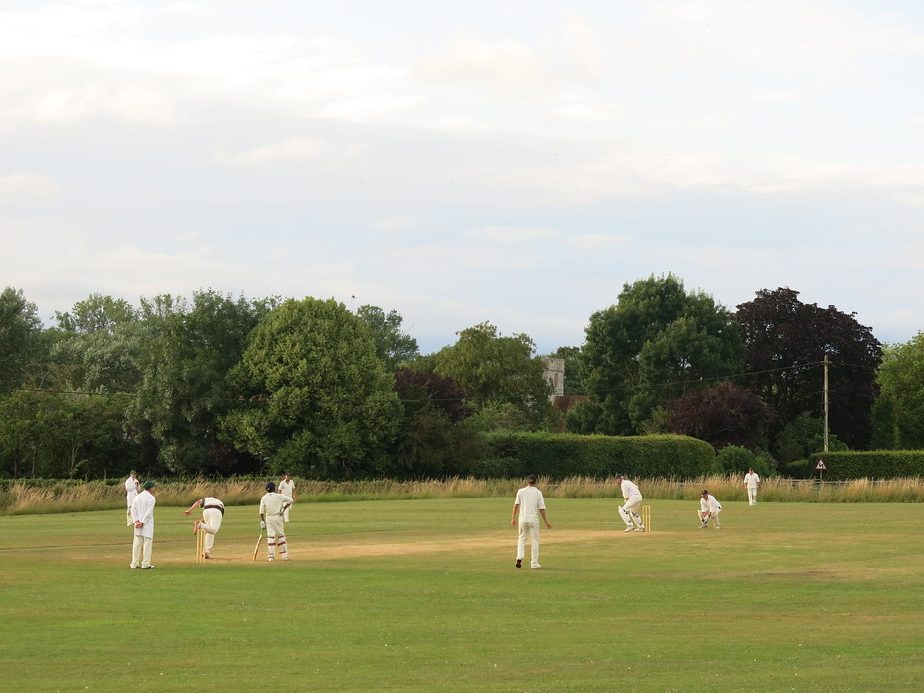
Photo: “Village cricket” by Peter Curbishley is licensed under CC BY 2.0.
Using form: Iambic hexameter: Daniel Moreschi, ‘A Wing-stroked Spectacle’

Segmented sets of starlings sharply elevate
towards candescent skies, suspend, then circulate
in sync. Their wingspans whisper sunset symphonies
while manifesting silhouetted symmetries.

With poise, finesse and swiftness, they transform the air
into an ever-changing scape; this canvas where
each turn and swirl unfolds a painterly display:
a moving mural, rendered on a dying day.

The starlings coalesce to make a checkered veil.
They crown the clouds and skim across a coastal trail,
then separate as if surrendering to gusts,
and cover summits like a desert’s storm-flung dust.

With tapered pace, their fevered flights revert to long
glissades of shimmering shades; a showy dance along
a latent stopgap stage. They stir, careen, decline,
retracing what remains of lofty lazuline,

before it all becomes a screen of red-specked gold.
The starlings falter in its wake; they cannot hold
their elegance in fading light. Their spirals wane
in streaming chains. They spill in spates of jet-black rain.

*****

This poem was originally published by the Society of Classical Poets at the start of the year, after being awarded 4th place in their annual competition.

Daniel Moreschi writes: “Through its descriptions of the flights of starlings, this poem is intended to evoke reflections on how moments of beauty can be transient; the starlings’ flight patterns are fleeting and subject to change, much like all beautiful moments in life. I felt that verse written in alexandrines, brimming with fluidity, was an appropriate means to depict such an aerial display.”

Daniel Moreschi is a poet from Neath, South Wales, UK, who experienced a significant turning point when his ongoing battle with severe M.E. upended his life. However, during this period, he also rediscovered his passion for poetry, which had lain dormant since his teenage years. Writing has become a distraction from his struggles. Daniel has been acclaimed by over 80 poetry competitions and published in numerous NFSPS anthologies of prize-winning poetry, as well as by Lunar Codex, The Lyric, Society of Classical Poets, The Dawntreader, Westward Quarterly, Wishbone Words, The Chained Muse, Every Writer Resource, and an array of other journals and publications.
Instagram: @daniel.moreschi

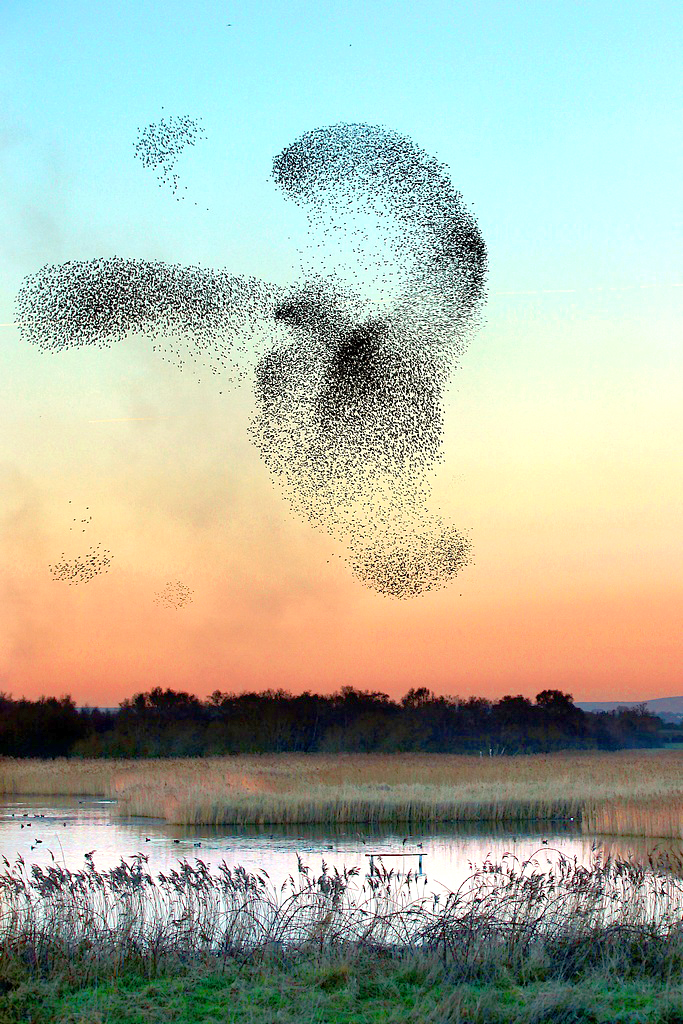
Photo: “STARLING MURMURATION” by Tony Armstrong-Sly is licensed under CC BY-ND 2.0.

Short poem: RHL, ‘Friendship, Not Passion’

I had a friendship, more than passionate love, for you;
we could have been so good, easy, together.
But there’s that issue of your strong religious thoughts,
whereas I let my thoughts change with the weather.

I… well, and who’s the I you think that you address?
I ramble, googly-eyed, my arms elastic.
There are so many sweet but sadly firm believers.
I’m – more than atheist – iconoclastic.

*****

If you’re used to iambic pentameter the meter of this poem feels just a little off, with its lines of alternating 12 and 11 syllables, i.e. alternating hexameters and feminine-ending pentameters… not quite comfortable. Which is perfectly in keeping with the relationship described. And I don’t remember precisely which long-ago not-quite-girlfriend I had in mind when I wrote it; I’ve been attracted to more than one charming female, wonderfully calm and sane except for some unfortunate religious orientation or other.

I’m reminded of the 19th century Punch cartoon of the two guests at a dinner party:
She: “And what is your religion, sir?”
He: “Madam, all men of sense are of the same religion.”
She: “And which religion is that, pray tell?”
He: “Madam, men of sense never say.”

Which is all very well for friendship, but hardly a solid basis for a deeper relationship. You’re better off if you hold out for someone philosophically compatible, unless you (and they) really don’t care. In which case, you’re philosophically compatible!

‘Friendship, Not Passion’ was originally published in Lighten Up Online, edited by Jerome Betts.

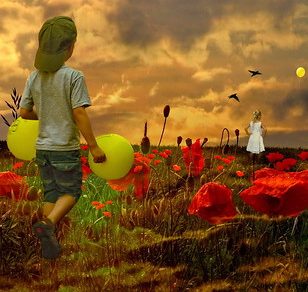
Illustration: “Friendship” by h.koppdelaney is licensed under CC BY-ND 2.0.

Odd poem: ‘When I Was Fair and Young’, by Queen Elizabeth I

When I was fair and young, and favour gracèd me,
Of many I was sought, their mistress for to be;
But I did scorn them all, and answered them therefore,
‘Go, go, go, seek some otherwhere,
Importune me no more!’

How many weeping eyes I made to pine with woe,
How many sighing hearts, I have no skill to show;
Yet I the prouder grew, and answered them therefore,
‘Go, go, go, seek some otherwhere,
Importune me no more!’

Then spake fair Venus’ son, that proud victorious boy,
And said, ‘Fine Dame, since that you be so coy,
I will so pluck your plumes that you shall say no more,
‘Go, go, go, seek some otherwhere,
Importune me no more!’

When he had spake these words, such change grew in my breast
That neither night nor day since that, I could take any rest.
Then lo, I did repent that I had said before,
‘Go, go, go, seek some otherwhere,
Importune me no more!’

Elizabeth (Ms. Tudor, if you prefer) was born in 1533 and became Queen of England at age 25, in 1558. This poem dates from some three or four years later, and the painting above is from the same time. Given how youthful she looks in her late 20s, the poem may be more playful than self-pitying–but she was also well past the age that sex and marriage would have been expected. As it was she had had to lead an extremely careful life: England was weak and unstable when she came to the throne: her father Henry VIII had broken with the Pope and formed the Church of England; her older sister Mary, on becoming Queen, had turned the country back to Catholicism and Elizabeth had narrowly escaped death as a traitor; Elizabeth inherited a country where people were burnt at the stake for not being of the correct faith… but the correct faith kept changing.

By her late 20s the Court was trying hard to have her married to a powerful European monarch to strengthen the country by alliance. The Catholic Philip II of Spain was one possiblity, the Lutheran Erik XIV of Sweden was another. Again, everything involved a religious balancing act. Meanwhile flattering portraits showing vitality and power were created and exchanged as part of the negotiations–and Elizabeth sent her court painter to Sweden to paint Erik. But for whatever reason she never married. In 1588 Philip attempted a full scale invasion with his Armada, but that failed as well. Elizabeth died in 1603 aged almost 70, still nicknamed (though probably unfairly) ‘the Virgin Queen’.

Regarding the poem: technically, the first three lines of each stanza are in iambic hexameter and are followed by an uneven refrain. The first two lines rhyme, and the third rhymes with the end of the refrain. It looks very singable. There is some unevenness in the scansion, and Elizabeth has marked the midpoint of most of the hexameters with a comma; this divides the line into two natural clauses or parts, and also signals a little pause for the sake of smooth reading–particularly useful in the shortened second line of the third stanza and the lengthened second line of the fourth.

Photo: Painting of Elizabeth I in 1562, probably painted by her court artist Steven van der Meulen, or his workshop.