Tag Archives: lake

Dialect verse: William Henry Drummond, ‘The Wreck of the Julie Plante’

On wan dark night on Lac St. Pierre,
      De win’ she blow, blow, blow,
  An’ de crew of de wood scow “Julie Plante”
      Got scar’t an’ run below—
  For de win’ she blow lak hurricane,
      Bimeby she blow some more,
  An’ de scow bus’ up on Lac St. Pierre
      Wan arpent from de shore.

  De captinne walk on de fronte deck,
      An’ walk de hin’ deck too—
  He call de crew from up de hole,
      He call de cook also.
  De cook she ‘s name was Rosie,
      She come from Montreal,
  Was chambre maid on lumber barge,
      On de Grande Lachine Canal.

  De win’ she blow from nor’ -eas’ -wes’,—
      De sout’ win’ she blow too,
  W’en Rosie cry, “Mon cher captinne,
      Mon cher, w’at I shall do ?”
  Den de captinne t’row de beeg ankerre,
      But still de scow she dreef,
  De crew he can’t pass on de shore,
      Becos’ he los’ hees skeef.

  De night was dark lak wan black cat,
      De wave run high an’ fas’,
  W’en de captinne tak’ de Rosie girl
      An’ tie her to de mas’.
  Den he also tak’ de life preserve,
      An’ jomp off on de lak’,
  An’ say, “Good-bye, ma Rosie dear,
      I go drown for your sak’.”

  Nex’ morning very early
      ‘Bout ha’f-pas’ two—t’ree—four—
  De captinne—scow—an’ de poor Rosie
      Was corpses on de shore,
  For de win’ she blow lak hurricane,
      Bimeby she blow some more,
  An’ de scow bus’ up on Lac St. Pierre,
      Wan arpent from de shore.

MORAL
  Now all good wood scow sailor man
      Tak’ warning by dat storm
  An’ go an’ marry some nice French girl
      An’ leev on wan beeg farm.
  De win’ can blow lak’ hurricane
      An’ s’pose she blow some more,
  You can’t get drown on Lac St. Pierre
      So long you stay on shore.

*****

William Henry Drummond (1854 – 1907) was born in Ireland shortly after the end of the Great Famine, and came to Canada as a boy with his parents. He became a doctor, but gained fame as the ‘Poet of the Habitant’, celebrating the rural communities of Quebec with humour and goodwill.

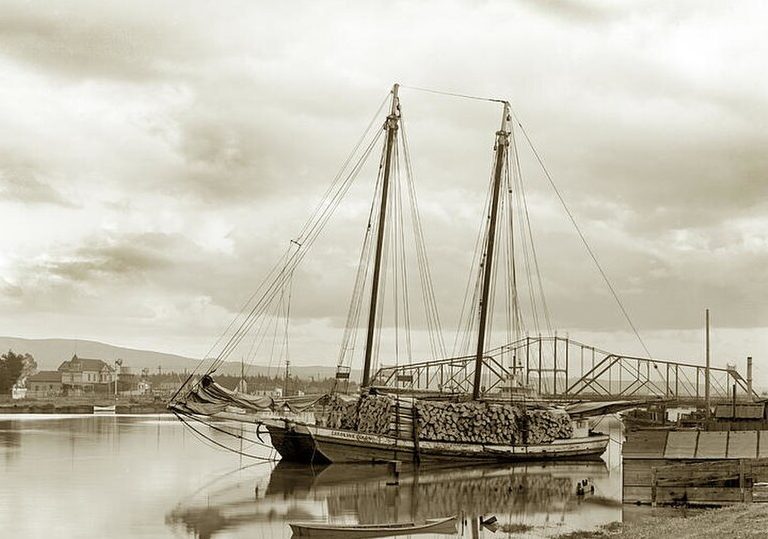
Photo: The scow schooner Caroline Dixon with a load of wood for the match factory.
Sonnet: Barbara Loots, ‘Intimations’

This is a Wordsworth morning. Not a leaf
trembles, the water shimmers beneath a shawl
of vapor, and the wild primordial call
of one loon sounds its tremolo of grief
across the lake. The sunlight like a thief
infiltrates slowly, making shadows crawl
out of the hollows where each animal,
furred, feathered, winged or scaled, to its brief
life awakens. My awakened eyes
and all the senses that belong to me
discover in the love that glorifies
whatever was and is and is to be
the wonder and perpetual surprise
of momentary immortality.

*****

Barbara Loots writes: “My husband Bill and I spend summer months in Canada on a tiny pile of granite dropped by a glacier in the middle of Blackwater Lake near Parry Sound, Ontario. Bill’s father purchased the island right after WWII for the tiny price of a property owned by the Crown, in a deal similar to the American Homestead Act: you must build a domicile on it within 18 months. The cottage cobbled together at that time still stands, with a few improvements, not yet including running water, electricity, or indoor plumbing. We bring a lot of books. I often meet the Muse among the towering White Pines. Poems are a natural consequence. Many of them appear in my collection The Beekeeper and other love poems (Kelsay Books 2020).”

“Intimations” appeared in the Fall 2025 issue of The Lyric (Volume 105 Number 4).

After decades of publishing her poems, Barbara Loots has laurels to rest on, but doesn’t. Residing in Kansas City, Missouri, Barbara and her husband, Bill Dickinson, are pleased to share the household with an acrobatic tuxedo kitty named Jane Austen. Barbara has work forthcoming in The Orchards Journal, The Shining Years II anthology, and I-70 Review. Her concerns and complaints can be found on Facebook and at barbaraloots.com. She serves as the review editor for Light Poetry Magazine (see Guidelines at lightpoetrymagazine.com). 

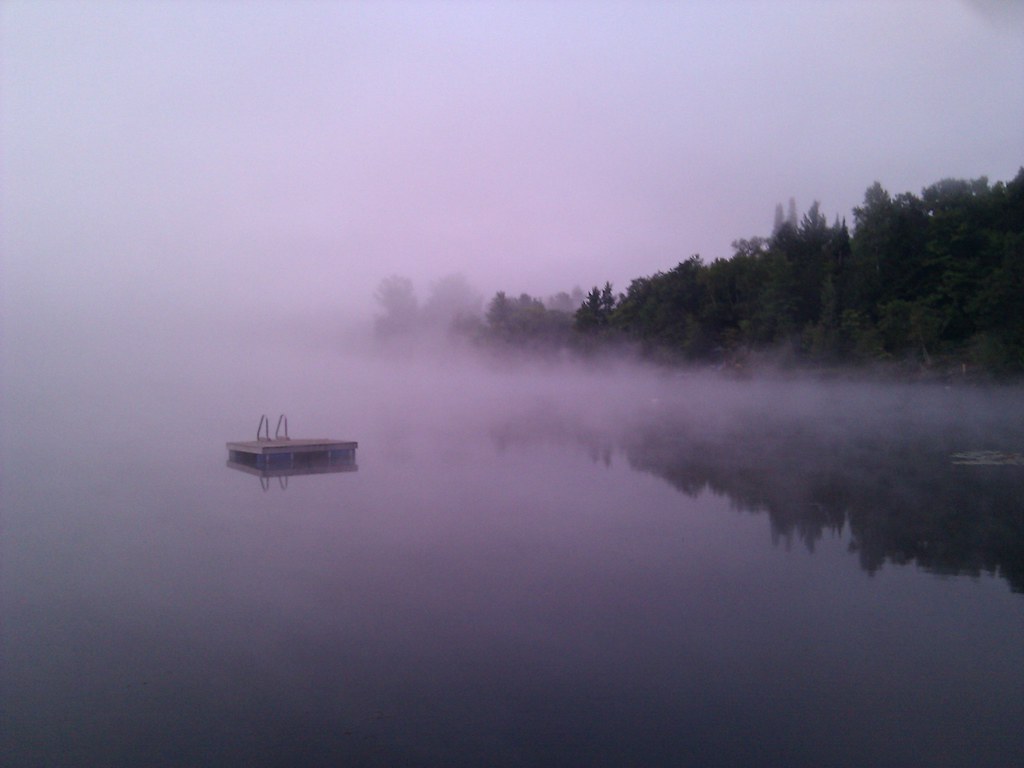
“Early morning lake” by josterpi is licensed under CC BY-NC 2.0.

Potcake Poet’s Choice: Frank Hubeny, “True”

Frank Hubeny

Frank Hubeny

The cloudy image on the lake
Comes from the gracious morning light
We left the darkness of the night,
Became aware of what’s at stake.
We now renew, rejoice, remake,
Reflect on what we know as true.
Our part seems small, like morning dew,
But later when the victory’s won
We may find out it was well done
And fully know and be known too.

Frank Hubeny writes: “I often write to prompts. I know other people who are also participating in the prompt will at least give the poem a glance. Ronovan is one of the many people out there posting writing prompts. He has a weekly Décima Poetry Challenge. This form has ten 8-syllable lines with a particular rhyme scheme: abbaaccddc. I do like the sound of four beats per line. I often post my own photos and so write about them if the theme of the prompt permits. For this poem I posted two photos of clouds on a pond in Techny Prairie in Northbrook, Illinois. The last line of the poem is intended to suggest 1 Corinthians 13:12 about seeing reflections, knowing in part and then knowing fully and being fully known. The being “fully known” is what was foremost in my mind. That thought along with the reflections on the pond in the photographs and Ronovan’s challenge to use the word “true” as a rhyme word in a décima motivated me to write this poem.”

Frank Hubeny lives between Miami Beach, Florida, and Northbrook, Illinois.  He has been published in The Lyric Magazine, Snakeskin Poetry Webzine, Ancient Paths Literary Magazine, Visual Verse and Vita Brevis.  He regularly posts photographs, short prose and poetry to his blog, https://frankhubeny.blog