Tag Archives: ode

Using form: George Simmers, ‘A Triumphal Ode’

decorative

A TRIUMPHAL ODE
Humbly Inſcribed to the Occaſion of The moſt Joyous and Auspicious ARRIVAL of
ANDREW MOUNTBATTEN-WINDSOR, Eſq.
at His Majeſty’s PRISON of BRIXTON
Composed with all due Solemnity & Pomp
and designed to be ſet to Muſick by
the late Great GEORGE FRIDERIC HANDEL

All the echoing prison round
Let great tumultuous welcome sound.
Let each incarcerated fellow
Loud and jubilantly bellow.
Let there be no dereliction;
Convicts, show your true conviction
In strong words and in minatory songs
That he is now where he belongs.

Let there be all kinds of musical cacophonies
Let there be mighty rattling of warders’ keys
Let there be synchronised humming of drug-transporting drones
Let them sound, the unharmonious ringtones of contraband phones
Let noise be noise in our unanimous celebration
Of this long-overdue incarceration.

He comes! Let every crooked eye be fixed on
The arrival of Mr Mountbatten-Windsor at Brixton.
He who for so long has sinned with impunity
Let him now be welcomed into the criminal community.
Here with the weaklings and the wicked,
Here with the druggie and the dickhead,
Here among the child molesters,
The frauds and Just Stop Oil protestors
The terrorists, the traitors
And the far-right agitators,
The ponces and the nonces, plus the mugger and the blagger,
The cracksman with a jemmy and the psycho with a dagger,
All citizens of this prison world, the scum of every slum
Rejoice and raise a happy voice that he at last is come
He, born second in line to the throne, now come to live
In the world where the snout baron rules, and the man with the shiv

Let him, the ex-royal, the ex-envoy for trade
Come here among his kindred, to the future he has made.

*****

George Simmers writes: “The Epstein revelations have muddied the reputations of many eminent men, and nobody looks grubbier than Mr Mountbatten-Windsor. The distasteful stories and compromising photographs have told their story. The only way is down. This Ode looks forward to celebrating an event that the British public is anticipating eagerly.

“It is doubtful whether prosecutions will follow for many of Mr Epstein’s guests. Their morals may be questionable and their reputations have suffered, but illegality can be hard to prove – it was Mr Epstein himself who did all the luring and procuring. But Mr Mountbatten-Windsor, because of his distinguished family connections, was lured not only with massages, but also with financial inducements. At the time when he was an official trade envoy of the British government, he had access to financial information (such as details of a forthcoming budget) that could have been very valuable to an investor like Mr Epstein. Documents in the voluminous Epstein archive suggest that such information was indeed shared. Mr M-W could therefore be prosecuted for the very serious offence of misconduct in a public office. This ode looks forward to the time when this foolish man is made to answer for his misdeeds.

“Such are the delays that have slowed the British court system since the hiatus of the Covid years, that legal experts estimate that Mr Mountbatten-Windsor’s case is unlikely to reach a court until 2030. It’s a long time to wait, but in the final eventuality, I hope that this ceremonial ode will be sung joyously by a massed choir. I imagine it set to music by that eminent composer George Frideric Handel, who was very good at such things. To those who object that Mr Handel is dead, I would point out that there is a psychic in America who has made productive contact with the shade of Mozart. Several peasant concerti have apparently resulted. I’m sure the lady could persuade Mr. Handel’s ghost, too, to come up with the goods. I imagine something a bit like the Hallelujah Chorus, but maybe even more jubilant.”

‘A Triumphal Ode’ was first published in Snakeskin.

George Simmers used to be a teacher; when he retired he then amused himself by researching a Ph.D. on the prose literature of the Great War. He now spends his time pottering about, walking his dog and writing a fair bit of verse. He is currently obsessed by the poetry of Catullus, and has self-published a slim volume of translations. He has edited Snakeskin since 1995. It is probably the oldest-established poetry zine on the Internet. His work appears in several Potcake Chapbooks, and his most recent general collection is ‘Old and Bookish‘. Another may be on the way.

Double sonnet, Daniel Galef, ‘A Nightingale to a Sad Poet’

(Keats’s ‘Ode to a Nightingale’ from the other side)

You slump at my tree’s foot, complex angsts brewing
While our red-clawed, red-beaked animal furies
In these shadowy plots hatch our own undoing.
If thinking is man’s ruin, have no worries.
If you could speak the whistling words of birds
Whose sound to you like music now appears,
As nature’s snow-white cream man sours to curds
To chew, our songs would curdle in your ears:
‘Fly!, fly! The bearded fox is on the prowl!’—
And ‘Keep away! These berries are quick poison!’—
‘I need a mate, or I was born for nought’—
‘Go south, go south!’—‘The horned and hoary owl
Brings swift, crook-taloned death.’ You seek strange joys in
Ignorance, to envy lives so fraught!
Now dull-brained human scientists proclaim
That tool-use is no more unique to apes
Than language, war, or thumbs. They’re all the same
Emergent properties, like wine from grapes.
I am not certain that is Hippocrene;
The Pierian Spring leaves no such scarlet stain.
A jug of wine might well complete the scene:
Your book of verse, &c. A brain
Like smiling Aesop’s, where morals mask the roar
Of lions, the flopping fear of fish in the net,
The worm-wove cloak we dress up in our tomb in—
I think that must be Lethe. Drink, and soar
Above your brain, and me, and quite forget
That you were all too sentient, all too human.

*****

Daniel Galef writes: “I’m a sucker for parodies and response poems! My first book features riffs on Byron, Swift, Ernest Thayer, the ancient epigrammatist Nossis the Epizephyrian, and Doris Day. A few years ago in my master’s program I took a[n excellent] poetry workshop with Barbara Hamby focusing on the history of the Ode, as part of which she had everyone memorize Keats’s “Ode to a Nightingale.” We’d all read the poem before, but engaging with it so closely for a sustained duration was a really lovely experience, and having the whole poem by rote is an excellent party trick if you ever need to clear the room at the end of a party. At the end of the class I sent Professor Hamby a little parody piece, a rebuttal from the nightingale’s point of view to the moping poet sitting underneath its tree. (It was also a gesture of peace because I had gotten on her bad side by insinuating that the speaker calling the nightingale “dryad of the trees” was redundant because all dryads are by definition of the trees.) That poem was three pages or so and more directly parodying Keats’s style, as well as being written with the same stanzaic structure as Keats’s. It was also just for fun and thoroughly unprintable. But something I’ve been doing lately when I can’t bring myself to write an original poem is to sonnet-ize other things I’ve written—short lyric poems, long narrative poems, free verse, even short short stories—as I’m currently putting together a second collection of Imaginary Sonnets, a series of persona poems I’ve been writing for years inspired by the Victorian poet Eugene Lee-Hamilton. I cherrypicked a handful of my favorite lines from the long nightingale poem and spun some sonnet-stuff around them and ended up with this. It was still too much material for fourteen lines but fit into a double-sonnet, which is half as good.”

Daniel Galef’s poetry, half-serious and half-non-, has been published in a variety of venues themselves both serious and non-. His first book, Imaginary Sonnets, collects 70 persona poems from the point of view of various historical figures and literary characters, including Lucrezia Borgia, Christopher Smart’s cat, and a taco. “A Nightingale to a Sad Poet” first appeared in the Spring/Summer 2025 issue of Sein und Werden. Other recent writing can be found in the Indiana Review, the Best Small Fictions anthology, and Scientific American.

Bard of the Mossy Cot” by Giles Watson’s poetry and prose is licensed under CC BY-SA 2.0.


Potcake Poet’s Choice: Amit Majmudar, ‘Eyespots’

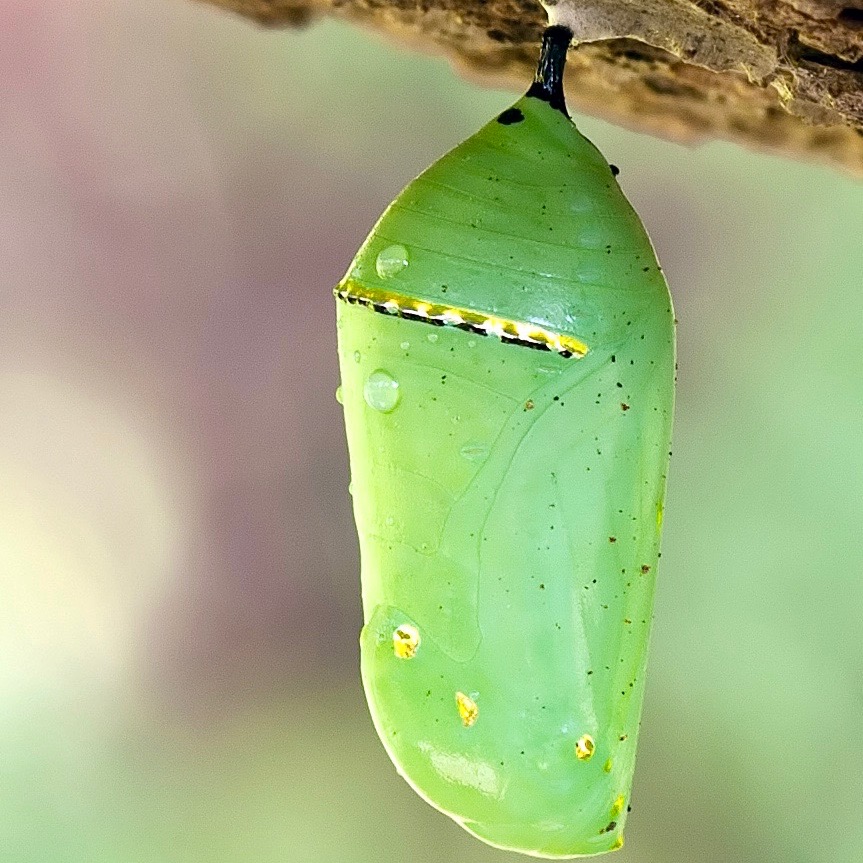
Caterpillars build their bunkers out
of terror. Transformation hunts them, haunts them
as oak leaf peepholes open underfoot
to bare the air, the emptiness that wants them.
I have a measure of infinity
inside me. A is no and mit is measure
in an ancestral tongue that haunts me, hunts me.
I’m half in love with what I have to be.
The other half is looking for a razor
to make of me the Amit who was once me,

my yogi’s beard a clump of Spanish moss
limp at my feet, a piece of furry roadkill.
I’m no ascetic. Half in love with loss,
I’ll seek out beauty, or at least my ode will,
night-blooming jasmines dooming my samadhi,
scenting, resenting my hermetic dark
because they know a yogi, breathing in
his first girlfriend’s perfume, unarchives her body,
and drives her, after dusk, to the vanished park
where memory of sin cocoons the sin.

Caterpillars ravel bunkers into
bodybags—no way for them to know
the moment that they poke themselves a window,
the rebirth they were hiding from will show:
Two stained-glass windows mounted on my back,
two earshaped eyespot petals I can flex
and fold, a flailing that transforms to flight
while all the darkling jasmines that I lack,
past loves that called me onward to the next,
unpetal in the bodybag of night.

In love, or half in love, with mere aesthetics,
I’ve daydreamed Himalayan caves, a hive
that hums with “Aum” from ninety-nine ascetics,
their senses hibernating, half alive.
No one has ever scaled Kailash, the peak
where Shiva sits in bud, in shut-flytrap samadhi
with ashes smeared across his chest and arms.
But that’s just not the changelessness I seek.
I want my language, shapely as a body,
to weave and rive cocoons, enchantments, forms

with giant wings inside their ashgray berries.
I want my transience to live in speech,
if only as a resonance that carries,
like jasmine scent, beyond my voice’s reach.
I tell myself: Old soul, don’t be afraid
of changing. You are old enough to know,
whenever something changes, something dies,
but the dark you flowered in won’t let you fade.
A crack in this cocoon admits a glow.
The blue moon butterfly will wear your eyes.

Amit Majmudar writes: “This poem, ‘Eyespots’, is what I think of as a Keatsian ode, borrowing its stanzaic form and (I hope) something of its musicality. Yet the poem incorporates Hindu religious imagery throughout and sings of self-transformation in a way that isn’t to be found in Keats. This hybridization of Eastern and Western traditions in the poem feels idiosyncratic. There remain elements still opaque to me about it; so I never really delved into the metaphysical significance of the title’s false eyes, these seeming sense organs that are not actually sensing anything, but, given the focus on ascetic imagery, there seems to be something in that. Maybe in another essay? Or another poem….

I feel as though there are poems I have written that someone else could conceivably have written. But not this one; even ignoring that my name hides caterpillar-like inside the cocoon of the poem, I feel that the range of influences and ideas is simply too idiosyncratically “me” for this to have come from any other poet’s hand. Will everyone like it? Probably not, for precisely that reason. But I know that no one else could have produced this sequence of words, so I confess a certain fondness for it. It’s the one of my literary children who most resembles me. And it’s as good a way as any to get to know me as a writer.”

Amit Majmudar is a diagnostic nuclear radiologist who lives in Westerville, Ohio, with his wife and three children. The former first Poet Laureate of Ohio, he is the author of the poetry collections What He Did in Solitary and Dothead among other novels and poetry collections. Awarded the Donald Justice Prize and the Pushcart Prize, Majmudar’s work has appeared in The New York Times, The New Yorker, Best of the Best American Poetry, and the eleventh edition of The Norton Introduction to Literature. Two novels are forthcoming in India in 2022: an historical novel about the 1947 Partition entitled The Map and the Scissors, and a novel for young readers, Heroes the Color of Dust. Visit www.amitmajmudar.com for more details.

‘Eyespots’ was first published in Measure Review.