Throne of my lonely niche, my wealth, my love, my moonlight. My most sincere friend, my confidant, my very existence, my female Sultan, The most beautiful among the beautiful… My springtime, my merry-faced love, my daytime, my sweetheart, laughing leaf… My plants, my sweet, my rose, the one only who does not distress me in this world… My Istanbul, my Caraman, the earth of my Anatolia My Badakhshan, my Baghdad, my Khorasan My woman of the beautiful hair, my love of the slanted brow, my love of eyes full of mischief… I’ll sing your praises always I, lover of the tormented heart, Muhibbi of the eyes full of tears, I am happy.
*****
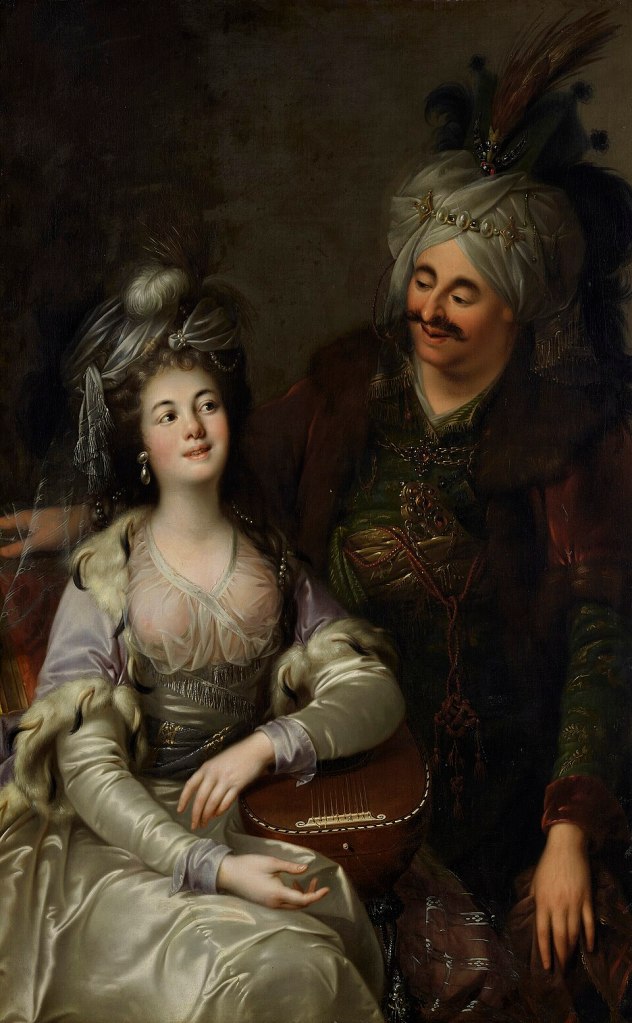
Suleiman the First, born in 1494, was Ottoman emperor from 1520 to 1566. Known to his subjects as The Lawgiver from his extensive reforms of education, society, taxation and criminal law, he was known in the West as The Magnificent for his court surpassing Europeans in grandeur. He formed an alliance with the French against the Hapsburgs, extended the empire in the Balkans and North Africa, and broke with tradition by marrying a Ukrainian or possibly Polish slave from his harem: Roxelana, or Hürrem, the mother of his successor Selim the Second. Under the pen name Muhibbi, he wrote love poems for Roxelana.
Painting: Attributed to Anton Hickel (1745-1798), Roxelana and Suleiman the Magnificent
An Austrian army, awfully arrayed, Boldly by battery besieged Belgrade. Cossack commanders cannonading come, Dealing destruction’s devastating doom. Every endeavour engineers essay, For fame, for fortune fighting – furious fray! Generals ‘gainst generals grapple – gracious God! How honours Heaven heroic hardihood! Infuriate, indiscriminate in ill, Just Jesus, instant innocence instill! Kindred kill kinsmen, kinsmen kindred kill. Labour low levels longest, loftiest lines; Men march ‘mid mounds, ‘mid moles, ‘mid murderous mines; Now noxious, noisy numbers nothing, naught Of outward obstacles, opposing ought; Poor patriots, partly purchased, partly pressed, Quite quaking, quickly “Quarter! Quarter!” quest. Reason returns, religious right redounds, Suwarrow stops such sanguinary sounds. Truce to thee, Turkey! Triumph to thy train, Unwise, unjust, unmerciful Ukraine! Vanish vain victory! vanish, victory vain! Why wish we warfare? Wherefore welcome were Xerxes, Ximenes, Xanthus, Xavier? Yield, yield, ye youths! ye yeomen, yield your yell! Zeus’, Zarpater’s, Zoroaster’s zeal, Attracting all, arms against acts appeal!
Belgrade was besieged nine times between 1440 and 1806. It is right on the edge of the area the Ottoman Turks were able to wrest from the Christians, and control went back and forth. This poem is about the 1789 Siege of Belgrade, when the Austrians showed up in mid September with 120,000 troops and 200 siege guns to try to take control of the Belgrade fortress that was held by 9,000 Ottoman troops with 456 cannon. On 6th October the Austrians began a devastating bombardment. Two days later, in exchange for the surrender of Belgrade, the Ottoman garrison was given a free passage with their personal and private possessions to Orșova; a prisoner exchange was also arranged between the combatants.
The poem was written by British journalist and poet Alaric Alexander Watts (1797-1864) and published in 1828. There are a couple of versions floating about on the internet, with various spellings and typos, and with and without the ‘Just Jesus’ line which deteriorates from J’s to I’s. The rhyme pairing isn’t perfect, the metre is imperfect, the syntax is stretched in places, and meanings and references are sometimes obscure. (‘Suwarrow’ for instance is the brilliant Russian general Alexander Suvorov who, though instrumental in winning battles with Turkey and others in the late 18th century, was not present at the 1789 Siege of Belgrade. He was defeating the Turks elsewhere at the time, but how can you ignore a general credited with winning 63 major battles, and never losing one?)
My initial impression is that the metre is an easy-to-read, easy-to-recite ‘four beats to the bar’, but the number of syllables varies with the needs of the alliteration:
But then it dawns on me that the poem is actually in iambic pentameter, with five beats… but the first line is so technically weak that it’s misleading: it has eleven syllables instead of ten unless you pronounce the second word ‘Austrin’, and also requires the ‘-ly’ of ‘awfully’ to be a stressed syllable. But once you reinterpret the rhythm of that line, the poem settles down properly. (There is a good lesson in poetics here: the technical purity of your opening line is super important!)
Anyway, I think we can cut Watts some slack: I don’t know of any other alliterative abecedarian poem at all, though surely there must be some. Wikipedia quotes this fragment from the Harper Handbook to Literature:
An abecedarius always alliterates Blindly blunders, but blooms: Comes crawling craftily, cantering crazily, Daring, doubtless, dark dooms.