Tag Archives: poetic difficulties

Villanelle: Janice D. Soderling, ‘The Poor Poet, Carl Spitzweg’

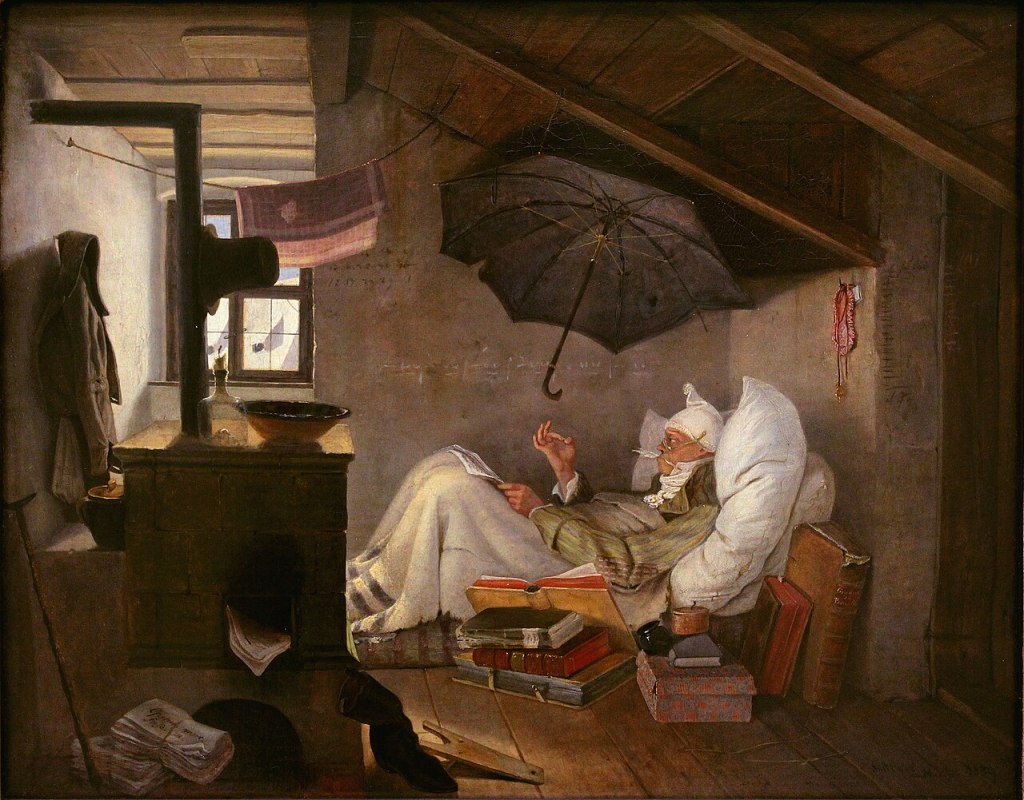
Der Arme Poet (best-known painting by Carl Spitzweg, 1839)

​​If only I can hatch a heartfelt rhyme,
(with thought and frowns, it can’t be very hard),
I’ll take my rightful place with the sublime.

O, gradus ad parnassum. One quick climb.
I’ll be crème de la crème and avant-garde,
if only I can hatch a heartfelt rhyme.

Top hat, cravat and walking stick meantime
are ready—attributes to reap regard.
I’ll take my rightful place with the sublime.

No more damp attic life; no fleas or grime.
My poem will be perfection—a petard!
If only I can hatch a heartfelt rhyme.

My peers will shout, “Alors, a paradigm!
Such lofty wit, a wise camelopard.“
I’ll take my rightful place with the sublime.

I bite my quill: crime, slime, Mülheim, enzyme.
The world will bow, salute and call me bard.
If only I can hatch a heartfelt rhyme,
I’ll take my rightful place with the sublime.

*****

Janice D.Soderling writes: ​​“This poem is ekphrastic, generated from a preceding work of art.
“About the mysterious motor that generates, I can say little. But no composer, artist, poet, sculptor works ex nihilo. Earliest man, woman, looked at their handprint, their footprint, and a thought rose, an urge to express what they felt – a primitive fear of death perhaps – and off they went to the caves to imprint their hand, or to carve a footprint on the rockface by the sea. A shout-out that Kilroy was here.
“We hear music in the babbling brook, in the sighing wind, in the raindrop falling from leaf to leaf and plopping into the puddle below. There is poetry in the emotive sounds we make and hear: tinkling laughter, cooing seduction, growling rage, keening sorrow, barking grief. Of such, language is made; of language Shakespeare made Sonnet 73.
“All art is imitation, from birdsong to a symphony orchestra, from the walking stride to the metrical verse. All art is a denial of death. Even the comic art.“

​​Janice D. Soderling is an American–Swedish writer who lives in a small Swedish village. Over the years, she has published hundreds of poems, flash and fiction, most recently at Mezzo CamminEclecticaLothlorien Poetry Journal and Tipton Poetry Journal. Collections issued in 2025 are The Women Come and Go, Talking (poems) and Our Lives Were Supposed to Be Different (short stories).

‘The Poor Poet’ was originally published in American Arts Quarterly, and republished in the current Well Met, where links at the bottom will take you to other poets in the issue.

Pic credit: Carl Spitzweg, The Poor Poet (via Wikipedia)​

​​​

Sonnet: Sue Parman, ‘Kaizen: How to Build a Poem’

Ignore your hand and focus on the pen,
which writes without your knowledge of the whole.
Do not insert the personal. Avoid translation.
The changes made are small and gradual.

Commas herd their letters toward a distant
goal of rhymes and metaphors but do not
specify a conscious “I” or soul,
a bold new vision or a school of thought.

Write like a dancer making small mistakes.
What is wrong to you fulfills your friend’s desire.
Cuttings and shit are what it takes
to grow a garden from a funeral pyre.

A poet will die unless she learns to laugh.
Do not hit DELETE. Save everything as DRAFT.

*****

Sue Parman writes: “When I was four years old, my father asked me, ‘When is a door not a door?’ His answer, ‘when it’s ajar,’ infuriated and then intrigued me. I began to keep a journal in which I wrote down sentences such as, ‘If the Devil is evil, God is odd.’ Puns were my intro-duction to poetry, a form of verbal play that taught me that words, rather than being a lifeline to truth, could be slippery and contain many truths at the same time. One of my favorite poets is Kay Ryan, the queen of poetic puns (see her ‘Bestiary’). As an anthropologist, I consider them a vital contributor to mental health, since they satisfy the needs of large-brained mammals to avoid epilepsy by indulging in surprise.”

Sue Parman is an anthropologist and award-winning essayist, short story writer, poet, and playwright. She is the author of two poetry books, “The Thin Monster House” and “Carnivorous Gaze,” and her poems have been published in a variety of journals and anthologies, including the above poem in Rattle. She writes in a number of other genres as well, including anthropological travel memoirs and mysteries. Her most recent publications include a short story, “Gannets and Ghouls,” which appeared in the September/October 2024 issues of Ellery Queen Mystery Magazine; and a nonfiction essay, “You Can’t Get There from Here,” that was awarded the Travelers’ Tales Grand Prize for Best Travel Story of 2024. After teaching anthropology in California for thirty-five years, she moved to Oregon in search of water, and travels frequently in hopes of getting lost. https://www.sueparman.com

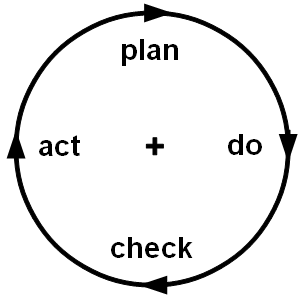
Photo: “PDCA-Cycle-Kaizen” by Tagimaguitar is licensed under CC BY-SA 3.0.

Poem: “Optimism”

Do you have a clear detection
Of an unexpired affection?
Are you reckoned to come second in her life?
Was there someone there before you?
Let it be, don’t let it bore you;
It’ll maintain her somewhat saner as your wife.

This little throwaway poem was recently published in Lighten Up Online. In my mind its value is not so much as a commentary on modern marriage, as an enjoyable way to string some rhymes together. I no longer have any idea what was on my mind when I wrote it.

Many poets would analyse this as written in trochees with lines of either four or six feet, the third line being

ARE you RECKoned TO come SECond IN her LIFE?

but to my mind the lines have only either two or three strongly accented syllables, with the third line being

Are you RECKoned to come SECond in her LIFE?

It is a short piece of patter, which is emphasised by the internally stressed rhymes of reckoned/second and maintain-her/saner. But that leads to a problem: there is a difficulty with the beginning of the last line, and it is hard to find a smooth flow.

Originally it read

‘Twill maintain her —

Archaic, said LUPO editor Jerome Betts, and requested a change for publication as

It’ll keep her —

I accepted this, not noticing that I was losing the rhyme with saner. So why not

It’ll maintain her —

Now the problem is that there is one syllable too many, and we don’t have a smooth flow from the previous line.

You’ll maintain her —, perhaps?

That gives a brand new problem, a subtle shift of meaning from the abstract “it” to the personal “you”, with a much more active sense of “maintain her” and even a suggestion of financial concern.

If it was just an oral presentation, you could probably slide by with

‘t’ll maintain her —

but is that acceptable, comprehensible, in print?

My operating principle with poetry is that there is always a solution. But in this case I haven’t yet found it.