Tag Archives: Potcake Chapbooks

Using form: Nonce form: RHL, ‘Camelot at Dusk’

From under low clouds spreading from the south
The red sun drops slow to night’s waiting mouth.
Rush lamps are lit; the guards changed on the walls;
Supper will not be served in the Great Halls
With Arthur still away. Each in their room,
The members of the Court leave books or loom
To say their Vespers in the encroaching gloom.

Lancelot, up in his tower,
Sees the sunset storm clouds glower,
Feels his blood’s full tidal power,
Knows he has to go.
In her bower, Gwenivere
Puts a ruby to her ear,
Brushes firelight through her hair,
Feels her heartbeat grow.

Guard, guard, watch well:
For the daylight thickens
And the low cloud blackens
And the hot heart quickens
To rebel.

From his tower, caring not
For consequences, Lancelot
Crosses courts of Camelot,
Pitying his King.
In her bower, Gwenivere
Feels his presence coming near,
Waits for footfalls on the stair,
Lets her will take wing.

Guard, guard, watch well:
If attention slackens
When the deep bond beckons,
Evil knows Pendragon’s
In its spell.

And as the storm clouds, rubbing out the stars,
Deafened the castle and carved lightning scars,
Drenched Arthur rode for flash-lit Camelot
Where he, by Queen and Knight, was all forgot.

*****

‘Camelot at Dusk’ was originally published by Candelabrum, a now-defunct poetry magazine in the UK which appeared twice-yearly from April 1970 to October 2010. Candelabrum provided what was, in the 1970s, a very rare platform for British poets working in metrical and rhymed verse.

Technically, the poem uses a variety of forms. The opening and closing passages use iambic pentameter with simple sequential rhyme for a level of detachment (and the only times Arthur is mentioned by name). The passages with Lancelot and Gwenivere use shorter trochaic lines with denser rhymes for more intensity. The passages of warnings to the guards… well, they have a shifting but repeating structure all their own.

Because of the bracketing of the more emotional passages by the more detached opening and closing, the piece feels very complete. As a whole, it is a nonce form. Whether I can ever repeat it successfully, I don’t know. I have tried, but not been satisfied with the result.

‘Camelot at Dusk’ can also now be found in The Hypertexts, which gives it a very respectable Seal of Approval. And it features in the Potcake Chapbook ‘Lost Love’.

Photo: “Eilean Donan Castle at Dusk” by Bruce MacRae is licensed under CC BY-NC-SA 2.0.

Using form: Short poem: Helena Nelson, ‘Duel’

Your false self says to my true self, Hate.
My true self says to your false self, No.

Your false self says to my false self, Shit.
My false self says to your false self, Go.

Your true self says to my false self, Love.
My false self says to your true self, Late.

Late, too late, too late, too late.
My true self sings to your true self, Wait.

*****

Helena Nelson writes: “I can’t explain this easily. It’s both simple and obscure, like a sealed box holding the idea of opposition: a duel between two people, a duet; dual positions. Then there’s the idea of a two-sided self: the true or authentic self versus the manipulative side, the side that does deliberate damage. I don’t even believe in ‘the true self’; but I do in this poem. And I recognise a dispute where one person (especially if for some reason acting from twisted emotion) can push another to come back from that same position, even when they don’t want to. From experience, I’ve known this. The rhyming words trace the development. The slant rhyme between Hate and Shit, for me, has a dark twist. Hate is powerful but Shit is horrible. Late is potentially the last word. The poem could end there, but it doesn’t. Each of these two people summons a ‘true self’. Each dismisses the ‘false’. ‘Late, too late, too late, too late’ is the line that breaks the pattern. No direct speech in that line, perhaps because it’s not a spoken statement but a feeling experienced by both. For me, there’s intense sadness at this point, and the shadow of death too, and because of this—just in time—true speaks to true. Only seventy words in the whole thing but most repeated several times. If you go by unique usage, fifteen words in total. It reminds me of one of R. D. Laings’ Knots. The switch from ‘says’ to ‘sings’ at the end? Yes—significant.”

Helena Nelson runs HappenStance Press (now winding down) and also writes poems, one of which is ‘Duel’. It was originally published in PN Review, collected in Plot and Counter-Plot, Shoestring Press, 2010, and was reprinted in the Potcake Chapbook ‘Lost Love’. Her most recent collection is Pearls (The Complete Mr and Mrs Philpott Poems). She reviews widely and is Consulting Editor for The Friday Poem.

Photo: “Argument” by helena_perez_garcia is licensed under CC BY-NC-ND 2.0.

Weekend read: Quincy R. Lehr, ‘Thud!’

There’s thudding from the floor above that never seems to stop.
I’m trying to sleep, or waiting for the other shoe to drop
as midnight clomps toward 2 AM and hours of darkness dwindle
into the gray of going to work. This rent’s a fucking swindle.

Where’s my damn connection gone? The internet’s too slow.
Get me Jobs or get me Gates. Those bastards need to know.

I called her on a Friday, and we swore that we would meet.
I hailed a taxi, ended up along a different street —
similarly named, but swathed in layers of graffiti.
A drip of sweat ran down my neck; the air was cold and sleety.

Where’s that old-time romance gone? Who will sigh and blubber
over at hers at 3 AM with a lavatory rubber?

I saw a TV talking head while ordering a bagel
who talked about the budget mess — but then he quoted Hegel
about the end of history. Some Weltschmerz is okay,
but save it for the pop songs, man, and don’t get in the way.

Where’s my hometown paper gone? The owner’s on the run
from ranters on the blogosphere. Something must be done.

He met my eyes and shook my hand, and though you wouldn’t know it,
that jerk-off in a business suit calls himself a poet/
critic/impresario and manages quite well.
He smiled and quoted Dante, but I only thought of Hell.

Where’ve our tortured artists gone, Catullus or Syd Barrett?
Chasing after the latest grant and following the carrot.

The upstairs stomps are quicker now and spreading to the hall.
My head’s beneath the pillow. Damn it — won’t she ever call?
I half hope that she’s safe in bed and blithely fast asleep,
but fantasize her all alone and looking up mid-weep.

Where’s the just comeuppance gone? What happened to bad karma?
It got renamed and bottled up and bought out by Big Pharma.

There’s violence in the movies, and there’s violence on TV;
there’s violence on the city streets…. Fuck off! Don’t talk to me!
There’s anger in the headlines, and there’s fury in the verse
spat out at downtown open mikes. I don’t know whom to curse.

Where’ve the old-time standards gone? The censors look forlorn
from hip hop, emo, techno, goth. What happened to the porn?

Times Square’s gone all Disneyfied. The red-light district’s blue.
Godspeed to all you chicks with dicks, and hello, Scooby-Doo.
Farewell, Adult Emporium! You’re now a clothing store,
maybe a Planet Hollywood — and God knows which sucks more.

Where’s my filthy city gone? They smothered it in bleach,
hired a doorman, raised the rent, and placed it out of reach.

What’s to blame? Is it our greed or lack of common sense?
Is it violence in our past, or just incompetence?
Perhaps it’s economic or the crush of circumstance.
Or was it just a thwarted wish to get into her pants?

Where’s that upstairs thumping gone? The silence settles deep
into the still and humid air. I still can’t get to sleep.

*****

Quincy R. Lehr writes: “Thud! is a New York City madsong, with gentrification, insomnia, political decay, and urban loneliness mixing together in a sort of minestrone soup of misery that is also, I think, pretty funny.”

Born in Oklahoma, Quincy R. Lehr is the author of several books of poetry, and his poems and criticism appear widely in venues in North America, Europe, and Australia. ‘Thud!‘ was first published in Measure and was reprinted in the Potcake Chapbook ‘City! Oh City!‘ His book-length poem ‘Heimat‘ was published in 2014. His most recent books are ‘The Dark Lord of the Tiki Bar‘ (2015) and ‘Near Hits and Lost Classics‘ (2021), a selection of early poems. He lives in Los Angeles.
https://www.amazon.com/Quincy-R.-Lehr/e/B003VMY9AG

Photo: “sleepless” by ebrkut is licensed under CC BY-ND 2.0.

John Beaton, ‘A Many-Splendoured Thing?’

Is love a beaming, eye to eye? An oath—you-only-till-I-die?
A U that comes before an I? A hullabaloo-cum-lullaby?
A flirt? A tilting of the neck? An art? A Machu Picchu trek
back in time to that valiant peck on virgin cheek, that what-the-heck?

A brace of lovebirds who embrace instead of pecking cheeks, a plaice
whose eyes achieve a state of grace—as one on one side of its face?
A willing ear we learn to ration between soliloquies? A fashion?
The winning chips we hope to cash in from laying on the wheel of passion?

A bridle? Or a bridal dress? An if-you-love-me-you’ll… duress?
A scandal in the gutter press? A touch-me-there-uh-huh caress?
A smile without the crow’s-feet creases? A summer fling that never ceases?
A joining of two jigsaw pieces? A joke? A yoke with quick-releases?

Love grins with its beret askew, climbs up the sky and paints it blue
then turns the sun to shine on you and says, “You’re puzzled? Hey, me too!”

*****

John Beaton writes: “This started with recollection of a joke by British comedian, Benny Hill: there’s quite a difference between ‘What is this thing called love?’ and ‘What is this thing called, love?’ I decided to come up with humorous answers and they started occurring to me in pairs of rhymed pairs.
I want this to be light and playful. I cobbled the answers together in octameter lines, each with two rhymed tetrameter halves, and configured the lines in three quatrains (aabb) and a rhymed couplet. The result has elements of the sonnet form—fourteen lines and a turn at the end of line twelve. I’ve also played with alliteration and internal rhyme.”

John Beaton’s metrical poetry has been widely published and has won numerous awards. He recites from memory as a spoken word performer and is author of Leaving Camustianavaig published by Word Galaxy Press, which includes this poem. (It is also in the Potcake Chapbook Rogues and Roses.) Raised in the Scottish Highlands, John lives in Qualicum Beach on Vancouver Island.
https://www.john-beaton.com/

What do you see through love?” by TW Chang is licensed under CC BY 2.0.

Julia Griffin, ‘Wasp Waste’

The exoplanet Wasp in Pisces
Subsists despite unending crises:
It’s hard to keep an even keel
At near the melting-point of steel,
And even heroes’ hearts might cower
With winds 10,000 miles per hour.
The place can furthermore rely on
Incessant rain of molten iron.
All this might serve as a directive
To keep our problems in perspective.

*****

Editor’s note: Inspired by a story in The Guardian, “Scientists identify rain of molten iron on distant exoplanet. Conditions on Wasp-76b in Pisces include temperatures of 2,400C and 10,000mph winds”, this poem by Julia Griffin ran in Light’s Poems of the Week on 16 March 2020. It was reprinted in the Potcake ChapbookRobots and Rockets‘.

Julia Griffin lives in south-east Georgia/ south-east England. She has published in Light, LUPO, Mezzo Cammin, and some other places, though Poetry and The New Yorker indicate that they would rather publish Marcus Bales than her. Much more of her poetry can be found through this link in Light.

Photo: “Most Earthlike Exoplanet Started out as Gas Giant” by NASA Goddard Photo and Video is licensed under CC BY 2.0.

Poem: ‘City! Oh City!’

Cities–once all smeared with grime,
rich but dirty, full of crime–
clear the excess cars and dust
if their governments are just,
house the homeless, and among
their cares: clean water, healthy young.
Gorgeous buildings grow and twist
through a river’s gentle mist;
trees in leaf for urban hikes:
sculptures, cafes, books and bikes…
children run wild in the park
till theatre signs light up the dark;
music spills from bars at night–
the well-run city’s a delight.

*****

This poem was published (in 2021 or 2022, the Bahamas Post Office seems to have lost my copy so I’m not sure yet) in The Lyric Magazine, Jean Mellichamp calling it “a breath of fresh air”. I wrote it to be an upbeat view of the modern world in contrast to a lot of the more worrying future issues that I’m often concerned with; and when I put together the ‘City! Oh City!’ Potcake Chapbook, I included the poem to balance some of the less rosy views of urban life–though my poem is nowhere near as skilled as the pieces in the chapbook by Maryann Corbett, Amit Majmudar and others.

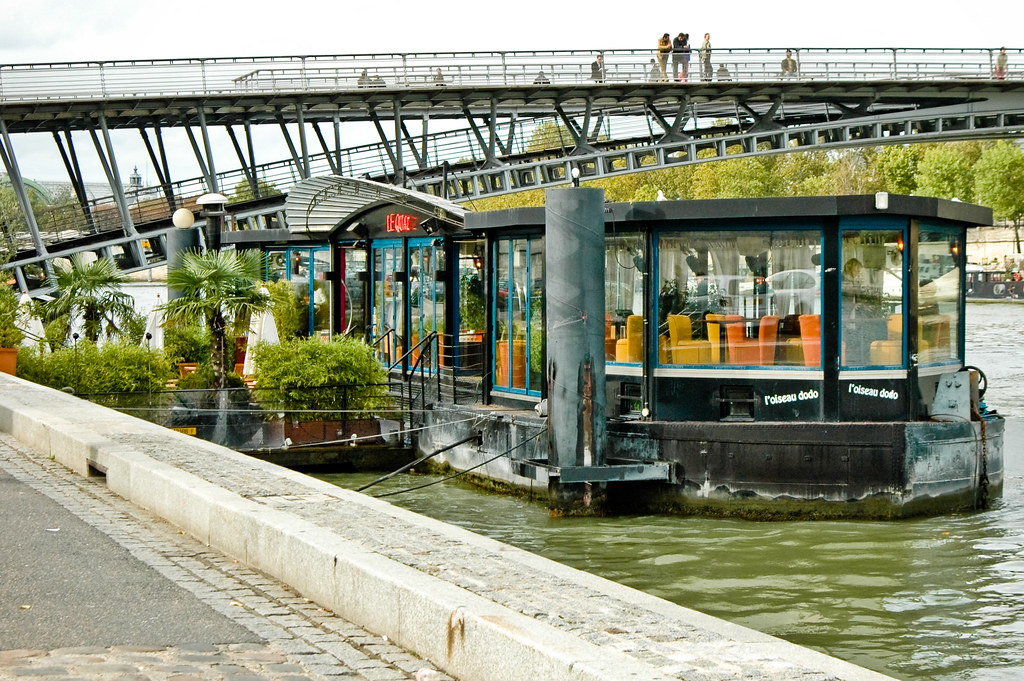
Photo: “le quai river cafe on seine” by grahamdale74 is licensed under CC BY-NC-SA 2.0.
Using form: Couplets: Maryann Corbett, ‘Fugue in October’

Baroque chamber ensemble and homeless encampment, Saint Paul

Perfect: the singers, strings, and keyboards. Perfect
Bruised sky above the tents of the squatters’ district
the little jewel-box church, its bright acoustic
calm in the year’s last mildness, the only music
softened a little in the candles’ lighting,
the mumbling underpass. The wind. No fighting
for this is God’s mind, woven of harmonies
for once. Tonight, for once, no one ODs—
and our souls thread through the flame of the vigil lamp
someone got lucky at the entrance ramp
as we hold, hold to Monteverdi’s line
(panhandling, on this warm day, with a sign)
and stop our breath until the last string dies
and parcels out his manna of salty fries
in the last great chord of his Beatus vir
while sirens wail some sorrow, far from here.

*****

Editor’s comments: “In case it isn’t clear from whatever device you are reading this on, each couplet here is comprised of a line about a musical ensemble in a church followed by a line about a homeless encampment under a highway. You can read it straight through as a soft-voiced line followed by a harsher one; or you can read every other line in one voice and the remaining lines in a different voice; either way, you are blending two very different aspects of city life into a larger, richer picture of community sharing, whether in glamour or squalor. This is an unusual and remarkably effective use of rhymed couplets of iambic pentameter.
The contrast built into the poem, and the skill with which it was done, made it a natural poem for inclusion in the ‘City! Oh City!‘ Potcake chapbook. It first appeared in Measure Review; and is included in the collection In Code.

Maryann Corbett writes: “Events that trigger a poem need not be as simultaneous as the poem makes them seem. The choral concert in this poem took place on a subzero night during the Christmas season; the rise of homeless encampments occurred at a warmer time of year–but both could be happening in my city at any time, and they probably still are.”

Maryann Corbett earned a doctorate in English from the University of Minnesota in 1981 and expected to be teaching Beowulf and Chaucer and the history of the English language. Instead, she spent almost thirty-five years working for the Office of the Revisor of Statutes of the Minnesota Legislature, helping attorneys to write in plain English and coordinating the creating of finding aids for the law. She returned to writing poetry after thirty years away from the craft in 2005 and is now the author of two chapbooks, five full-length collections already published, and a forthcoming book. Her fifth book, In Code, contains the poems about her years with the Revisor’s Office. Her work has won the Willis Barnstone Translation Prize, has appeared in many journals on both sides of the Atlantic, and is included in anthologies like Measure for Measure: An Anthology of Poetic Meters and The Best American Poetry 2018.

Her web page: http://maryanncorbett.com

Photo: “sleeping on the rock of ages” by waferboard is licensed under CC BY 2.0.

Launch: Potcake Chapbook 12, ‘City! Oh City!’

City! Oh City! – poems on the light and dark of urban life. Thirteen of the best contemporary English-language poets present their wildly differing takes on the glamour and squalor, the joy and heartbreak, the varied people and the hidden wildlife of our modern cities.

Five of the poets are new to the Potcake Chapbook series, and I’m delighted to be adding Kate Bingham of England, Francis O’Hare of Northern Ireland, Pino Coluccio of Canada, and Quincy R. Lehr and J.D. Smith of the US. They join eight returning poets. Amit Majmudar and Maryann Corbett deserve special mention for their brilliant use of form to capture contradictory situations: Majmudar’s static street scene which suddenly changes pace to a hectic chase, Corbett’s interwoven Baroque chamber ensemble and homeless encampment with their separate realities in a shared evening in Saint Paul, Minnesota. In addition: Michael R. Burch, Jerome Betts, Terese Coe, Marcus Bales, Martin Elster and myself; everyone contributes to this memorable capture of the complexity of the modern city.

Bios, photos and links to read more of their work can all be found on the Sampson Low site’s Potcake Poets page, while all the chapbooks in the series, showing which poets are in which, are here. Each of the 12 chapbooks is profusely illustrated (of course) by Alban Low, and can be yours (or sent as an intriguing gift) for the price of a coffee.

Value the city – citification is civilisation!

Launch: Potcake Chapbook 11, ‘Lost Love’

‘Lost Love – poems of what never happened, and of the end of things that did’… how bittersweet; but what a collection of poets, and what a diversity of stories and observations!

Seventeen poets are packed into this chapbook. Seven have appeared before: Marcus Bales, Melissa Balmain, Michael R. Burch, Vera Ignatowitsch, Martin Parker, Gail White and myself. Ten are new to the series, with wicked little pieces from Brooke Clark, Cody Walker and three from Wendy Cope, and with longer poems from N.S. Thompson, James B. Nicola, Mary Meriam, Helena Nelson, David Whippman, Richard Fleming and Vadim Kagan. Bios, photos and links to read more of their work can all be found on the Sampson Low site’s Potcake Poets page, while all the chapbooks in the series, showing which poets are in which, are here. Each of the 11 chapbooks is profusely illustrated (of course) by Alban Low, and can be yours (or sent to an ex) for the price of a coffee.

Heartbreak has never had a happier manifestation!

Updated Call for Submissions: Potcake Chapbooks

I am always keen to read and consider rhymed and metered verse that has already been published. There are several chapbooks that are jostling in the queue for completion and publication:

City! Oh City! (urban life)
Just a Little Naughty
Portraits Unpleasant
Various Heresies (religion)
The Horror of Spring! (seasons)
a Christmas season chapbook, needs Hanukkah, Divali, Festivus, etc

and there are more; but a recent one, ‘Robots and Rockets’, wasn’t part of my original plans: I just ran across a bunch of Science Fiction poems that I liked, and they filled a chapbook nicely. So I’m an unashamed opportunist. I’ll modify my plans if I think something better is available. All the chapbooks listed above are nearly full already but, as with all of them, if I run across another poem I really like, I’ll include it. And if I receive enough good poems on an unplanned theme, that theme will get slotted in.

And if I receive more good poems than I can fit in a chapbook, there is a good chance of a second chapbook on the same theme. The most recent, ‘Travels and Travails’, is similar to the very first, ‘Tourists and Cannibals’; and the upcoming ‘Lost Love’ (which has gone to Alban Low for illustrating) is similar to the second chapbook, ‘Rogues and Roses’.

When there is enough good material on a single theme to fill 13 pages of a chapbook (still leaving room for Alban’s artwork, of course), then it may become the next project. But until a chapbook actually goes to print everything is subject to change. An even better poem may show up and displace one tentatively placed. A slew (or slough) of poems on a new theme may cause a reprioritisation of planned chapbooks.

This is one of the reasons that I prefer to consider only poems that have already been published–so that I don’t feel guilty about having a bunch of poems that will sit with me for months, years, and may or may not be included in the Potcake series. I have flagged a thousand poems that interest me; but I can only publish a dozen in a chapbook, and only a few chapbooks will get produced in a year.

Poems in the chapbooks run from two or three lines to some 40 lines in length–obviously, with space at a premium, poems over 20 lines and running over one page are less likely to be included… but it does happen. Other criteria: I’m looking for wit, elegance, a variety of traditional and nonce forms, a variety of voices and moods: happy, sad, angry, sardonic, meditative… anything interesting I can scrounge. If you have something you think I might like, on any topic, please send it along to robinhelweglarsen@gmail.com. Submit:

  • Formal, or traditional verse: rhymed and metrical
  • Previously published
  • Must be your own work, you must have the rights to it
  • Send 3 to 10 poems in a single attachment, or in the body of the email
  • In a covering note, include a link to where I can read more of your work

I can’t promise to use your work, but I will read it and reply!