Tag Archives: reflection

Quincy R. Lehr, ‘As if by chance’

When I looked at her, and when her lips
Pulled back to show her teeth, and when her voice
Broke into laughter, I could only think
Of moments that I’d pissed away, each choice
I’d left to others, and the careless slips
That landed me beside an empty drink.
That afternoon, I could have sworn I saw
A thinner, hopeful version of my face
Staring from behind her retinas–
Familiar, yes, the eyes, the skin, the jaw,
But in that instant somehow out of place.
It cast a knowing frown. The gravitas
Was overbearing. Nonetheless, we filled
The void with gossip, anecdotes and smut,
Comparing chatty journals–note by note.
Like poets, we dissembled in the rut
That each of us was in, our chances killed
By loss of nerve or failure to emote.
But still, a sneer could not have hurt me more
Than her clear laugh that sang of expectations
So long forgotten from a distant day
When youth still spread before me, and the poor
And pitiful attempts at explanations
Still lay in ambush, only years away.

*****

Quincy R. Lehr writes: “This poem was literally about running into a high school friend of mine by chance on the day I defended my doctoral dissertation (though that’s not in the poem). It’s funny how old I thought I was at twenty-nine.”

Born in Oklahoma, Quincy R. Lehr is the author of several books of poetry, and his poems and criticism appear widely in venues in North America, Europe, and Australia. His book-length poem ‘Heimat‘ was published in 2014. His most recent books are ‘The Dark Lord of the Tiki Bar‘ (2015) and ‘Near Hits and Lost Classics‘ (2021), a selection of early poems. He lives in Los Angeles.
https://www.amazon.com/Quincy-R.-Lehr/e/B003VMY9AG

Photo: “Young woman laughing” by Snapshooter46 is licensed under CC BY-NC-SA 2.0.

Quincy R. Lehr, ‘Lines for my father’

I think I owe some kind of explanation
As I grow tired and listless fingers writhe
Above the unpecked keyboard pad. I’m not
Quite out to blame you or your generation
For where I’m at tonight. You paid the tithe
That life exacts. It’s sanctimonious rot
If we deny the pain of paying it–
And our denials never help one bit.

Unlike you, I found myself involved
In protest politics when I was young.
I spouted crap about the working class
While searching for a problem to be solved.
I mocked you then, since stirring tunes are sung
In brayed crescendos, with a blaze of brass
Booming triumphs won against the odds–
Unjust societies and jealous Gods.

You seemed so cautious–tastefully attired
With modest ties and polished wing-tipped shoes,
A cautious, kindly smile that reached your eyes.
A man to be respected, not admired,
Neither adulated nor abused.
Ambitions of an ordinary size
Were often past your reach. A nagging doubt
Set in, and now I know what that’s about.

Tonight, I type these words as it gets late,
And no one calls to beckon me to bed.
I scoffed at what you’d craved–the tenure track,
The slow-accruing pension from the state,
The wife (who left you). Though you’re good and dead
(And at this hour, my eyes are going slack)
And though you cannot answer, I’ll report
–While having to imagine your retort–

That we’re no happier than you, and can’t
Quite seem to sit for tests that you had failed.
Our phones are packed with numbers we won’t call.
The televisions blast a constant rant
That we ignore like letters still unmailed–
Or unconceived. Clichés about a ball
That’s dropped don’t work–or maybe don’t apply.
We never picked it up. I wonder why.

This recognition’s only dawning now
As streetlights speckle glimmers on your urn
Beside my unmade bed, and as I write
These words to you in lieu of sleep. Somehow,
The brays of drunks outside my window turn
Almost comforting, as if the night
Is full of us–insomniac, astray,
And muttering defiance at the day.

*****

Quincy R. Lehr writes: “As for that poem, my father died in 2003, when I was twenty-seven. The content pretty much speaks for itself, I think. I was young, lonely, and frequently drunk when I wrote it.”

Editor’s comment: I admire the technical skill of the poem: the steady iambic pentameter; the abcabcdd rhyme scheme with the final couplet providing a punch; the integrity of the individual stanzas, each patiently laying out a mood, a thought, a situation. And I relate to the young man’s restless, unquiet, unsettled life, and the comparison to his father’s existence, his dismissal of his father’s achievements, his simultaneous recognition of the inevitable connections. It is a satisfying telling of an individual’s unique early life, in the context of the universal discord between generations.

Born in Oklahoma, Quincy R. Lehr is the author of several books of poetry, and his poems and criticism appear widely in venues in North America, Europe, and Australia. His book-length poem ‘Heimat‘ was published in 2014. His most recent books are ‘The Dark Lord of the Tiki Bar‘ (2015) and ‘Near Hits and Lost Classics‘ (2021), a selection of early poems. He lives in Los Angeles.
https://www.amazon.com/Quincy-R.-Lehr/e/B003VMY9AG

Potcake Poet’s Choice: Frank Hubeny, “True”

Frank Hubeny

Frank Hubeny

The cloudy image on the lake
Comes from the gracious morning light
We left the darkness of the night,
Became aware of what’s at stake.
We now renew, rejoice, remake,
Reflect on what we know as true.
Our part seems small, like morning dew,
But later when the victory’s won
We may find out it was well done
And fully know and be known too.

Frank Hubeny writes: “I often write to prompts. I know other people who are also participating in the prompt will at least give the poem a glance. Ronovan is one of the many people out there posting writing prompts. He has a weekly Décima Poetry Challenge. This form has ten 8-syllable lines with a particular rhyme scheme: abbaaccddc. I do like the sound of four beats per line. I often post my own photos and so write about them if the theme of the prompt permits. For this poem I posted two photos of clouds on a pond in Techny Prairie in Northbrook, Illinois. The last line of the poem is intended to suggest 1 Corinthians 13:12 about seeing reflections, knowing in part and then knowing fully and being fully known. The being “fully known” is what was foremost in my mind. That thought along with the reflections on the pond in the photographs and Ronovan’s challenge to use the word “true” as a rhyme word in a décima motivated me to write this poem.”

Frank Hubeny lives between Miami Beach, Florida, and Northbrook, Illinois.  He has been published in The Lyric Magazine, Snakeskin Poetry Webzine, Ancient Paths Literary Magazine, Visual Verse and Vita Brevis.  He regularly posts photographs, short prose and poetry to his blog, https://frankhubeny.blog

Sonnet: “Out Island Town in the Early Morning”

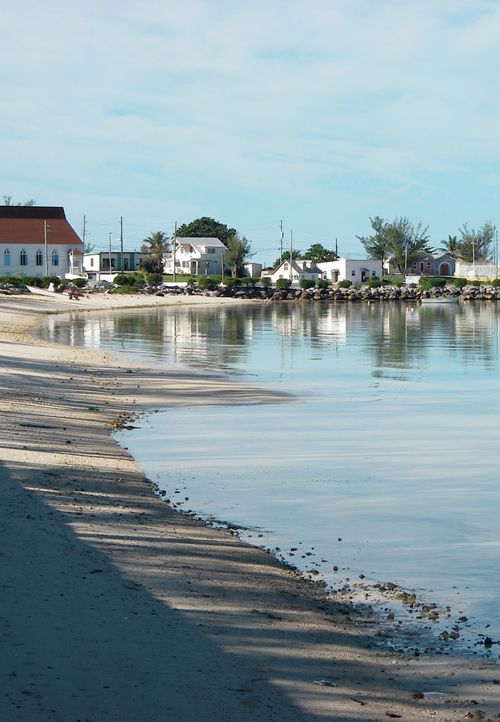
Harbour reflection

Harbour reflection

Before the sun is up, the people are.
Fishermen have gone out, for noon’s fierce light
Will punish them, and their desires are slight:
To sell their catch, drink cold beer by a bar.
The workers hitch rides with some early car
That will go fairly near their building site.
Women prep kids’ meals, feeling it’s not right
To have to leave to clean some tourist spa.

Only the unemployed and office staff
Still sleep while roosters crow and seagulls laugh,
And the light rising in its eastern glow
Shows Harbour houses in a double row,
One on the Cay, the other upside down
Painted on windless glass, a mirror town.

This sonnet was first published in The Hypertexts, the massive poetry collection assembled by Michael R. Burch. There’s not much to say about the poem… it’s a love poem to Governor’s Harbour, my home town.

But sonnets in general have a charm for many people. They seem just the right size both to hold a description or a complex thought that has tendrils in various directions, and to be small enough to be memorised. They are a good tool for high school classrooms, containing a richness of thought for analysis and an opportunity to develop memory skills. They allow a learner to absorb and express the power of the language’s potential for rhythm and rhyme. A good education will have made you familiar with dozens of sonnets, and they and their organising principles remain deeply embedded somewhere within you all your life.