Tag Archives: refrain

Using form: Quatrains with refrain: Jerome Betts, ‘Plus ça change. . .’

If, as a child, he had a spreading rash,
The squitters, then, far worse, was constipated,
Or boasted big blue bruise and graze and gash,
A doctor murmured, “Yes, it’s age-related.”

When, in mid-life, and seeking novel thrills,
He got a dose of something best not stated
So had to suffer jabs and bitter pills,
A doctor murmured, “Yes, it’s age-related.”

Come his declining years, which tax most brains,
His wits would wander, now grown antiquated,
And while he rambled down his memory’s lanes
A doctor murmured, “Yes, it’s age-related.”

Until, one day of flowers and muffled peals,
Cause of demise at last certificated,
As up the aisle he rolled, worm-food on wheels,
A doctor murmured, “Yes, it’s age-related.”

*****

Jerome Betts writes: “Hearing a phrase new to you can start some process in the brain leading toa piece of verse. Here it was my GP saying of some minor ailment It’s age-related. It stuck in my mind, and I think triggered a recollection of a Thomas Hood poem, The Doctor, its seven stanzas all ending with the refrain Yes, yes, said the Doctor, / I meant it for that!, the dodgy physician’s unvarying response to reports of the disastrous effects, even death, of his prescriptions. Not long after, the sight of a hearse on wheels rather than on bearers’ shoulders entering a Devon church provided the idea for the last stanza of this essay in black humour which appeared in Snakeskin.

Jerome Betts lives in Devon, England, where he edits the quarterly Lighten Up Online. Pushcart-nominated twice, his verse has appeared in a wide variety of UK publications and in anthologies such as Love Affairs At The Villa NelleLimerick Nation, The Potcake Chapbooks 1, 2 and 12, and Beth Houston’s three Extreme collections. British, European, and North American web venues include Amsterdam QuarterlyBetter Than StarbucksLightThe Asses of ParnassusThe HypertextsThe New Verse News, and  Snakeskin.

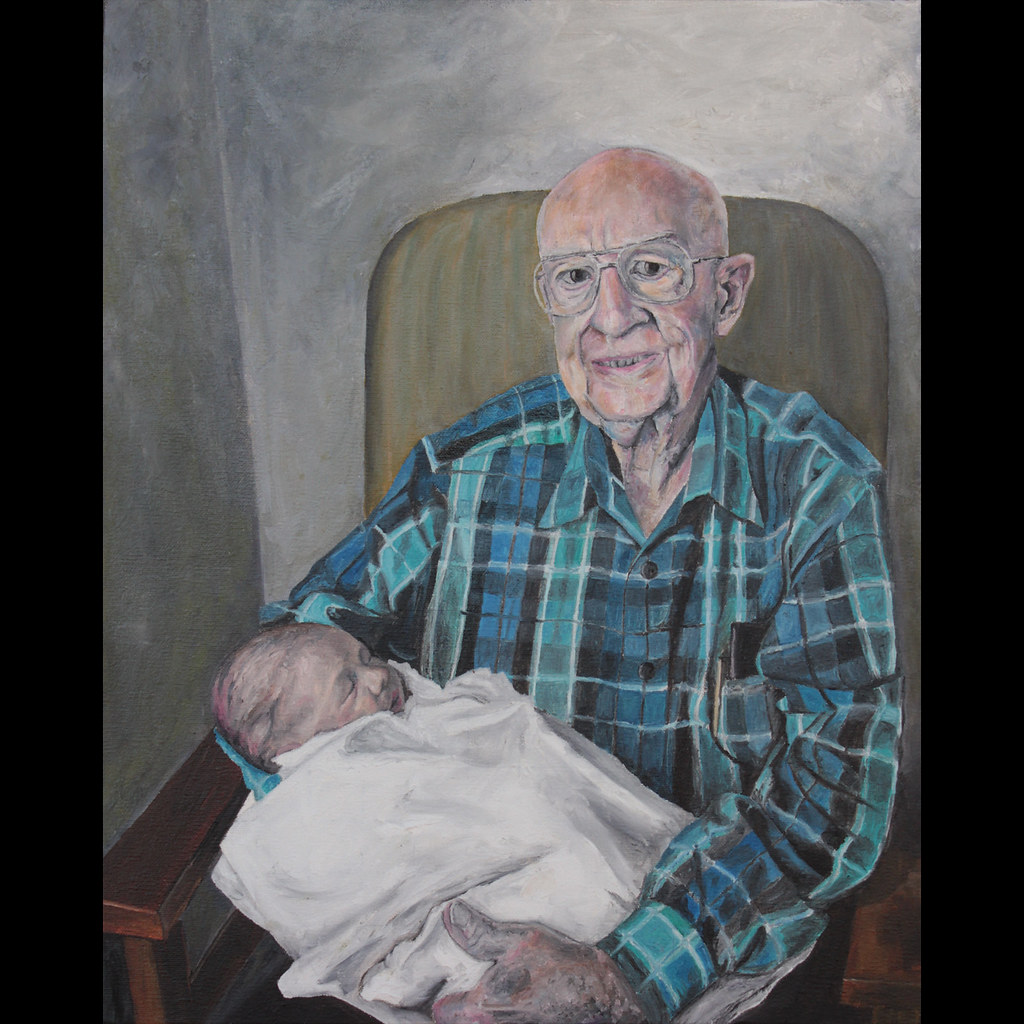
Illustration: “Great Grandfather and Child” by Melissa Flores is licensed under CC BY-NC-ND 2.0.

Using form: Refrain; Nina Parmenter, ‘Sense’

I am a bag of chemicals
with charge for eighty years,
I am a gassy mirage
that winks as oblivion nears.
Around me swill the stars,
my thoughts, the gods and insanity,
and nothing makes sense but this leaf
as it dances, drunk on gravity.

I am a pointless voice track
on a puff piece of DNA,
I am the ooze that awoke
and decided to live anyway.
Around me swings the void,
nirvana and calamity,
and nothing makes sense but the sea
as it dances, drunk on gravity.

*****

Nina Parmenter writes: “In 2021, in my strenuous efforts not to write pandemic poems, I probably wrote a lot of pandemic poems. This one, about focusing on tiny moments in nature to avoid thinking about the big scary things is a great example! I made it a foreword to my collection ‘Split, Twist, Apocalypse‘ because its slightly jolly air of existential dread sets the tone for the book nicely, I think.”

Editor’s comment: As with popular songs as well as verse forms such as the ballade, villanelle, triolet and rondeau, the use of a refrain (whether exact or varied) strengthens the poem by bringing the conclusion of each stanza back to a core image or message.

Nina Parmenter has no time to write poetry, but does it anyway. Her work has appeared in Lighten Up Online, Snakeskin, Light, The New Verse News, Ink, Sweat & Tears, and the Potcake Chapbook ‘Houses and Homes Forever’. Her home, work and family are in Wiltshire.
https://ninaparmenter.com/

Time Lapse of Stars During Earth’s Rotation” by Image Catalog is marked with CC0 1.0.

Odd poem: ‘When I Was Fair and Young’, by Queen Elizabeth I

When I was fair and young, and favour gracèd me,
Of many I was sought, their mistress for to be;
But I did scorn them all, and answered them therefore,
‘Go, go, go, seek some otherwhere,
Importune me no more!’

How many weeping eyes I made to pine with woe,
How many sighing hearts, I have no skill to show;
Yet I the prouder grew, and answered them therefore,
‘Go, go, go, seek some otherwhere,
Importune me no more!’

Then spake fair Venus’ son, that proud victorious boy,
And said, ‘Fine Dame, since that you be so coy,
I will so pluck your plumes that you shall say no more,
‘Go, go, go, seek some otherwhere,
Importune me no more!’

When he had spake these words, such change grew in my breast
That neither night nor day since that, I could take any rest.
Then lo, I did repent that I had said before,
‘Go, go, go, seek some otherwhere,
Importune me no more!’

Elizabeth (Ms. Tudor, if you prefer) was born in 1533 and became Queen of England at age 25, in 1558. This poem dates from some three or four years later, and the painting above is from the same time. Given how youthful she looks in her late 20s, the poem may be more playful than self-pitying–but she was also well past the age that sex and marriage would have been expected. As it was she had had to lead an extremely careful life: England was weak and unstable when she came to the throne: her father Henry VIII had broken with the Pope and formed the Church of England; her older sister Mary, on becoming Queen, had turned the country back to Catholicism and Elizabeth had narrowly escaped death as a traitor; Elizabeth inherited a country where people were burnt at the stake for not being of the correct faith… but the correct faith kept changing.

By her late 20s the Court was trying hard to have her married to a powerful European monarch to strengthen the country by alliance. The Catholic Philip II of Spain was one possiblity, the Lutheran Erik XIV of Sweden was another. Again, everything involved a religious balancing act. Meanwhile flattering portraits showing vitality and power were created and exchanged as part of the negotiations–and Elizabeth sent her court painter to Sweden to paint Erik. But for whatever reason she never married. In 1588 Philip attempted a full scale invasion with his Armada, but that failed as well. Elizabeth died in 1603 aged almost 70, still nicknamed (though probably unfairly) ‘the Virgin Queen’.

Regarding the poem: technically, the first three lines of each stanza are in iambic hexameter and are followed by an uneven refrain. The first two lines rhyme, and the third rhymes with the end of the refrain. It looks very singable. There is some unevenness in the scansion, and Elizabeth has marked the midpoint of most of the hexameters with a comma; this divides the line into two natural clauses or parts, and also signals a little pause for the sake of smooth reading–particularly useful in the shortened second line of the third stanza and the lengthened second line of the fourth.

Photo: Painting of Elizabeth I in 1562, probably painted by her court artist Steven van der Meulen, or his workshop.