Tag Archives: religion

RHL, ‘Cultural Context’

Between the Prime primeval Evil
with its shaky tale of taily snake and fruit,
and the (only medi-evil)
Renaissance and lute,
come Greeks and Romans, Arabs, and
(skirting the border
of anything that looks like law and order)
Vikings searching for new land.
From all of these
I draw my science and mythologies.
It’s all intriguing, never scary –
at least, to me;
ymmv.

*****

For those not familiar with this particular piece of slang, “ymmv” is an abbreviation for “your mileage may vary”, itself an abbreviation for the idea that different people have difference experiences and perceptions. What I like about its use here is that it provides the missing rhyme for either of the two previous lines, depending on how you say it.

‘Cultural Context’ was published recently in Blue Unicorn.

Photo: “Straight out of the Holy Land!” by One lucky guy is licensed under CC BY-NC-SA 2.0.

Pope Francis: ‘Dear Poets, Help Us Dream’ (excerpts)

Dear poets, I know that you hunger for meaning, and that is why you reflect on how faith questions life. (…) Poetry is open; it throws you into another realm.

In light of this personal experience, today I would like to share some thoughts with you on the importance of your service.

The first thing I want to express is this: you are eyes that see and dream. Not only do you see, but you also dream. A person who has lost the ability to dream lacks poetry, and life without poetry does not work. We humans yearn for a new world that we may never fully see with our own eyes, yet we desire it, seek it, and dream of it. A Latin American writer once said that we have two eyes: one of flesh and the other of glass. With the eye of flesh, we see what is before us; with the eye of glass, we see what we dream. Woe to us if we stop dreaming—woe to us! (…) Indeed, poetry does not speak of reality from abstract principles but rather by listening to reality itself: work, love, death, and all the little and great things that fill life. Yours is — to quote Paul Claudel — an “eye that listens.” (…)

I would also like to say a second thing: you are the voice of human anxieties. Often, these anxieties are buried deep within the heart. You know well that artistic inspiration is not only comforting but also unsettling because it presents both the beautiful realities of life and the tragic ones. Art is the fertile ground where the “polar oppositions” of reality — as Romano Guardini called them — are expressed, always requiring a creative and flexible language capable of conveying powerful messages and visions. For example, consider when Dostoevsky, in The Brothers Karamazov, tells the story of a little boy, the son of a servant, who throws a stone and hits one of his master’s dogs. The master then sets all the dogs on the boy. He runs, trying to escape the fury of the pack, but ultimately, he is torn apart under the satisfied gaze of the general and the desperate eyes of his mother.

This scene has tremendous artistic and political power: it speaks to the reality of yesterday and today, of wars, social conflicts, and our personal selfishness. It is just one poetic passage that challenges us. And I’m not only referring to the social critique in that passage. I speak of the tensions of the soul, the complexity of decisions, the contradictions of existence. There are things in life that, at times, we can’t even understand or find the right words for: this is your fertile ground, your field of action. (…)

That is what I want to ask of you today as well: go beyond the closed and defined borders, be creative, do not domesticate your anxieties or those of humanity. I fear this process of taming because it stifles creativity, it stifles poetry. With the words of poetry, gather the restless desires that inhabit the human heart so they do not grow cold or die out. This work allows the Spirit to act, creating harmony amidst the tensions and contradictions of human life, keeping the fire of good passions alive, and contributing to the growth of beauty in all its forms, beauty that is expressed precisely through the richness of the arts.

This is your work as poets: to give life, to give form, to give words to all that human beings live, feel, dream, and suffer, creating harmony and beauty. It is a work that can also help us better understand God as the great “poet” of humanity. Will you face criticism? That’s okay, bear the weight of criticism while also learning from it. But never stop being original, creative. Never lose the wonder of being alive.

So, eyes that dream, voices of human anxieties; and therefore, you also have a great responsibility. And what is it? It’s the third thing I want to say: you are among those who shape our imagination. Your work has an impact on the spiritual imagination of the people of our time. Today, we need the genius of a new language, powerful stories, and images. (…)

Dear poets, thank you for your service. Continue dreaming, questioning, imagining words and visions that help us understand the mystery of human life and guide our societies toward beauty and universal fraternity.

Help us open our imagination so that it transcends the narrow confines of the self and opens up to the entire reality, with all its facets, thus becoming open to the holy mystery of God. Move forward, without tiring, with creativity and courage!

I bless you.

*****

The above is a substantial excerpt from the letter Pope Francis wrote for the book ‘Verses to God: An Anthology of Religious Poetry‘ (published by Crocetti Editore), curated by Davide Brullo, Fr. Antonio Spadaro, and Nicola Crocetti. The letter is given in full in the Vatican News.

The Economist’s obituary for Pope Francis states he insisted on: “no papal cape or red slippers, just a plain white cassock and his ordinary black shoes. (…) No crest-embellished dinner plates, no new pectoral cross; he kept the iron-plated one he had worn, from 1998, as archbishop of Buenos Aires. No 12-room apartment in the Vatican, but a two-room suite in the guests’ hostel, and meals in the dining room with everyone else. “We’ll see how long it lasts,” said one aide, uncomfortable. It lasted until he died; for in Buenos Aires, after all, he had cooked his own meals and travelled by bus. (…) In Buenos Aires he was called the “Slum Bishop” for insisting that he, and his priests, should go out in the streets and on the margins. (…) He made a point of reaching out, feeding hundreds of homeless with pizza at the Vatican and adopting several families of Syrian refugees.”

So, sympathy for the homeless, and refugees… and poets. There’s a spiritual resonance to that grouping!

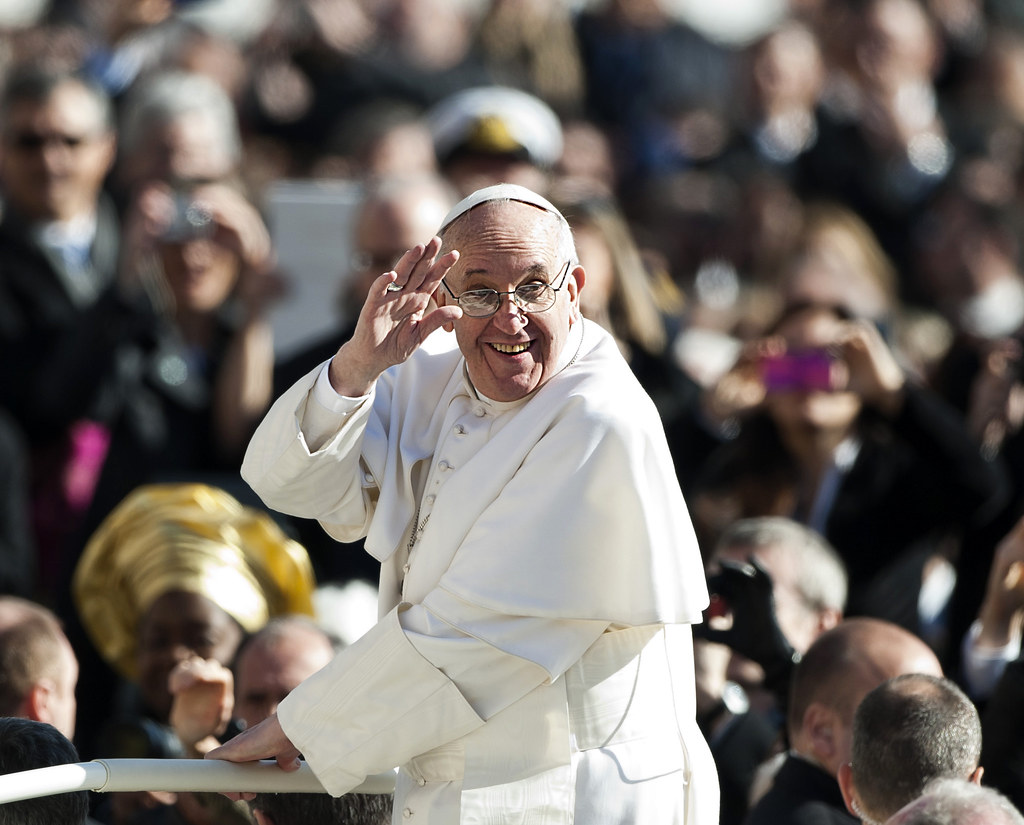
Photo: “The Inauguration Mass For Pope Francis” by Catholic Church (England and Wales) is licensed under CC BY-NC-SA 2.0.
Short NSFW poem: RHL, ‘The Fig Tree’

The fig leaf symbol’s one of History’s greats
As, inter alia,
It hides, discloses and exaggerates
Male genitalia.
The fruit itself suggests the female form —
Dripping with honey
The little hole breaks open, pink and warm…
The Bible’s funny.

First published in The Asses of Parnassus, this poem was republished in Better Than Starbucks, which earned a “Kudos on your brilliant ‘The Fig Tree'” from Melissa Balmain, editor of Light. And it has now been added by Michael R. Burch to my page in The HyperTexts. That’s a wonderful set of editorial acceptances – it makes me proud, and I have to erase my lingering suspicion that the poem would be thought too rude for publication. Now I rate the poem more highly, as being not just a personal favourite but also acceptable to a wider audience.

It sometimes feels that all I write is iambic pentameter. It is always reassuring when a poem presents itself with half the lines being something else, and the result is a lighter, less sonorous verse. The rhymes are good; the poem’s succinct and easy to memorise. I’m happy with it.

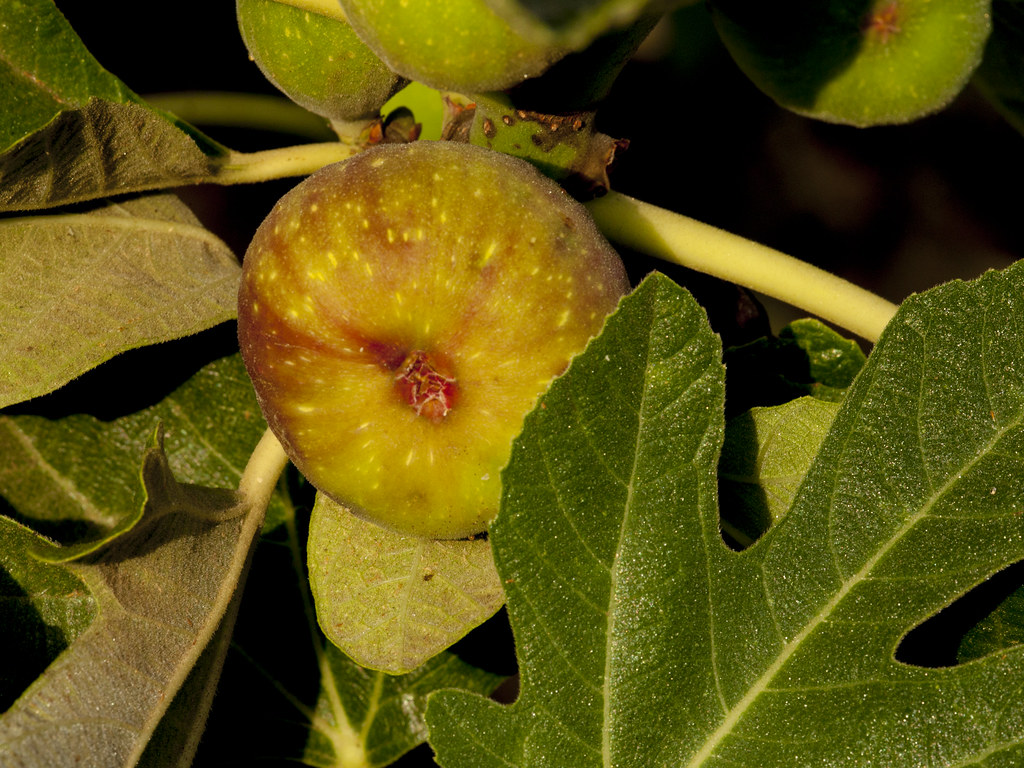
Photo: “Ripe Fig at Dawn” by zeevveez is licensed under CC BY 2.0.

Semi-formal: RHL, ‘Laffable Religion’

No matter how seemingly affable,
a priest always hopes to be greased;
while others, invoking hellfire,
have us wait for our trip in the hearse
and preach in their suits neatly creased,
these fishers of men that are gaffable,
in this world that they’ve made mud and mire.
That the point of a flock’s to be fleeced
can only be said in light verse;
for religion is simply so laughable
it’s amazing it’s not yet deceased.

*****

Isn’t it amazing that the Pope can claim to have voluntarily taken a vow of lifelong poverty, and millions of his supporters who live in involuntary poverty send money to support him living in a palace? Is it different from a billionaire politician soliciting donations from his impoverished supporters? Is the human need to glorify the tribal god and the tribal leader never going to end?

This poem was first published in The HyperTexts, as part of the August 2024 Spotlight.

RHL, ‘Deuteronomy 20: 16-18’

You’ve no autonomy
under Deuteronomy;
it’s your obligation
to your tribal nation
to kill all Palestinians
so you don’t sin against
God, who’s neurotic.
Yes, Yahweh’s psychotic.
No escaping his wrath,
no path but the psychopath.

*****

For Christians and Jews who state (as Jesus did) that every reported command by God in the Torah / Old Testament must be obeyed, I ask their position on Deuteronomy 20. This contains the command for the complete genocide of the non-Jews living in the land which Moses claimed had been given to the Jews by God. (Note: not expulsion or enslavement of the people living there, but the death of all of them and their animals.) The reason? So that they don’t teach evil ways to the Jews:

16 But of the cities of these people, which the Lord thy God doth give thee for an inheritance, thou shalt save alive nothing that breatheth:
17 But thou shalt utterly destroy them; namely, the Hittites, and the Amorites, the Canaanites, and the Perizzites, the Hivites, and the Jebusites; as the Lord thy God hath commanded thee:
18 That they teach you not to do after all their abominations, which they have done unto their gods; so should ye sin against the Lord your God.

To the extent that fundamentalist Jews constitute a large percentage of the Israeli population and are influential in the national government, the Palestinian situation cannot be resolved until scriptural passages like this are dragged out into the open and examined and discussed: was that passage only for then, and things are different now? Or does the command to massacre non-Jews still hold for today’s Jews in “the Holy Land”?

This poem was first published in The HyperTexts, where Michael R. Burch maintains extensive collections of poetry related to both the Holocaust and the Palestinian Catastrophe.

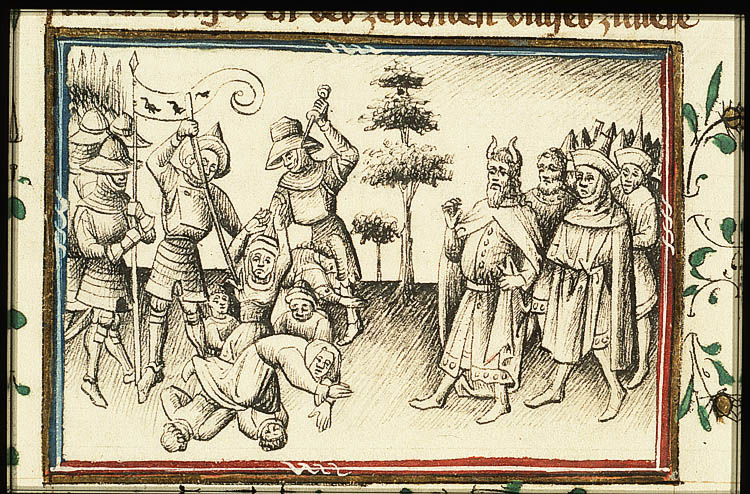
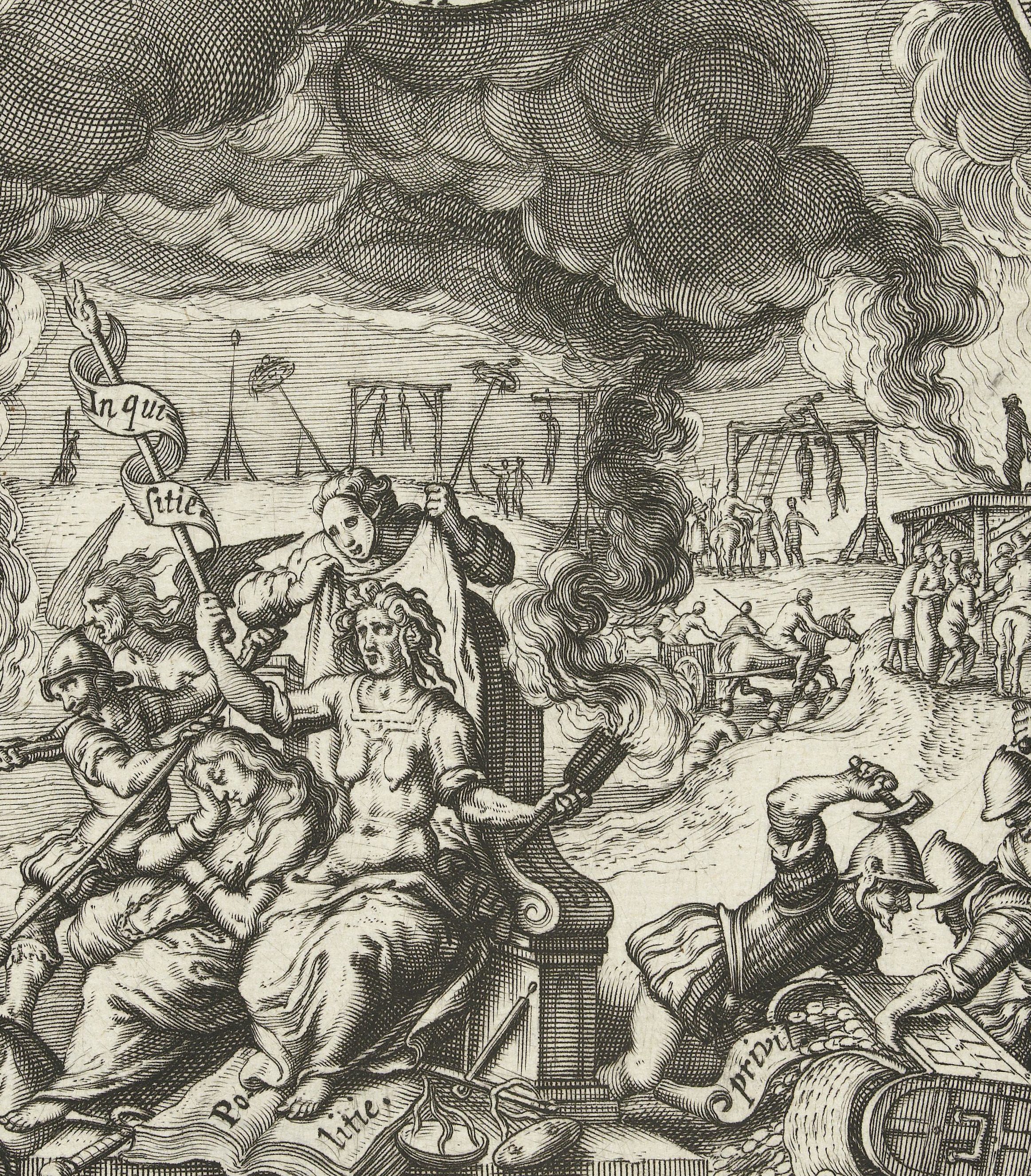
Illustration: “Moses has the mature women and the male children of the Midianites killed” is marked with Public Domain Mark 1.0.

Brian Allgar, ‘Genesis’

One sunny morning, strolling in my garden,
I stumbled, and my foot crushed something’s head.
“Me dammit!” I exclaimed, “I beg your pardon”,
Looked down, and saw my Serpent lying dead.
 
Now this was most vexatious, for I’d planned
That this poor snake would implement my scheme
To give my little friends a helping hand,
And lead them gently from their childish dream.
 
The Serpent was supposed to tempt the couple
With luscious fruit that Eden’s trees bedecks;
My chosen agent, sinuous and supple,
Would lead the pair to knowledge – and to sex.
 
Omniscience can have its limitations,
And even Godly schemes may gang agley.
I’d once envisaged teeming populations,
But this, perhaps, was better, in its way.
 
No Spanish Inquisition, no Crusades,
No slaves, and no Industrial Revolution,
No mining sites where once were leafy glades,
No factory chimneys belching out pollution.
 
No nation-states, no border wars to settle,
No Holocaust, no tribal genocide,
No Rap, no Hip-Hop, Punk or Heavy Metal,
No hamburgers with coleslaw on the side.
 
No guns, no bullets, no demented shooters,
Since nothing could be made, except of wood;
No mobile phones (thank Me!) and no computers …
I looked on all of this, and found it good.
 
Yet what of those who should have lived hereafter?
No Homer, Shakespeare, Mozart, Botticelli?
No P. G. Wodehouse? (I was fond of laughter,
Though, being God, I didn’t have a belly).
 
Descendants all, but only if they had ’em.
(No Michelangelo, no Sistine Chapel?)
My mind made up, I called to Eve and Adam:
“I wondered if you’d care to try an apple?”

*****

Brian Allgar writes: “As a devout atheist, I felt it my duty to shed some light on the truth behind the Creation myth.”

Brian Allgar was born a mere 22 months before Adolf Hitler committed suicide, although no causal connection between the two events has ever been firmly established. Despite having lived in Paris since 1982, he remains immutably English. He started entering humorous competitions in 1967, but took a 35-year break, finally re-emerging in 2011 as a kind of Rip Van Winkle of the literary competition world. He also drinks malt whisky and writes music, which may explain his fondness for Mendelssohn’s Scottish Symphony.

He is the author of “The Ayterzedd: A Bestiary of (mostly) Alien Beings” and “An Answer from the Past, being the story of Rasselas and Figaro”, both available from Kelsay Books and Amazon.

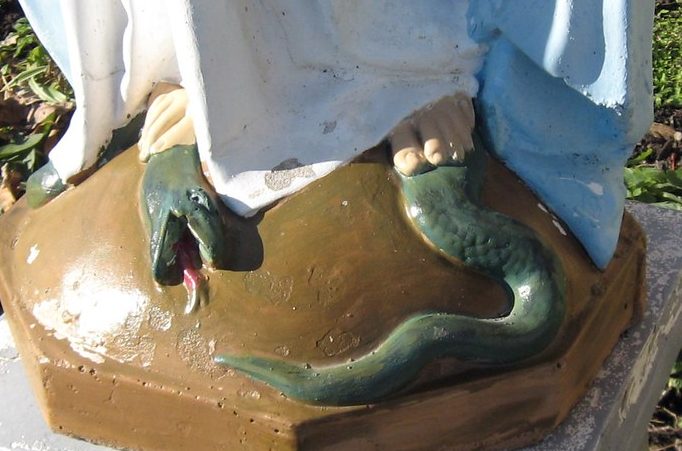
Photo: “Mary’s Feet” by elycefeliz is licensed under CC BY-NC-ND 2.0.

Short poem: RHL, ‘Friendship, Not Passion’

I had a friendship, more than passionate love, for you;
we could have been so good, easy, together.
But there’s that issue of your strong religious thoughts,
whereas I let my thoughts change with the weather.

I… well, and who’s the I you think that you address?
I ramble, googly-eyed, my arms elastic.
There are so many sweet but sadly firm believers.
I’m – more than atheist – iconoclastic.

*****

If you’re used to iambic pentameter the meter of this poem feels just a little off, with its lines of alternating 12 and 11 syllables, i.e. alternating hexameters and feminine-ending pentameters… not quite comfortable. Which is perfectly in keeping with the relationship described. And I don’t remember precisely which long-ago not-quite-girlfriend I had in mind when I wrote it; I’ve been attracted to more than one charming female, wonderfully calm and sane except for some unfortunate religious orientation or other.

I’m reminded of the 19th century Punch cartoon of the two guests at a dinner party:
She: “And what is your religion, sir?”
He: “Madam, all men of sense are of the same religion.”
She: “And which religion is that, pray tell?”
He: “Madam, men of sense never say.”

Which is all very well for friendship, but hardly a solid basis for a deeper relationship. You’re better off if you hold out for someone philosophically compatible, unless you (and they) really don’t care. In which case, you’re philosophically compatible!

‘Friendship, Not Passion’ was originally published in Lighten Up Online, edited by Jerome Betts.

Illustration: “Friendship” by h.koppdelaney is licensed under CC BY-ND 2.0.

Poem: ‘True Believers’

A visionary dies an ignoble death;
prophets arise
who transmute his tale to a fairytale,
uplifting, wise,
and establish themselves to receive as
on his behalf, cash from pilgrims, believers–
all of it lies.

One of the new believers rashly tries
to challenge the powers the fairytale calls Evil,
strikes at the Powers That Be, is caught and dies,
dies an ignoble death… Prophets arise
and transmute the events into a new fable,
glory surpassing the skies.
At a cost, of course, they spread out a table
for all to gather and feast. They, the deceivers,
live yet again from the wealth of the true believers;
one of whom…

*****

I love seekers after Truth, Knowledge, the Meaning of Life, no matter where they are led in belief or unbelief. I loathe those who come after them to distort the message and extort innocent followers. But it’s all an old, old story.

This semi-formal poem was first published in Snakeskin – thanks, George Simmers!

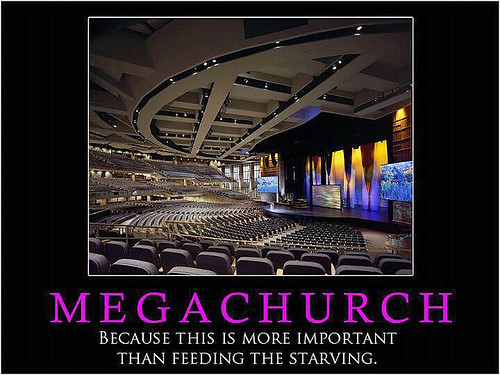
Photo: “Megachurch” by Silly Deity is marked with Public Domain Mark 1.0.

Irregular Sonnet: ‘Where Do They Go?’

Where do they go, those children asleep?
Do they roost, or do angels put them on shelves?
Or do they go home, to some place they keep
locked far away from us and themselves,
Or an alternate universe? In, out, up, down?
Into a not-place, past care and past fear?
Past love and past tired, past smile, yawn and frown
into subtracted space, full of not here?

And where do they go, the dead?
We say we can’t know where they go,
just that they’re gone. But the crow
says, There is more to know that you don’t know –
says, Better ask instead
where do we go, when dead?

*****

This almost-regular sonnet was originally published in Bewildering Stories (thanks Don Webb). I thought it might be nice to emphasise (after some of irreligious poems) that I am not an atheist (except in the eyes of the organisedly religious). I am a Militant Agnostic: “I don’t know, and neither do you.”

Photo: “Good sleeping children in the morning” by michibanban is licensed under CC BY-NC-ND 2.0.

Calling the Poem: 4. ‘Of Gods’

What are the gods? Are they true? Fake? Wild? Tame?
They are in you, and/or you are in them.
They are the joy that apes feel in the storm –
They are the hearth that keeps the caveman warm –
Societies the shaman’s dreams create –
They are Fertility, Love, Hunting, War,
And tools, pots, crops that clutch the god-robe hem,
And Trickster’s tales and lies, the Path, the Door…
Conflicting aspects flesh the human frame,
Demand obedience to some inner Law
To which no individual can conform.
Changing and arguing, they made Rome great
Before the MonoFossilizers came.

*****

It’s difficult for me to express the comfortable balance I have between belief and disbelief. On the one hand, something is the Creator and Sustainer of All the Worlds – in rough numbers, a billion galaxies of a billion stars each, and who knows how many planets with billions of life forms. On the other hand, all the stories of Heaven and Hell, of Odin and Hel, are such simplistic preliterate nonsense that I have to be an atheist. On the third hand, that preliterate sensibility is who we are, how we evolved, and is the key to a holistic understanding of oneself. Therefore I try to pay respectful attention to the simplistic preliterate nonsense that wanders into my consciousness. “Primitive” religion is more useful than “advanced” religion because it is inchoate, formless, shifting, full of alternatives, ambiguous – and that appears closer to the forces that underlie Material Reality than rigid “advanced” religion can manage… and it is also closer to the unconscious that communicates with you through dream and intuition.

But as for exactly what the gods are, and what their relationship to the underlying Creator of the Universe… who knows!

This semi-formal poem is the 4th of 15 in the ‘Calling the Poem’ chapbook from Snakeskin.

Photo: “Greek Gods, take your pick” by dullhunk is licensed under CC BY 2.0.