Tag Archives: Snakeskin

Weekend read: long poem: ‘Catullus LXIII’ translated by George Simmers

Across the sea goes Attis in his ship of sleek rapidity,
To Phrygia, and its forest, which he rushes into eagerly,
The great goddess’s territory, her tree-dark sanctuary.
There he grabs a flint; he jabs and savages his genitals,
Stabs until he’s sure he’s lost the burden of virility;
His blood spills its darkness on the sacred ground surrounding him.
SHE now, never he, SHE reaches for a tambourine,
The tympanum, Cybele, that is used by your initiates,
She beats out her message on the leather of the instrument;
Up she rises, and calls out to all her followers:

        My she-priests hurry, to these woods of our divinity.
        Hurry all you wanderers, all great Cybele’s worshippers,
        You searchers for an otherwise, you riskers and adventurers
        You voyagers who’ve dared the seas that match you in your truculence,
        You like me whose dream has been self-immolated genitals,
        Like me detesting Venus with the utmost of ferocity,
        Set free your minds with the liberty of ecstasy.
        Gladden our goddess, hurry here to worship her,
        Hurry to this Phrygian domain of femininity,
        Hurry to the cymbals, to the gentle flute’s seductiveness,
        Towards the fevered drums and the Maenads’ ululations
        There we must hurry for the celebration ritual.

Attis thus addressed them; she had all the look of womanhood;
Tongues lisped lovingly and cymbals clashed resoundingly.
Attis led on frenziedly, her wild breath labouring
Free as a heifer who’s escaped the yoke of drudgery,
Weary in her lungs, she through the woods leads rhythmically
The Gallae, who are following behind her storming leadership.

They reach the home of Cybele, wearied out and staggering,
Hungry, over-stretched, exhausted by excessiveness.
Sleep commands their eyelids to slide down sluggishly
Excitement leaves their bodies; rage gives way to drowsiness.

Dawn comes. Sunlight. The golden face that radiates
Alike above the firm soil and the great sea’s turbulence,
Which drives away darkness and banishes the weariness
Even from Attis, who is gradually awakening.
(For the goddess Pasithea’s taking Somnus to her bosom now.)
Attis, pseudo-woman, is freed now from delirium
Remembers what she did before, and sees herself now lucidly,
And knows what she has lost, and now her heart weighs heavily.
It labours in her body as she turns and walks back steadfastly,
Steadfastly and sadly, heading back towards her landing-place.
Her tearful eyes look out to sea; she renders this soliloquy
Remembering her birthplace despairingly, lamentingly.

        My motherland, my origin, the one place that created me,
        I must shun you like a thief now, like some dishonest runaway.
        Deserting you for Ida, for a bleak and chilly wilderness,
        Where brute beasts lurk, fired by hunger and rapacity.
        Freed now from my madness by the shock of the reality,
        My eyes weep with a longing for the home that was my nourisher.
        Must life be now this wilderness, with only fading memories
        Of when I was a man – but I have severed that identity –
        A young man, supple, and the flower of the gymnasium,
        A champion of champions among the oily combatants
        Who wrestled for the glory – one who won the admiration
        And the friendship of so many – how my home was garlanded!
        But nevermore now I’ve become Cybele’s mere serving-wench,
        Now that I’m a Maenad, a half-man, whose sterility
        Must sentence me to exile, to a life of pointless wandering,
        Neighbour to the boar and the wild deer in its solitude.
        On these wild slopes of Ida, shadowed by the peaks of Phrygia.
        How I hate my rashness; my regret becomes an agony,

Her words flying upward reached the ears of a deity,
They reached the ears of Cybele, who unleashed from their harnesses
The lions of her anger, with instructions to the left-hand one:
‘Go seek out Attis, be my agent of ferocity,
Pursue him till he’s overtaken by insanity,
Make him regret attempting to escape from my supremacy,
Lash your flanks with your tail, whip up your aggressiveness
Let the place re-echo with untamed outlandish bellowing,
Toss your long red mane in anger,’ so ordered Cybele,
Loosening the brute, who charged away unstoppably,
Raging, careering, crashing through the undergrowth,
Till it reached the white shore, where the sea was opalescent,
And that is where it saw him, Attis, solitary, delicate.
The lion charged and Attis, in a terrified delirium,
Fled towards the forest, to a destiny of hopelessness,
To existence as a slave there, the property of Cybele.

Great Goddess Cybele, Lady of Dindymus,
Vent your anger, I beseech you, far from my place of residence.
May only others feel your goad to madness and to ecstasy.

*****

George Simmers writes: “I’m not normally one for explaining poems, but my Englished version of Catullus’s poem LXIII in the current Snakeskin might be fairly mystifying to anyone coming to it unprepared.

“This is a poem that is over two thousand years old, and a remarkable one. The Victorian critic W.Y. Sellar described the ‘Attis’ as the most original of all Catullus’s poems: ‘As a work of pure imagination, it is the most remarkable poetical creation in the Latin language.’

“First – to deal with a possible misconception; the Attis of this poem is not the god of that name, but a young Greek man who sails to Phrygia, the home of the Great Mother, the goddess Cybele (pronounce the C hard, like a K). In homage to her he castrates himself, to become like one of her Galli, or attendant priests. Attis celebrates jubilantly, but next morning wakes up and registers the finality of what he has done, and the irrecoverable loss of his previous identity. The poem ends with Cybele setting her lions onto him, to drive him into the forest of madness.

“Summarising the story bluntly makes it sound like a simple fable of self-harm and regret, but Catullus is not a simple poet. The poem is made more complex by the intensity of his identification both with the exultant castrated Attis, and with his later regret. Another way of looking at the poem is as a tragedy – Attis’s desire to reshape himself is a hubris that leads to his destruction. Yet although Attis is labelled a pseudo-woman (‘notha mulier’) the reality of his desire to become a woman, and the intensity of his joy when he has liberated himself from maleness, are never in doubt. Significantly, when he later expresses regret, it is not for the loss of his sexual identity, but for his social one. It is possible to see the poem as an expression of the conflict within the poet himself, between his wayward hedonistic urges and his strict Roman ethic; he imagines an extreme case of abandoning a Roman (upright male) identity and discovering the consequences.

“The poem’s intensity is in part created by the metre – galliambic. There may be Greek precedents – scholars disagree, I think – but this poem has no known fore-runner in Latin verse. It seems to be based on the rhythms of the Galli’s ceremonial music (at the Roman Megalesian festivals, presumably, where the Great Mother was celebrated, by priests carrying tambourines and castrating-knives). It is an insistent, forward-driving metre, with a unique line ending, a pattering of three short syllables. English versification is different from Roman, and direct imitation of the galliambic metre in English does not work (although Tennyson had a go in his poem Boadicea). I have tried to find an equivalent that produces a similar forward-driving rhythm. It is based on a line of two halves; before the caesura I have allowed myself some freedom, to avoid predictability, but the second half of every line hammers with dactyls, always ending with a three-syllable word or phrase. This is the best solution I’ve found to the poem’s challenge. I’ve looked at various free-verse translations, but they all seem rather slack, lacking the energy of the original. Translations into blank verse or heroic couplets make the poem too staid. The prosody of the original was unique, controlled, purposeful, and a translation needs to be equally unexpected and distinctive.

“I suspect that my version may work better spoken aloud than on the page – but then I’m attracted to T.J. Wiseman’s theory that the original poem was originally written for performance (perhaps as accompaniment to a dance, perhaps at a Megalesian festival). Elena Theodorakopoulos agrees, and in a rather good essay available on the Internet, has written:

I am convinced that the poem must have been written with performance at or around the Megalesia in mind. My suggestion is that it was written for one of the gatherings patrician families held at their homes during the Megalesia [….] It makes sense to imagine the poem performed at such an event: the thrill of the violence and the orgiastic frenzy, the mystery of who exactly Attis was, and the sexual ambivalence of the performance, would all have provided the perfect ambience for such a gathering. And when the final lines are spoken, asking the great goddess to visit others with her fury and to keep away from the speaker’s house (domus), they are spoken by the poet himself, whose identification with Attis’ frenzy during the reading must help to appease the goddess and to keep the noble domus in which the performance has taken place safe from harm.

“Catullus LXIII is a poem full of subtleties and mysteries (I keep on finding new things in it, and new ways to tweak my version,and you can expect the translation in Snakeskin to be updated from time to time). Like most readers I was first attracted to Catullus by his short poems of love and hate. I am gradually discovering that there was so much more to him. I’m now looking at poem 64…”

*****

George Simmers used to be a teacher; now he spends much of his time researching literature written during and after the First World War. He has edited Snakeskin since 1995. It is probably the oldest-established poetry zine on the Internet. His work appears in several Potcake Chapbooks, and his recent diverse collection is ‘Old and Bookish’. ‘Catullus LXIII’ is from Snakeskin 320, and the explanation is from the Snakeskin blog.

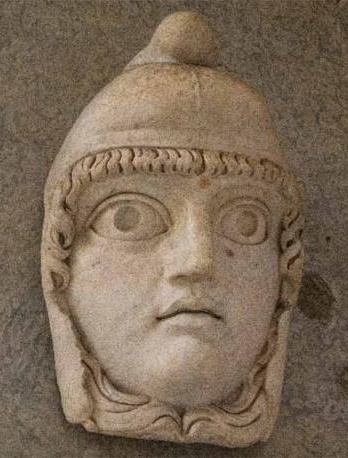
Photo: from Snakeskin 320 (August/September 2024)

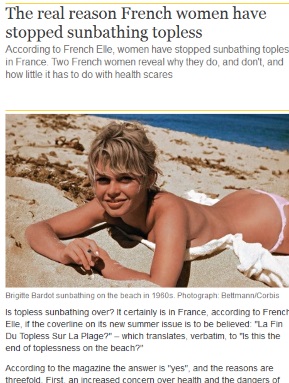
Conor Kelly, ‘On Reading the Guardian News Item: France falls out of love with topless sunbathing’

Now planes are falling from the sky
brought down by bombs or storms of sand
and bodies flying through the air,
incinerated where they land.
Now drones are flying over towns
and villages where families lie
scattered upon the blood-dimmed earth
rent by a missile from on high.
 
    In times like these, it’s good to know
    successors to Brigitte Bardot,
    whose breasts were often on display,
    are covering up in Saint-Tropez.
 
Now children on a blood-strewn yard
lie dying in a UN school
and learn, too late, that modern war
is subject to no human rule.
Now girls asleep in their school dorm
are woken, kidnapped, taken deep
into impenetrable land
while parents, friends and teachers weep.
 
    At times like this it’s good to know
    what may be à la mode, although
    French women think it is passé
    to bare their breasts in Saint-Tropez.
 
Now drive-by shootings in the hood
leave strangers dying, one by one,
and children other children kill
when they discover Daddy’s gun.
Now vigilantes late at night
who stand their ground while they patrol
can shoot the mad, the drunk, the strange,
disdaining talk of gun-control.
 
    At times like this it’s good to know
    bikini tops are now on show
    as toplessness is now risqué
    upon the beach at Saint Tropez.
 
Now new and old diseases take
their toll on those who try to cure
the sad, the suffering, the sick,
when each prognosis is unsure.
Now chemists working in a lab
and patients undergoing trials
are seeking what alleviates
from what are merely fads, lifestyles.
 
    At times like this it’s good to know
    that suntanned breasts no longer glow
    and fashion fans are now au fait
    with what is chic at Saint Tropez.

*****

Conor Kelly writes: “Tragedy and comedy, war and peaceful sunbathing, gunshots and film shoots, dead bodies and bare bodies, vigilantes and voyeurs, the consequential and the chic, the chemical and the comical, the bad and the fad; this poem is based on a fundamental contrast between the fatal depravities of the modern world as outlined in the longer stanzas and changing trends in body images as outlined in the refrain. Despite the serious subject matter, it is not to be taken too seriously. The poem was originally published in the September 2014 issue of Snakeskin (https://www.snakeskinpoetry.co.uk/210topless.html)”

Conor Kelly was born in Dublin and spent his adult life teaching in a school in the city. He now lives in Western Shore, Nova Scotia from where he runs his twitter (X) site, @poemtoday, dedicated to the short poem. He has had poems printed in Irish, British, American, Canadian and Mexican magazines. He was shortlisted for a Hennessy New Irish Writers award. At the ceremony one of the judges, Fay Weldon, asked him, “Where are you in these poems?”  He is still asking himself that same question.

https://www.instagram.com/conorkelly.poems/

Photo: from Snakeskin

Sonnet: RHL, ‘Denmark is not a Friend’

To poets, lovely Denmark’s not a friend:
there’s too much commonsense, it’s too prosaic.
These blonds just blindly make life a bland blend;
but life should be a salad, a mosaic.
Long live the Christiania anarchists!
Bare feet, graffiti, dog shit, broken glass!
Runaways, pushers, folk on Wanted lists,
the type you’re careful around when they pass.

Well, maybe I exaggerate… I love
museums, bike lanes, all the walking streets,
orderly lines where people never shove,
the clean green parks, the clean stores full of treats…
And after all, I write in sonnet form:
a lovely, useful, ordinary norm.

*****

I wrote this sonnet last month in Denmark, and it was published in the June Snakeskin, an all-rhyme issue. (I’ve tinkered with the title and one of the lines…) The opposing arguments for personal freedom and social responsibility are hardly new, and I agree with both. Perhaps I need to reread Matthew Arnold’s ‘Culture and Anarchy‘… <downloads> <peers>… hm… no, too much religion.

Photo: Postcard in Snakeskin

Using form: Double Dactyl: Alex Steelsmith, ‘Clairevoyance’

Claire Ferchaud (fer-SHO) was a young French shepherdess and mystic who became a modern-day Joan of Arc during World War I, campaigning to add the image of the Sacred Heart to the French flag. Though her proposal was ultimately rejected as a merely symbolic gesture, it was taken seriously and honored by the distinguished General Ferdinand Foch, who became Supreme Commander of Allied Forces.

Fearlessly, peerlessly,
Claire the clairvoyant one
pushed a proposal that
fizzled, although

Foch the preeminent
generalissimo
said, “Let’s all try it—and  
not just Ferchaud.”

*****

Alex Steelsmith writes: “I tend to read widely and randomly, but ‘Clairevoyance’ didn’t come about in the usual way. Another double dactyl I had written, about the French mystic Marthe Robin, appeared in the previous issue of Snakeskin. In an email exchange I had with Snakeskin editor George Simmers about that poem, he happened to mention Claire Ferchaud, another fascinating Frenchwoman that Marthe brought to mind. I thought it would be a fun challenge to see if I could come up with one about Claire. That’s when I looked into her story and the pun leaped out for the last line of the poem. It felt a bit irreverent to be lightly punning on the name of someone who presumably was very serious and wouldn’t have been especially amused. In any case, I have George to thank for giving me the idea for the subject of the poem.” 

Alex Steelsmith’s writing has appeared in USA TodayThe Washington PostThe Spectator, LightSnakeskinLighten Up Online, and other venues. He has been a Light featured poet, and a Pushcart Prize and Best of the Net nominee. More of his writing – and his artwork – is at http://www.alexsteelsmith.com/

Photo from Snakeskin

Using form: Songs as poems: Duncan Gillies MacLaurin, ‘But At Least I Had A Ball’

I’ve always loved to sing an’ dance.
I’m better at the first.
An’ given even half a chance,
I’m bound to do my worst.
I’ve struggled sometimes with romance,
succumbed to alcohol,
but at least I had a ball.

I liked to smoke a lot of weed
an’ hash while in my prime.
I’d barely write an’ hardly read,
just wasted space an’ time.
I didn’t think that I’d succeed
with anything at all,
but at least I had a ball.

I did some LSD an’ coke,
but didn’t dare touch smack.
The people on it weren’t a joke.
I’ve never sampled crack.
I still enjoy a drink an’ smoke.
Like everyone, I’ll fall,
but at least I had a ball.

I wasn’t any good at jazz.
I tried it on trombone.
I’ve stayed away from razzmatazz.
I’d rather be alone.
I’ll never be as famous as
that guy from Montreal,
but at least I had a ball.

I found myself in poetry,
then turned it into song.
I see it as my destiny.
It’s here that I belong.
I may end up in poverty
with nobody to call,
but at least I had a ball.

*****

Duncan Gillies MacLaurin writes: “I’ve been wanting to do songs like Cohen and Dylan for years – ones that have a repetend at the end, and I’ve finally achieved that.” This poem was published in the current edition of Snakeskin.

Duncan Gillies MacLaurin is a Scottish poet who was born in Glasgow in 1962. He studied Classics at Oxford, left without a degree, and spent two years busking in the streets of Europe. He met a Danish writer, Ann Bilde, in Italy in 1986 and went to live in Denmark, where he teaches English and Latin. His collection of 51 sonnets, I Sing the Sonnet (2017), is online at Snakeskin. He blogs here. His experiences as an ex-pat poet are described in the first issue of the e-zine, The Chimaera.

Photo: “We Had Some Wild Parties” by lyndawaybi3 is marked with CC0 1.0.

Political poem: George Simmers, ‘Navalny’

In memory of Alexei Navalny, killed at the IK-3 penal colony,
16 February, 2024.

1.
Rough and chivvying cold winds blow
The helpless dead leaves to and fro.
Leaves have no say in where they go
But we’re alive so can say no –
Let us praise those men who show
Resistance to the easy flow.

2.
Navalny, prisoner in the snow,
In numbing twenty-eight below,
Has paid the price for saying no;
He’s gone the way we feared he’d go.

That’s Putin, making sure all know
That retribution comes in tow
For those who won’t go with the flow.
‘All dissidents will finish so,’
The message is: ‘Go with the flow,
Or you too could end on Death Row.’

I imagine his warders: Did they know
A twinge of guilt at this, or show
Regret or shame? I doubt it. No –
Why should men let a conscience grow
When they can just go with the flow?
When life is so much easier so,
When every television show,
The papers and the radio
All radiate a conformist glow
Incessantly, so all men know
Life’s comfier with the status quo.
It’s only awkward sods say no,
Go their own way, not with the flow.
Those have a dangerous row to hoe,
And who can blame the average Joe
For on the whole deciding: ‘No,
That’s not for me. I’d rather toe
The line, collect my wages, know
I’m safe and needn’t undergo
What brave men have to suffer. No,
Go with the flow, go with the flow.’

3.
In Moscow brave girls risk a blow
By laying flowers in the snow
To honour him for saying ‘No’.
Brave girls. I admire them so.

*****

George Simmers writes: “This poem began because our local Arts Festival announced its theme as ‘Flow’. Which made me grumble a bit: was I supposed to write stuff about how nice it was that rivers flowed? Not my style. But then I thought about people who go against the flow by saying ‘No!’ and that suggested a subject and a rhyme scheme. It was only after I’d scribbled a few possible lines that I came across a photo of young women in Moscow placing flowers in the snow as tributes to the murdered Russian dissident, Alexei Navalny. In some towns, such protestors had been arrested or beaten up by the police.

“It’s thirty-odd years since I visited Russia. That was at the time of perestroika and hopefulness. We had a contact in Moscow who took us to see the sights, including the Arbat, a popular meeting- place. He said: ‘Can we stop and talk here for a few minutes? I ask because a few years ago If I had been seen here in conversation with a foreigner, I should have been arrested.’ Freedom was precious then, but repression returned.

“Navalny was a lawyer who campaigned against the corruption endemic in Russian political life. In 2020 he was poisoned with Novichok (probably by the Federal Security Service) ; after hospital treatment in Berlin that saved his life, he returned to Russia, even though he knew of the dangers. He was immediately arrested, and ended up in an Arctic Circle corrective colony. The exact circumstances of his death still remain unclear, but while in prison he had suffered from malnourishment and mistreatment.

“Writing this poem I remember Auden’s words: ‘Poetry makes nothing happen.’ Auden pointed out that political poems make the writer feel better, but have no positive effect in the real world. He was right, as usual, which is why I mostly avoid writing poems about politics. But I don’t really see this as a poem about Navalny. I could have chosen to write about Alan Bates and his twenty-five year battle for justice for postmasters, or about Kathleen Stock and others, who opposed the dangerous ideology of the Tavistock clinic. Going against the flow matters everywhere, not just Russia. The form is monorhyme, mostly because that’s how the poem started, and it wasn’t too difficult to keep going. Monorhyme is easier than it looks, so long as you choose the right rhyme word to start with. Don’t try it with ‘month’ or ‘silver’.

“Nalvalny’s death made a news splash in February, but since then more recent horrors have displaced it on the news pages. So maybe this poem will do a little good as a reminder of a brave man. Thank you for re-blogging it.”

The poem will be part of the film ‘Wordflow’ (a film by John Coombes with a soundtrack of stories and poems by Holmfirth Writers’ Group in a continuous showing from 10am-4pm), presented at the Holmfirth Arts Festival in Yorkshire on Sunday, June 16th, upstairs at the ‘Nowhere’ bistro, Norridge Bottom, Holmfirth, HD9 7BB.

George Simmers used to be a teacher; now he spends much of his time researching literature written during and after the First World War. He has edited Snakeskin since 1995. It is probably the oldest-established poetry zine on the Internet. His work appears in several Potcake Chapbooks, and his recent diverse collection is ‘Old and Bookish’.

Annie Fisher: ‘Grumpy Grandad’s Nursery Rhyme’

Cock a buggery doodle doo!
I’m bending to lace up this buggery shoe!
You’d be buggery bad-tempered too
If the buggery cock
Woke you buggery up
At buggery, buggery five twenty two!

*****

Annie Fisher writes: “When our grandchildren were very small, we would sometimes visit to help with child care. The children would often burst into our bedroom early in the morning yelling ‘Cock-a-doodle-doo!’ (Probably encouraged by their parents). On one occasion my husband was staying with them for a few days without me. On the second day he sent me a text at the crack of dawn. The text read ‘Cockabuggerydoodledoo!’ and so I understood that his day had already begun! I thought ‘cockabuggerydoodledoo’ (a case of ‘expletive infixation’, Google tells me) had irresistible rhythmic force.
My poem is, of course, based on the traditional nursery rhyme:
Cock a doodle doo!
My dame has lost her shoe,
My master’s lost his fiddling stick
And knows not what to do.

Annie Fisher’s background is in primary education, initially as a teacher and later as an English adviser. Now semi-retired she writes poetry (this one appeared in Snakeskin) for both adults and children and sometimes works as a storyteller in schools. She has had two pamphlets published with HappenStance Press: (2016) and (2020), and is due to have another pamphlet published in the next couple of months with Mariscat Press. It will be called ‘Missing the Man Next Door’. She is a member of Fire River Poets in Taunton, Somerset and a regular contributor to The Friday Poem https://thefridaypoem.com/annie-fisher/

Photo: “cock-a-doodle-doo.” by alyssaBLACK. is licensed under CC BY-SA 2.0.

Tom Vaughan, ‘The Great and the Good’

Why sing of the lives
of the fortunate few
whose gong-heavy entries
weigh down Who’s Who ?

They’re smug on their summits
and on Footsie Boards,
Permanent Secretaries
or rotund Law Lords;

generals, merchant bankers,
Top Brass at the Beeb,
dons, doctors, bishops. . .
You can spot the breed

by their ability
blind obedience to claim
from drudges and drivers
and shy, single, tame

PAs who sacrifice
lonely weekends
to type bland speeches
for skimpy stipends.

O don’t be deceived
by the Great and the Good –
you’re a rung on their ladder
on their fire, wood,

grain for their harvest,
a wheel on their car,
corpse on their D-Day,
night for their star.

*****

Tom Vaughan writes: I’ve long been fascinated by the phrase ‘the Great and the Good’, having reached the conclusion during long years of government service that the great cannot generally also be good, given the demands of the exercise of power. But I am also intrigued by the loyalty such people can inspire, and the longing for leaders that reflects, despite the advice given by my favourite political commentator, Bob Dylan, in Subterranean Homesick Blues – ‘Don’t follow leaders/Watch the parkin’ meters’.”

‘The Great and the Good’ was first published in Snakeskin 265, October 2019.

Tom Vaughan is not the real name of a poet whose previous publications include a novel and two poetry pamphlets (A Sampler, 2010, and Envoy, 2013, both published by HappenStance). His poems have been published in a range of poetry magazines, including several of the Potcake Chapbooks:
Careers and Other Catastrophes
Familes and Other Fiascoes
Strip Down
Houses and Homes Forever
Travels and Travails.
He currently lives in Brittany.
https://tomvaughan.website

Photo: “MPs and House of Commons officials stand in the House of Lords chamber at the opposite end to the throne, the bar, to listen to the Queen’s Speech” by UK Parliament is licensed under CC BY-NC 2.0.

Semi-formal: Annie Fisher, ‘Today I’ll be a Slug’

I’ll flow
slug-slow,
go naked
(naked’s fine).
My only mission
is to glisten.
Watch me shine.

*****

Annie Fisher writes: “I wrote the slug poem a year ago when I was on a writing retreat on the island of Iona in the Inner Hebrides. I was writing all sorts of other stuff on the retreat and that little poem popped into my head during a free-writing morning splurge. I guess the idea of slowing down, going with the flow, being true to oneself and letting one’s inner radiance shine is very much in keeping with the vibe of Iona, but it wasn’t a conscious thing.
I do love short poems. I’ve had others published on Snakeskin, including:

SONG THRUSH, MAY MORNING

Bird at my window, early, early,
Something to say, to say, to say,
This morning will not come again,
Make the most of today today.

That poem plays with the fact that the song thrush repeats its song. I sometimes sing it with some friends as a round using a tune we wrote. Here’s one other from the Snakeskin archive which I’m rather fond of:

GRANNY ON THE NAUGHTY STEP

Granny sits on the Naughty Step
Thinks about what she has done
Wishes she’d been a bit naughtier
It might have been fun…”

Annie Fisher’s background is in primary education, initially as a teacher and later as an English adviser. Now semi-retired she writes poetry for both adults and children and sometimes works as a storyteller in schools. She has had two pamphlets published with HappenStance Press: (2016) and (2020), and is due to have another pamphlet published in the next couple of months with Mariscat Press. It will be called ‘Missing the Man Next Door’. She is a member of Fire River Poets in Taunton, Somerset and a regular contributor to The Friday Poem https://thefridaypoem.com/annie-fisher/

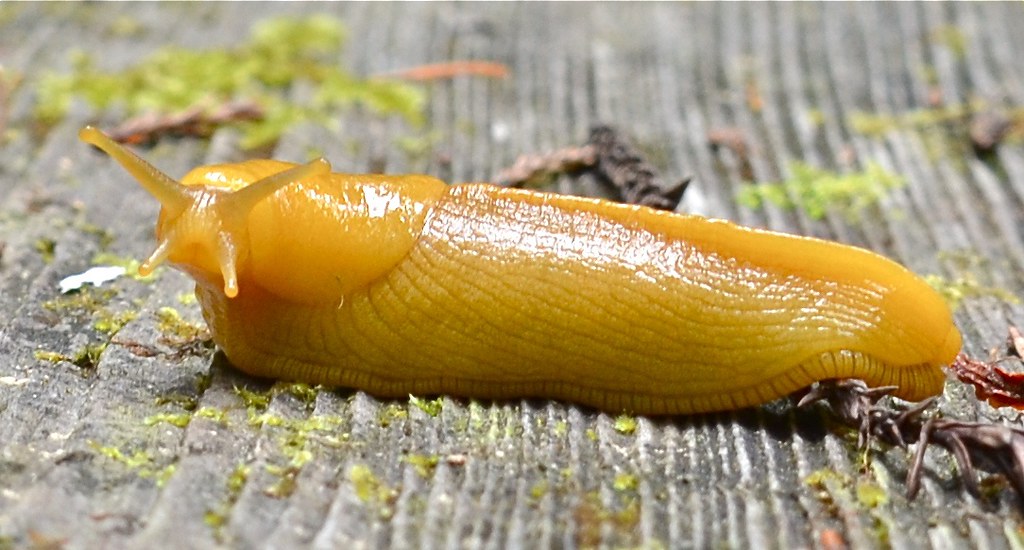
Photo: “Banana Slug – A Series” by goingslo is licensed under CC BY-NC-ND 2.0.

Tom Vaughan, ‘On the Twilight Mountains’ (Jeremiah 13:16)

On the twilight mountains
leopards change their spots
distributing their cast-off coats
to helpworthy have-nots –

lions and lambs and lynx lie down
and tell each other tales
of how at sea the seals now go
for walks with killer whales –

lovers linger hand in hand
promising to be
truthful, faithful, thoughtful, kind,
supportive company –

and peace seems deep and peace seems long
until the morning sun
wakes us from our ancient dream
like a starter gun.

*****

Tom Vaughan writes: “The poem (published in Snakeskin 316, April 2024) is among several inspired by my current reading of Robert Alter’s magnificent – and magnificently thought-provoking – translation of the Hebrew Bible. However gloomy the concluding stanza, and however accurately that gloom may reflect the violence and slaughter always at the heart of the world, I hope the poem also catches some of the equally permanent and however illusory yearning for things to be otherwise.”

Tom Vaughan is not the real name of a poet whose previous publications include a novel and two poetry pamphlets (A Sampler, 2010, and Envoy, 2013, both published by HappenStance). His poems have been published in a range of poetry magazines, including several of the Potcake Chapbooks:
Careers and Other Catastrophes
Familes and Other Fiascoes
Strip Down
Houses and Homes Forever
Travels and Travails.
He currently lives in Brittany.
https://tomvaughan.website

Illustration: ‘The Peaceable Kingdom’ by Edward Hicks, via Snakeskin