Tag Archives: Sonnet Scroll

Sonnets: David M. Katz, ‘Two Sonnets for Patrick Stewart, who read Shakespeare online during Covid’

I.
You slow it down and speak the speech from home
As if admitting no impediments,
No infectious thoughts into your room,
No intrusions, anxious sentiments,
Just cadences of comfort from your couch.
As close as that. Yet you are far enough
To thwart contamination borne of touch,
Random droplets in the air, a cough.
Every day I come to sit with you
To put this ghastly time and place aside,
Inject your native lightness here anew
Into my thoughts of those who may have died,
Or may be dying, or contaminate
Those in the street who can’t self-isolate.
II.
Summoning the bard into your lungs
Might be your day’s initial antidote
Against the plague. Then, climbing up the rungs
To the apex of the ague in the throat
Of your talent, holding his lines there
As if to muster powder for a shot
At wiping out the virus with a prayer
Or spell enacted in a sacred spot,
You step into the spirit of the thing.
You’ve got us where you want, and we’ve got you,
Artful doctor. You begin to sing.
We feel as if we just might make it through.
We step into your seance every day.
You gesture, and the plague has gone away.

*****

David M. Katz writes: “These two poems are part of “These Masks,” a “diary” of 20 Shakespearean sonnets I wrote from March to May 2020, during the very start of the pandemic. When I began, I resolved to read one of Shakespeare’s sonnets a day, along with Helen Vendler’s commentary on it in her book, The Art of Shakespeare’s Sonnets, and then write a sonnet responding to what was happening in the world. Before I wrote the sonnets published here (#s 4 and 5 in the sequence) I found that the great actor Patrick Stewart had begun reading a Shakespeare sonnet a day online from his home. I had previously found Stewart’s 1995 performance in the role of Prospero in The Tempest in New York’s Central Park an inspiration to me poetically and, now, there he was, a bright light during the dark days of the plague, reading to us intimately, every day. The sonnets are in praise of that great joy.”

The ‘Sonnets for Patrick Stewart’ were first published in the Sonnet Scroll of The Poetry Porch.

David M. Katz is the author of five books of poetry—The BiographerIn Praise of ManhattanStanzas on Oz, and Claims of Home, all published by Dos Madres Press, and The Warrior in the Forest (House of Keys). Poems of his have appeared in Able Muse, Poetry, The Paris Review, The Hudson Review, and THINK. He is a co-host of the Morningside Poetry Series in Manhattan and posts frequently on his website, The David M. Katz Poetry Blog. He recently starred in Gully’s Paradise, a feature-length film by Shalom Gorewitz.

Photo: ‘Patrick Stewart Performs the Complete Sonnets of William Shakespeare’ is an unabridged audio book from Simon & Schuster.
Sonnet: RHL, ‘Why I Lie’

When hitchhiking, inevitably tasked
with answers to ‘Where from?’ and ‘Origin?’
I lie to simplify the tales I’d spin
if my odd background really were unmasked.
(The childhood travels, seas in which I’ve basked;
prep school: Jamaica. Teen years schooling in
a former English palace, slept where Queen
Victoria stayed…) because then I’d be asked:
‘Why hitchhike? Spoiled kid! Don’t lie! Get out!’

Therefore of course I have to cut some slack
for other people with their bogus tales:
big boasters may have nothing to boast about,
while quiet ones may not want to go back,
whether to jobs or spouses, wars or jails.

*****

I thought I’d pair this with Marion Shore’s reflection on lies, which I republished here in the previous post. The issue of deliberate lies is unresolved for me, along with so many other things. But at least I (rarely) lie about my confused background any longer – I just mention bits that seem relevant in the context.

‘Why I Lie’ was first published in the Sonnet Scroll of the Poetry Porch.

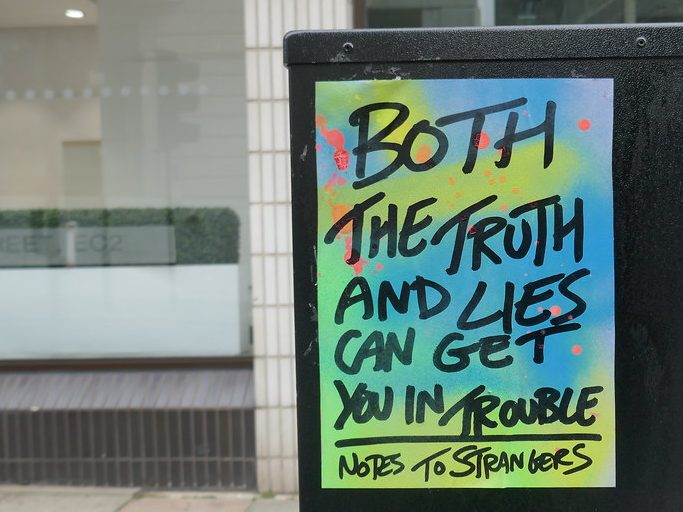
Both the truth and lies can get you in trouble” by duncan cumming is licensed under CC BY-NC 2.0.

Sonnet: Jean L. Kreiling, ‘Fado for Beginners’

Fado (Portuguese): fate, and also a Portuguese style of music for
solo singer and guitar, usually expressing saudade, or longing.

Most of us long for something—love or wine
or one more hour before we say goodbye—
or feel an ache that we can’t quite define,
the pulsing of our blood a silent sigh.
In Portugal, we see the shiny thrones
of kings who yearned for women and for land;
we taste the port and tread the cobblestones,
admire bright tiles—but only understand
this place when we hear passion made of song:
when fado marries fervent poetry
to music. Then it’s clear that we belong,
for we too know desire and memory.
As if returning from a long exile,
our pulses, too, sing fado for a while.

*****

Jean L. Kreiling writes: “At a small, dimly lit club in Lisbon, my friends and I enjoyed delicious green soup and cod cakes, along with the attentions of a charming waiter.  But as a musician myself, with high standards and somewhat narrow tastes, I was not sure whether the promised Fado performance would appeal to me. When the young performers appeared between appetizer and entrée, and then between entrée and dessert, they immediately drew me into their spell of gorgeous sound and irresistible emotion. I was impressed by the flawless technique of both singer and instrumentalists, but more than anything, I was tremendously moved; I think I caught a glimpse of the Portuguese soul. I feel so fortunate to have shared the depth of humanity one hears in Fado.

Fado for Beginners’ first appeared in the Sonnet Scroll of The Poetry Porch.

Jean L. Kreiling is the author of four collections of poetry; her work has been awarded the Able Muse Book Award, the Frost Farm Prize, the Rhina Espaillat Poetry Prize, and the Kim Bridgford Memorial Sonnet Prize, among other honors. A Professor Emeritus of Music at Bridgewater State University, she has published articles on the intersections between music and literature in numerous academic journals.

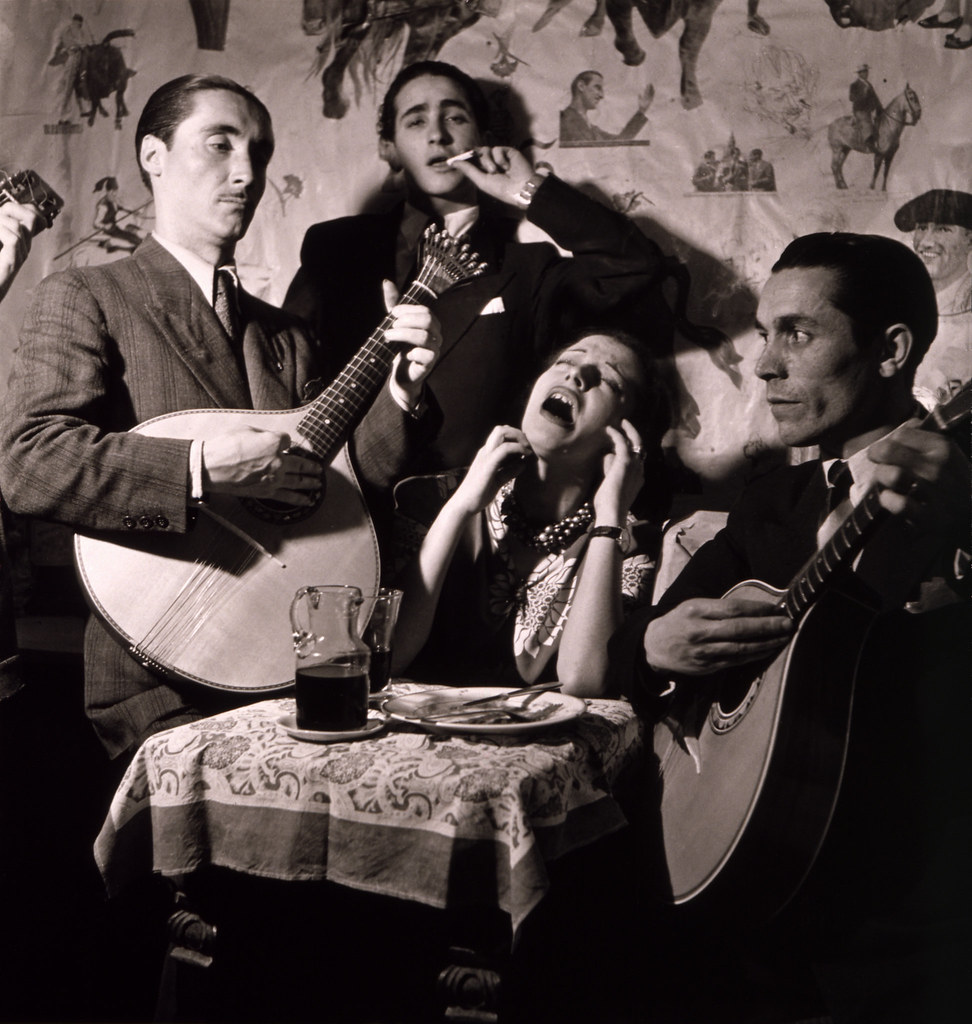
Photo: “Toni Frissell: Fado singer in Portuguese night club, Lisbon, 1946” by trialsanderrors is licensed under CC BY 2.0.