Without black tea, his mornings never start. The newspaper should be upon his bed; Not finding it will make his eyes all red. As if examining a piece of art, He reads each page. Loud oohs such as ‘My heart!’, ‘Another swindle!’, or ‘So many dead!’, Are heard as if the earth’s weight’s on his head. Harrumphing, he jumps to the Cultures part. A pensioner today, back in those days, He was a banker. Now, he saunters, plays Carom with me, or spends the noontimes planting Camellias —- a work he finds enchanting. At times, he sits before some dusty files, Puts on the glasses, thumbs through them, and smiles.
Shamik Banerjee is a poet from Assam, India. Some of his recent publications include Spelt, Ink Sweat & Tears, Modern Reformation, San Antonio Review, The Society of Classical Poets, Third Wednesday, and Amethyst Review among others.
One month from when you met me, when you brought the first of many gifts, a 45 of plaintive praise and longing, who’d have thought that forty-five years later we’d survive on weekends, holidays, and summer breaks, a foretaste of the end in every start, anticipation ballasted with aches as we put love on hold and live apart?
You are a holiday. The working week unspools like toilet paper from a roll. My attitude goes airborne when we speak, and when we meet, my heart swoops like a shoal of fish. Would we have lost this giddy glow, living together? Better not to know.
*****
Susan McLean writes: “It makes me feel ancient to realize that for younger readers I will have to explain that a 45 was a record with one song on each side, which played on a record player at 45 revolutions per minute. Love poems themselves tend to feel old-fashioned these days, though this one is about a relatively modern problem, the long-term, long-distance relationship in which both people are employed full time at jobs far apart from one another. The form, a Shakespearean sonnet, mirrors the content, in that the rhymes are separated from one another until the end, when they are reunited. The poem was originally published in the online journal of female formalist poets Mezzo Cammin, and it later appeared in my second book of poetry, The Whetstone Misses the Knife.
Half of my favorite works of fanfiction are stories that anesthetize the pain produced by the original’s depiction of harsh events: the person whom the main character loved who met a tragic end is resurrected in the fan-made sequel; the star-crossed couple gets a chance to mend, and consummate, a bond that has no equal.
The other half are stories that prolong the pain and also boost its magnitude deliciously until my nerves all tingle: near-misses multiply, and roadblocks throng; epiphanies loom close yet still elude; misunderstandings keep our heroes single.
*****
Jenna Le writes: “I believe there’s been a fair amount of published scholarship in recent years about fanfiction and fanfiction culture. I admit I’m not up-to-date on any of it, really, and am only really conversant with such aspects of it as I have personally chanced to encounter. I can only say there seems to have been recent movement toward increased legitimization of the field: in 2019, one of the prestigious Hugo Awards for speculative fiction was awarded to a body of fan-work/transformational work, for instance. Just as for other flavors of fiction, there are probably infinitely many ways to classify and subclassify fanfiction. Novelist Naomi Novik‘s work and interviews are maybe a good place to start looking, for people curious to learn more.”
The neighbor’s child has built a muddy shrine to Satan in our yard. And I’m supposed to cut the lawn? OK, but look at those croquet clubs that she used (good God, they’re mine) to pound her pentagrams of chicken bone into the ground. The handles are unscrewed from all the hammer heads. It’s kind of shrewd the way she placed that PlayskoolTM telephone.
Still, little girls should not touch garden tools or take the plastic rake out of the shed– she’s tied it with those jump ropes to the tree. A shattered flower pot. The Barbie head. Horrific how this child has learned the rules of Belial for sculpting in debris.
*****
Rick Mullin writes: “The little girl, A., is a friend of our family and was one of three girls that spent most days playing in our yard. One day they split up, each doing their own thing in their own corner of the yard. The Shrine to Satan, as I called it, was crafted by A. The architect of the horror described in this poem is getting married today.”
Rick Mullin’s poetry has appeared in various journals and anthologies, including American Arts Quarterly, Measure, The New Criterion, The Dark Horse, The Raintown Review, Epiphany, and Rabbit Ears: TV Poems. ‘Shrine to Satan’ is from his chapbook “Aquinas Flinched”, Exot books, 2008. His books include Soutine and Sonnets from the Voyage of the Beagle (Dos Madres Press, 2012 and 2014), Lullaby and Wheel (Kelsay Books, 2019), and Huncke (second edition, Exot Books, 2021). He is a painter and retired journalist living in northern New Jersey. His website is rickmullin.com and his art blog is onlyofobjects.wordpress.com
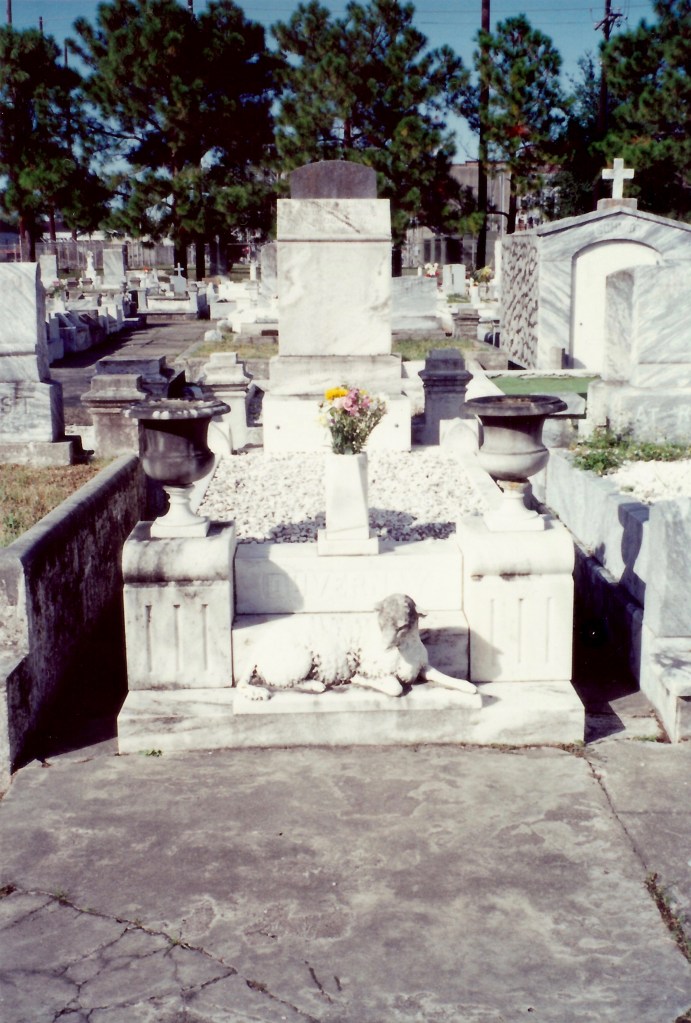
Hello. I’ve brought your favorite flowers again. How is going under there, my dead? On this side, we’re no better off than when you walked beside us. (Yes, I know I said the same last year.) The human race is not improvable. Ask any saint you meet. We’ve gone to war again without a thought. Our leaders shuffle bribes, our heroes cheat. Your children haven’t turned out awfully well, but who expected it? You’re not to blame. They’ll manage, and nobody burns in hell. Goodbye for now. I’m always glad I came. I make no promises about next year, but one way or another, I’ll be here.
*****
Gail White writes: “I wrote this while living in New Orleans, where the dead are buried above ground (mostly) because the city is below sea level. All Saints Day is still a big deal, when the family tomb gets a new coat of whitewash and flowers are placed on every grave. It’s time to reflect on family and faith and our all ending up in the same place, as I’ve tried to do here.”
Gail White is the resident poet and cat lady of Breaux Bridge, Louisiana. Her books ASPERITY STREET and CATECHISM are available on Amazon. She is a contributing editor to Light Poetry Magazine. “Tourist in India” won the Howard Nemerov Sonnet Award for 2013. Her poems have appeared in the Potcake Chapbooks ‘Tourists and Cannibals’, ‘Rogues and Roses’, ‘Families and Other Fiascoes’, ‘Strip Down’ and ‘Lost Love’. ‘A Visit on All Saints Day’ was originally published in Mezzo Cammin, and collected in her chapbook, ‘Sonnets in a Hostile World‘, also available on Amazon.
A poem is so obdurate and small Compared to what you wanted it to say And sometimes isn’t even close at all. For instance, this. I’ve worked on it all day, A metaphor for all of love’s affairs. I failed to ride the energy it gave, My form and balance gone. Nothing prepares You for the wildness of the standing wave. Possessing and possessed and then propelled Abruptly past the point of no control To merely peril, having once beheld The moving stillness of it all, all whole. Your head’s what every poem wants to split, While you stroke hard to stay ahead of it.
*****
Marcus Bales writes: “My online pal, the poet Liam Guilar, was a kayak adventurer, sneaking across borders to paddle the most dangerous rivers in the world. I went white water rafting once. You’re stuck in cold, wet, awkward positions that often turn suddenly painful. Why people do it over and over seems not just unreasonable but cold, wet, and painful. There are exhilarating moments, but you’re still cold, wet, and out of control. I could feel in my one experience that the out of controlness might be the point. Still, it was wet and cold. Very wet. Very cold.
“The confluence of Liam’s many tales, my paltry experience, and he and I both struggling to write poems is the impetus for this poem. I’ve often thought that maybe what it needs is a bucket of ice water suspended over the reader like a, well, like a bucket of Damocles, that sloshes over the head and down the back of the neck in order to make it work.”
Not much is known about Marcus Bales except that he lives and works in Cleveland, Ohio, and that his work has not been published in Poetry or The New Yorker. However his ‘51 Poems‘ is available from Amazon. He has been published in several of the Potcake Chapbooks (‘Form in Formless Times’).
You can almost see Vincent Price, black-robed, hunched above the console of a jumbo organ in the bowels of his creaky haunted manse; or maybe a stadium of damned souls, strobed in lurid red and howling nettle-robed as they plummet into Pandemonium, pore and pith aflame. It’s no troubadour, undoubtedly, this vast atonal gob.
As with the Roach Motel, we’d check in, but never out—us or anything, since it can swallow errant planets whole, and still, however much the mass, can’t eat its fill. Though it’s larger far than Jupiter or Mars, we can barely see it, thank our lucky stars.
*****
William Trowbridge writes in Rattle, where this poem was published: “I’ve spent most of my years as a poet writing free verse, though lately I find myself turning toward form. Unlike those who see formalist verse as dry and effete, I find it can generate power by means of barriers to play against—‘the net’ as Frost put it, by which he also meant boundary lines. If you pour gunpowder in a pile and light it, a mere flash occurs. But pack it tightly into a container, and you can get something more powerful. And, as opposed to the notion that form is restrictive, I agree with Richard Wilbur that it often liberates one from choosing the easy word in order to discover the better, surprising one. I haven’t moved into this part of town yet, but I stop there more and more.”
William Trowbridge’s tenth poetry collection, Father and Son, was published by Wayne State College Press Press in April. His poems have appeared in more than 45 anthologies and textbooks, as well as on The Writer’s Almanac, AnAmerican Life in Poetry, and in such periodicals as Poetry, The Gettysburg Review, The Georgia Review, The Southern Review, Plume, Rattle, The Iowa Review, Prairie Schooner, Epoch, and New Letters. He is a mentor in the University of Nebraska-Omaha Low-residency MFA in Writing Program and was Poet Laureate of Missouri from 2012 to 2016. For more information, see his website, williamtrowbridge.net.
Book discarded, like excess baggage shed by someone who has rapidly pushed on into uncharted regions far ahead, he sleeps in an old deck chair on the lawn. Gulls circle, skaters on an ice-blue lake, while he dreams on, oblivious, his face unshaded by a hat which, when awake, he wears with equanimity and grace. What does he dream? Is the unreal more real than those pale gulls that spiral high above? In sleep, has youth returned? No longer frail, does he relive time when impatient love was everything and all his heart desired, before life tricked him, left him old and tired?
*****
Richard Fleming writes: “I suppose Sunny Afternoon reflects my own station in life, that is, drifting steadily towards the end, with the usual collection of regrets that most of us have.”
Richard Fleming is an Irish-born poet (and humorist) currently living in Guernsey, a small island midway between Britain and France. His work has appeared in various magazines, most recently Snakeskin, Bewildering Stories, Lighten Up Online, the Taj Mahal Review and the Potcake Chapbook ‘Lost Love’, and has been broadcast on BBC radio. He has performed at several literary festivals and his latest collection of verse, Stone Witness, features the titular poem commissioned by the BBC for National Poetry Day. He writes in various genres and can be found at www.redhandwriter.blogspot.com or Facebook https://www.facebook.com/richard.fleming.92102564/
I love you with that love floppy and large, As one of us a man – the other, dog; Involved, detached, our life’s a travelogue Of countrysides seen from a rented barge, “Travels With You” along some river’s marge, Failing at interspecies dialogue Till tries at talk are lost in night and fog, Drifting with batteries we can’t recharge.
Yet there’s no option but to travel on, Each varied day no different than before, Wondering if we’ll find some magic door Which, risking entry, gives communion; And if, by talking, love would be enhanced, Or if we’d then destroy all we have chanced.
*****
Sonnet originally published in Candelabrum in 2007.
When our Quiz Bowl team of eighteen-year-olds snagged a berth in the finals, held in New York City,
my small-town Minnesotan brain cells dizzied— at last I’d be some place that mattered. Swag
was my teammate Anne’s fixation: knockoff bags peddled in Chinatown, affixed with glitzy
Kate Spade labels. Anne bought a sack of six, then forgot it on the airport shuttle’s shag
seats; someone swiped it within minutes. Kate, I learned a fact of womanhood that year:
even we knockoff girls, cheap, desperate to look like someone else, to imitate
a finer woman, have our value; we’re wanted, wanted, until we disappear.
*****
Jenna Le writes: “The anecdote narrated in the first ten lines of the poem poured out of me easily and naturally enough. It was an anecdote that had been knocking around inside my brain for many years, but it wasn’t until I sat down to write the poem that the incident’s metaphorical meaning — that is, the epiphany contained in the poem’s last four lines — seemed to crystallize in the air in front of my eyes — and, to me, made the whole poem worthwhile. Honestly, until I sat down to write the poem, it had never even occurred to me that such a slight-seeming anecdote might have any metaphorical meaning at all. I sat down to write the poem more or less on a lark, and then the sonnet form just sort of took over and forced me to look deeper, to see more depth in my own material. This is one of the reasons I love the sonnet form.”
Jenna Le (jennalewriting.com) is the author of three full-length poetry collections, Six Rivers (NYQ Books, 2011), A History of the Cetacean American Diaspora (Indolent Books, 2017), and Manatee Lagoon (Acre Books, 2022), the last of which is the collection in which “Purses” appears and which can be purchased here: https://press.uchicago.edu/ucp/books/book/distributed/M/bo185843950.html