Tag Archives: sun

Semi-formal villanelle: Peggy Landsman, ‘Light Villanelle’

Look at all the work the universe has done.
It makes the most of ordinary light
from new moon to full moon, from sun to setting sun.

It does the work of all the worlds rolled up into one
mind-boggling miracle of space and time and light.
Look at all the work the universe has done.

Will we ever know for certain how the universe was begun?
Will we ever learn the reason for all this lovely light
from new moon to full moon, from sun to setting sun?

Much of what we think we see, we know in fact is gone.
Stars do die out long before we catch their traveling light.
Look at all the work the universe has done.

Now look at all the works of man, the wealth of our creation.
There are still no substitutes for heat and light…
from new moon to full moon, from sun to setting sun.

I’m ready to quit my day jobs now; to leave them, one by one.
All I want is to make the most of ordinary light,
to look at all the work the universe has done
from new moon to full moon, from sun to setting sun.

***

Peggy Landsman writes: “I had been up all one long winter night with a group of friends in Buffalo, NY, in the mid-1970s. At one point, sitting around the kitchen table, I suddenly noticed daylight coming through the window. I had a moment of epiphany and blurted out: “Look at all the work the universe has just done!” After I went home and got some sleep, I started the work of writing the poem.”

“Light Villanelle” was first published in a now defunct online journal, Bringing Sonnets Back.

Peggy Landsman is the author of the full-length poetry collection, Too Much World, Not Enough Chocolate (Nightingale & Sparrow Press, 2024), and two poetry chapbooks: Our Words, Our Worlds (Kelsay Books, 2021) and To-wit To-woo (Foothills Publishing, 2008). She lives in South Florida within a short drive of a good library and a beautiful beach. A selection of her online publications is available on her website:  peggylandsman.wordpress.com

Illustration: “HAPPY NEW YEAR ~ Welcome 2014 ~ love letters from earth ~” by Cornelia Kopp is licensed under CC BY-NC-ND 2.0.
Joe Crocker, ‘What Sunflowers See’

They lift and fix their heavy insect eyes
upon the East, from where the sun will send
the bees to stroke and lick and fertilize.
 
They wait, where once they craned their necks to see
his passing arc. They wait, amazed. Surprise
has painted yellow lashes, perfectly
 
coronal round a crowded, dark eclipse.
Its buzzing beauty pixelates and stares.
An alien array of cells unzips.
 
A thousand thousand sisters nurse the same
regret. His warmth is gone. And left behind
to hang their heads, disconsolate, they blame
themselves. Their tears drop hard and black and blind

*****

Joe Crocker writes: “The French call them Tournesols because, when they are growing, the follow the sun. But when the flowerhead is fully formed, they all face East so they warm up quickly and are more attractive to the bees. The poem came about because I’ve been seeing them more frequently in our local supermarkets and my wife grew some this year. Seeing them close up, I was reminded of the reaction a friend from many years ago used to have. She liked them but kept her distance because she was spooked by their dense busy centres. So the insect eye was the starting metaphor and then the poem led me on. Big, beautiful, disturbing, and in the end, sad.”

Joe Crocker is no relation of the Sheffield-born rock singer. But he does live in Yorkshire and gets by (with a little help from his friends). He is a bit old now to be starting out in poetry but was infected by the muse during Covid lockdown a couple of years ago and has had a few things published, mainly in Snakeskin magazine (where this poem first appeared) and other online venues. He doesn’t have a website but if you Google him, you’ll learn a lot more about a certain Sheffield-born rock singer.

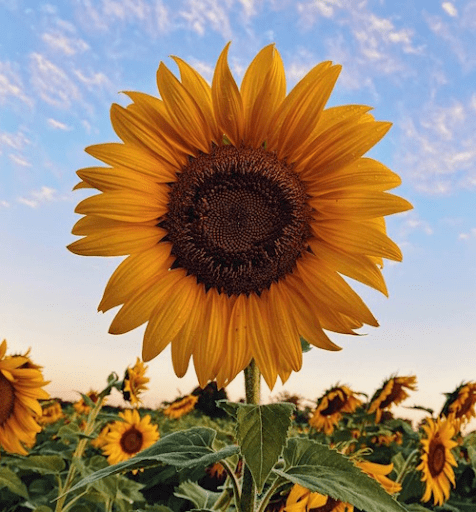
Photo: accompanied the poem in Snakeskin.

Poem: “I Started Out Alone”

I started out alone
with no numbers and no words.
The people gave me food and clothes.
I loved the sun and birds.

And when I reach the end,
numbers and words all done,
have to be fed and dressed again,
I’ll love the birds and sun.

This little poem was published recently in Bewildering Stories, and I like it for a couple of reasons: its simplicity (echoing the simplicity of the states of beginning and end of life, the simplicity of the basics of being human); and its completeness – it covers an entire life, and I can’t think of more words that could be added; and the formality, not only of the simple rhythm and simple rhymes, but of the structure, the line-by-line echoing of the beginning of life in the end of life.

For all these reasons it is an easy little poem to remember and recite, and that is satisfying in itself.