Tag Archives: The Economist

Pope Francis: ‘Dear Poets, Help Us Dream’ (excerpts)

Dear poets, I know that you hunger for meaning, and that is why you reflect on how faith questions life. (…) Poetry is open; it throws you into another realm.

In light of this personal experience, today I would like to share some thoughts with you on the importance of your service.

The first thing I want to express is this: you are eyes that see and dream. Not only do you see, but you also dream. A person who has lost the ability to dream lacks poetry, and life without poetry does not work. We humans yearn for a new world that we may never fully see with our own eyes, yet we desire it, seek it, and dream of it. A Latin American writer once said that we have two eyes: one of flesh and the other of glass. With the eye of flesh, we see what is before us; with the eye of glass, we see what we dream. Woe to us if we stop dreaming—woe to us! (…) Indeed, poetry does not speak of reality from abstract principles but rather by listening to reality itself: work, love, death, and all the little and great things that fill life. Yours is — to quote Paul Claudel — an “eye that listens.” (…)

I would also like to say a second thing: you are the voice of human anxieties. Often, these anxieties are buried deep within the heart. You know well that artistic inspiration is not only comforting but also unsettling because it presents both the beautiful realities of life and the tragic ones. Art is the fertile ground where the “polar oppositions” of reality — as Romano Guardini called them — are expressed, always requiring a creative and flexible language capable of conveying powerful messages and visions. For example, consider when Dostoevsky, in The Brothers Karamazov, tells the story of a little boy, the son of a servant, who throws a stone and hits one of his master’s dogs. The master then sets all the dogs on the boy. He runs, trying to escape the fury of the pack, but ultimately, he is torn apart under the satisfied gaze of the general and the desperate eyes of his mother.

This scene has tremendous artistic and political power: it speaks to the reality of yesterday and today, of wars, social conflicts, and our personal selfishness. It is just one poetic passage that challenges us. And I’m not only referring to the social critique in that passage. I speak of the tensions of the soul, the complexity of decisions, the contradictions of existence. There are things in life that, at times, we can’t even understand or find the right words for: this is your fertile ground, your field of action. (…)

That is what I want to ask of you today as well: go beyond the closed and defined borders, be creative, do not domesticate your anxieties or those of humanity. I fear this process of taming because it stifles creativity, it stifles poetry. With the words of poetry, gather the restless desires that inhabit the human heart so they do not grow cold or die out. This work allows the Spirit to act, creating harmony amidst the tensions and contradictions of human life, keeping the fire of good passions alive, and contributing to the growth of beauty in all its forms, beauty that is expressed precisely through the richness of the arts.

This is your work as poets: to give life, to give form, to give words to all that human beings live, feel, dream, and suffer, creating harmony and beauty. It is a work that can also help us better understand God as the great “poet” of humanity. Will you face criticism? That’s okay, bear the weight of criticism while also learning from it. But never stop being original, creative. Never lose the wonder of being alive.

So, eyes that dream, voices of human anxieties; and therefore, you also have a great responsibility. And what is it? It’s the third thing I want to say: you are among those who shape our imagination. Your work has an impact on the spiritual imagination of the people of our time. Today, we need the genius of a new language, powerful stories, and images. (…)

Dear poets, thank you for your service. Continue dreaming, questioning, imagining words and visions that help us understand the mystery of human life and guide our societies toward beauty and universal fraternity.

Help us open our imagination so that it transcends the narrow confines of the self and opens up to the entire reality, with all its facets, thus becoming open to the holy mystery of God. Move forward, without tiring, with creativity and courage!

I bless you.

*****

The above is a substantial excerpt from the letter Pope Francis wrote for the book ‘Verses to God: An Anthology of Religious Poetry‘ (published by Crocetti Editore), curated by Davide Brullo, Fr. Antonio Spadaro, and Nicola Crocetti. The letter is given in full in the Vatican News.

The Economist’s obituary for Pope Francis states he insisted on: “no papal cape or red slippers, just a plain white cassock and his ordinary black shoes. (…) No crest-embellished dinner plates, no new pectoral cross; he kept the iron-plated one he had worn, from 1998, as archbishop of Buenos Aires. No 12-room apartment in the Vatican, but a two-room suite in the guests’ hostel, and meals in the dining room with everyone else. “We’ll see how long it lasts,” said one aide, uncomfortable. It lasted until he died; for in Buenos Aires, after all, he had cooked his own meals and travelled by bus. (…) In Buenos Aires he was called the “Slum Bishop” for insisting that he, and his priests, should go out in the streets and on the margins. (…) He made a point of reaching out, feeding hundreds of homeless with pizza at the Vatican and adopting several families of Syrian refugees.”

So, sympathy for the homeless, and refugees… and poets. There’s a spiritual resonance to that grouping!

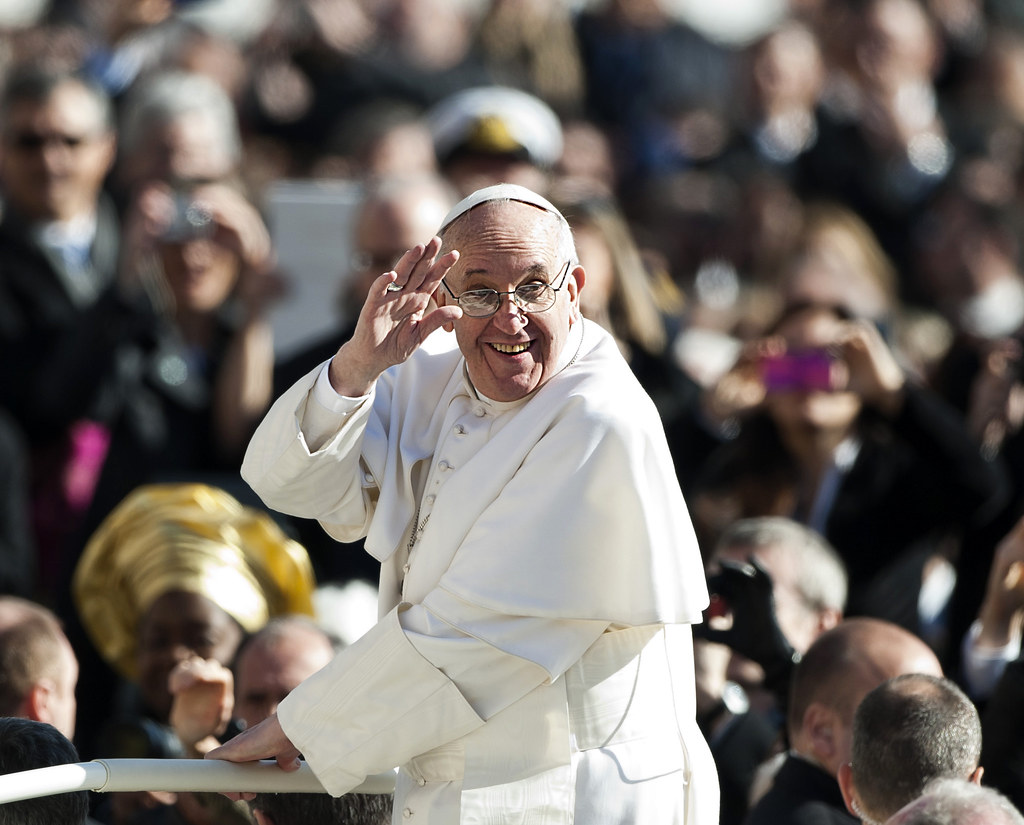
Photo: “The Inauguration Mass For Pope Francis” by Catholic Church (England and Wales) is licensed under CC BY-NC-SA 2.0.
Political poem: Leonard Cohen, ‘Democracy’

It’s coming through a hole in the air
From those nights in Tiananmen Square
It’s coming from the feel
That it ain’t exactly real
Or it’s real, but it ain’t exactly there;
From the war against disorder
From the sirens night and day
From the fires of the homeless
From the ashes of the gay
Democracy is coming to the U.S.A.

It’s coming through a crack in the wall
On a visionary flood of alcohol
From the staggering account
Of the Sermon on the Mount
Which I don’t pretend to understand at all;
It’s coming from the silence
On the dock of the bay
From the brave, the bold, the battered
Heart of Chevrolet
Democracy is coming to the U.S.A

It’s coming from the sorrow in the street
The holy places where the races meet
From the homicidal bitchin’
That goes down in every kitchen
To determine who will serve and who will eat;
From the wells of disappointment
Where the women kneel to pray
For the grace of God in the desert here
And the desert far away
Democracy is coming to the U.S.A.

Sail on, sail on
O mighty ship of state!
To the shores of need
Past the reefs of greed
Through the squalls of hate
Sail on, sail on, sail on…

It’s coming to America first
The cradle of the best and of the worst
It’s here they got the range
And the machinery for change
And it’s here they got the spiritual thirst;
It’s here the family’s broken
And it’s here the lonely say
That the heart has got to open
In a fundamental way
Democracy is coming to the U.S.A.

It’s coming from the women and the men
Oh baby, we’ll be making love again
We’ll be going down so deep
The river’s going to weep
And the mountain’s going to shout Amen!
It’s coming like the tidal flood
Beneath the lunar sway
Imperial, mysterious
In amorous array
Democracy is coming to the U.S.A.

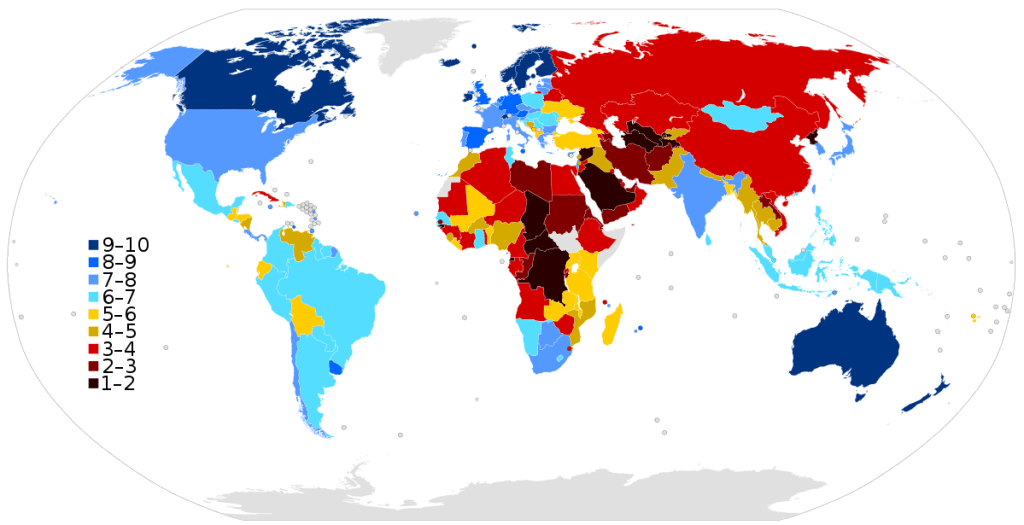
The United States is a “flawed democracy” (as defined by The Economist Intelligence Unit, see below). “Democracy” was written by the Canadian poet/singer/novelist Leonard Cohen over three years in the early 1990s. The song as we have it was boiled down from some 60 verses, scattered through seven or eight notebooks. In his book “Songwriters On Songwriting” he explains, “This was when the Berlin Wall came down and everyone was saying democracy is coming to the east. And I was like that gloomy fellow who always turns up at a party to ruin the orgy or something. And I said, ‘I don’t think it’s going to happen that way. I don’t think this is such a good idea. I think a lot of suffering will be the consequence of this wall coming down.'”

There are so many strong lines in this poem that, although written 30 years ago, resonate today. I particularly like

It’s coming from the sorrow in the street
The holy places where the races meet

and the mention of America as

The cradle of the best and of the worst

as well as the timeless, human dynamic of

From the homicidal bitchin’
That goes down in every kitchen
To determine who will serve and who will eat;

Photo: A map of the world showing the results of The Economist’s Democracy Index survey for 2016. This file is licensed under the Creative Commons Attribution-Share Alike 4.0 International license. The USA has been stuck in the third tier for the past few years, scoring below 8 on a 10-point scale. Those in the first tier, scoring above 9, are the five Nordic countries plus New Zealand, Australia, Ireland, Canada, Switzerland and the Netherlands.

Note that almost all of the top tier countries use some form of Proportional Representation (PR) to elect their governments. Several of their parliaments include parties with Trump-style xenophobic parties, because it is important to include representatives of all opinions in a democracy. But with PR the most extreme parties of right and left are unlikely to be included in a government, let alone dominate it. With PR the parliament gets the benefit of hearing all concerns and points of view, and the voters get the opportunity to vote more closely for who they want: a choice of libertarian, fundamentalist, green communist, as well as more mainstream conservative, liberal or social democrat. Voter turnout is naturally higher than in a two-party system which fails to address the interests of a large percentage of the population.

Other points that can be made from looking at the truest democracies: 1) Unicameral structures score best, meaning the US could have just the House, no Senate. 2) There is no need for separation of the Executive and Legislative functions; separating them doesn’t provide any benefit, despite the holy mantra of “checks and balances”, it merely destroys efficiency and obfuscates responsibility and encourages confrontation. 3) The Judiciary should not be appointed by the government, it functions best if it is developed with true independence within its own legal system.

The American system is an interesting historical artifact, but long outdated and highly counterproductive to good government. When Americans have written new constitutions for countries that they have taken over, the results have not been good. They should let the Scandinavians do it.

I recommend watching the Danish TV series ‘Borgen‘ (it has English subtitles) for a practical view of a single-chamber, multiparty system of coalition government.

Poetry Resources: The Economist’s ‘Johnson’ blog

You may be surprised to hear of The Economist magazine as a poetry resource, but it is a much wider-ranging weekly than most people realise. Start from the back with its chosen Obituary (eccentric and eclectic, it has included Alex the African Grey parrot, writers such as Ray Bradbury written up in their own style, and dictators, deposed kings, and UFO abductees). Move forwards into the Books and Arts section, further into Science and Technology… there’s a lot there, before you get to the finance, business and politics that is the purpose of it all.

Apart from the half dozen book reviews (eccentric and eclectic, of course), the weekly ‘Johnson’ column or blog post covers all things word and language related. The current edition’s Johnson is headed ‘Degrees of Separation’ in the print edition, while online it calls itself ‘Words, like people, have tangled and extensive family trees – surprising connections emerge if you look back far enough’.


The article is focused on Proto-Indo-European’s development into the whole range of modern languages from Gaelic to Bengali; how different the origins may be of words that have identical spelling and pronunciation and have apparently related meaning (a pawn and to pawn); and the surprising common ancestry of apparently unrelated words (such as ‘divine’ and both halves of the word ‘Tuesday’).

Inasmuch as writing relies for much of its power on the richness of words and their ripples of meaning, association and derivation, The Economist’s Johnson column is a worthwhile and engaging weekly read for all writers, and especially poets.

Poetry Resources: Rat’s Ass Review

Rat’s Ass Review, as you can guess from its name, is one of those in-your-face Rat's Ass Reviewpublications where a poet can place material that some of the more delicate magazines would blush to read. Edited by Roderick (“Rick”) Bates since 2014, and by founder David M. Harris before that, it is defined by the editor as “an online poetry journal whose editorial fancies are no more arbitrary than any other; they are simply more overtly so. I publish what I like.”

Rick, and David before him, are refreshingly open about their prejudices and preferences in the very long, useful and thought-provoking Submission Guidelines page. “There’s only one editor here, one person whose taste determines what gets into the RAR, and if you don’t like my taste, I don’t give a rat’s ass. Go someplace else for your poetry dose. (I don’t really think that makes me different from all the millions of others with online poetry zines, but I’m willing to admit it.) Send me your best poetry. I don’t particularly care whether it’s formal or informal, metrical or free verse, rhyming or not. I’ve written all those possibilities myself. A good poem isn’t one that gets the grades for following particular rules. And I’m sure I’ll reject plenty of good poems anyway. I’m not even sure I’m looking for good poems. I’m looking for my kind of poems.

So RAR is clearly formal-friendly… but formal isn’t good enough in itself, no matter how technically accomplished. The poem has both to be immediately accessible, and to provide deeper thoughts on rereading. It has to appeal the editor, whose idiosyncrasies you can only guess at. The best thing to do, of course, is to read through a couple of issues of the magazine. Apart from the two regular issues a year, there have been other unique ones: “Love and Ensuing Madness” and, given the current state of society and politics in the US, “Such an Ugly Time“. So there’s a clue to what the editor is looking for! The magazine boasts of its brash good humour and world-weary cynicism. And the word “fuck” appears as casually here as it does in British material like The Economist or John Oliver’s rants.

Detailed technical submission requests include “type your poems using Times or Times New Roman, font size 12, left justified, and don’t capitalize the first word of every line as though you were writing with a quill pen.

And the most helpful piece of advice for anyone unsure whether their material will be appreciated or accepted is simply this: “Go ahead and Submit.”