Tag Archives: women's lives

Sonnet: Meredith Bergmann, ‘Public Art’

A girl, eleven, racing down the street
(who might be an imaginary daughter)
pulled by her Lab (a female?) plants her feet
before a statue whose bronze skirt has caught her
big dog’s attention.
Works of art command
our gaze, on average, for three seconds. Thought
or feeling must work quickly. We can’t stand
like statues—life is taxed and overwrought.
She doesn’t have her gadget, so she scans
the stone: “Remember”, “Deepen” and “Surpass.”
Her dog is eager for a fresher scent.
The sculptures, though, are asking if she can
imagine she might wield these words. It’s fast.
This is the moment of the monument.

*****

‘Public Art’ was originally published in The Sonneteer.

Meredith Bergmann is an award-winning sculptor whose public monuments can be seen in New York, Boston and beyond. Her Women’s Rights Pioneers Monument was unveiled in Central Park in August 2020, and she recently unveiled a monument for the historic center of Lexington, MA. Her many poetry publications include Barrow Street, Connecticut River Review, Contemporary Poetry Review, Hopkins Review, Hudson Review, LightMezzo Cammin, New CriterionNew Verse Review, Tri Quarterly Review and the anthologies Hot Sonnets, Love Affairs at the Villa NelleAlongside We Travel: Contemporary Poets on Autism, Powow River Poets Anthology II, and the forthcomingThe Country in the Mirror: Poems of Protest and Witness. She was poetry editor of American Arts Quarterly from 2006-2017. She has won three honorable mentions from the Frost Farm Poetry Prize, and in 2020, a 2nd prize from the Connecticut Poetry Club. Her chapbook A Special Education is available online from Bainbridge Island Press, and The Dying Flush, with poetry and illustrations by Bergmann, 2024 is available from EXOT Books.

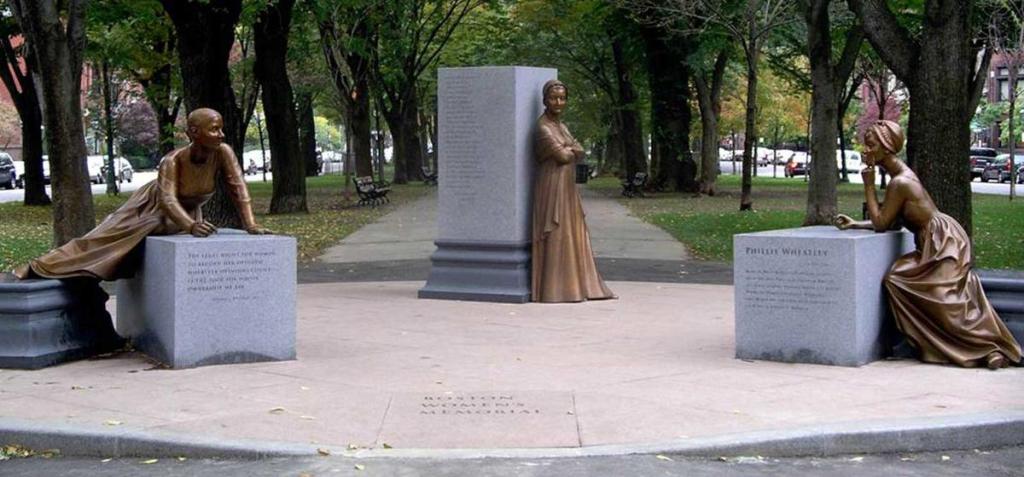
Photo of Boston Women’s Memorial, Meredith Bergmann, 2003, from City of Boston
Using form: Ballade variant: Barbara K. Loots, ‘Opera: a Ballade’

Sometimes the heroine is just a girl,
an innocent set up to be betrayed.
Whether she loves a hero or a churl,
she’ll face a three- or four-hour escapade
in which her feelings and her fate are swayed
by charm, by force, deception, or disguise
she’s helpless to resist or to evade.
And then she dies.

Sometimes around the heroine unfurl
fate’s sinister entrapments. Undismayed,
she feels the storm of accusation swirl
and knows the price of honor must be paid.
Beset by Powers That Must Be Obeyed,
she suffers while the chorus vilifies.
Her hopes of justice and redemption fade.
And then she dies.

Sometimes the heroine, a perfect pearl,
whether a princess or a village maid,
regardless of her protest or demurral,
becomes the object of an evil trade,
a bloody game, a sinister charade,
with hidden motives and transparent lies,
with clash of insult and with flashing blade.
And then she dies.

Through every lamentation and tirade,
each heroine embraces her demise
despite how fervently she might have prayed.
And then…

*****

First published in Light with the note “After watching 33 free streamed operas from the MET during quarantine.” Barbara Loots writes: “Watching those gorgeous productions from the MET day after day during COVID confinement was a saving grace. I have a journal with a complete list, where I starred the ones I liked best for future reference. Kansas City’s excellent Lyric Opera recording of the brand new opera “The Shining” (yes, based on the horror story by Stephen King) recently won a Grammy.”

Barbara Loots resides with her husband, Bill Dickinson, and their boss Bob the Cat in the historic Hyde Park neighborhood of Kansas City, Missouri. Her poems have appeared in literary magazines, anthologies, and textbooks since the 1970s. She is a frequent contributor to Light. Her three collections are Road Trip (2014), Windshift (2018), and The Beekeeper and other love poems (2020), at Kelsay Books or Amazon. More bio and blog at barbaraloots.com

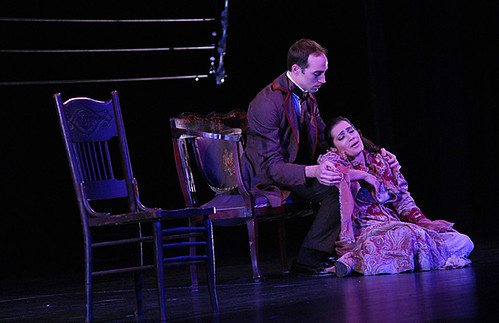
Photo: “This picture makes me happy” by James Jordan is licensed under CC BY-ND 2.0.