Tag Archives: Zach Weinersmith

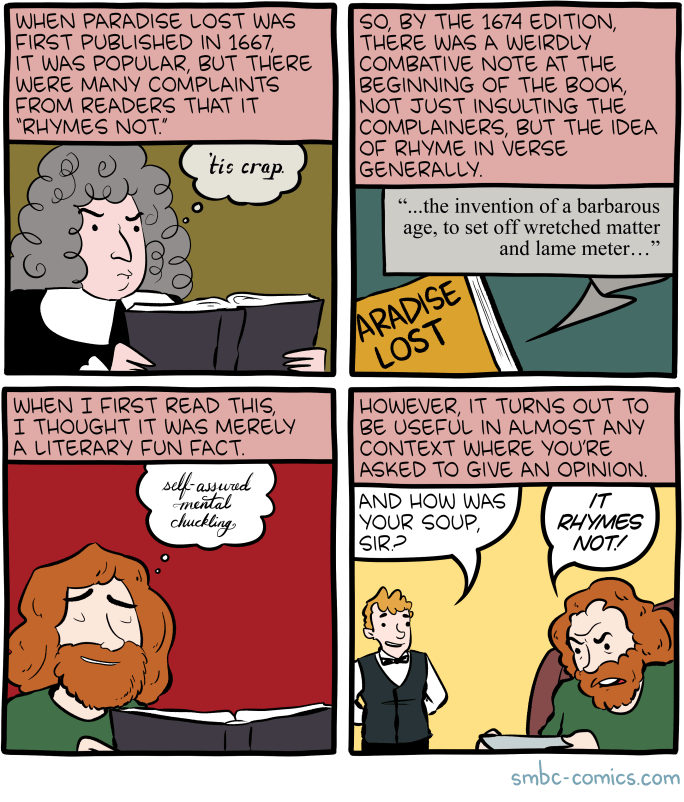
Opinion: ‘Rhymes’ by Zach Weinersmith

John Milton was perfectly capable of expressing himself in rhyme, as in his Petrarchan sonnet on his blindness, When I Consider How My Light Is Spent. Paradise Lost attracted a lot of criticism for its boring lack of rhyme (as well as a lot of unthinking religious approval for its wretched matter). At the front of the second edition of his Paradise Lost in 1674, John Milton defends his books-long use of blank verse:

“The measure is English heroic verse without rime, as that of Homer in Greek, and of Virgil in Latin—rime being no necessary adjunct or true ornament of poem or good verse, in longer works especially, but the invention of a barbarous age, to set off wretched matter and lame metre; graced indeed since by the use of some famous modern poets, carried away by custom, but much to their own vexation, hindrance, and constraint to express many things otherwise, and for the most part worse, than else they would have expressed them. Not without cause therefore some both Italian and Spanish poets of prime note have rejected rime both in longer and shorter works, as have also long since our best English tragedies, as a thing of itself, to all judicious ears, trivial and of no true musical delight; which consists only in apt numbers, fit quantity of syllables, and the sense variously drawn out from one verse into another, not in the jingling sound of like endings—a fault avoided by the learned ancients both in poetry and all good oratory. This neglect then of rime so little is to be taken for a defect, though it may seem so perhaps to vulgar readers, that it rather is to be esteemed an example set, the first in English, of ancient liberty recovered to heroic poem from the troublesome and modern bondage of riming.”

Tell that to Geoffrey Chaucer; his Canterbury Tales is longer, rhymed, more varied and more engaging. As Samuel Johnson wrote, “Milton formed his scheme of versification by the poets of Greece and Rome, whom he proposed to himself for his models so far as the difference of his language from theirs would permit the imitation.” And that’s the problem: Greek and Latin poems are simply not appropriate models for a Germanic language’s poetry.

One of the benefits of rhyme is that it prevents a writer from rambling on fluffily and indefinitely, the way anyone capable of writing blank verse can do. Indeed, when you look at a modern poet’s recent collection you are likely to see short, tight half-page pieces that rhyme, and longer, looser multi-page pieces that don’t. I invariably prefer the former. I find them more enjoyable to read, more succinctly expressed, easier to appreciate, more fun to remember and quote. The others are just lazy, uninspired fillers, or politico-religious pamphlets where zeal has replaced poetry… cf. Paradise Lost.

Illustration: ‘Rhymes‘ by Zach Weinersmith, who publishes a Saturday Morning Breakfast Comics (or SMBC) cartoon daily. He is the author of several brilliant and provocative books, including the previously reviewed ‘Shakespeare’s Sonnets: Abridged Beyond the Point of Usefulness‘.
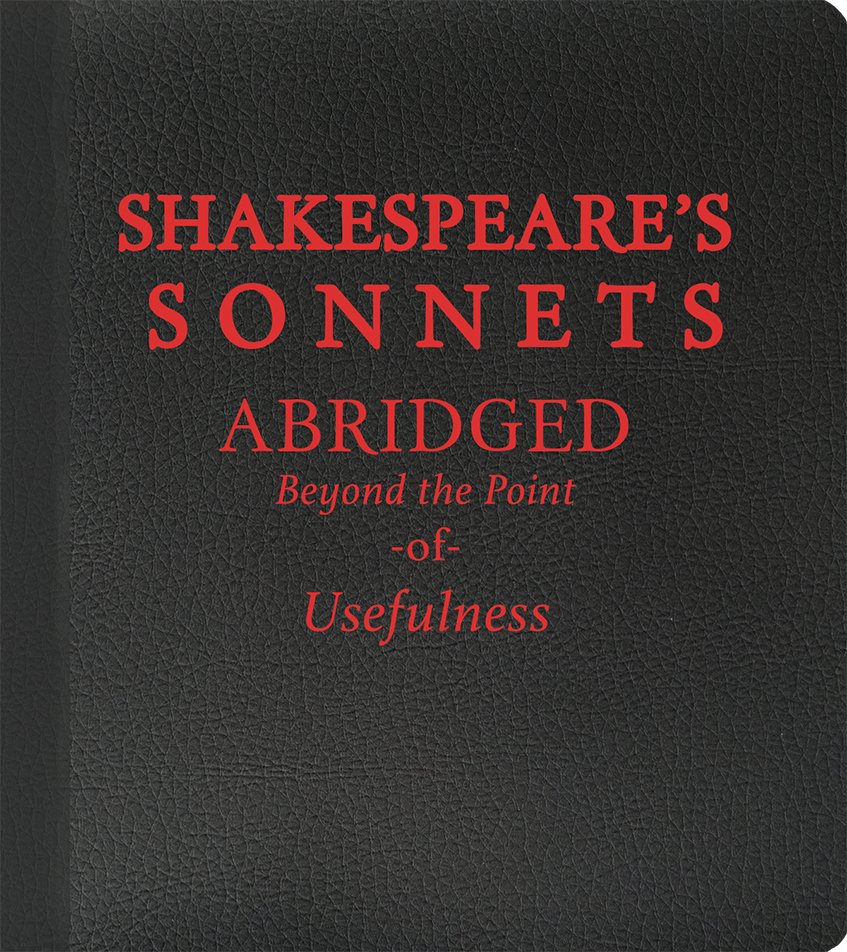
Review: “Shakespeare’s Sonnets: Abridged Beyond the Point of Usefulness” by Zach Weinersmith

Shakespeare's sonnets

Zach Weinersmith is best known as the creator of Saturday Morning Breakfast Comics, a daily comic of random existentialism, religion, robots, sex, etc. As a gift to people self-isolating or otherwise inconvenienced in a time of Covid-19, he is making eight of his books available free as PDFs. I chose one for its intriguing title, and discovered the most amazing piece of literature, more offbeat-creative than anything I’ve read recently: “Shakespeare’s Sonnets, Abridged Beyond the Point of Usefulness“.

What he has done is abridge each of Shakespeare’s 154 sonnets from its rhymed pentameters into a rhymed couplet, abridging the pentameters into tetrameters. (And sonnet 145 being uniquely written in tetrameter, he naturally reduces to trimeter.) For a taste of this, consider Sonnet 18:

Shall I compare thee to a summer’s day?
Thou art more lovely and more temperate.
Rough winds do shake the darling buds of May,
And summer’s lease hath all too short a date.
Sometime too hot the eye of heaven shines,
And often is his gold complexion dimmed;
And every fair from fair sometime declines,
By chance, or nature’s changing course, untrimmed;
But thy eternal summer shall not fade,
Nor lose possession of that fair thou ow’st,
Nor shall death brag thou wand’rest in his shade,
When in eternal lines to Time thou grow’st.
So long as men can breathe, or eyes can see,
So long lives this, and this gives life to thee.

Under Weinersmith’s treatment, it becomes

Summer’s bad, then dies. You won’t.
(OK, you will, but poems don’t.)

But cutting through to the simple essence of the poem without any of that unnecessary flowery stuff is only part of what he has achieved: the greater gift is that in radically abridging the poems, Weinersmith allows the entire series to be seen as a connected series of comments, almost diary entries, in Shakespeare’s relationship first with the so-called “Fair Youth” (the first 126 sonnets) and then the “Dark Lady” (the last 28).

As Weinersmith points out in his brief but enormously enlightening introduction,

‘the term “Fair Youth” is not present in the sonnets, but is something of a euphemism designed to, as poet Don Paterson writes in Reading Shakespeare’s Sonnets , “[keep] everything just on the right side of sodomy”.

After the initial 126 poems, we encounter the 28 “Dark Lady” sonnets. These contend with an unattractive, bad-smelling, yet surprisingly popular married woman whom Shakespeare nags until she sleeps with him. Most of the poems that follow this consummation concern how Shakespeare hates himself for having sex with her. Remember this next time you receive these as a Valentine’s gift.’

Weinersmith lays out the whole flow of Shakespeare’s relationship with the Fair Youth, and the relationship of both of them with the Dark Lady… You will never think of Shakespeare the same again. Read Weinersmith’s introduction, then blast through his couplets. You may, like me, find yourself needing to work your way through the damn sonnets themselves, and see them for the first time as they truly are.