Monthly Archives: October 2023

Using form: Accentual Metre: Susan McLean, ‘Stone’

Offered bread,
I asked for a stone.
The stone was good,
but I ate alone.

I took my bows
in a hail of rocks,
and built my house
of stumbling blocks.

But its walls are aligned
so true and tight
that they keep out the wind
that blows all night.

*****

Susan McLean writes: “And when the tempter came to him, he said, If thou be the Son of God, command that these stones be made bread.” Matthew 4:3 (King James Version)
“Or what man is there of you, whom if his son ask bread, will he give him a stone?” Matthew 7:9 (King James Version)

“I am not a religious believer, nor have I been one for many decades. But the poetry of the Old Testament and the metaphorical language of the New Testament both left their mark on me. Paradoxes and counterintuitive arguments, so integral to parables, are also at the core of poetry. Bread and stones—what does it mean to refuse the former in favor of the latter? To reject the normal and necessary, while choosing the impossible and unsustaining, can only lead to being misunderstood and rejected oneself, possibly even persecuted. Yet in this poem I argue that, paradoxically, taking the hard and lonely path has its own rewards. A stumbling block is solid; with a sufficient number of them, one can build a shelter that can withstand the strongest winds.
“The slant rhymes in lines 1 and 3 of each stanza, with their hint of dissonance, meet the resolution of the true rhymes in lines 2 and 4. Because dimeter lines, with just two stresses per line, can quickly become monotonous if the lines are too regular, I chose to use accentual meter instead of the more predictable accentual-syllabic meter. Therefore, the number of syllables per line varies from a low of three to a high of six. “This poem, originally published in the online journal The Chimaera, later appeared in my second poetry book, The Whetstone Misses the Knife.”

Susan McLean has two books of poetry, The Best Disguise and The Whetstone Misses the Knife, and one book of translations of Martial, Selected Epigrams. Her poems have appeared in Light, Lighten Up Online, Measure, Able Muse, and elsewhere. She lives in Iowa City, Iowa.
https://www.pw.org/content/susan_mclean

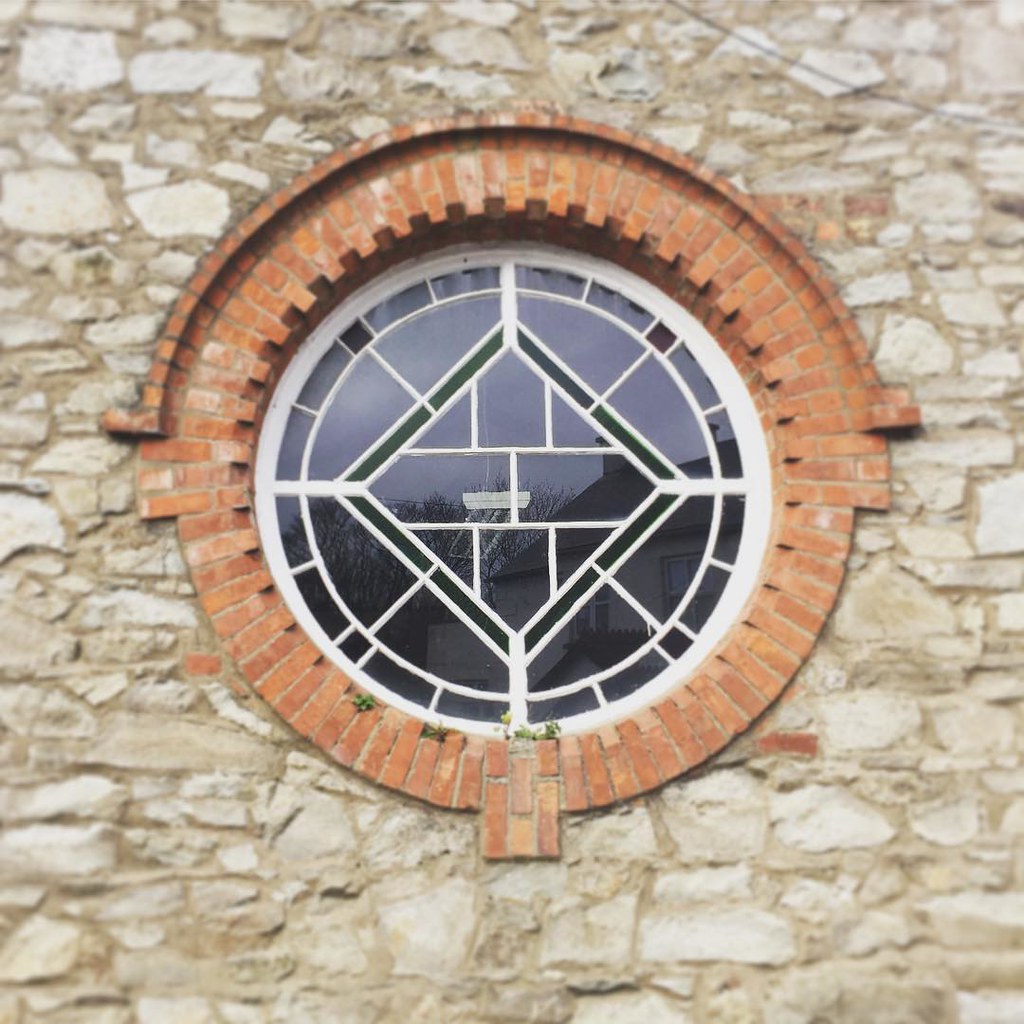
Photo: “Beautiful circular window and rough stone wall on this quaint little former school house in Arklow from the 1800s #windows #arklow #irisharchitecture” by irishhomemagazine is licensed under CC BY-SA 2.0.

NSFW Sonnet: ‘Restaveks’

Illegals, both of us; married last year,
now she cleans houses, I cut grass, sweep decks,
for superrich who see us as mere specks
while their big spaceship exit they prepare.
Earth will be fishless, treeless, plastic, bare.
They’ve offered us both jobs as restaveks,
but I said No, they just want us for sex.
She said Then suck them off, why should you care?
I said, We’ll stay. She said, I said I’d go.
I said, You’d leave me? She said, Stay, be dead.
I said, That makes you nothing but a whore.
She said, I fucked him for your job, you know;
I go to space, I’ll live, have food, have bed,
and, if I’m good, oh maybe so much more…

*****

“Restavek” is normally a term for a child of an impoverished Haitian family, sent to live as a domestic servant for a wealthier (or less poor) family. There are an estimated 300,000 in Haiti, mostly girls; and an unknown number in the Haitian communities in the US.

This sonnet (Petrarchan, rhyming ABBA ABBA CDE CDE) was recently published in the frequently NSFW Rat’s Ass Review – thanks, Roderick Bates!

Illustration: “Tiny Empires 3000” by Daniel Voyager is licensed under CC BY 2.0.

Using form: Sonnet within Sonnet: Daniel Kemper, ‘Her Petrarchan Heart’

a Petrarchan sonnet embedded inside an Elizabethan sonnet

I smile in my Italian heart—but English ways,
against emotions so taboo, require some tact
and so I’m hiding in plain view. My eye still strays.
My nerves are tinder. But the part below this act,
which kindles want, slips through the art I layer on
and now that art is burning too. It’s civil war:
I smother it, but when I do, though flames seem gone,
the smolderings rebel, restart, and billow more.
And yet I’ve learned to love this dance and my disguise
far more than I let on I do. I bait and stare.
I turn demure. It draws you in, intensifies,
and stops. I am not queen by chance. I hold you there:
But if I let you go will you pull through your doubt,
let my Elizabeth stay in…and Petrarch out?

*****

Daniel Kemper writes: “Her Petrarchan Heart is a sonnet within a sonnet, tetrameter within hexameter, to illustrate the real personage inside the speaker.”

Editor’s note: You can indeed read down the poem, line by line, skipping the last four syllables in each line:
I smile in my Italian heart
against emotions so taboo

you will find the rhythm and rhymes easily enough to guide you, and it is a complete poem in itself, the heart sonnet (Petrarchan, rhyming ABBA ABBA CDE CDE) within the speaker sonnet (Shakespearean, rhyming ABAB CDCD EFEF GG).

The poem(s) first appeared in The Society of Classical Poets.

Daniel Kemper is a systems engineer living in California. He writes that his “poetry rebels against the constraints of form, not by destroying it and discarding it, but by turning the tables” in his approach. Only recently emerging into the poetry scene Kemper has already been accepted for publication at thehypertexts.com, The Creativity Webzine, Amethyst Review, Rat’s Ass Review, and Ekphrastic Review. He earned a BA from NC State, and an MBA from University of Phoenix, is currently enrolled in an MA program in Creative Writing at Cal State U, Sacramento, and is working towards being certified to teach community college.

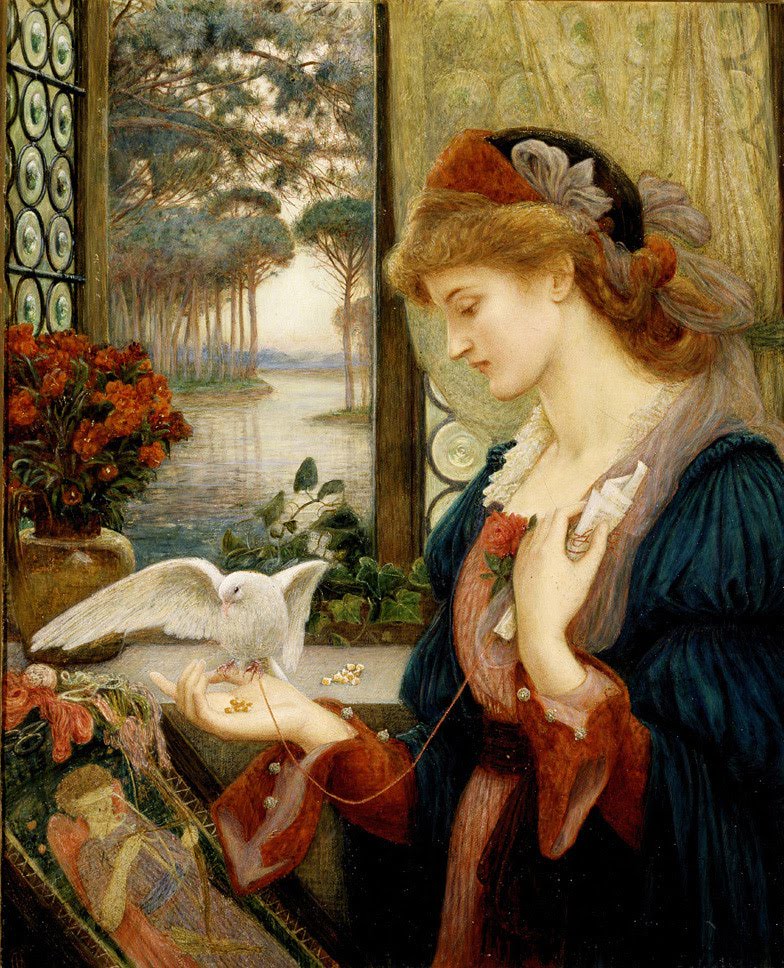
Illustration: “Marie Spartali Stillman – Love’s Messenger [1885]” by Gandalf’s Gallery is licensed under CC BY-NC-SA 2.0.