Tag Archives: Daniel Kemper

Sonnet variation, amphibrachic: Daniel Kemper, ‘Impossible Love’

“Water causes the mind to become.” Pratītyasamutpāda

Impossible love is the spirit of poems escaping
the rhythms, and forms, and the former expressions
of lovers like Shakespeare and Ovid. Reshaping
traditions re-feathers the beds for the sensual sessions
and canopy-shaking delights of The Muse, yet neither
The Lady, so dark and complex, nor Corinna her equal,
nor any persona She dons, entertains the idea of a breather;
instead, with a tumble of laughter, it’s time for a sequel.
Impossible love is eternal renewal; The Muse’s
allure is forever unique, yet the heart of her dances
is primal and deep. The relationship calms and confuses
the poet: the infinite love. But the finite romances.
The union of poet and Muse re-invents and recovers
the poetry born of the love of impossible lovers.

*****

Daniel Kemper writes: “On first read The Muse will likely be understood as “the muse,” IOW, the actual, earthly woman who inspires a poet. The bit about “any persona she dons” will get read as merely “her varied moods” or some such. But there’s a reason for the Buddhist epigram. There’s a reason for capitalizing The Muse. This is The Muse as a spirit, a spirit whose visit inspires and is itself an inspiration who arrives, created (or summoned?) by aspiration.  Writing then, is making love to The Muse, who sometimes inhabits the bodies of mortals, the personae she dons…  Alas, is it possible for spirit and flesh to commingle?

“Clearly this poem is all-in on the classical style, save that it’s a sonnet in amphibrachian meter (x / x). Few poems exist at all in the canon in amphibrachs, but there are some. All sloppy. No sonnets. Few realize that when you read through the end of the line, as generally one should, these become a simple anapestic meter (x x /) like “…[Christ]mas and ALL through the HOUSE not a CREATure was STIRRing not EVen a MOUSE.]

x / x    x / x    x / x    x / x   
becomes
x / x   x /  x   x /  x   x /  x  x /  x  x /  x   x /  x   x / x   

meh. Anyway…        

“PS: There’s a little meta-textual play where the poem talks about “escaping the rhythms and forms and former expressions.” The line is self-referential. This poem, being a sonnet in a meter that no sonnet has yet been written in, is itself “escaping the rhythms and forms and former…”  

‘Impossible Love’ is previously unpublished.

Daniel Kemper, a former tournament-winning wrestler, black belt in traditional Shotokan karate, and infantryman has earned a BA in English, an MCSE (Systems Engineering), an MBA, and an MA in English and had works accepted for publication at more than a dozen magazines, including a pushcart nomination. He’s been an invited presenter at PAMLA 2024 and presided over the Poetics Panel in 2025 and has been the feature poet at several Sacramento venues.

seventh sense” by woodleywonderworks is licensed under CC BY 2.0.

Sonnet variation: Daniel Kemper, ‘No Matter What, You’ve Got To Strut’

 
A courtly, grand, tradition; sure, but men
are men, and poets, poets; so, of course
behind their art is merry mischief, force
of guile, if not just force; but having then
been properly improper once again
with risqué sonnets, sometimes merely coarse
(if richly rhymed), how long must we endorse
these minuets? Will someone shout, A-men!?
 
Step it up and shake a foot, a
hand, a bodice: make it syncopated–
let it, having been elaborated,
settle for a minute.
Strike a pose. Then strut. And put a
little music in it.

*****

Daniel Kemper writes: “No Matter What, You’ve Got To Strut” –Yes, I’m quoting Buddy Love from Eddie Murphie’s version of The Nutty Professor! This, as you can tell from all the meta-textual wordplay (using a rime riche and then naming it [richly rhymed, and on and on]) was a lot of fun to write, but there’s a serious aspect to it as well. I’ve gone hog wild exploring sonnets and meters. This could be considered one of the culminating branches of that.

Sonnets in non-iambic meters:                            trochaic, anapestic, dactylic                                          {sonnet “space” increased by x4}

Sonnets that used more than one meter:

              Four possible meters to mix                                                                                                          {sonnet “space” increased by x64!}

Rule: One meter: one line, no changing within a line, only between them.

Most definitions of sonnets assumed iambic meter and so did not rule out the other meters. Many also implied only one meter throughout, but so long as it’s metrically consistent, it should be considered. Maybe there’s less wiggle room here, but I think I can lawyer it anyway.

Oooh, but then, in tandem with my poetic symphony inventions, I my thoughts ran down two paths at once. Other variations that I could “legally” do and, out of all the possible sonnet types, why are only a few around?

Other variations:

              Vary the line lengths: There are precedents. Shakespeare, #145 (tetrameter); Hopkins, Curtal sonnet (L11 is a half-length line), Spenserian Stanza (not a sonnet) last line is hexameter.

              Vary the rhyme schemes.

                             In multi-sonnet pieces, what effects can be achieved by moving the rhymed lines around a bit?

                            Why some combinations of rhymes and not others (bridge to second path).

So I felt leeway to go hog wild with variations—however, I was bound and determined to be “legal.” (I do not care for the lack of rigor in the thinking that allows “free verse sonnets” and “blank sonnets.”) Since I was starting with tradition, well, I started with tradition… That’s for the first half of [Strut].

I got a coder to help me run some common permutations for 14 lines. If 1.) they must all rhyme and 2.) no more than two consecutive rhymes and 3.) no rhyme is separated by more than two intervening lines, then there are 165,995 possible combinations for a sonnet. Why then do we have about a dozen and a half? Sure people “invent” new ones all the time, but those one-offs die pretty fast.

I arrived at two answers. One is historical. There are only so many poets writing formal poetry over only so many years—and poets actually tend to be conservative in bringing new forms to the canon.  The other is musical. There’s huge stuff here. Too much for this email. Suffice to say, there has to be a melodic contour, a musicality, a beat, a riff, a tension and release—NOT arbitrarily ordered rhymes. How does one define that “musicality”? It’s tough; what differentiates a melody from a random string of tones?

Back to [Strut]. Now you can see how the second half formed up in my mind and why the proliferation of musical terminology, also meta-textual. It is syncopated where it calls for syncopation. The meter before the volta and after are different. The rhyme pattern, btw, remains one of the traditional variations of the Petrarchan Sonnet.

As you look closer, you’ll notice that it’s not irregular; it’s highly structured. Key is that rhyming lines are the same length as each other, though different from others. That keeps the music in it—a kind of predictability despite change, an added degree of recognition. This is the future of the sonnet, the 21st century sonnet, IMO.”

*****

‘No Matter What, You’ve Got To Strut’ was first published in Rat’s Ass Review.

Daniel Kemper, a former tournament-winning wrestler, black belt in traditional Shotokan karate, and infantryman has earned a BA in English, an MCSE (Systems Engineering), an MBA, and an MA in English and had works accepted for publication at more than a dozen magazines, including a pushcart nomination. He’s been an invited presenter at PAMLA 2024 and presided over the Poetics Panel in 2025 and has been the feature poet at several Sacramento venues.

2014 07 05 Street Performer Strikes a Pose” by Jerome Olivier is licensed under CC BY-NC-ND 2.0.

Sonnet: Daniel Kemper, ‘We Talked’

Why the mumbled answers, often feeling
weary, staring out the window: bitter,
wistful, dreamy, harried — always reeling,
not engaging, letting out a titter,
mocking laughs or strange and distant crying?
But eventually she says it’s cancer,
not affairs, not me – then we were trying,
talking even if there was no answer.
But I would have those awful times again:
I whispered her to sleep and once she slept
I stroked her scalp and tucked her sheets, and then
I ran off to the shower and I wept.
We talked. We really talked though it was draining,
as one, about the time that was remaining.

*****

Daniel Kemper writes: “This poem is utterly imagination, perhaps of the “O my prophetic soul” variety. Alexandra (that’s her name) and I were out of contact at the time, but it would have been right as she came down with cancer, if I have my timeline right. It’s a multi-meter sonnet of the kind I thought probably the easiest to which I could introduce people. It starts off in trochaic meter and changes to iambic at the volta. This design choice was to have descending meter for the down mood, and when looking at the bright spot, change to ascending meter. The couplet unifies them via iambic meter plus feminine endings, hopefully that accented the coming together of the two at the end, even if unconsciously.”

‘We Talked’ was originally published in Rat’s Ass Review.

Daniel Kemper, a former tournament-winning wrestler, black belt in traditional Shotokan karate, and infantryman has earned a BA in English, an MCSE (Systems Engineering), an MBA, and an MA in English and had works accepted for publication at more than a dozen magazines, including a pushcart nomination. He’s been an invited presenter at PAMLA 2024 and presided over the Poetics Panel in 2025 and has been the feature poet at several Sacramento venues.

Photo: “Sick Day” by RLHyde is licensed under CC BY-SA 2.0.


Using form: Sonnet within Sonnet: Daniel Kemper, ‘Her Petrarchan Heart’

a Petrarchan sonnet embedded inside an Elizabethan sonnet

I smile in my Italian heart—but English ways,
against emotions so taboo, require some tact
and so I’m hiding in plain view. My eye still strays.
My nerves are tinder. But the part below this act,
which kindles want, slips through the art I layer on
and now that art is burning too. It’s civil war:
I smother it, but when I do, though flames seem gone,
the smolderings rebel, restart, and billow more.
And yet I’ve learned to love this dance and my disguise
far more than I let on I do. I bait and stare.
I turn demure. It draws you in, intensifies,
and stops. I am not queen by chance. I hold you there:
But if I let you go will you pull through your doubt,
let my Elizabeth stay in…and Petrarch out?

*****

Daniel Kemper writes: “Her Petrarchan Heart is a sonnet within a sonnet, tetrameter within hexameter, to illustrate the real personage inside the speaker.”

Editor’s note: You can indeed read down the poem, line by line, skipping the last four syllables in each line:
I smile in my Italian heart
against emotions so taboo

you will find the rhythm and rhymes easily enough to guide you, and it is a complete poem in itself, the heart sonnet (Petrarchan, rhyming ABBA ABBA CDE CDE) within the speaker sonnet (Shakespearean, rhyming ABAB CDCD EFEF GG).

The poem(s) first appeared in The Society of Classical Poets.

Daniel Kemper is a systems engineer living in California. He writes that his “poetry rebels against the constraints of form, not by destroying it and discarding it, but by turning the tables” in his approach. Only recently emerging into the poetry scene Kemper has already been accepted for publication at thehypertexts.com, The Creativity Webzine, Amethyst Review, Rat’s Ass Review, and Ekphrastic Review. He earned a BA from NC State, and an MBA from University of Phoenix, is currently enrolled in an MA program in Creative Writing at Cal State U, Sacramento, and is working towards being certified to teach community college.

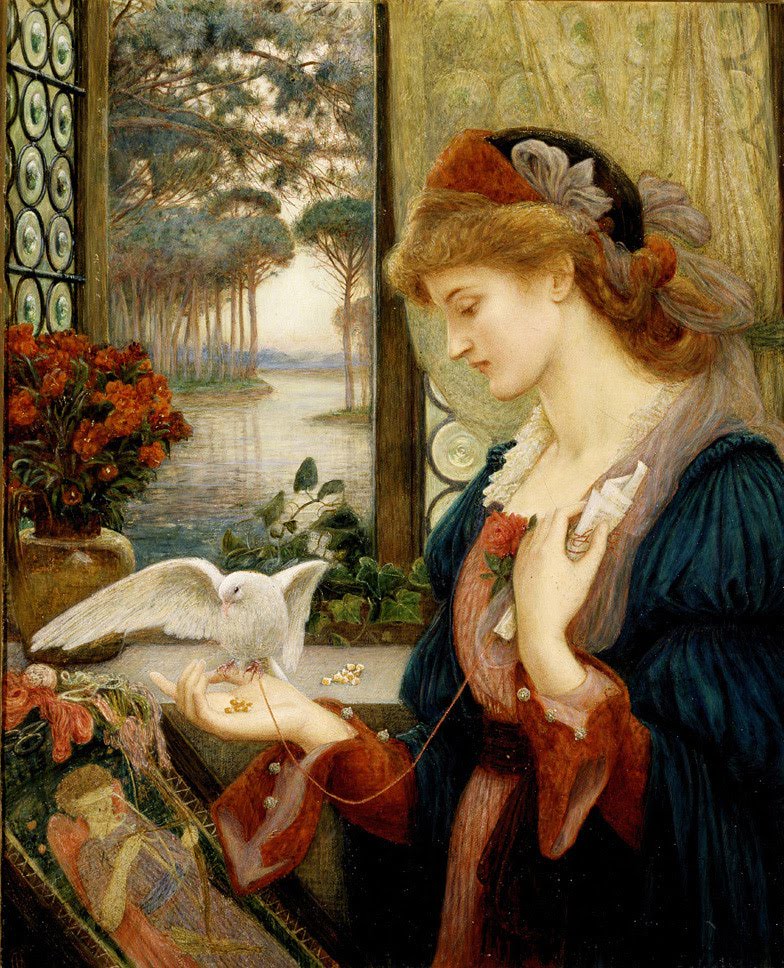
Illustration: “Marie Spartali Stillman – Love’s Messenger [1885]” by Gandalf’s Gallery is licensed under CC BY-NC-SA 2.0.