Monthly Archives: June 2025

Sonnet Crown: Amit Majmudar, ‘Recourse’

1.

Time, like love, is cyclic. Please come back
to me. I’ll stand here waiting, wanting while
the mare without her rider rounds the track.
I want to weave a crown for you, design
a daisy chain whose threaded stems become
a bracelet that handcuffs your wrist to mine.
My shadow’s gnomon tilts like a sun dial’s.
I know you’re somewhere close. I feel a thrum,
a thrill beneath the stillness of the earth,
the way a woman, days before the birth,
places her husband’s hand on the sea swell
that rises out of her and passes through her,
and, touching so much vastness, he can tell
for all their time as one, he never knew her.

2.

For all our time as one, I never knew you—
but doesn’t learning come from repetition?
I’ll do this better if I do it over.
I’ll know your every need by heart, pursue you
like truth. I’ll learn to be a truthful lover.
I’ll circle back to freshman year and woo you.
No song’s recorded in a single session.
No sinner’s shriven after one confession.
It’s time that grows the pearl. Nacre layers
the sand grain, like a secret in the mouth.
Repentance grows, too—grows by daily prayers
into a faith whose trigger seed was doubt.
I am a pearl diver in your depth.
I never left. I just came up for breath.

3.

I never left, I just came up for breath,
but now I am ready to follow you all the way down.
I’ve read we get euphoric as we drown.
Samsara swirls us under. When we break
the whitecaps for an instant, that is death.
Don’t make us wait to be reborn before
we love again. You know me—I’ll just make
the same mistakes. Or make things even worse.
So what if time’s a circle? Doesn’t mean
we have enough of it. The now we’re in
will never come again. So come again
into my life, and love me sight unseen.
We’re both at sea, and no good at dead reckoning.
A burning town’s the only lighthouse beckoning

4.

Our house of light is burning down. It beckons in
the gloaming. The road I’m roaming is a ring.
All time is circular. We’re only seconds in.
All reasoning is circular. I sing
the seasons all the way around the year.
There was a chemist once whose dream disclosed
benzene’s atomic structure. What appeared
before him was a serpent swallowing
its tail—aroma’s O, ouroboros.
I’m wise at last to what the image knows.
I see my answer now, my big mistake.
A ring! Why couldn’t it have been this clear
back then? I see it best when I’m awake.
I’ve circled back. But there is no one here.

5.

I’ve circled back, but there is no one where
the ring road ends. It ends in newfound ruins,
a shell-flecked nest, a rain-worn blade that bears
a message for us. Who can read the runes?
Nietzsche proclaimed the eternal return
and threw his arms around a bleeding horse
to feel the centuries reversing course.
His gooseflesh rose like spores that pock a fern.
Let vultures circle, only widdershins
above the ring road where I wait alone,
knifing in bark a promise of my own.
I know the ring road ends where it begins.
Time is a circle I can put to use:
a wheel to roll things back, a crown, a noose.

6.

A wheel to roll things back, a crown, a noose:
My own Venn diagram of rings to choose
from. Fill its center up with hourglass sand,
and that’s where Archimedes, kneeling, draws.
This is the Roman siege of Syracuse;
he’s hard at work on time, its shape and laws.
He looks up from a boot. A soldier stands
above him, dripping gladius in hand.
Do not disturb my circles, says the Greek.
The soldier studies them, then runs him through—
and so reveals what Archimedes seeks,
the circle, like a circuit, broken, weeks
and months and centuries and aeons spilling
in slow, concentric circles from the killing.

7.

In slow, concentric circles from the still-pink
narcotic kiss print of the cupping glass,
let your memories ripple outward, killing
the pain I’ve caused you. We are not our past,
though time is cyclic. Cycles can be broken,
souls reborn in this life, sleepers woken.
Not that I can sleep beneath this star.
Horizon, magic circle, boxing ring—
time is the space, the spell, the place we spar,
the dome in which your name is echoing.
It’s where I pray the theory into fact
that love, like time, is cyclic. Please come back.

*****

Amit Majmudar writes: “The sonnet crown is a naturally recursive form of forms. The beginning of each sonnet is also an ending, and vice versa. A candle tilts to light a candle that tilts to light a candle, until the occult circle of flame is complete, and the poet sits inside it, meditating the next line, which may well be the line just written.

“This sonnet crown took, as its subject, the tendency of lovers, or at least their memories, to relapse. “Relapse” means to fall back, etymologically. To fall back in love; to fall back out of love. The sonnets enact through form and content alike the recrudescence of the past. The last line of the overall crown matches the first line of the overall crown. The reappearance of the old pain makes it a crown of thorns.

“I wrote this sonnet crown first line to last. I had never even attempted one before, but I relinquished myself to the music-making. I could do that because I circled around a theme–recursion in love–rather than trying to tell a story or present a philosophical argument or any such prosaic thing. Just pure pursuit of the right sounds. This crown came at the end of a sonnet-writing tear so my hand was in practice, as it were.

“Close readers will notice that the crown is imperfect, however. In the final, truncated sonnet, the speaker makes haste to return to the beginning, to break the process of endless recursion. Accordingly, the rhyme word of the line where the deviation begins is “broken”–and it’s there that the formal pattern–the “cycle”–itself is broken. Broken/woken collapses the separated rhyme sounds into a couplet, with a second couplet to conclude the 12-line ending–a couplet of couplets, the original pair formation and the hoped-for repeat pair formation, embodied in the music of the ending that is, at last, a new beginning. “

*****

Amit Majmudar is a poet, novelist, essayist, and translator. He works as a diagnostic nuclear radiologist in Westerville, Ohio, where he lives with his wife and three children. Recent books include Twin A: A Memoir (Slant Books, 2023), The Great Game: Essays on Poetics (Acre Books, 2024), and the hybrid work Three Metamorphoses (Orison Books, 2025). “Recourse” was first published in Plume Poetry, and will be appearing in Majmudar’s forthcoming collection, Things My Grandmother Said, in early 2026. 
More information at www.amitmajmudar.com

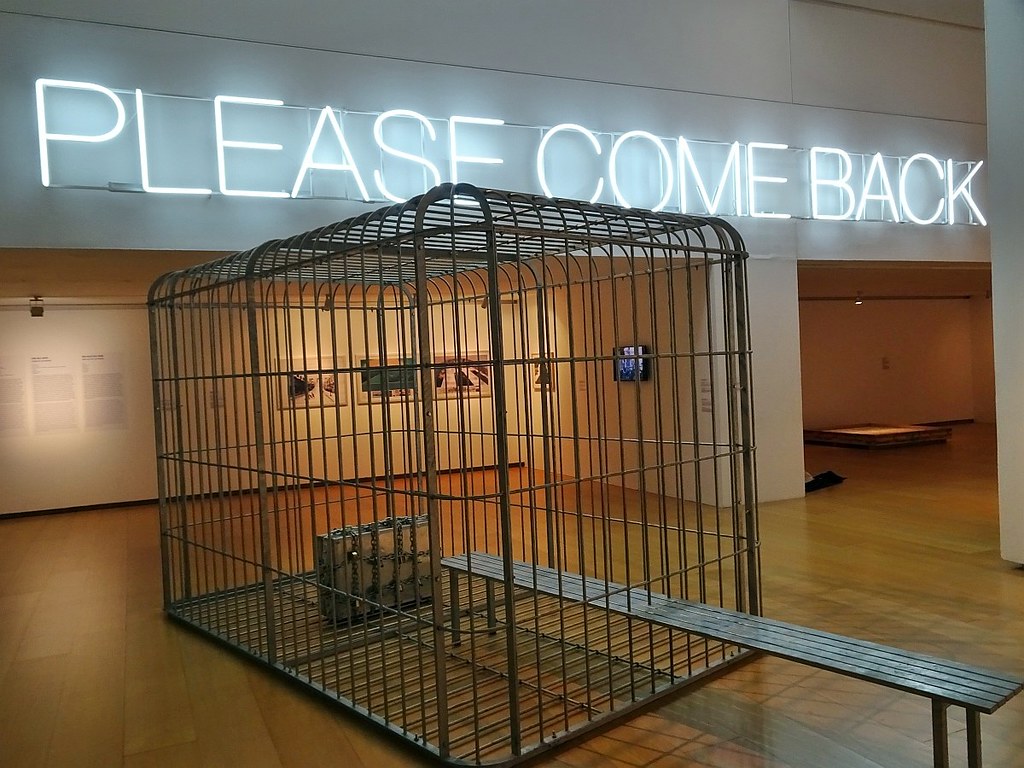
Photo: “0103-IVAM – Please Come Back 05” by gibbix1 is licensed under CC BY-NC 2.0.
Using form: John Gallas, ‘travellin feet: a Camaguey sonnet”

Im walkin in my feet to Camaguey.
The sun comes up. Im cracklin like a chicken …
Takin time
. Now somethins comin, kickin
clouds of yeller grit behind me – Hey!
Stop! … It dont. Who cares? It whirls away.
I seen inside the flyin cotton curtain –
Business sat with Care
. My toes are hurtin …
Whoa, I got to walk another day.
How quick they drive to worry … What I got
the other end improves with evry ache,
an every dusty extra hour I take.
Im good n weary. An Im good n hot.

Whyever hurry? … Happiness will keep …
an sorrow passes – Sleep my baby, sleep.

*****

John Gallas writes: “The Coalville Divan – 100 sonnets – included this one. The 100 are based on Old Persian Proverbs (an ancient 1920 book I found in a junk shop). A heady experience, like being addicted to Rum or something, to enter a period of writing highly formal, all-the-same-form poems. I loved it, and it built on itself as I went along, but I needed something different after the 200 tankas of ‘Billy Nibs’ (Carcanet 2024) and had withdrawal symptoms (wanting to make the tankas rhyme!).
“The proverb for this one was ‘To walk and sit is better than to run and burst’. I set it in Cuba because I’d just been there for a month. I had 2 rhyming dictionaries, 2 thesauruses, atlases, and Wikipedia while I worked on these, each one set in a different country. The challenge, I guess, is to sound accomplished/natural whilst obeying all the rhyme/metrical rules very exactly.”

John Edward Gallas FEA was born in Wellington in New Zealand and is of Austrian descent. He attended the University of Otago in his native New Zealand, and won a Commonwealth Scholarship to Merton College, Oxford to study Medieval English Literature and Old Icelandic and has since lived and worked in York, Liverpool and various other locations in England as a bottlewasher, archaeologist and teacher.

John Gallas’ works are listed at https://www.johngallaspoetry.co.uk/

Photo: “Tired Man Walking” by RobertoCobianchi is licensed under CC BY-NC-SA 2.0.

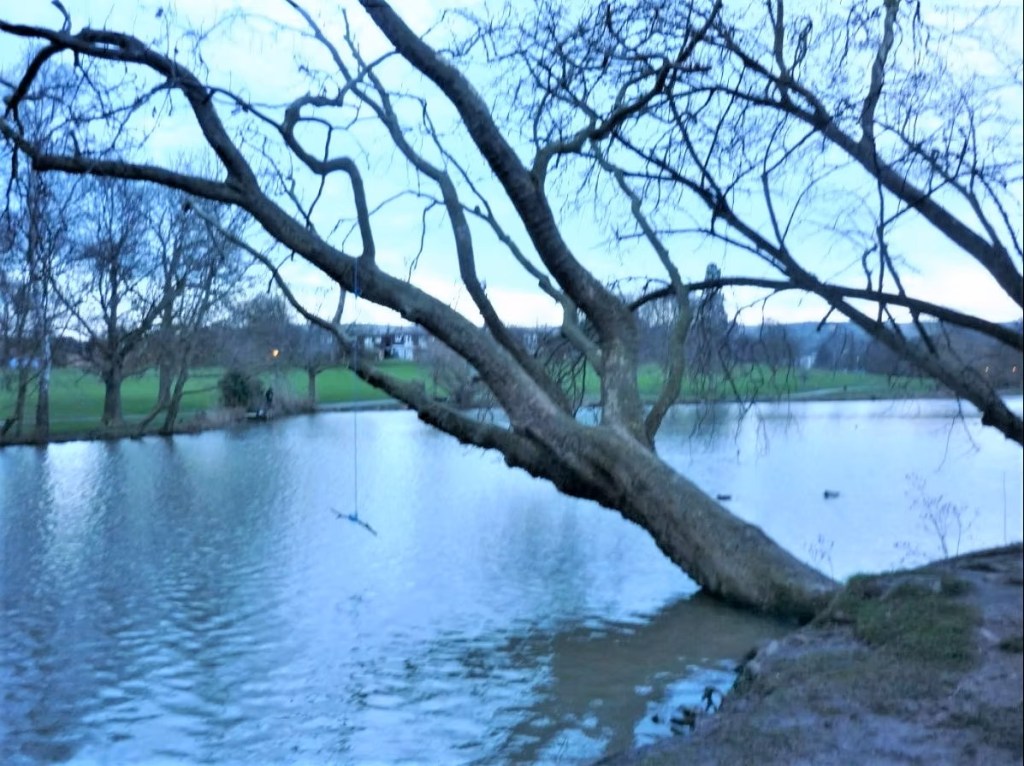
F.F. Teague, ‘Lament of the Leaning Trees’

We were planted to stand, not to sprawl in this way
  by the larger of lakes in the park,
to stare straight at the sky through the night and the day,
  not to ogle our own shades of bark.

But the lake has swelled swampily over the years,
  seizing soil in her cool clammy clench,
with a treasure of twigs-and-grass, sweet chestnut spheres,
  and a hoard of hard wood, once a bench.

How we cling to the earth with our tendrilous toes
  while the lake laps in sinister sheen,
rousing daily and nightly our powerless throes
  as we lean, and we lean, and we lean.

*****

​’Lament of the Leaning Trees’ was first published in The HyperTexts, July 2021​

F.F. Teague writes: “I composed this in January 2021, while recovering from a broken leg and a few complications. A photo of the leaning trees appeared on the Facebook page Pittville Swans & Friends. I hadn’t been out for a while and it was lovely to see the Leaning Trees again. Suddenly I started thinking about being able to leave my flat one day, which made me feel a bit more cheerful about things. When I got out, I took the above photo.
“The trees have been leaning ever since I can remember. I lived in an area of Cheltenham called Fairview, not far from Pittville, for about nine months in 2001 and they were certainly leaning at that point. Every time I visit the park, I half-expect to see at least one tree lying in the water. But they must have very strong roots, because they just keep leaning. The council has removed a few branches over the years yet the shape of the trees remains distinctive.”

Felicity Teague (Fliss) is a copyeditor by day and a poet come nightfall. She lives in Pittville, a suburb of Cheltenham (UK). Her poetry features regularly in the Spotlight of The HyperTexts; her work has also appeared in AmethystLighten Up OnlineNew Verse ReviewSnakeskinThe Dirigible Balloon, and The Ekphrastic Review. Her first collection (2022) is titled From Pittville to Paradise; her second (forthcoming 2025), Interruptus: A Poetry Year. Other interests include art, film, and photography.

Photo by F.F. Teague

Quatrains: D.A. Prince, ‘Weeds’

for Helena Nelson

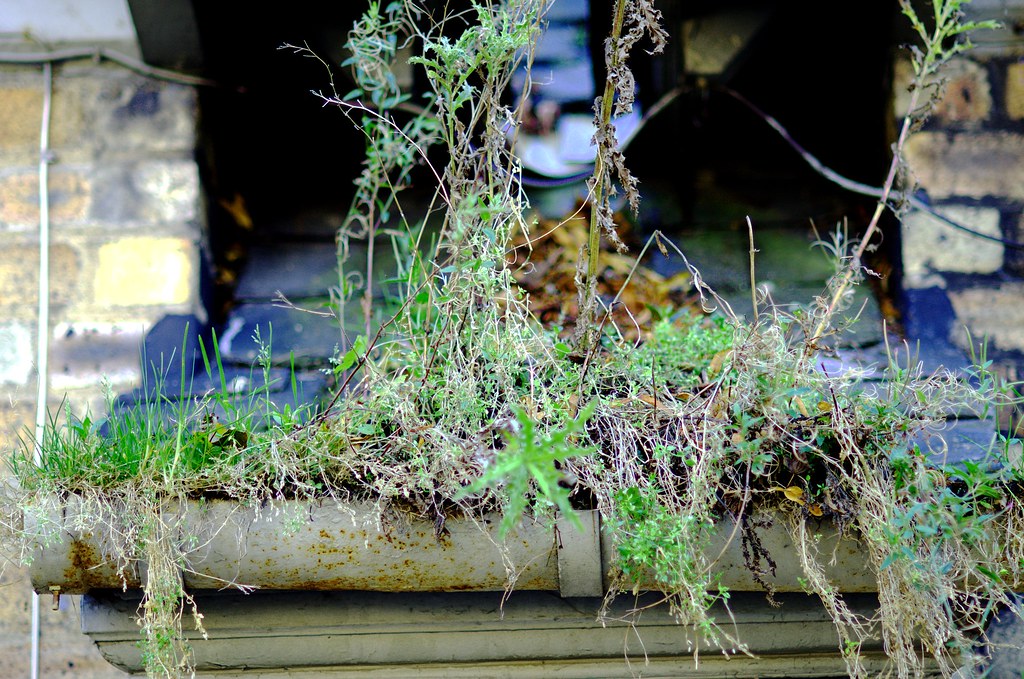
Let’s celebrate those seeded in guttering
high overhead — bird-dropped or wind-blown
in shy, shaded corners, not cluttering
the road-edge like litter or casually sown

on the garden’s margins. Buddleia, birch —
slender and whippy, fretful and restless,
only a small claw-hold on their high perch,
a loose version of themselves in endless

inventive air. No one, much, bothers them,
leaving their roots exploring the secret cracks
between bricks and flashing. Unless a stem
strangles a cable or a branch unpacks

some weathered pointing, troubling it, they’re safe:
every airhead, living only to dance
the delights of lightness, each sinuous waif
born from easy freedom, sun and rain and chance.

*****

D.A. Prince writes: “There’s a tradition of poets printing some of their work privately for circulation to friends. Now that Helena Nelson (aka HappenStance Press) is making more time for her own writing she has created a series of pamphlets about those unregarded — and usually unloved — plants generally dismissed as ‘weeds’, in which each is accorded its own sonnet. Richard Mabey’s Weeds: The Story of Outlaw Plants is the source for the botanical information while she brings a poet’s attention to what makes each one individual. She has sent these pamphlets to friends so, for the moment, only a few of us have seen them.

“I don’t habitually write poems dedicated to named people: this is, I think, the first time I’ve done it but I wanted to respond, as a way of thanking her both for long friendship and for all the poetic ongoings we’ve shared. I asked her, somewhat cautiously, if she’d agree to a dedication, then — later — if she’d agree to the poem appearing in a pamphlet.

“Her poems were sonnets so if I’d written a sonnet it could have looked competitive — and that wasn’t the point. Four quatrains, rhymed, seemed to suit the subject. In its original layout it appeared as a solid sixteen-line block but when we were working on the poems that make up my latest pamphlet (Continuous Present, New Walk Editions, 2025) Nick Everett, my editor, suggested that setting it in quatrains would suit the air and space those rooftop-rooted weeds have around them, and to my mind that’s lifted the poem in a way it needed. 

“As for gardening, I’m now very happy to let the weeds flourish.”

D.A. Prince lives in Leicestershire and London. Her first appearances in print were in the weekly competitions in The Spectator and New Statesman (which ceased its competitions in 2016) along with other outlets that hosted light verse. Something closer to ‘proper’ poetry followed (but running in parallel), with three pamphlets, followed by a full-length collection, Nearly the Happy Hour, from HappenStance Press in 2008. A second collection, Common Ground, (from the same publisher) followed in 2014 and this won the East Midlands Book Award in 2015. HappenStance subsequently published her pamphlet Bookmarks in 2018, with a further full-length collection, The Bigger Picture, published in 2022. New Walk Editions published her latest pamphlet, Continuous Present, in 2025.

*****

Photo: “guttered” by bigbahookie is licensed under CC BY-NC-ND 2.0.

Sonnet: J.D. Smith, ‘Behind the Epic’


The people’s greatest men go forth for years
By land or sea, depending on the foe,
Arrayed with shining swords, shields, helmets, spears
And dazzling banners raised again to show
 
Who holds dominion over flocks and fields,
Who levies tribute and is far renowned
For showing mercy to the town that yields,
That isn’t burned or leveled to the ground.
 
The singer of the tribe, near-sighted, lame,
Stays with the women and shares in their chores
Until he’s asked to lend a lasting fame
To heroes’ actions in their latest wars.
 
A traveler who visits on a whim
Might note how many children look like him.

*****

J.D. Smith writes: “This poem is rooted perhaps as much in popular culture as in the long narratives of the past. Readers of a certain age will recognize the title as a variation on the VH-1 series Behind the Music, which documented the frequently seamy and hedonistic underside of bands’ and artists’ careers. I am also having a bit of fun with highly gendered work roles; this consideration strikes me as increasingly relevant given the rise and metastasis of the “manosphere” and its conflation of masculinity and predation. As for the final couplet, somewhere in the back of my mind was a running gag from King of the Hill. Hank Hill’s friend Dale, while obsessed with conspiracy theories, never quite figures out why his son bears a more than passing resemblance to another character on the program.”

J.D. Smith’s seventh collection of poetry, The Place That Is Coming to Us, will be published in September by Broadstone Books. His first fiction collection, Transit, is available from Unsolicited Press. Further information and occasional updates are available at www.jdsmithwriter.com.

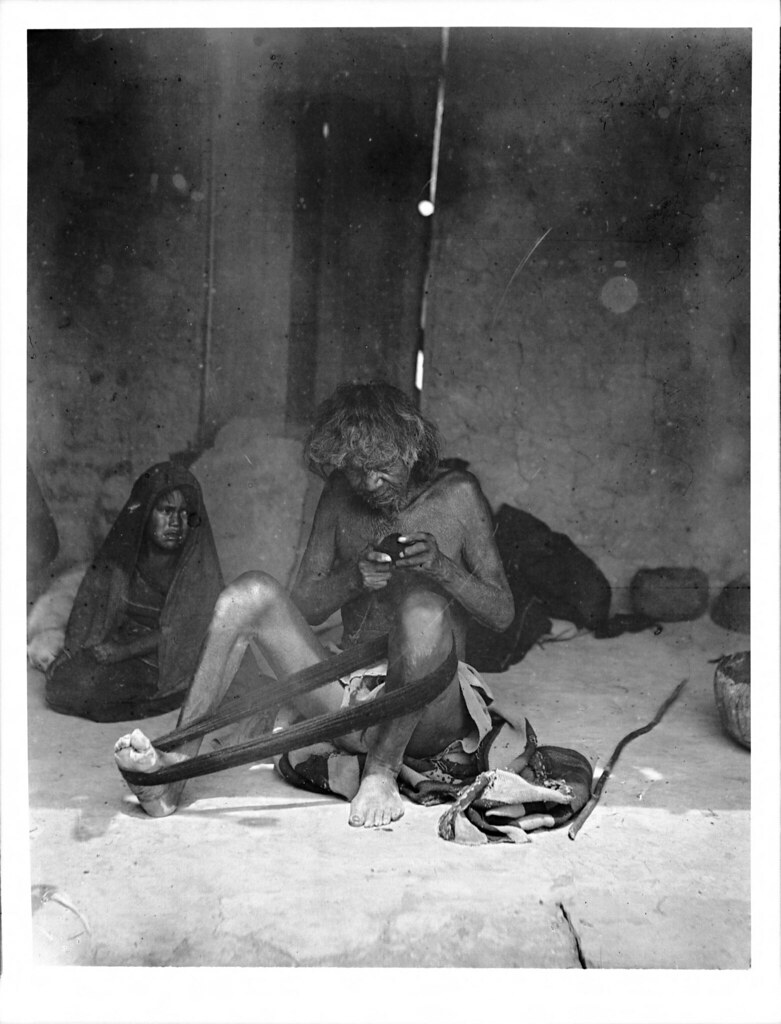
Photo: “Old blind man winding yarn with a young girl watching, Arizona, ca.1898 (CHS-4572)” by  is licensed under CC BY 2.0.

Semi-formal quatrains: Rachel Hadas, ‘Roadblock’

Call me the bee buzzing in the museum.
The younger sister fussing through a house
still stiff with loss.
The meddling goblin in the mausoleum.

My dream: with three in the front seat, we drive
under a bridge and halt. A huge gray bus
blocks the whole road, including us,
the only travelers who are left alive.

It’s drizzling; the windshield wiper blades
busily gesture, yet we’re nearly blind.
You two seem not to mind
blank windows, pulled-down shades.

I mind. I want to get out and explore,
to move around
the deathly obstacle. “Don’t make a sound,”
you say. (Who are you?) “Don’t go near that door.”

Our mountain drive last month—that wasn’t dreamed.
We three again. We ran a dog down. I
alone looked back, alone let out a cry.
I saw it lying in its blood and screamed.

So tell me what these images portend.
Am I a noisy bird of evil omen
or just a person, apprehensive, human,
moving ahead, kid sister into woman,

stonewalled by death each time she rounds a bend?

*****

Rachel Hadas writes: ” ‘Roadblock’ is an older poem, inspired by a visit to my sister and her then husband  years ago.  Our drive, and running over the dog really happened, as did the dream…but which came first?  And another question: would I have remembered either the car accident or the dream had I not written them into a poem?  Dreams still figure often in my poems.  And the fact that I’ll always be a younger sister, while it doesn’t get mentioned all that frequently, is a permanent feature of my consciousness that probably works its way into many of my poems however subliminally. The bee buzzing: my sister once complained that going to a museum with me was like going to a museum with a bee, a comment I’d forgotten until rereading this poem brought it back.  And those “blank windows, pulled-down shades”: doesn’t poetry often strive to pull the shades up?”

‘Roadblock’ is collected in ‘Halfway Down the Hall: New and Selected Poems’ (Wesleyan University Press, 1998)

Rachel Hadas’s recent books include Love and Dread, Pandemic Almanac, and Ghost Guest. Her translations include Euripides’s Iphigenia plays and a portion of Nonnus’s Tales of Dionysus. Professor Emerita at Rutgers-Newark, where she taught for many years, she now teaches at 92Y in New York City and serves as poetry editor of Classical Outlook. Her honors include a Guggenheim fellowship and an award from the American Academy-Institute of Arts and Letters.

Photo: “Bus Crash at Ladprao-Chokchai4” by isriya is licensed under CC BY-NC 2.0.

Sonnet: Barbara Loots, ‘Climbing’

I have begun to narrow down desire.
As though tracing a river to its source
I climb, charting the change higher and higher
from placid meander to the turbulent course
where it began. I have loved much, not well,
collecting worlds to carry on my back.
What shall I leave? The spirits that compel
this climb demand a spare and steady pack.
Leave beauty, wonder. They are everywhere.
Leave hope, and drink from the relentless stream.
Leave knowledge, learn trust in the nimble air
until, suspended by a slender dream,
you seek only to climb, and not to know
where you came from, where you have to go.

*****

Barbara Loots writes: “Climbing is one of my earliest successful sonnets. Over the decades, I have turned to it again and again as life bears out its wisdom.”

After decades of publishing her poems, Barbara Loots has laurels to rest on, but keeps climbing. The recent gathering at Poetry by the Sea in Connecticut inspired fresh enthusiasm. Residing in Kansas City, Missouri, Barbara and her husband Bill Dickinson are pleased to welcome into the household a charming tuxedo kitty named Miss Jane Austen, in honor of the 250th birthday year of that immortal. She has new work coming in The Lyric, in the anthology The Shining Years II, and elsewhere. She serves as the Review editor for Light Poetry Magazine.

Photo: “Himalayian Stream of Life” by Lenny K Photography is licensed under CC BY 2.0.

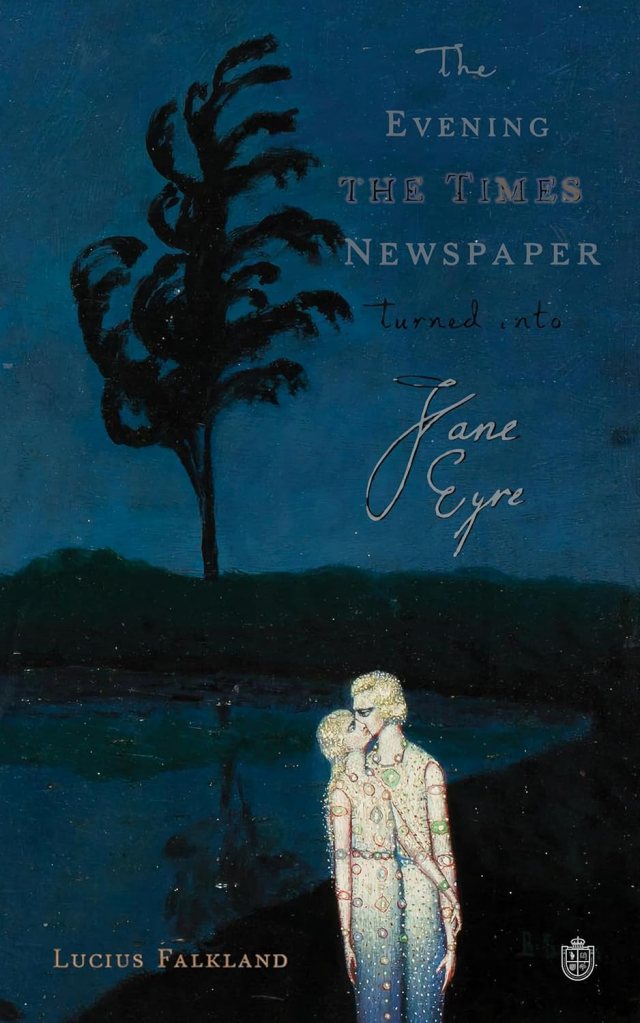
Lucius Falkland, ‘The Evening The Times Newspaper Turned Into Jane Eyre’

My life had become like a broadsheet,
The Telegraph, maybe The Times:
The financial section—prose sober and neat;
Inflation—the yen falls and climbs.
While reading this daily, and ever more jaded,
By boring discussions of wages,
My newspaper tore, the ink quickly faded:
You ripped your way up through the pages.

The suits on the concourse at Waterloo Station
All noticed my joy and my fright.
My Times underwent a divine transformation
Like someone regaining his sight.
You stood by the clock where they waited for trains,
Familiar, reserved, but with flair.
My journal of record? It went up in flames:
In a flash, I was reading Jane Eyre.

My feelings, so dulled by SSRIs
And age with the wealth of a hovel,
Without any warning felt very alive;
I was suddenly part of a novel.
My wife was now Bertha, enraged in the attic,
Your boyfriend was St. John, I guess.
Attraction was instant, inspiring, emphatic:
This burgundy-nailed governess.

The prose promptly altered: transcendent, noetic,
No longer the stark black and white;
Facts, figures, but beauty so very poetic:
A sunset one Thornfield Hall night.
I’m not quite as brooding as him, that I’m sure,
And you’re not as serious or neat.
The Times had become such a hideous bore,
All it took was for us two to meet.

Within half an hour we both felt so certain
But English restraint and control
Meant it took time to say we were clearly one person,
Each making the other one whole.
I’ve accepted my life’s not The Times but Jane Eyre
And in Brontë my future I’ll find.
Let’s hope if this moves beyond an affair
I don’t get myself burnt and go blind.

*****

Lucius Falkland writes: “This poem (first published in The Society of Classical Poets) recalls how my sometime paramour and I first met and very quickly felt that we had encountered ourselves in each other. Due to the large age gap, her friend referred to me as Mr Rochester, from Jane Eyre. This is how we started referring to each other. Her boyfriend also became known as St John thereafter. It also tries to capture the feeling, when you are deeply in love, that life seems fateful and inherently profound, as though you are just a character in a novel written by someone else. The jocular tone attempts to encapsulate the joy and absurdity of the experience.”

Lucius Falkland is the nom de plume of a writer and academic originally from London. His first poetry volume, The Evening The Times Newspaper Turned Into Jane Eyre, was published in 2025 with Exeter House Publishing. It can be purchased here.

Iambic heptameter: Simon MacCulloch, ‘Jasmina’

Jasmina is the doorway, Jasmina is the key;
Jasmina walks the path beside the pearl-infested sea.
The angels peer bewildered from the god-infested sky;
Jasmina is the only how that doesn’t need a why.

I see her in the morning in her robe of melting frost;
She visits me at noontime when the meaning has been lost.
At evening she invades the nooks the spiders thought their own
Till night demands a moon; she stoops, and hurls it like a stone.

I used to think her complicated, now I know she’s not
(A how that doesn’t need a why has little use for what).
I used to think she’d care for me, if only for a while;
I used to think a lot of things before I saw her smile.

I never hear her speaking though I think she has a song
Which many claim to know although they always get it wrong.
She feels like furry gossamer and tastes like perfumed smoke;
I often hear her laughter but I never learn the joke.

Jasmina is a destiny, Jasmina is a doom;
Jasmina is a woman but with stars within her womb.
The demons peer demented from their hope-infested hell
And beg her for a story, but she hasn’t one to tell.

*****

Simon MacCulloch writes: “Jasmina is a slightly offbeat take on the great western goddess motif (Aphrodite, the Virgin Mary etc). It is not based on anyone I know.”

Simon MacCulloch lives in London and contributes poetry to a variety of print and online publications, including Reach Poetry, View from Atlantis, Pulsebeat Poetry Journal, Spectral Realms, Black Petals and others. Jasmina was originally published in Blue Unicorn.

Photo: “mask” by new 1lluminati is licensed under CC BY 2.0.

Susan Jarvis Bryant, ‘Once Upon a Tortured Trope’

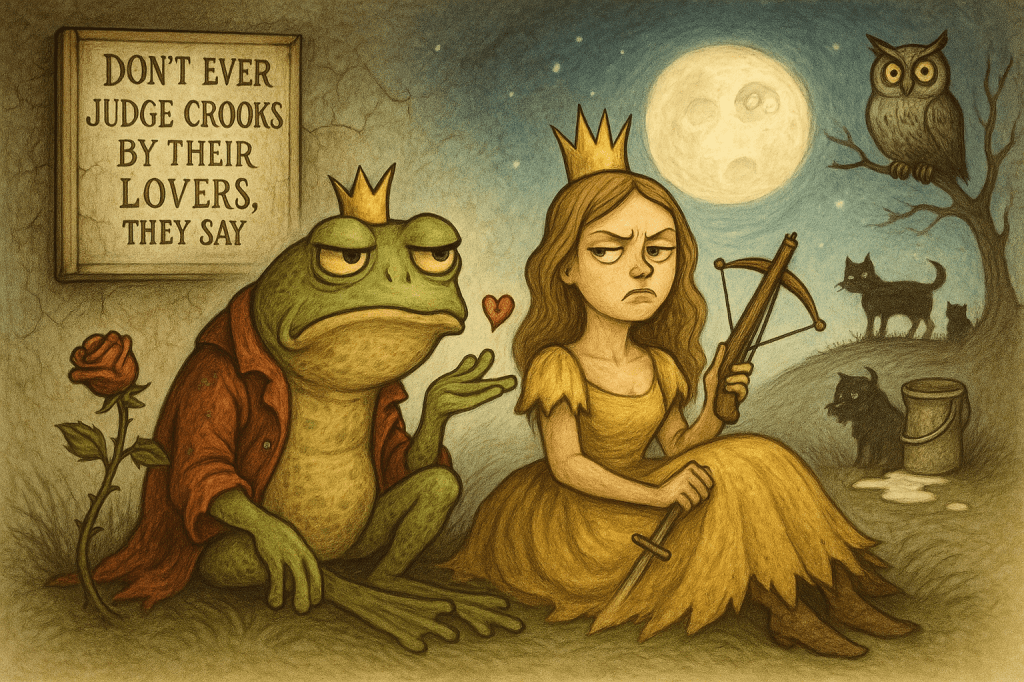
Don’t ever judge crooks by their lovers, they say  
On book covers nailed to the wall.
The frog sends his kiss at the bend of the day
To Belle who is beast of the ball. 

As tough as a cucumber, cool as old boots, 
An untroubled damsel of flair
Is shooting for stars. When the pussy-owl hoots
She snares a short prince with blonde hair. 
  
They sail inky skies on a silver-lined dream
To greener scenes up in the hills.
But honey and moons aren’t as sweet as they seem 
When cats and dogs reign and milk spills.

His rose bears a thorn and his shoulder, a chip. 
Hyenas have stolen his laughter.
All charm hits the skids as she grapples to slip 
The grip of his gripe ever after.

*****

Susan Jarvis Bryant writes: “I really don’t have anything to say about the poem, other than I had huge fun writing it. It’s the same with all of my poems – I never suffer for my art, which makes me reluctant to call myself a poet. I’d like to say I write my poems in a tearstained, whisky-soaked haze while my Muse tangos with the ghost of Dylan Thomas through Welsh valleys, but this is not so.  I just snigger away as the ink flows like a bad comedienne laughing at her own jokes.”

‘Once Upon a Tortured Trope’ was originally published in Snakeskin.

Susan Jarvis Bryant is originally from the U.K. and now lives on the coastal plains of Texas. Susan has poetry published on The Society of Classical Poets, Lighten Up Online, Snakeskin, Light, Sparks of Calliope, and Expansive Poetry Online, The Road Not Taken, and New English Review. She also has poetry published in The Lyric, Trinacria, and Beth Houston’s Extreme Formal Poems and Extreme Sonnets II anthologies. Susan is the winner of the 2020 International SCP Poetry Competition and was nominated for the 2022 and 2024 Pushcart Prize. She has published two books – Elephants Unleashed and Fern Feathered Edges.

Art: AI + RHL