Monthly Archives: September 2025

Sonnet: Joe Crocker, ‘Stick and Twist’

The more that you dislike the way I am,
the less I worry what it is you like.
I let go the way that you don’t like
the rattled heart of me, the way I am.

 
Perhaps we’re going through a sticky patch.
The patch that stuck us down long years ago
is not as sticky now. But even so,
its tar has held us close enough to catch.
 
It covers up the cracks and hides the shabby
seams we couldn’t mend. We still pretend
to rub along regardless. In the end,
perhaps we are just averagely unhappy.
 
The way we blister love and twist its scar.
We sort of stick it out. And peel apart.

*****

Joe Crocker writes: “I wrote this poem a year or two ago as an expression of frustration and sadness about the slow decline of a long marriage. The title is  an allusion to the UK card game Pontoon (Blackjack in the States?) where you can either hold your cards (stick) or ask the dealer for another (twist). It’s written from the perspective of one person in two voices. The italic lines are pained and self-pitying and the middle stanzas are him trying to figure out what has happened.”

‘Stick and Twist’ was originally published in the current Rat’s Ass Review.

Joe Crocker has a 25 yds breast-stroke certificate, several Scouting badges and “O” level Epistemology. He has won prizes – bubble bath mostly, a bottle of Baileys once. His poems squat in obscure corners of the internet. He doesn’t have a pamphlet or a website but if you Google his name and add “poetry” you’ll find most of his published work (as well as links to a deceased Sheffield rock singer.) He gets by with little help from friends.

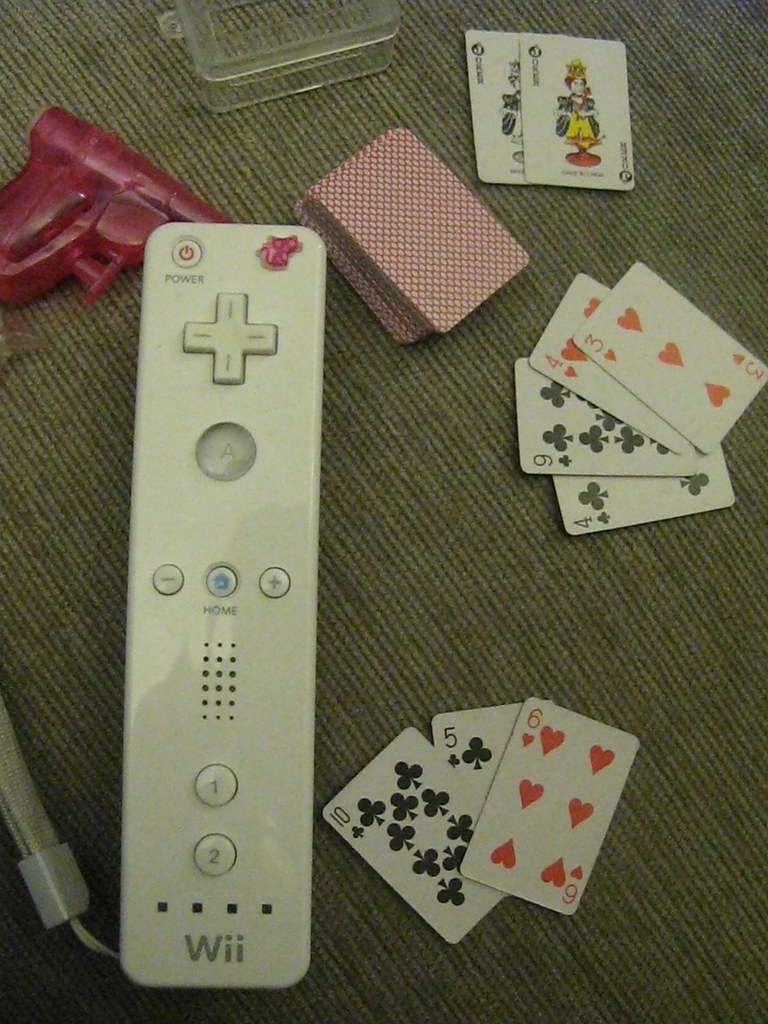
Photo: “Playing Pontoon with tiny cracker cards” by Rain Rabbit is licensed under CC BY-NC 2.0.

Sonnet: RHL, ‘Wine Cellar’

Down in the cobwebbed cellars of the mind
fabulous wines you don’t dare drink are stored,
each carrying a price you can’t afford;
so you pass by, deliberately blind.
Upstairs a loved one, dreamier than a vision,
displays each quality your soul desires –
or is a mere projection from the fires
the building’s furnace stokes with soft derision.
Your passions aren’t alive, alight, upstairs:
your love a mere projection of the schemes
the animated house evolves. Your dreams
live in your basement, though you’re unawares.
Though Bacchus urge you to uncork that wine,
the world would find it filthy, not divine.

*****

What I like about Rat’s Ass Review is that the editor will acknowledge and deal with the darker sides of being human… Not horror stories which are mostly pretty simplistic; but poems about the darkness built into all social animals. RAR is a rare journal: full spectrum, light and dark. This sonnet is in the current issue; thanks, Roderick Bates!

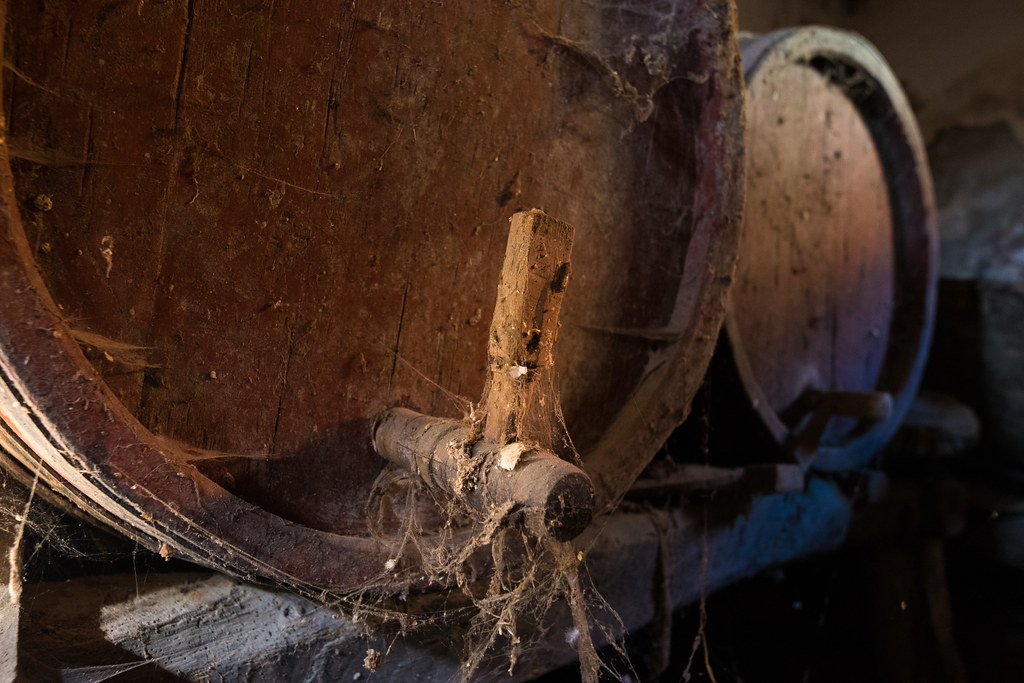
Photo: “Wine barrels in an old cellar” by Ivan Radic is licensed under CC BY 2.0.

Using form: Quatern: Susan McLean, ‘Cropped’

He doesn’t care for flowers or for fruit,
so don’t implore him not to clip or prune
the fig trees and camellias. His pursuit
of geometric form makes him immune

to luscious tastes and beauties others crave.
He doesn’t care for flowers or for fruit,
so once the buds appear, don’t try to save
them from his trimmer. All your pleas are moot.

He holds a tidy yard in high repute,
a verdant symbol of his mastery.
He doesn’t care for flowers or for fruit,
but takes some pleasure in your misery

as he destroys what you had hoped to see.
His need to have control is absolute,
and you can’t argue with machinery.
He doesn’t care for flowers or for fruit.

*****

Susan McLean writes: “This poem started with my desire to write a quatern, a form that I had encountered in Chad Abushanab’s workshop on rare poetic forms at the Poetry by the Sea conference in 2024. A quatern is four quatrains long, and the first line of stanza one becomes the second line of stanza two, and so on. As for the poem’s content, it grew out of a dispute about gardening practices with someone I know well. I was unable to convince him to change his ways. I should add that his ascribed motives are all conjectural on my part, not based on anything he said. But poets don’t really lose an argument; they just take the opportunity to restate it as a poem. This poem first appeared in the August 2025 issue of Snakeskin.”

Susan McLean has two books of poetry, The Best Disguise and The Whetstone Misses the Knife, and one book of translations of Martial, Selected Epigrams. Her poems have appeared in Light, Lighten Up Online, Measure, Able Muse, and elsewhere. She lives in Iowa City, Iowa.
https://www.pw.org/content/susan_mclean

Photo: Snakeskin

Odd poem: Sir Arthur Conan Doyle, ‘A Reminiscence of Cricket’

Once in my heyday of cricket,
One day I shall ever recall!
I captured that glorious wicket,
The greatest, the grandest of all.

Before me he stands like a vision,
Bearded and burly and brown,
A smile of good humoured derision
As he waits for the first to come down.

A statue from Thebes or from Knossos,
A Hercules shrouded in white,
Assyrian bull-like colossus,
He stands in his might.

With the beard of a Goth or a Vandal,
His bat hanging ready and free,
His great hairy hands on the handle,
And his menacing eyes upon me.

And I – I had tricks for the rabbits,
The feeble of mind or eye,
I could see all the duffer’s bad habits
And where his ruin might lie.

The capture of such might elate one,
But it seemed like one horrible jest
That I should serve tosh to the great one,
Who had broken the hearts of the best.

Well, here goes! Good Lord, what a rotter!
Such a sitter as never was dreamt;
It was clay in the hands of the potter,
But he tapped it with quiet contempt.

The second was better – a leetle;
It was low, but was nearly long-hop;
As the housemaid comes down on the beetle
So down came the bat with a chop.

He was sizing me up with some wonder,
My broken-kneed action and ways;
I could see the grim menace from under
The striped peak that shaded his gaze.

The third was a gift or it looked it-
A foot off the wicket or so;
His huge figure swooped as he hooked it,
His great body swung to the blow.

Still when my dreams are night-marish,
I picture that terrible smite,
It was meant for a neighboring parish,
Or any place out of sight.

But – yes, there’s a but to the story-
The blade swished a trifle too low;
Oh wonder, and vision of glory!
It was up like a shaft from a bow.

Up, up like a towering game bird,
Up, up to a speck in the blue,
And then coming down like the same bird,
Dead straight on the line that it flew.

Good Lord, it was mine! Such a soarer
Would call for a safe pair of hands;
None safer than Derbyshire Storer,
And there, face uplifted, he stands

Wicket keep Storer, the knowing,
Wary and steady of nerve,
Watching it falling and growing
Marking the pace and curve.

I stood with my two eyes fixed on it,
Paralysed, helpless, inert;
There was ‘plunk’ as the gloves shut upon it,
And he cuddled it up to his shirt.

Out – beyond question or wrangle!
Homeward he lurched to his lunch!
His bat was tucked up at an angle,
His great shoulders curved to a hunch.

Walking he rumbled and grumbled,
Scolding himself and not me;
One glove was off, and he fumbled,
Twisting the other hand free.

Did I give Storer the credit,spo
The thanks he so splendidly earned?
It was mere empty talk if I said it,
For Grace had already returned.

*****

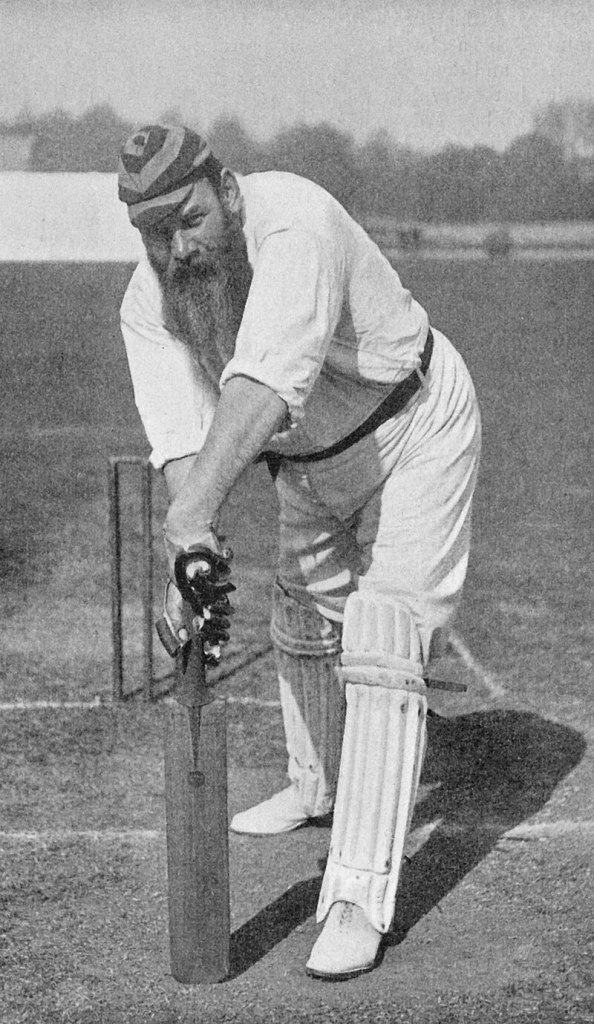
A Reminiscence of Cricket is a poem written by Arthur Conan Doyle. On 23-25 August 1900, Conan Doyle played in a first class cricket match against W.G. Grace where he scored 4, and took the wicket of Grace who had scored 110.

The creator of Sherlock Holmes, Sir Arthur Ignatius Conan Doyle played in ten first-class matches, mainly for the MCC, between 1900 and 1907. As a lower-order right-handed batsman and occasional slow bowler, he scored 231 runs, average 19.25, in 18 innings with a top score of 43. His only first-class wicket came against London County at Crystal Palace on 25 August 1900 when he had WG caught by the wicket-keeper off a skier for 110.

I found this poem with an extensive commentary by someone called Shamanth: “I’ve loved it primarily because of the allure of an amateur lifestyle that it portrays – an age where you could study medicine, play first class cricket, referee boxing bouts and marathons, and still produce brilliant literature, when you could live without sacrificing any dimension of your life, without putting your head down to specialize in any one field, when you did something simply because you loved it without having to forfeit other aspects of your life that you loved just as much. It makes you long for a lifestyle with such freedom.”

Credit: “From photo by E. Hawkins & Co., Brighton” – K. S. Ranjitsinhji, The Jubilee Book of Cricket Third Edition
Wordplay: Barbara Lydecker Crane, ‘Anna Graham’s Quirk’

Not verbose, she’s quite the obverse.
Anna Graham has one fixation—
rearranging conversation
as voices rant on. Here, ears rehearse

how letter counters can construe;
how each artist paints their traits;
how calipers find replicas for mates.
The game won’t wane—it spells anew.

Is she just wired or truly weird?
She does lament her mental quirk
at night. Some ghastly thing will lurk:
serpents in a dream appeared

with pertness. Asleep, she can’t outrun
a rioter, her editor . . .
a teardrop turning predator . . .
a charging gnu with loaded gun

Mornings end each nightly bout
as Anna walks the beach for miles,
where Laughing Gulls will make her smile.
Esprit persists… is that spelled out?

*****

Barbara Lydecker Crane writes: “I was unaware British people tend to pronounce this surname ‘Gray-um’ instead of the American ‘Gram’. I’m punning on the American pronunciation, and the poem won in the humor category of the Chicagoland Poetry Contest in 2021. Although I’m not nearly as obsessive as this fictional woman is about anagrams and “mirror words” (a pair that spell each other backwards), I enjoy such wordplay. My book BackWords Logic (Local Gems Press, 2017) is all quatrains that contain mirror words, with line drawings by Frances McCormick.”

In 2024 Barbara Lydecker Crane won the Kim Bridgford Memorial Sonnet Crown Contest and First Prize in the Helen Schaible Contest, modern sonnet category. She has twice been a finalist for the Rattle Poetry Prize. Able Muse recently published her fourth collection, You Will Remember Me

Photo: “An Anagram” by tcees is licensed under CC BY 2.0.

Odd, political poem: Emperor Qianlong, ‘My Feelings After the Ambassador of the Red-Haired English King, Macartney, Came to Pay Tribute and Give Offerings to Me’

Formerly Portugal presented tribute, now England is paying homage.
They have traveled further than Shu Hai and Heng-zhang;
My ancestors’ virtue must have reached their distant lands.
Though their tribute is nothing special, my heart approves sincerely.
Curios and their ingenious devices I do not prize.
Though what they bring is meager,
in my kindness to men from far away I make generous recompense –
Wanting to preserve my good health and power.”

*****

Original Poem:

《红毛英吉利国王差使臣马嘎尔尼奉表贡至,诗以志事》

  博都雅昔修职贡,英吉利今效荩诚。

  竖亥1横章输近步,祖功宗德逮远瀛。

  视如常却心嘉焉,不贵异听物翊2精。

  怀远薄来而厚往,衷深保泰以持盈。

This poem was written by the Qianlong Emperor (25 September 1711 – 7 February 1799; also known by his temple name Emperor Gaozong of Qing, personal name Hongli) after his meeting with the British ambassador Lord Macartney at the Emperor’s grand tent in his Summer resort at Jehol (Chengde) on September 14th, 1793. The embassy was then sent back to Beijing, the Emperor followed and saw the previously prepared British gifts on September 30th. The gifts and embassy did not impress and so they were ordered home on the following day. The whole two-year expedition is detailed here.

Lord Macartney was not impressed either, and wrote: “The Empire of China is an old, crazy, first rate man-of-war, which a fortunate succession of able and vigilant officers have contrived to keep afloat for these 150 years past, and to overawe their neighbors merely by its bulk and appearance, but whenever an insufficient man happens to have the command upon deck, adieu to the discipline and safety of the ship. She may perhaps not sink outright; she may drift some time as a wreck, and will then be dashed to pieces on the shore; but she can never be rebuilt on the old bottom.”

Illustration: William Alexander’s drawing of the reception of the Macartney embassy to China. Young Thomas Staunton (kneeling not kowtowing) receives a gift from the Emperor. Image by William Alexander available under a Creative Commons License

Rachel Hadas, ‘Summer Nights and Days’

So far the nights feel lonelier than the days.
In light, the living keep me company,
and memories of voices through the years.

Each summer threads a green familiar maze.
Emerging sun-struck, you can barely spy
the slow kaleidoscope of clouds and hours.

Those flannel nightshirts chilly sleepers wear
as summer wanes: I’m giving them away.
Pass it on: you keep at the same time.

A bough has broken from the Duchess tree.
Rain swelled the apples. Too much lightness weighs
heavy: the heft of the idea of home
tempered with the detachment of a dream,
or tidal pulls, like ocean, like moonrise.

*****

Rachel Hadas writes: “Summer Nights and Days, from perhaps 2009-2011, is one of a number of pieces written in and about Vermont which I recently tightened into short prose texts and collected in my latest book, Pastorals (2025); as it appears here, it’s still in its poem format. This piece may or may not have been written after my late husband’s death in 2011, but is certainly refers to a time when I was essentially living alone. My son and his visiting friends were the recipients of old nightshirts (more recycling).”

Rachel Hadas’s recent books include Love and Dread, Pandemic Almanac, and Ghost Guest. Her translations include Euripides’s Iphigenia plays and a portion of Nonnus’s Tales of Dionysus. Professor Emerita at Rutgers-Newark, where she taught for many years, she now teaches at 92Y in New York City and serves as poetry editor of Classical Outlook. Her honors include a Guggenheim fellowship and an award from the American Academy-Institute of Arts and Letters.

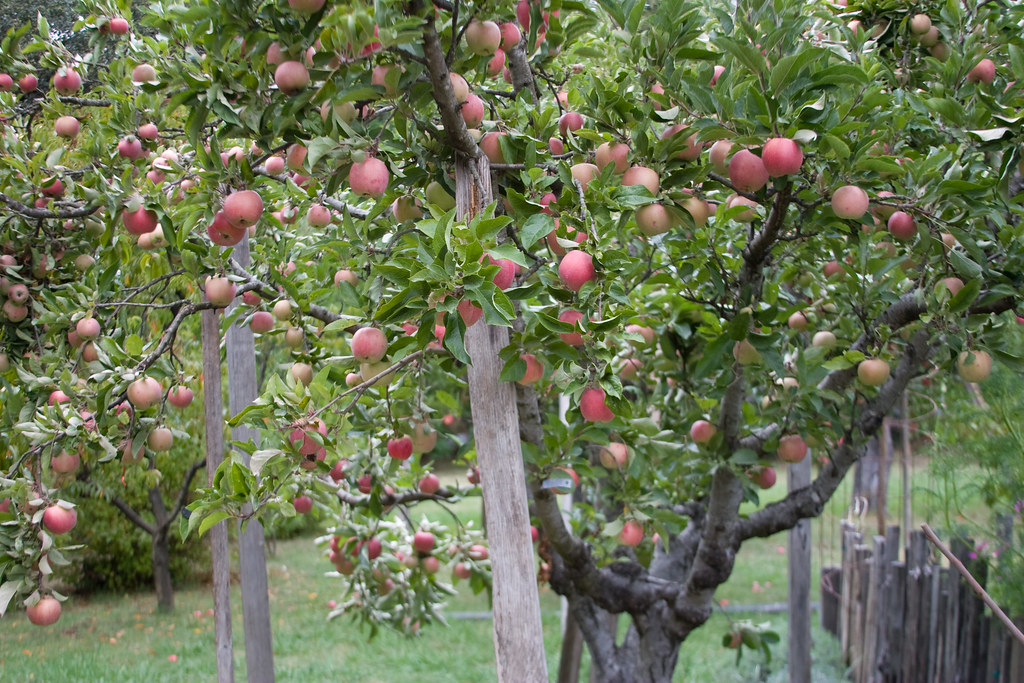
Photo: “Apple Tree” by bgreenlee is licensed under CC BY 2.0.