Category Archives: Chapbooks

Potcake Poet’s Choice: Gail White, ‘Orthodox Christmas Eve’

What am I doing here with all these Greeks?
Hoping, perhaps, at midnight Christmas Eve,
the unintelligible tongue God speaks
will summon even those who don’t believe
to Mary’s manger. Now the Virgin bears
the Master in the cave. As light through glass
he passes from her body. Joseph dares
believe the story; I can let it pass.
The incense rises like the church’s breath
into a frosty world. This night of birth
swells to a tide that tosses me past death.
But tides recede: I know this moment’s worth.
If love of beauty were the same as faith,
I’d walk in heaven with my feet on earth.

Gail White writes: “I love this poem and always secretly hoped it would become a classic, so I welcome the chance to bring it out again. The to-and-fro of faith and doubt is typical for me, as is the creeping into faith by way of aesthetics. But at this time of year faith wins, and I never let the day pass without listening to the King’s College choir singing ‘Once in Royal David’s City‘.”

Gail White is the resident poet and cat lady of Breaux Bridge, Louisiana. Her books ASPERITY STREET and CATECHISM are available on Amazon. She is a contributing editor to Light Poetry Magazine (lightpoetrymagazine.com). “Tourist in India” won the Howard Nemerov Sonnet Award for 2013. Her poems have appeared in the Potcake Chapbooks ‘Tourists and Cannibals’, ‘Rogues and Roses’, ‘Families and Other Fiascoes’ and ‘Strip Down’.
https://www.amazon.com/Asperity-Street-Gail-White/dp/1927409543

Potcake Poet’s Choice: Rob Stuart, ‘Hitchcock Acrostic’

My looming silhouette, obese and bald,
As well as my distinctive semi-slur
Still resonate, and even now I’m called
The cinema’s preeminent auteur,
Epitomising what François Truffaut
Revered: a moviemaker in control
Of everything on screen. I ran the show:
Finessing scripts and casting every role,
Selecting music and the mise-en-scène.
Unwilling as I was to look beyond
Simplistic plots that featured guiltless men
Plus pretty women (preferably blonde)
Entangled in intrigues, they all had doubt,
Not payoffs, situated at their heart:
Set bombs a-ticking, tension builds throughout,
Explode them and you blow it all apart.

Rob Stuart writes: “This poem was previously published in ‘Snakeskin’ although I have revised it since.

“Is this my best poem? Probably not, but it’s certainly the fiddliest I’ve ever written and consequently the most satisfying to have (perhaps) finished. A rhymed acrostic gives one very limited room for manoeuvre as it imposes constraints at both the beginning and end of each line, and this led to all manner of contrived rhymes and clunky word choices in my early drafts, including the version that was originally published a few years ago, and I have literally spent hours poring over lists of verbs beginning with a ‘u’ and synonyms for ‘suspense’ in the search for suitable replacements. I may yet go on to revise the poem further (I’m still not sure that the second to last line quite works), but I think it reads pretty damned well now. It’s a dinky little lesson in film history, too.”

Rob Stuart’s poems and short stories have been published in numerous magazines, newspapers and webzines including Ink Sweat and Tears, Light, Lighten Up Online, M58, Magma, New Statesman, The Oldie, Otoliths, Popshot, The Projectionist’s Playground, Snakeskin, The Spectator and The Washington Post. His work appears in the Potcake Chapbooks ‘Careers and Other Catastrophes‘ and ‘Wordplayful‘. He lives in Surrey, England with his family.

http://www.robstuart.co.uk/

Potcake Poet’s Choice: Tom Vaughan, ‘Happiness’

It’s easy to forget they’d fought a war:
his father drowned, half-brother bayoneted;
her kilted sibling captured at Dunkirk,
locked up for five long years. But yes they met

in uniform, lost half their friends, before
the normal world re-started when they wed:
mortgage; children; grinding office work –
all I suppose they wanted when they set

out as a couple. We must have been a shock:
busting their rulebook; scornful of sacrifice;
mocking their past and their belief in ‘progress’;

too young, too smashed, too angry to unlock
their silence, or to understand the price
they’d paid for what they’d still call happiness.

Tom Vaughan writes: “I chose Happiness it because I hope it gets right not just my own retrospective feelings about my parents, but also something more general about the generational shift between those who went through WW2 in their youth, and their less-tested offspring.

Secondly, because it’s a sonnet (a favourite form of mine), but in what I call a ‘roller’ rhyming (not always full rhymes) pattern, which tries to pull the reader down to the final line with a lurch which I hope is also of the emotions.

It was published in Dream Catcher in 2016, but has been picked up a couple of times elsewhere since then, including in your Families and Other Fiascoes chapbook.”

Tom Vaughan is not the real name of a poet whose previous publications include a novel and two poetry pamphlets (A Sampler, 2010, and Envoy, 2013, both published by HappenStance). His poems have been published in a range of poetry magazines, including several of the Potcake Chapbooks:
Careers and Other Catastrophes
Familes and Other Fiascoes
Strip Down
Houses and Homes Forever
Travels and Travails.
He currently lives and works in London.
https://tomvaughan.website

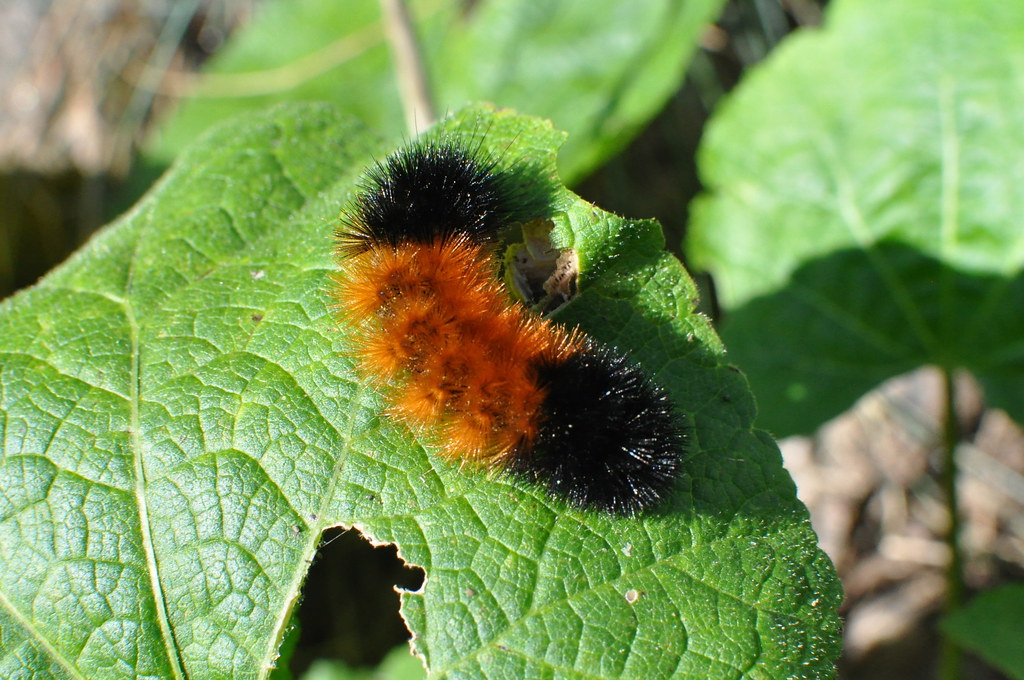
Potcake Poet’s Choice: Martin Elster, ‘The Woolly Bear’

Along a sylvan lane, you spy a critter
creeping with a mission, a woolly bear
fattened on autumn flora. So you crouch,
noting her triple stripes: the middle ginger,
each end as black as space. Her destination
is some unnoticed nook, a sanctuary
to settle in, greet the fangs of frost,
then freeze, wait winter out—lingering, lost
in dreams of summer, milkweed, huckleberry.
Though she’s in danger of obliteration
by wheel or boot, your fingers now unhinge her.
She bends into a ball of steel. No “ouch”
from bristles on your palm as you prepare
to toss her lightly to the forest litter.

She flies in a parabola, and lands
in leaves. Though she has vanished, both your hands
hold myriad tiny hairs, a souvenir
scattered like petals. When this hemisphere
turns warm again, she’ll waken, thaw, and feast
on shrubs and weeds (the bitterer the better)
then, by some wondrous conjuring, be released
from larval life. At length she will appear
a moth with coral wings—they’ll bravely bear
her through a night of bats or headlight glare,
be pulverized like paper in a shredder,
or briefly flare in a world that will forget her.

Martin Elster writes: “In the New England autumn, the leaves aren’t the only colorful feature in the landscape. Caterpillars are on the move, so they are more easily chanced on. A few years ago I lived briefly in a mainly rural and hilly town called New Hartford in the state of Connecticut. On my daily walks, I encountered many kinds of animals, including numerous lepidopterans (moths and butterflies), one species of which inspired this poem, an appropriate poem, I think, for late autumn or early winter.
The Isabella tiger moth (Pyrrharctia isabella) in its larval form is called the “banded woolly bear” (or “woolly bear” or “woolly worm”). The most remarkable attribute about the little critter is this (from Wikipedia):
“The banded woolly bear larva emerges from the egg in the fall and overwinters in its caterpillar form, when it literally freezes solid. First its heart stops beating, then its gut freezes, then its blood, followed by the rest of the body. It survives being frozen by producing a cryoprotectant in its tissues. In the spring it thaws.”
Covered in thick, fluffy-looking hair, the woolly bear sports bands of black and reddish-brown. There’s an age-old belief that the amount of brown on this critter can predict the severity of the coming winter. The more brown, the milder winter will be.
For the geeks: the rhyme scheme of the first stanza of the poem, similar to the bands on a woolly bear (ABA), is a chiasmus: ABC . . . CBA.

Martin Elster, who never misses a beat, was for many years a percussionist with the Hartford Symphony Orchestra (now retired). He finds contentment in long woodland walks and writing poetry, often alluding to the creatures and plants he encounters. His honors include Rhymezone’s poetry contest (2016) co-winner, the Thomas Gray Anniversary Poetry Competition (2014) winner, the Science Fiction Poetry Association’s poetry contest (2015) third place, and four Pushcart nominations. A full-length collection, Celestial Euphony, was published by Plum White Press in 2019.
This poem has appeared in The Road Not TakenAutumn Sky Poetry Daily, and The HyperTexts. His work has appeared in the Potcake ChapbooksCareers and Other Catastrophes‘ and ‘Robots and Rockets‘.

“Banded Woolly Bear (Isabella Tiger Moth) Caterpillar, Virginia” by Dave Govoni is licensed under CC BY-NC-SA 2.0

Potcake Poet’s Choice: Brian Gavin, ‘Country Church, Family Visit’

On the funeral road, five miles beyond the farm
it looms still, like a silo, then diminishes
as you get close. Your sound won’t raise alarm
out here. There’s none but you. The wishes
of no one left alive will keep you out,
or let you in. The door is probably locked
anyway, closed upon itself, redoubt
for certainties. Surrounding it the block
foundations — reservoirs of ice and weed —
still cluster, like white holes around the heart.
You will not try the door — where it might lead,
you cannot say. The dead have done their part,
for here you are among them once again,
between the legacies of grief — the snow,
the boxes of white quiet, the leaving, then
the watching it loom larger as you go.

Brian Gavin writes: “I like this piece because the church-image haunted (or taunted!) me for several years before I got around to giving it some context in a poem.  When it finally came to the page it felt like I had paid off a debt — like I had finally given the image a chance to tell its story.  The fact that this story turned out to be no story at all — just a bunch of hints and implications — seemed to fit the image.

Brian Gavin is a retired Distribution Manager who started writing poetry about 7 years ago. His poems have appeared in The Journal of Formal Poetry, Peninsula Poets and Snakeskin Magazine, and in the Potcake Chapbook ‘Careers and Other Catastrophes. He lives in Lakeport, Michigan, USA, with his wife Karen.

Potcake Poet’s Choice: Chris O’Carroll, ‘Postcard from the Afterlife’

How cool is Heaven? Where do I begin here?
The nightlife’s hipper than pre-war Berlin here,
Yet wholesome as a cozy country inn here.
I’m suave as Cary Grant or Errol Flynn here.
I’ve got broad shoulders and a dazzling grin here,
Plus perfect hair, flat abs and strong, cleft chin here.
(We all look like some sexy film star’s twin here.)
Nobody hates the color of your skin here.
Yang enjoys perfect harmony with yin here.
The food is rich, yet all of us stay thin here.
Nobody has to lose for me to win here.
We’re all on friendly terms with all our kin here.
No politicians practice crooked spin here.
I never get hung over from the gin here.
None of my favorite vices is a sin here.
Damned if I can tell how I got in here.

Chis O’Carroll writes: “I set out to write a matched pair of afterlife poems, assuming that the message from Hell would be inherently funnier.

The Internet’s top bloggers, your ex-lovers,
Share details of how bad you were in bed.
All books, despite the titles on their covers,
Are Dianetics or The Fountainhead.

That sort of stuff. Eternal bliss struck me as less promising comedy material somehow. But my lack of saintliness is pretty hilarious, and one of my many sins is loving monorhyme way more than I should, so the Paradise poem worked out OK after all. I’m often indebted to my wife or to various poet friends as I polish and fine-tune a poem. In this case, it was my late father who read an early draft and helped me punch the thing up. Naturally, this blog is available in Heaven, so he knows I’m giving him a shout-out.

Chris O’Carroll, author of The Joke’s on Me and Abracadabratude (both from Kelsay Books’ White Violet Press), is a Light magazine featured poet as well as a contributor to the Potcake Chapbooks series (Rogues and Roses, Families and Other Fiascoes, Wordplayful and Murder!) and The Great American Wise Ass Poetry Anthology. His poems appear in An Amaranthine Summer (published in memory of Kim Bridgford), Extreme SonnetsLove Affairs at the Villa Nelle, and New York City Haiku, among other collections. Chris is a member of Actors Equity and has performed widely as a stand-up comedian. He lives in Massachusetts with his wife, historian Karen Manners Smith.

Postcard from the Afterlife‘ was originally published in The Spectator.

Potcake Poet’s Choice: Paula Mahon, ‘Driven to the Mall in December’

I must go back to the mall again for the holidays are nigh
and all I ask is a parking space with direction posts nearby
in a covered lot, or a shoveled spot with room for a Chevy van.
There are two more days till the 25th and I have no Christmas plan.

I must go down to the mall again for the lure of the discount sale.
There’s just empty space ‘neath my Christmas tree, and I simply cannot fail.
And all I ask is some helpful clerk and ample stock for buying.
If there’s nothing left or the cost too dear, there will be a lot of crying.

I must go back to the mall again for the twinkling Christmas lights
that bedeck the trees and storefront shows of holiday delights.
I have had it with the crowds and lines, I’m no happy shopping rover
I can’t wait till the 26th when the holidays are over.

Paula Mahon writes: “I have just the timely thing for your blog… a holiday parody poem of John Masefield’s Sea-Fever.  This was originally published in Light.”

Paula Mahon is a practicing family physician and medical director of Health Care for Homeless in Manchester, NH. Her essays, poems and stories have been published in the Boston Globe, Light, The Lyric, The Road Not Taken, Pulse and the Potcake Chapbook ‘Strip Down – poems of modern life‘; she won The Lyric’s 2020 New England Prize for a poem called Two Points of View. She is married to Robert d’Entremont and mother to a son, Raymond, adopted from Kazakhstan.

Potcake Poet’s Choice: Jerome Betts, ‘In Northampton Museum’

Among the hide-and-canvas lace-ups made
For some poor elephant’s giant tender feet
And leathery minutiae of trade
     In boots, dissected or complete,

Mint Army-issue, every shade of bruise,
With Tudor scraps from trenches workmen dig,
You find a case containing John Clare’s shoes,
    Asylum-worn, and very big.

Jerome Betts writes: ”In Northampton Museum, published in Angle and The Hypertexts, is for me one of those pieces in which some lines just seem to arrive fully formed. In 1969-70 I lived for eighteen months in Northampton and sometimes visited its Shoe Museum whose displays reflected the traditional local industry. The town also still had the former Northampton County Asylum (now a private psychiatric hospital) where John Clare spent his last years. Somehow, the military  footwear, the curious elephant boots and Clare’s shoes all seemed to come together. Oddly enough, nearly  two years ago  I received a Lighten Up Online contribution about elephants from someone in the USA who, it turned out, knew another contributor who knew the American leader of the expedition in 1950, testing some theory about Hannibal’s’ crossing of the Alps, for which the elephant boots had been made.”

Jerome Betts was born and brought up on the Welsh border, but now lives in South Devon, where he edits the quarterly Lighten Up Online. In addition to articles and verse in consumer and specialist magazines his work has appeared in Pennine Platform, Staple and The Guardian, as well as anthologies like The Iron Book of New Humorous Verse, Limerick Nation, Love Affairs At The Villa Nelle,  Extreme Sonnets, Extreme Formal Poems and The Potcake Chapbooks 1 & 2, and online at Amsterdam Quarterly, Angle, The Asses of Parnassus, Autumn Sky Poetry Daily, Better Than Starbucks,  The Hypertexts, Light, The New Verse News, Parody, The Rotary Dial, Snakeskin, and other sites.

https://www.lightenup-online.co.uk/

Potcake Poet’s Choice: Terese Coe, ‘The Bumbly’ (after Edward Lear)

He ran the State in a daze, he did,
In a daze he ran the State:
In spite of howls and obnoxious jeers
And those who said it would end in tears
In a daze he ran the State!
And when the daze became a rout
That turned the country inside out
The Bumbly cried, I’m much too big!
I’m Alpha male, I’m never-fail,
the biggest gig and vig!
In a daze I’ll run the State!

So vast and vain, so vast and vain
Is the bog where the Bumbly brays;
His face is green, to think a strain,
And he ran the State in a daze.

He carried on in a daze, he did,
In a daze he carried on,
With carrion eaters on his staff,
Perpetual sneers and snickery laughs,
And predators stalking prey;
And though they said they’d legislate
They knew too little and much too late,
And worse, they could not stand up straight!
For in their skin was a powerful hate
That chewed them up till dawn.
So vast and vain, so vast and vain
Is the bog where the Bumbly brays;
His face is green, to think a strain,
And he ran the State in a daze.

And while he ran the State, he did,
And flew far over the seas
He incurred great debt and was bought by a bro
With a host of spies and some quid pro quo
And a hive of slithery sleaze.
And he bought a city or two, and some laws,
And when he was fitted with monkey claws
His climbed a tree, shrieked Chee-chee-chee!
And his arms reached down to his knees.
So vast and vain, so vast and vain
Is the bog where the Bumbly brays;
His face is green, to think a strain,
And he ran the State in a daze.

In twenty years they all were dead,
In twenty years or less,
And the people said How good they’re gone!
For they’d been through the muck of the Swamp-a-Thon,
And the dung of Fakery Cess.
And they feasted and drank at the Bumbly grave
With homemade wine and a weeklong rave,
And everyone sang, We shall live in chalets!
If only we live! We’ll attack and raze
The ruins of Fakery Cess!

So vast and vain, so vast and vain
Is the bog where the Bumbly brayed;
His face was green, to think a strain,
And he ran the State in a daze.

Terese Coe writes: “Writing this was more fun than I can say!”

Terese Coe’s poems and translations have appeared in Agenda, Alaska Quarterly Review, The Cincinnati Review, The Moth, New American Writing, New Writing Scotland, Ploughshares, Poetry, Poetry Review, The Stinging Fly, Threepenny Review, and the TLS, among many other journals. Her collection Shot Silk was listed for the 2017 Poets Prize. https://en.wikipedia.org/wiki/Terese_Coe

‘The Bumbly’ was first published in Xavier Review, 2019. Her ‘Apology From Fiji’ appeared in the Potcake Chapbook ‘Tourists and Cannibals’ from Sampson Low Publishers.

Potcake Poet’s Choice: Edmund Conti, ‘In Memoriam’

John Betjeman cannot read his In Memoriam.  Not
Today
    Or ever.

So what’s the use of writing another jot.
    Why, pray,
    Endeavor?

For he who could best compose one is decomposing.  Rot!
    Away
    Forever.

His spirit lives in every ingle-nook where England claims the heart
    And soul.

That poet so lightly musical, so serious and straight (an art)
    And droll.

Whose lines were seen and heard in every church, in every mart.
    And knoll.

Muckby-cum-Sparrowby cum Sphinx, County Westmeath, Cheltenham;
    The set.

Henley-on-Thames, also Highgate, Bristol, Clifton, Mint-on-Lamb:
    Gazette.

Places etched forever in his poems, each one a Betje-gram.
    Je bet!

We remember chintzy cheeriohs in his brilliant combinations.
    Cheeribye.

Farewell, so long, bunghosky, too — Goodbye to all his permutations.
    Never grim.
    Never dry.

Well, it’s getting time for supper and we’ve had our ruminations.
    This is him.
    Dry your eye.

Edmund Conti writes: “I remember saying (to myself) in high school after writing a few verses, “I’m not a poet I don’t like poetry, I just like to rhyme and scan.” I had an image of who poets were and what poetry was, and it just didn’t fit my imagined profile. I stuck to my guns for a while even as I was sending out my verse and getting comments like, “Please, no more rhymes” and “How about sending your smug cloaca elsewhere?” But eventually some poems were accepted and published and I met more poets and I got married. Marilyn loved poetry (no, she didn’t say real poetry but I imagined her thinking it). She was a member of a woman’s poetry group that called themselves The Lady Blue Stockings. They would smack their lips over Amy Lowell (“Christ, what are patterns for?”) and E. E. Cummings (“How do you like your blue-eyed boy, Mister Death?”). Marilyn tolerated my poetry but didn’t appreciate any of my parodies of her favorites.

Meanwhile, I met other poets and joined two groups: The South Mountain Poets and the Bards Buffet. The former was a local group (in NJ) and met weekly and discussed each other’s poems. I was usually advised to have more gravitas. The Bards, all light versifiers, met in a penthouse dining room of an insurance company in Manhattan.  Among them Willard Espy, William Rossa Cole, inventor of River Rhymes and other well-published poets.

So, in spite of myself, I was becoming a poet and appreciating others. Among them, Wallace Stevens, Robert Wallace, Vachel Lindsay, Frank O’Hara, and Robert Southey. And more and more swam into view. Luckily Marilyn brought many poetry books to the marriage and I found myself one day leafing through “John Betjeman’s Collected Poems.” There I came across his poem titled (entirely) “I.M. Walter Ramsden, ob. March 26 1947, Pembroke College, Oxford”. I loved the poem, the rhyming and the place names. Of course, I had to write my own version, not as parody, but an appreciation.  It was fun playing with the format and making up some English place names. One of my two or three favorite poems.

This was originally published in Orphic Lute. Later I sent it to Lighten-Up Online. They accepted it, made some changes to the place names and changed some of the wording. It was republished in my book “Just So You Know” from Kelsay Books. There I had problems with line lengths, some lines longer than Kelsay’s book limits allowed. Here it is, back in its original format.

Edmund Conti has recent poems published in Light, Lighten-Up Online, The Lyric, The Asses of Parnassus, newversenews, Verse-Virtual and Open Arts Forum. His book of poems, Just So You Know, released by Kelsay Books
https://www.amazon.com/Just-You-Know-Edmund-Conti/dp/1947465899/
was followed by That Shakespeherian Rag, also from Kelsay
https://kelsaybooks.com/products/that-shakespeherian-rag

His poems have appeared in several Potcake Chapbooks:
Tourists and Cannibals
Rogues and Roses
Families and Other Fiascoes
Wordplayful
all available from Sampson Low Publishers