
Category Archives: Poems

Potcake Poet’s Choice: Edmund Conti, ‘In Memoriam’

John Betjeman cannot read his In Memoriam.  Not
Today
    Or ever.

So what’s the use of writing another jot.
    Why, pray,
    Endeavor?

For he who could best compose one is decomposing.  Rot!
    Away
    Forever.

His spirit lives in every ingle-nook where England claims the heart
    And soul.

That poet so lightly musical, so serious and straight (an art)
    And droll.

Whose lines were seen and heard in every church, in every mart.
    And knoll.

Muckby-cum-Sparrowby cum Sphinx, County Westmeath, Cheltenham;
    The set.

Henley-on-Thames, also Highgate, Bristol, Clifton, Mint-on-Lamb:
    Gazette.

Places etched forever in his poems, each one a Betje-gram.
    Je bet!

We remember chintzy cheeriohs in his brilliant combinations.
    Cheeribye.

Farewell, so long, bunghosky, too — Goodbye to all his permutations.
    Never grim.
    Never dry.

Well, it’s getting time for supper and we’ve had our ruminations.
    This is him.
    Dry your eye.

Edmund Conti writes: “I remember saying (to myself) in high school after writing a few verses, “I’m not a poet I don’t like poetry, I just like to rhyme and scan.” I had an image of who poets were and what poetry was, and it just didn’t fit my imagined profile. I stuck to my guns for a while even as I was sending out my verse and getting comments like, “Please, no more rhymes” and “How about sending your smug cloaca elsewhere?” But eventually some poems were accepted and published and I met more poets and I got married. Marilyn loved poetry (no, she didn’t say real poetry but I imagined her thinking it). She was a member of a woman’s poetry group that called themselves The Lady Blue Stockings. They would smack their lips over Amy Lowell (“Christ, what are patterns for?”) and E. E. Cummings (“How do you like your blue-eyed boy, Mister Death?”). Marilyn tolerated my poetry but didn’t appreciate any of my parodies of her favorites.

Meanwhile, I met other poets and joined two groups: The South Mountain Poets and the Bards Buffet. The former was a local group (in NJ) and met weekly and discussed each other’s poems. I was usually advised to have more gravitas. The Bards, all light versifiers, met in a penthouse dining room of an insurance company in Manhattan.  Among them Willard Espy, William Rossa Cole, inventor of River Rhymes and other well-published poets.

So, in spite of myself, I was becoming a poet and appreciating others. Among them, Wallace Stevens, Robert Wallace, Vachel Lindsay, Frank O’Hara, and Robert Southey. And more and more swam into view. Luckily Marilyn brought many poetry books to the marriage and I found myself one day leafing through “John Betjeman’s Collected Poems.” There I came across his poem titled (entirely) “I.M. Walter Ramsden, ob. March 26 1947, Pembroke College, Oxford”. I loved the poem, the rhyming and the place names. Of course, I had to write my own version, not as parody, but an appreciation.  It was fun playing with the format and making up some English place names. One of my two or three favorite poems.

This was originally published in Orphic Lute. Later I sent it to Lighten-Up Online. They accepted it, made some changes to the place names and changed some of the wording. It was republished in my book “Just So You Know” from Kelsay Books. There I had problems with line lengths, some lines longer than Kelsay’s book limits allowed. Here it is, back in its original format.

Edmund Conti has recent poems published in Light, Lighten-Up Online, The Lyric, The Asses of Parnassus, newversenews, Verse-Virtual and Open Arts Forum. His book of poems, Just So You Know, released by Kelsay Books
https://www.amazon.com/Just-You-Know-Edmund-Conti/dp/1947465899/
was followed by That Shakespeherian Rag, also from Kelsay
https://kelsaybooks.com/products/that-shakespeherian-rag

His poems have appeared in several Potcake Chapbooks:
Tourists and Cannibals
Rogues and Roses
Families and Other Fiascoes
Wordplayful
all available from Sampson Low Publishers
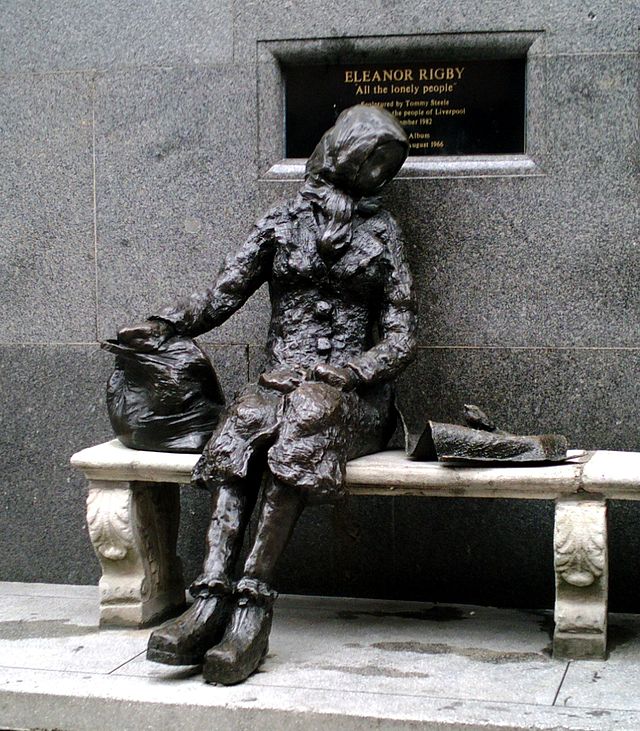
Songs as poems: Lennon-McCartney, ‘Eleanor Rigby’

Eleanor Rigby picks up the rice in the church where a wedding has been,
Lives in a dream.
Waits at the window, wearing the face that she keeps in a jar by the door,
Who is it for?

All the lonely people,
Where do they all come from?
All the lonely people,
Where do they all belong?

Father McKenzie writing the words of a sermon that no one will hear,
No one comes near.
Look at him working, darning his socks in the night when there’s nobody there,
What does he care?

All the lonely people, (etc)

Ah, look at all the lonely people!

Eleanor Rigby, died in the church and was buried along with her name,
Nobody came.
Father McKenzie, wiping the dirt from his hands as he walks from the grave,
No one was saved.

All the lonely people, (etc)

Written and released in 1966 on the Revolver lp and also as a double-A-side single with Yellow Submarine, ‘Eleanor Rigby’ was part of the Beatles’ dramatic move away from simple pop love songs into a vastly larger realm of portraits and social concerns and musical experimentation. Here, in a few lines, we have the protagonist’s lonely day-to-day life and unattended funeral, weaving back and forth with the empty church and its equally lonely priest. If Paul Simon’s ‘I Know What I Know’ is like a condensed Alice Munro short story, ‘Eleanor Rigby’ could be a full-length novel by Knut Hamsun or Kazuo Ishiguro… reduced to three 4-line verses and a refrain or two. The ideas are expressed as simple visual events, without speech. The words are straightforward, the rhymes uncomplicated–and some are slant rhymes, almost unnoticeable in song: been/dream, from/belong, grave/saved. But the impact is very powerful.

So who is the poet behind the song? Its article in Wikiwand states:

McCartney wrote the first verse by himself, and the Beatles finished the song in the music room of John Lennon’s home at Kenwood. John Lennon, George Harrison, Ringo Starr and Lennon’s childhood friend Pete Shotton all listened to McCartney play his song through and contributed ideas. Harrison came up with the “Ah, look at all the lonely people” hook. Starr contributed the line “writing the words of a sermon that no one will hear” and suggested making “Father McCartney” darn his socks, which McCartney liked. It was then that Shotton suggested that McCartney change the name of the priest, in case listeners mistook the fictional character in the song for McCartney’s own father.

McCartney could not decide how to end the song, and Shotton finally suggested that the two lonely people come together too late as Father McKenzie conducts Eleanor Rigby’s funeral. At the time, Lennon rejected the idea out of hand, but McCartney said nothing and used the idea to finish off the song, later acknowledging Shotton’s help.

Lennon was quoted in 1971 as having said that he “wrote a good half of the lyrics or more” and in 1980 claimed that he wrote all but the first verse, but Shotton remembered Lennon’s contribution as being “absolutely nil”. McCartney said that “John helped me on a few words but I’d put it down 80–20 to me, something like that.” Historiographer Erin Torkelson Weber has studied all available historical treatments of the issue and has concluded that McCartney was the principal author of the song, while speculating that Lennon’s assertions to the contrary were the result of lingering unresolved anger and the influence of manager Allen Klein.

John Lennon may have the stronger reputation as a poet, but this gem appears to be Macca’s. (Sorry; Sir Paul’s.)

Wikiwand credit: CC BY-SA 4.0 license

Potcake Poet’s Choice: Noam D. Plum, ‘Making a Clean Breast of It’

(Three of four men, according to a survey,) would rather take a shower with a beautiful celebrity than with their partner. “I’m not surprised,” said lifestyles counselor Carol Wise. – Reuters

Wise Wise
Replies,
“It’s no surprise.
It’s thighs–
Not ties–
That tantalize.

“True love’s the prize?
It’s otherwise.

“If four comprise
The sampling size,
Three guys
Revise
Their picks. Love dies.

“The fourth one lies.”

—–

Noam D. Plum writes: “The counselor’s name exerted a strong pull toward writing this. I like that the title is as funny as the poem. I was surprised and delighted that Mary Meriam considered this enough of a sonnet to include it in Irresistible Sonnets.”

Another poet’s pseudonym, Noam D. Plum has published in The Spectator, The Country Mouse, Light Poetry Magazine (where this poem was first published) and elsewhere. Having won several prizes, he is a more successful breadwinner than the poet for whom he fronts.

His poems have appeared in the Potcake Chapbooks ‘Wordplayful’ and ‘Murder!’

Poem: ‘Wild Oats’

He sowed wild oats
From John O’Groats
As far as Walvis Bay;
West to Cancun,
Up to the Moon,
And back to old Cathay.

Who will forgive
The way he lived?
Where are the children, though?
Daughters and sons
Under what suns?
Who’ll ever even know?

Now settled down,
Mayor of his town,
Friend to both poor and rich,
He’s no regrets
For he forgets…
That selfish son of a bitch.

This poem started with those first two lines, triggered by a photographer’s fundraising paramotor trip from John O’Groats to Land’s End this past summer. BBC story and photos here. No wild oats are involved in the story, but ‘John O’Groats’ is such an evocative name, you have to rhyme it with something… and then you just end up following the rhymes wherever they go. That’s how it often is for me, anyway. No editorial opinion is implied, no persons living or dead, no animals were harmed, etc.

The poem was published in Snakeskin 289, i.e. this October. Editor George Simmers was good enough to point out a particularly weak rhyme and a suggested improvement for it, which I happily took.

“wild oats” by john curley is licensed under CC BY-NC-SA 2.0

Review: ‘101 Sonnets’ edited by Don Paterson

This has to rank as one of the all-time great poetry anthologies. Yes, it contains only sonnets. Yes, several of them are dense in structure or in language (several are in Scots, with words and phrases translated in footnotes). Yes, there is only one sonnet per poet. It is very rich material, and took me a couple of weeks for a first read because there is a lot of absorb. And it has a fabulous Introduction by the British editor Don Paterson – a well-respected poet who avoided including any sonnet of his own.

The sonnets are not put into any formal grouping, but rather flow conversationally from one to the next, the themes often shifting through unexpected juxtaposition. So the first nine run through an amazing sequence of idealised love, woman as muse, kissing, sensual religiosity, obscenity, and charm. It starts with Robert Frost’s
She is as in a field a silken tent
and progresses to Robert Graves’ woman/muse
This they know well: the Goddess yet abides.
Though each new lovely woman whom She rides

to Jo Shapcott’s ‘Muse’
When I kiss you in all the folding places
to Alexander Montgomerie’s
So swete a kis yistrene fra thee I reft
to Wilfred Owen’s
Between the brown hands of a server-lad
The silver cross was offered to be kissed

John Donne’s
Batter my heart, three-personed God
William Alabaster’s ‘Upon the Crucifix’
Feed greedy eyes and from hence never rove,
Suck hungry soul of this eternal store,
Issue my heart from thy two-leaved door,
And let my lips from kissing not remove.

Craig Raine’s ‘Arsehole’
I dreamed your body was an instrument
and this was the worn mouthpiece
to which my breathing lips were bent.

to Robert Herrick
A sweet disorder in the dress
Kindles in clothes a wantonness

The 101 Sonnets provide a wild ride. The next in the book are Poe’s ‘An Enigma’, Wordsworth’s
The world is too much with us; late and soon,
Getting and spending, we lay waste our powers

(incidentally the first sonnet I learnt by heart, one that helped shape my life) and J.K. Stephens’ parody critique of Wordsworth
Two voices are there: one is of the deep (…)
And one is of the old half-witted sheep (…)
And, Wordsworth, both are thine
.

And so on through all aspects of life and death, English landscapes, Irish history, real parents, imaginary children, mythology, poetry, the seasons, the close observation of small everyday items… Wendy Cope paired with Edmund Spenser, Gwendolyn Brooks with John Milton… A very rich and rewarding collection.

And the 17-page Introduction is the single best essay on poetry that I’ve ever read. Naturally it is focused on the sonnet, covering its definition, its history, its structure; but in so doing it talks about wider issues such as the nature of iambic pentameter, and in a couple of places it goes into the nature of poetry itself: it mentions one of the advantages of the sonnet being that it is small enough
to be easily memorised, which is the whole point of the poem–that it should lodge itself permanently in our brains. We should never forget that of all the art forms, only the poem can be carried around in the brain perfectly intact. The poem is no more or less than a little machine for remembering itself: every device or trope, whether rhyme or metre, metaphor or anaphora, or any one of the thousand others, can be said to have a mnemonic function in addtion to its structural or musical one. Poetry is therefore primarily a commemorative act–one of committing worthwhile events and thoughts and stories to memory.

Later Paterson states
Poetic arguments appear to cohere simply because they rhyme. Rhyme always unifies sense, and can make sense out of nonsense; it can trick a logic from the shadows where one would not have otherwise existed. This is one of the great poetic mysteries.

All in all a brilliant book, and highly rereadable.

Potcake Poet’s Choice: Bruce McGuffin, ‘News Hound’

I sit and I stare at the TV and stew.
The news is so bad I don’t know what to do.
Then a dog nose appears and it rests on my knee
‘Til I look at my dog, who is looking at me.
And she gives a small wag. Her eyes silently say
The same thing they do at this time every day
“Why are you here in this room, on this couch
Watching the news and becoming a grouch?
There are dogs to be petted, with ears you can scratch,
Outside in the park there are squirrels to catch.
Let’s go for a walk, we should give it a try.
Bring a ball too, you’re a ball throwing guy”.
So I pet her and scratch her, it’s good for the blues.
And tonight we’ll go walking right after the news.

Bruce McGuffin writes: “My favorite dog poem is the one called ‘News Hound‘, above. It’s not my best dog poem technically speaking, but it captures the essence of dog. At least the better sort of dog, which I have been lucky enough to have owned a few of over the years.”

This poem first appeared in Lighten Up Online, on Dec. 1 2018.

Bruce McGuffin writes all kinds of poetry, but meter has a way of sneaking in even when it’s not invited, sometimes bringing rhyme along for the ride. His subjects range from the profound to the utterly frivolous with a decided tilt toward frivolous, which he justifies by claiming he writes for his own amusement. He divides his time between Lexington Massachusetts, where he has a day job as an engineer at a radio research lab, and Antrim New Hampshire, where he lives with his wife and pretends to be practical (when he’s not writing poetry). At work the practical engineers think he’s a theorist, and the theorists think he’s a practical engineer. His poetry has appeared in Light, Lighten Up Online, The Asses of Parnassus, Better Than Starbucks, and other journals. His poem ‘The Mad Scientist‘ appeared in the Potcake Chapbook ‘Robots and Rockets‘.

Potcake Poet’s Choice: Ann Drysdale, ‘Sleeping in Tongues’

Three of us breathing; me and dog and cat.
Awoken by a faint and plaintive mew,
I hold my own breath, ascertaining that
the sound comes from one of the other two.
I act upon an educated guess
and lay a hand on cat, who quickly twists
into a different pose of idleness
and settles, silent. But the sound persists.
So dog it is, who wheezes in a dream
that has bestowed on him the gift of tongues
and things both are, and are not, what they seem.
I let the captive air out of my lungs.
Three of us breathing, dog and cat and me;
companionable synchronicity.

Ann Drysdale writes: “This poem emerged from a situation that took a minute to happen and evolved into a sonnet that takes a minute to read. I can almost believe that it sprang fully-formed from my fingertips, now that the pile of sawdust, chippings and paintflakes generated by the making of one into the other has been swept under the carpet and forgotten.”

Ann Drysdale now lives in South Wales and has been a hill farmer, water-gypsy, newspaper columnist and single parent – not necessarily in that order. Her most recent volume of poetry, Vanitas, joined a mixed list of published writing, including memoir, essays and a gonzo guidebook to the City of Newport. Another collection is accreting nicely and is due to be published next year.

Her poems have been published in several of the Potcake Chapbooks:
Tourists and Cannibals
Rogues and Roses
Careers and Other Catastrophes
Families and Other Fiascoes
Houses and Homes Forever
… all available from Sampson Low for the price of a coffee.

Potcake Poet’s Choice: Gail White, ‘Julian of Norwich in Seclusion’

Because an anchoress could have a cat,
We may assume she had one. That it sat
Beside her while the pilgrims came and went,
Giving, like her, a lesson in content.
That it was quiet when her visions came
And when they passed it slumbered just the same,
But any mice who trespassed in the cell
Were given reason to believe in hell.
That with a feline love of body heat
It nestled in her lap or on her feet.
That it died peacefully, grown old and fat.
Love was my meaning, purred St. Julian’s cat.

Gail White writes: “The Ancrene Wisse or Ancrene Riwle (Rule for Anchoresses), written in Middle English in the 13th century, states that an anchoress might have a cat, although other animals were forbidden. I have therefore taken the liberty of sketching the life of a cat belonging to Julian of Norwich. Her book, A Revelation of Divine Love in Sixteen Showings, ends by asking if the reader wishes to know God’s meaning in her visions, and replies ‘Love was His meaning’. I have transferred this sentiment to her cat.”

Gail White is the resident poet and cat lady of Breaux Bridge, Louisiana. Her books ASPERITY STREET and CATECHISM are available on Amazon. She is a contributing editor to Light Poetry Magazine. ‘Tourist in India’ won the Howard Nemerov Sonnet Award for 2013.

Her poems appear in several of the Potcake Chapbooks:
Tourists and Cannibals
Rogues and Roses
Families and Other Fiascoes
“Strip down,” she ordered
… all available at https://sampsonlow.co/potcake-chapbooks/ for the price of a coffee.

Potcake Poet’s Choice: John Beaton, ‘Shadow-casting’

Cast your line toward the sun
and let your shadow fall behind you.
Face the glare, absorb its stun,
and cast your line toward the sun
for casting shade makes wild things run;
so face the brightness though it blind you—
cast your line toward the sun
and let your darkness fall behind you.

John Beaton writes: “It’s often said that fly-fishing is about more than fish—that it has mystical, or at least meditative, aspects. I feel that way. This little poem illustrates how my fly-fishing thoughts one day wandered from the river-bank to philosophy.

The title echoes a term from the book and subsequent movie, A River Runs Through It. Away from the river Brad Pitt may have become a hellion but, on the water, he’s a magician. Supposedly, by casting repeatedly in the air he can make the trout think a hatch of flies is taking place. It’s a dubious concept, but the term suits the way light and fly-casting in the poem take on metaphorical significance.

The poem has been previously published in Gray’s Sporting Journal. Its form, which comes from medieval French poetry, is the “triolet”. The triolet has only eight lines and some repeat. The first, fourth and seventh lines are almost identical, as are the second and eighth. The rhyme pattern is ABaAabAB, with capital letters denoting repeats. My version has four-beat lines (“tetrameter”) and the beats in the first line are: CAST your LINE toWARD the SUN.”

John Beaton’s metrical poetry has been widely published and has won numerous awards. He recites from memory as a poetry performer. This poem appears in his book “Leaving Camustianavaig” published by Word Galaxy Press. Raised in the Scottish Highlands, John lives in Qualicum Beach on Vancouver Island.

https://www.john-beaton.com/

Photo: ‘Deschutes shadow-casting’ from John Beaton

Potcake Poet’s Choice: Jean L. Kreiling, ‘The Waves’

Sprawled on a pew of sand, you meditate
on miracles of tide and time. Without
a prayer but apparently devout,
and humbled by the water’s shifting weight,
you watch with wonder, even venerate
this higher power rolling in and out:
omnipotence too obvious to doubt,
authority too awful to debate.
Like salty spray, some blue-green grace may cling
and seep unsanctified into your soul,
without a psalm or sermon—for the sea
makes its own joyful noise: the breakers ring
uncounted changes, and no church bells toll
more faithfully or irresistibly.

Previously published in 14 by 14. 

Jean L. Kreiling writes: “Growing up on the beach, and living on another coast in adulthood, I have never lost the sense of awe and humility that the sea inspires.  And of course I have never succeeded in capturing its magic in words, but I hope I’ve made a start in this poem.  Its form, my favorite, imposes the sonnet’s graceful structure onto what might otherwise have been an amorphous rhapsody; in addition, its meter and rhyme might suggest a bit of the ocean’s own rhythms and harmonies.”

Jean L. Kreiling is the author of two collections of poetry: Arts & Letters & Love (2018) and The Truth in Dissonance (2014). Her work appears widely in print and online journals, and has been awarded the Able Muse Write Prize, three New England Poetry Club prizes, the Plymouth Poetry Contest prize, and several other honors.  She is Professor Emeritus of Music at Bridgewater State University, and an Associate Poetry Editor for Able Muse: A Review of Poetry, Prose & Art.   

Her poem ‘The Salisbury Crags’ which first appeared in the Orchards Poetry Journal, is included in the ‘Travels and Travails’ Potcake Chapbook.