Category Archives: Poems

Potcake Poet’s Choice: David Galef, ‘Nohow’

I do what I don’t
If I can’t and then could.
I wouldn’t say won’t
When I mustn’t but should.

Do I never need not
Any time that’s all now?
Should I get what I’ve got
Nowhere here but not how?

When the whos turn to whom
As I do till I die,
I will rumor the room
And stop asking why.

David Galef writes: “Nohow, besides being a homage to Cummings, is the kind of celebration of sound and sense that people always seem to enjoy. First published in Blue Unicorn.”

David Galef has published over two hundred poems in magazines ranging from Light and Measure to The Yale Review. He’s also published two poetry volumes, Flaws and Kanji Poems, as well as two chapbooks, Lists and Apocalypses. In real life, he directs the creative writing program at Montclair State University.
www.davidgalef.com

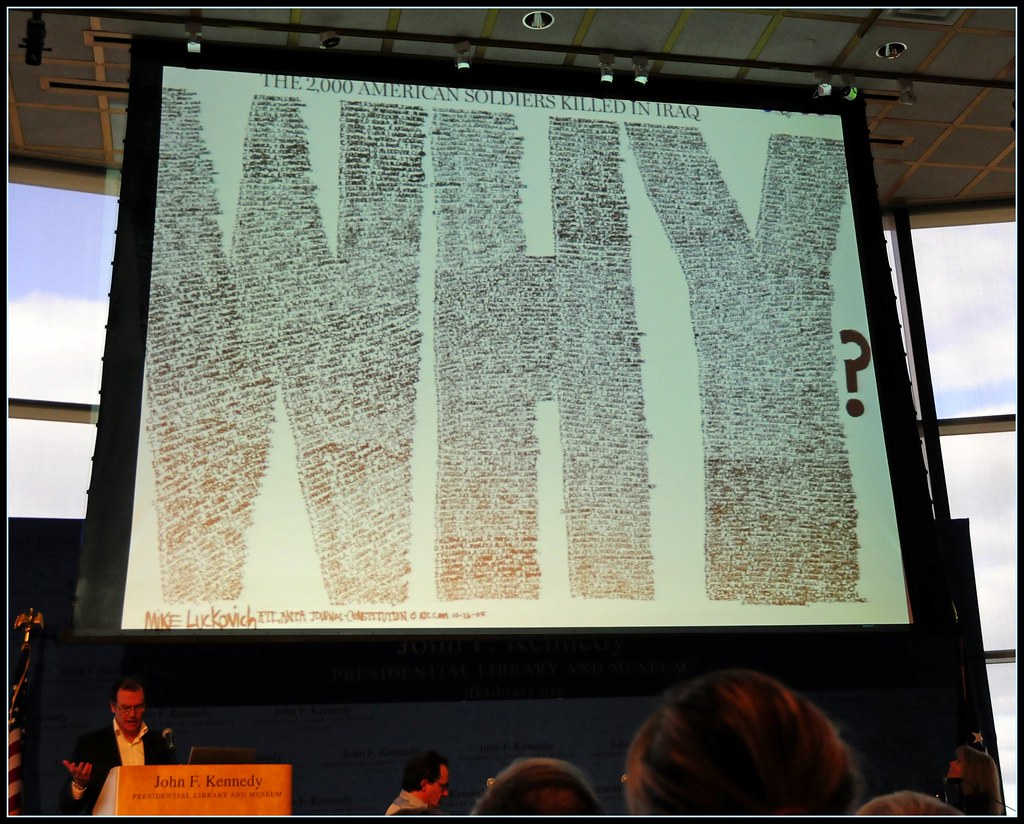
“‘Why?’, Mike Luckovich, Pulitzer-Winning Political Cartoonist (1 of 4)” by Tony Fischer Photography is licensed under CC BY-NC-SA 2.0

Short poem: ‘The Inevitable Future’

Now that I’ve got Windows 10,
11 comes; and then, and then…
Next: self-driving flying cars,
Trump in jail and Musk on Mars.

Certain things appear inevitable in the businessman’s crystal ball… Well, we’ll see. This short poem was published in the ever-succinct Asses of Parnassus – thanks, Brooke Clark!

Odd poem: D.H. Lawrence dialect verse, ‘The Collier’s Wife’

Somebody’s knockin’ at th’ door
Mother, come down an’ see!
–I’s think it’s nobbut a beggar;
Say I’m busy.


It’s not a beggar, mother; hark
How ‘ard ‘e knocks!
–Eh, tha’rt a mard-arsed kid,
‘E’ll gie thee socks!

Shout an’ ax what ‘e wants,
I canna come down..

–‘E says, is it Arthur Holliday’s?
–Say Yes, tha clown.

‘E says: Tell your mother as ‘er mester’s
Got hurt i’ th’ pit–
What? Oh my Sirs, ‘e never says that.
That’s not it!

Come out o’ th’ way an’ let me see!
Eh, there’s no peace!
An’ stop thy scraightin’, childt,
Do shut thy face!


‘Your mester’s ‘ad a accident
An’ they ta’ein’ ‘im ‘i th’ ambulance
Ter Nottingham.’–Eh dear o’ me,
If ‘e’s not a man for mischance!

Wheer’s ‘e hurt this time, lad?

–I dunna know,
They on’y towd me it wor bad–
It would be so!

Out o’ my way, childt! dear o’ me, wheer
‘Ave I put ‘is clean stockin’s an’ shirt?
Goodness knows if they’ll be able
To take off ‘is pit-dirt!

An’ what a moan ‘e’ll make! there niver
Was such a man for fuss
If anything ailed ‘im; at any rate
I shan’t ‘ave ‘im to nuss.

I do ‘ope as it’s not very bad!
Eh, what a shame it seems
As some would ha’e hardly a smite o’ trouble
An’ others ‘as reams!

It’s a shame as ‘e should be knocked about
Like this, I’m sure it is!
‘E’s ‘ad twenty accidents, if ‘e’s ‘ad one;
Owt bad, an’ it’s his!

There’s one thing, we s’ll ‘ave a peaceful ‘ouse f’r a bit,
Thank heaven for a peaceful house!
An’ there’s compensation, sin’ it’s accident,
An’ club-money–I won’t growse.

An’ a fork an’ a spoon ‘e’ll want–an’ what else?
I s’ll never catch that train!
What a traipse it is, if a man gets hurt!
I sh’d think ‘e’ll get right again.

D.H. Larence was the son a a barely literate coal-miner at Brinsley Colliery in Nottinghamshire. This poem is from the environment of his childhood, in the dialect he grew up in. To make the three-way conversation a little easier to navigate, I’ve italicised the wife’s words.

As for the dialect, it’s not difficult, more of an accent than anything. “Scraighting” isn’t a word I know, but it’s obvious from the context. Other words: “nuss” is “nurse”. “Owt bad” doesn’t mean “knocked out badly”, it means “aught bad”, “anything bad”.

Potcake Poet’s Choice: Michael R. Burch, ‘Ordinary Love’

Indescribable—our love—and still we say
with eyes averted, turning out the light,
“I love you,” in the ordinary way

and tug the coverlet where once we lay,
all suntanned limbs entangled, shivering, white…
indescribably in love. Or so we say.

Your hair’s blonde thicket now is tangle-gray;
you turn your back; you murmur to the night,
“I love you,” in the ordinary way.

Beneath the sheets our hands and feet would stray
to warm ourselves. We do not touch despite
a love so indescribable. We say

we’re older now, that “love” has had its day.
But that which Love once countenanced, delight,
still makes you indescribable. I say,
“I love you,” in the ordinary way.

Michael R. Burch writes: “These are some tidbits about the poem:
This was my first villanelle and it’s missing a tercet. The missing tercet was pointed out to me by the formalist poet Richard Moore, who said he still liked the poem. I didn’t feel that I had anything to add, so I left the poem as it was. I’ve never been a stickler for the rules, anyway.
‘Ordinary Love’ was originally published by The Lyric. It later won the 2001 Algernon Charles Swinburne Poetry Award, was published by Romantics Quarterly, which had sponsored the contest, and RQ nominated it for the Pushcart Prize.
The poem has been translated into Hungarian, as noted below.
That’s not too shabby for my first villanelle!
Here is the complete publication history:
Published by The Lyric, Romantics Quarterly, Amerikai költok a második (in a Hungarian translation by István Bagi), Mandrake Poetry Review, Carnelian, the Net Poetry and Art Competition, Famous Poets & Poems, FreeXpression (Australia), PW Review, Poetic Voices, Poetry Renewal, Poem Kingdom and Poetry Life & Times; also winner of the 2001 Algernon Charles Swinburne Poetry Award sponsored by Romantics Quarterly and nominated for the Pushcart Prize. The last time I checked online, it returned nearly 10,000 results for the first line.”

Michael R. Burch is an American poet, editor and translator who lives in Nashville, Tennessee with his wife Beth, two outrageously spoiled puppies, and the ghost of a hamster, Olive, murdered by a former canine family member. For an expanded bio, circum vitae, career timeline, reviews, interviews and other information of interest to scholars, please click here: Michael R. Burch Expanded Bio. To read the best poems of Mike Burch in his own opinion, with his comments, please click here: Michael R. Burch Best Poems.

“Ordinary LOVE” by InfoMofo is licensed under Openverse from WordPress.org

Odd poem: Robert Frost, ‘The Draft Horse’

With a lantern that wouldn’t burn
In too frail a buggy we drove
Behind too heavy a horse
Through a pitch-dark limitless grove.

And a man came out of the trees
And took our horse by the head
And reaching back to his ribs
Deliberately stabbed him dead.

The ponderous beast went down
With a crack of a broken shaft.
And the night drew through the trees
In one long invidious draft.

The most unquestioning pair
That ever accepted fate
And the least disposed to ascribe
Any more than we had to to hate,

We assumed that the man himself
Or someone he had to obey
Wanted us to get down
And walk the rest of the way.

At a poetry reading in the Library of Congress, Robert Frost apparently described “The Draft Horse” as a poem “that nobody knows how to take“. That’s one way to look at it. Another way is that everyone who reads it seems to quite confidently take it in a different direction.

It has been called an allegory of the atom bomb–but, though first published in 1962, it was actually written in the 1920s, long before the bomb.

It’s been called an allegory of American expansionism.

It has been suggested as “a metaphor for the lives of ordinary citizens in totalitarian states, such as Nazi Germany, Soviet Russia and West Germany.” (West Germany. Really.) “Then the man could be an agent of the government, who does what he deems necessary and then disappears again.

Again, “In many cultures, the horse is traditionally a symbol for power. The horse has played a large role in American history. Robert Frost’s The Draft Horse may be a reflection of the power struggles he saw around him and the senseless actions he perceived in the conflicts.

How about “One analysis of the poem is that fate is unavoidable. Why struggle to stop or question fate when by its very definition it cannot be stopped?

Here’s the complete commentary from one blogger: “I’m on a bit of a poetry moment right now. The Draft Horse by Robert Frost is possibly one of the best poems ever written and well worth sharing with anyone willing to read writing at it’s highest art form.” (“it’s”, sic. Also, he miscopied one of the lines as “Any more than we had to hate,” thereby losing the meaning.) A more extensive commentary is in a comment posted to that blog:

I love this poem ! i think it is a great description of postlapsarian life. Laterns wont burn buggies are frail, the horse is too heavy.the night is so dark …
amidst all that a fellow deliberately stabs your horse.

People of good will are always hesitant to blame problems on hate.
and any way walking is a fine way to get there

And then there’s this thesis towards an M.A.:
WHY I KILLED THE DRAFT HORSE:
THE GOLDEN BOUGH, ROBERT FROST, AND “PROGRESS”
by Eugene Charles McGregor Boyle III

August 2013
The absence of criticism on Robert Frost’s “The Draft Horse” suggests that it is a challenge to Frost scholarship. This reading views Frost’s strange and neglected poem as a return to a monomyth offered by James Frazer’s hugely influential The Golden Bough. In “The Draft Horse,” Frost reconsiders the concept of ceremonial sacrifice that undergirds Frazer’s encyclopedic study of world culture and, by performing ceremony as a kind of modem poesis, Frost complicates the hero/sacrificial object role and critiques the progressive ideology that grounds Frazer’s account to fashion a troubling epic for modern America that implicates its national readers in a kind of savagery.

(Supported with references not just to Frazer’s “Golden Bough” and Eliot’s “Wasteland”, but also Dante’s “Inferno” and Lovecraft’s “Call of Cthulhu”, among others.)

Here is another take on it: “This is a very simple, straightforward story, but the reader cannot just leave it like that. Why would Frost have written this poem if he had only wanted to say “a stranger killed a horse”? The reader is therefore faced with the fact that “The Draft Horse” is a symbolic poem that must be read at another level, otherwise it has no purpose.

Well, why does it have to have a “purpose”? It’s a poem, for god’s sake. Maybe the poem “means” exactly what one or other of the above-quoted commenters thinks… but maybe Frost just had a strange dream. Or maybe someone had told him of an incident. Maybe the rhymes and images just floated around in his head. Who knows? Who cares? It’s a poem and, for some reason, it resonates (differently) with a lot of people. It’s an odd poem. Enjoy!

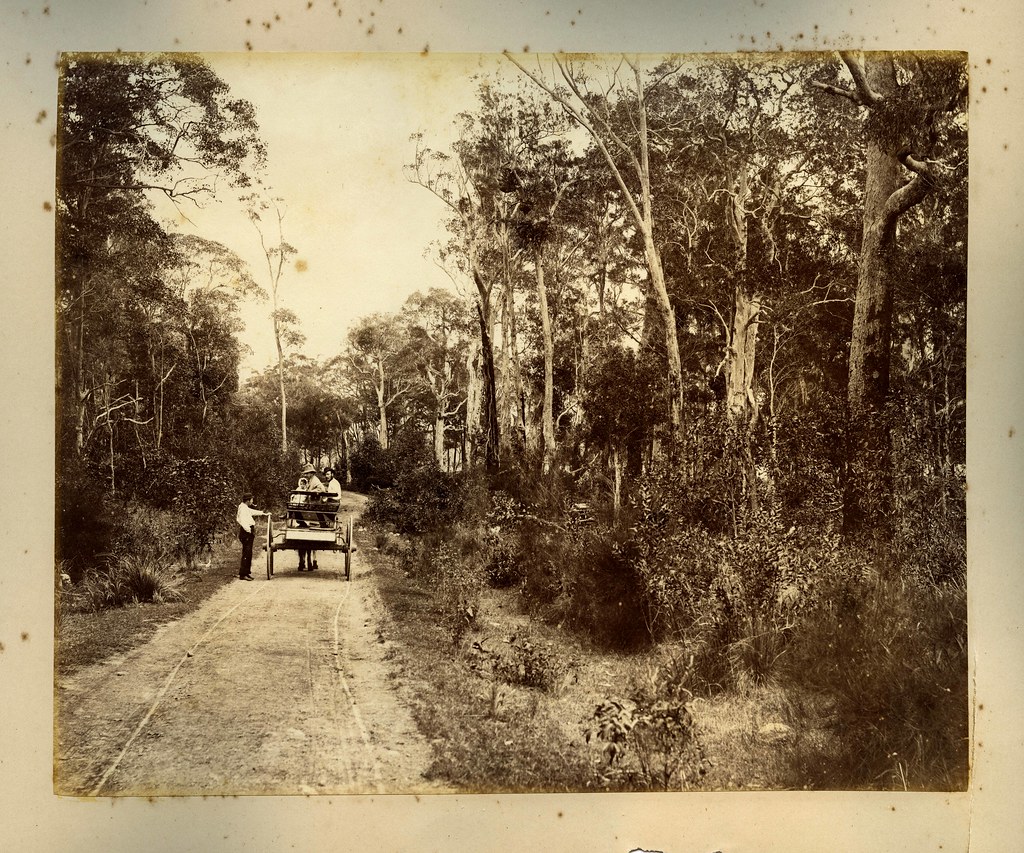
“Horse and Buggy on a Bush Track” by Blue Mountains Library, Local Studies is licensed under openverse from WordPress.org
Potcake Poet’s Choice: David Galef, ‘Justification’

And malt does more than Milton can
To justify God’s ways to man.
—A. E. Housman

When I am beaten down by work and love,
And others head for local dives to drink,
I clench my soul and strive to rise above,
For stimulating words to make me think.
O show me Milton’s paradisial route,
Far airier than the foamiest of stout.
Of man’s first disobedience and the fruit
Are all I need and all I care about.
A bottled brew’s sufficient for the poor
In spirits, not for spirituality.
How can a tankard filled with beer quench more
Than slaking drafts of a theodicy?
I’d bring it to the bar, but I get looks
When I enact the fall from all twelve books.

David Galef writes: “Justification is both an appreciation and dig at Milton, an attitude older than Samuel Johnson’s comment about Paradise Lost, ‘None ever wished it longer than it is.’ It came out in Light.”

David Galef has published over two hundred poems in magazines ranging from Light and Measure to The Yale Review. He’s also published two poetry volumes, Flaws and Kanji Poems, as well as two chapbooks, Lists and Apocalypses. In real life, he directs the creative writing program at Montclair State University.
www.davidgalef.com

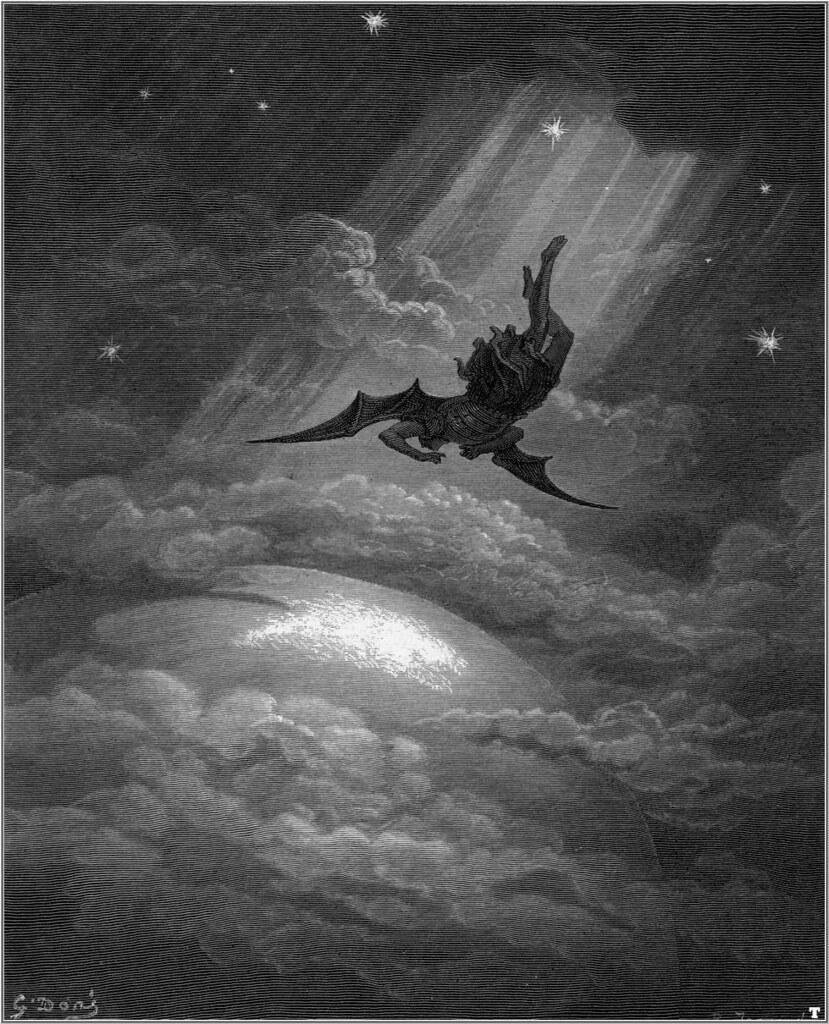
“DORÉ, Gustave Illustration for John Milton’s Paradise Lost 1866” by carulmare is licensed under CC BY 2.0

Potcake Poet’s Choice: Michael R. Burch, ‘Epitaph for a Palestinian Child’

I lived as best I could, and then I died.
Be careful where you step: the grave is wide.

Michael R. Burch writes: “This original epigram once returned over 90,000 results for its second line and still returned over 4,200 results the last time I checked. The epigram began as “Epitaph for a Child of the Holocaust” and was set to music by Sloane Simon after the Pittsburgh synagogue shooting.

It has been published by Romantics Quarterly, Poetry Super Highway, Mindful of Poetry, Poets for Humanity, The New Formalist, Angle, Daily Kos, Katutura English (Namibia), Genocide Awareness, Darfur Awareness Shabbat, Viewing Genocide in Sudan, Setu (India), Brief Poems, Better Than Starbucks and ArtVilla; also translated into Romanian by Petru Dimofte, into Turkish by Nurgül Yayman, into Czech by Z J Pinkava, into Indonesian by A. J. Anwar.”

Michael R. Burch has over 6,000 publications, including poems that have gone viral. His poems have been translated into fourteen languages, incorporated into three plays and two operas, and set to music by seventeen composers. He also edits TheHyperTexts.

“ICU child Shifa hospital, Gaza” by Kashklick is licensed under CC BY-NC 2.0

Potcake Poet’s Choice: D.A. Prince, ‘Horatio’

Always in shadow, on the edge, the light
falling on someone else. I’m used to it—
fidus Achates, and half-acolyte.
Besides, the sidelines are a safer bet
so I survive—at least, upon the page,
though never in imagination.
The curtain falls: I vanish with the stage.
Even Rosencrantz and Guildenstern live on
in other times but I—the dutiful
and sober pal, the philosophic friend—
dissolve. I fade. Meanwhile, the beautiful
capture your soul beyond the play’s neat end
where I’m to set, with due fidelity,
the record straight. You won’t remember me.

From: Common Ground, HappenStance Press, 2014.

D.A. Prince writes: “In the middle of a lively debate about which actor had played the definitive Hamlet, I realised I had no memory at all of any actor playing Horatio. There would have been an equal number, obviously. Horatio is on Elsinore’s battlements in the opening scene, questioning the existence of ghosts, and he’s there in the final scene, surrounded by corpses, giving the penultimate speech. In between he hovers in Hamlet’s shadow, necessary but—if I’m a typical theatre-goer—unmemorable. He doesn’t even get to cross the stage in Tom Stoppard’s Rosencrantz and Guildenstern are Dead. The world is full of people like Horatio so I thought I would give him a brief
acknowledgement: for turning up, for hanging on, for being there.”

D A Prince lives in Leicestershire and London. Her first appearances in print were in the weekly competitions in The Spectator and New Statesman (which ceased its competitions in 2016) along with other outlets that hosted light verse. Something closer to ‘proper’ poetry followed, with three pamphlets, followed by a full-length collection, Nearly the Happy Hour, from HappenStance Press in 2008. A second collection, Common Ground, (from the same publisher) followed in 2014 and this won the East Midlands Book Award in 2015. HappenStance published her pamphlet Bookmarks in 2018 and will bring out a further collection in 2022. There’s just the little matter of a title to resolve first.

Illustration: Hamlet and Horatio in the Graveyard (Eugène Ferdinand Victor Delacroix)

Potcake Poet’s Choice: Jane Blanchard, ‘The Kahler Grand Hotel (near the Mayo Clinic)’

I see the waitress cock her head to try
to figure out what I just said. Across
the booth my husband will not meet my eye
until she leaves to place our order. Sauce
for goose and gander holds that I will get
a turn to laugh (or not) at him. Neither
of us can hide where we are from. I let
him think his accent less than mine—either
of us can drawl a syllable into
a sentence. Fine. Most locals here speak plain
Midwestern as they welcome others who
seek remedies for matters inhumane.
How I may talk does not mean one iota
when visiting Rochester, Minnesota.

Jane Blanchard writes: “The Kahler Grand Hotel appeared in Third Wednesday (Winter 2020) right before COVID-19 changed all of our lives. This sonnet discloses how Jimmy and I tried to cope with a different medical crisis several years earlier. A little humor can go a long way when dealing with a scary situation. To this day we appreciate the many kindnesses shown to us when we were very vulnerable and very far from home.”

A native Virginian, Jane Blanchard lives and writes in Georgia. Her latest collection with Kelsay Books is Never Enough Already (2021).

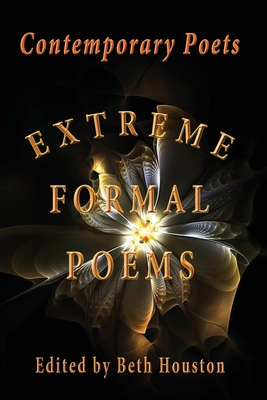
Review: ‘Extreme Formal Poems – Contemporary Poets’, ed. Beth Houston

Beth Houston has compiled an excellent anthology of formal verse (i.e. poems that use traditional structures of exact rhyme and tightly controlled meter; typically in familiar forms like the sonnet, villanelle, ballade, etc, but sometimes in a nonce form, a form specially created by the poet for that particular poem, and then rigorously maintained for all its stanzas). What is unusual in this day and age is these are all contemporary poets, for the most part American, though with half-a-dozen who at least started out in the UK. (In the interests of disclosure: two of my poems are in this book, and I am one of the non-Americans.)

The poems range in a variety of moods through a whole host of modern topics. With examples from first stanzas only, we have a flippant take on nature:

The female fly is nearly chaste.
She hasn’t any time to waste;
Her life’s a span of weeks, not months,
And so she copulates just once.

– Max Gutmann, The Fly

a rueful look at the military:

You’ve made us proud–the prosperous and free.
It doesn’t matter that a GED
was all the education you could get,
or that you signed up on a drunken bet.

– Barbara Loots, Thank You For Your Service

lighthearted memories:

In sloppy FM waves nostalgia rolls:
I wanna hold! You are the sunshine of!
Each oldie on the golden dial extols
Your soul, your body’s curves, your rockin’ love.

– Chris O’Carroll, Classic Hits

Villon-reflecting reflections on time and mortality:

Where are the flushed and frantic teens,
The hormones’ fevered ebbs and flows?

(Fire buckets, water, verbal screens.)
The girls–good grief!–that parents chose
And others–how the mind’s eye glows!
Who floated inches off the floor?

(Flout censor’s ruling–fish-net hose.)
With dodo, great auk, dinosaur.
– Jerome Betts, Ballade of Inevitable Extinction

pastoral descriptions of nature:

On moorland, on meadow, from dark sky I’m falling,
through peat, into pavement, I’m seeping, I’m sinking.
Above me the crows and the curlews are calling,
and of me the hares and the horses are drinking.

– Tim Taylor, Water of Holme

witty observations flavored with wordplay and interior rhymes:

I’m far from young enough to know it all.
With age my inner sage has paled and died.
My dimmer, dumber cerebellum’s fall
Leaves ever-clever youth aloof and snide.

– Susan Jarvis Bryant, I’m Far From Young Enough

But what you don’t get from the openings to the poems is that most of them pack a punch at the end. There will be a twist to the story, or a summation that recasts everything in a different light, or a straight-out contradiction of what the reader was being led to expect. The poems may be extremely formal. They are also extremely good.

The only regret I have is that some of the very best contemporary formal poets are missing: both the publicity-prominent (e.g. A.E. Stallings, Amit Majmudar, Gerry Cambridge, Wendy Cope) and the more reclusive (Pino Coluccio, Rose Kelleher, Marcus Bales). But happily there are still 37 excellent and prize-winning poets in Beth Houston’s well-selected anthology. So the good news is that a great many superb formalists are writing today, and–believe it or not–this looks like a Golden Age for formal verse. And ‘Extreme Formal Poems‘ is a very good manifestation of it.