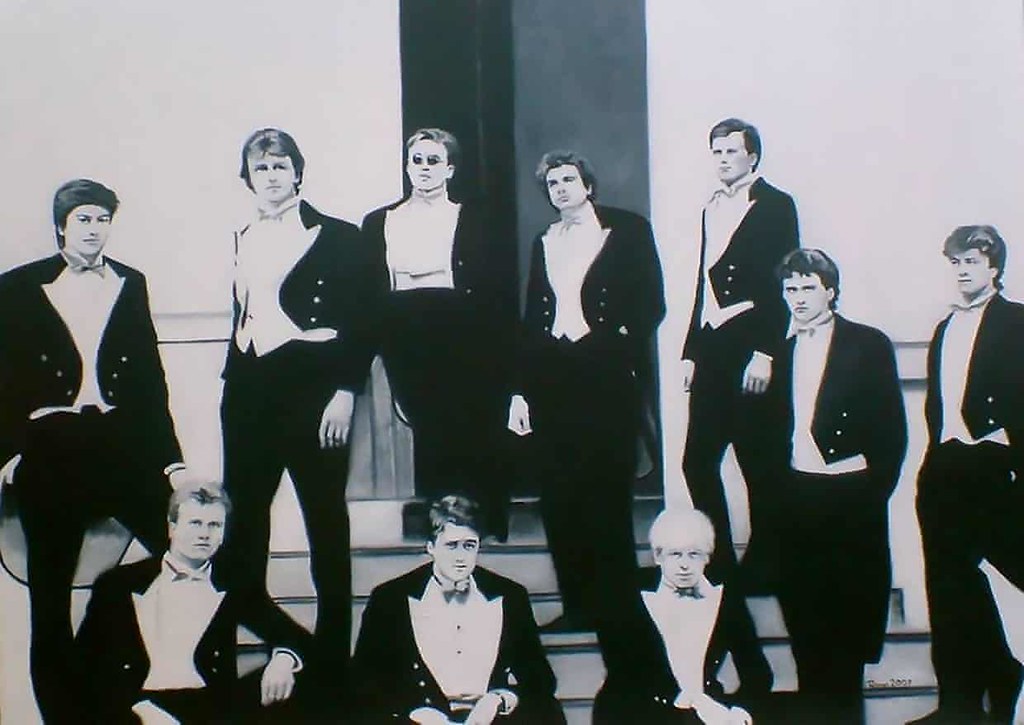
Some suffer from a travel itch but I call that a snivel glitch I only want to travel rich and love it: it’s my privelitch. O privelitch, o privelitch!
I only go to schools most rich, (and only eat foods superrich), then college has to be Oxbritch, for that’s my privelitch. I love you, love you, bitch!
I wear the robes and coronitch, I swear by God I’ve found my nitch, for, be I tubby, tall or titch, I’ve got my privelitch. O privelitch, o privelitch, I love you, love you, bitch!
I never on my class would snitch (or if I do, it’s just a smitch); I’m faithful – cept for those I ditch, for that’s my privelitch. O privelitch, o privelitch!
I down it nail, I up it stitch, call me a wizard or a witch, I’ve got it all, with perfect pitch, for that’s my privelitch. I love you, love you, bitch!
My life with none I’d ever switch, I’m over all, no slightest twitch, and even when I’m in Death’s ditch my tomb shouts Privelitch! O privelitch, o privelitch, I love you, love you, bitch!
*****
Don’t think I’m unaware of my own privilege: white males with above-average education are a privileged minority in any country. But also you reading this, whoever you are, you are privileged to not be a child in Gaza or any of the other hells that humans make for each other on an otherwise beautiful planet; you are privileged to be alive during this affluent and pivotal time in human history. And of course those who in addition have cultivated a taste for poetry… is there maybe a hint of privilege there?
This poem, like Buccaneer, was recently published in Magma.
Page one, above the fold: the world in flames. A luxury hotel gapes like a sore. In mammoth type, the headlines yell the names of prophets stoking hells of holy war.
In Business, meanwhile, there is calm discussion of sales rates for the sexy underclothes pitched by Victoria’s Secret, and a fashion for surgical revision of the nose.
It isn’t news to those who sell the paper: their readers can take only so much hell. They proffer me the surgeon and the draper as pastures where my bovine brain may dwell,
ignoring, while it chews on this confection, the screams of children from the other section.
*****
Maryann Corbett writes: “My records tell me that ‘Saturday Edition’ is one of my very earliest sonnets and very earliest acceptances, appearing in The Barefoot Muse in 2007 and included in Mary Meriam’s Irresistible Sonnets in 2014. It was among the poems that gave me the lightbulb realization that I tend to write sonnets when I’m angry.”
Maryann Corbett earned a doctorate in English from the University of Minnesota in 1981 and expected to be teaching Beowulf and Chaucer and the history of the English language. Instead, she spent almost thirty-five years working for the Office of the Revisor of Statutes of the Minnesota Legislature, helping attorneys to write in plain English and coordinating the creation of finding aids for the law. She returned to writing poetry after thirty years away from the craft in 2005 and is now the author of two chapbooks and six full-length collections, most recently The O in the Air (Franciscan U. Press, 2023). Her work has won the Willis Barnstone Translation Prize and the Richard Wilbur Award, has appeared in many journals on both sides of the Atlantic, and is included in anthologies like Measure for Measure: An Anthology of Poetic Meters and The Best American Poetry.
A rainy day in Cleveland. I almost said “The skies are gray.” Of course the skies are gray, It’s raining, so — what could they be instead? I meant to mow the rest of the lawn today, But it’s a day to watch the garden grow. The finches, flashing in the too-long grass, Are pecking dandelion seeds, and glow Their special yellow through rain-dotted glass. The internet is off. I sit and watch The irises and roses in the rain, And do not read about the ugly botch The greedy criminals in charge sustain So they can strut around, so white, so male, And cheat and lie to keep themselves from jail.
*****
Marcus Bales writes: “The rap against democracy has until now always been that the public, once it realized they could simply vote themselves money and benefits, would bankrupt the state voting themselves benefits and money. For 250 years the US public managed not to do that, though the reactionaries always accused them of it. It turns out the real danger is that if you have enough money you can just buy the government and operate it as a racket to benefit yourself and your cronies, even when there are laws in place that you have to break in order to do so. The problem with democracy, it turns out, is not that people are irresponsible but that the wealthy are liars and thieves.”
Not much is known about Marcus Bales except that he lives and works in Cleveland, Ohio, and that his work has not been published in Poetry or The New Yorker. However his ’51 Poems’ is available from Amazon. He has been published in several of the Potcake Chapbooks – Form in Formless Times.
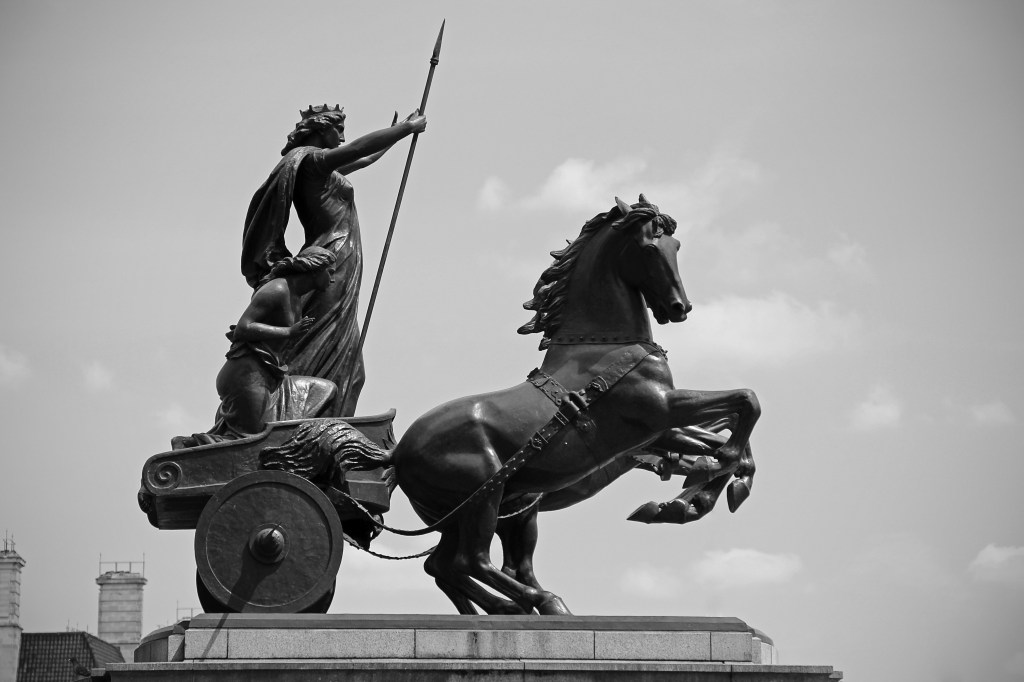
(The statue of Boadicea and her Daughters by Thomas Thornycroft was erected in 1902 near Westminster Bridge London.)
Set up, the civic skyline Shardless, A proxy late Victoria then, She charges, rein-free, grim, regardless, Towards the Gothic giant, Big Ben.
Just what is known about this fiery And long ago wronged ruler’s life? Such fields for scholarly enquiry Are now churned up by toxic strife.
For some, her Roman power rejection Makes for a memory well kept green, While others mock as myth-confection Their proto-Brexit British queen.
Remainers, Leavers, play Have at you! That chariot and rearing pair Of horses make a super statue. Whoever wins, she’ll still be there.
*****
Jerome Betts writes: “I find statues fascinating with their largely unchanging nature as the people and scenes around them change and they make an obvious target for revolutionaries, rowdies and rhymers. Boadicea, unveiled without ceremony in 1902 because of Edward the 7th’s appendicitis, strikes me as a splendid piece of slightly unhistorical sculpture and useful landmark for visitors. Amusement at her lack of reins and apparent charge towards the Palace of Westminster blended with the Brexit debate when the piece was published in Better Than Starbucks. Whether this dooms the last two stanzas to the archives remains to be seen.”
Jerome Betts lives in Devon, England, where he edits the quarterly Lighten Up Online. Pushcart-nominated twice, his verse has appeared in a wide variety of UK publications and in anthologies such as Love Affairs At The Villa Nelle, Limerick Nation, The Potcake Chapbooks 1, 2 and 12, and Beth Houston’s three Extreme collections. British, European, and North American web venues include Amsterdam Quarterly, Better Than Starbucks, Light, The Asses of Parnassus, The Hypertexts, The New Verse News, and Snakeskin.
Something there is that likes a wall, that likes it spiked and likes it tall,
that likes its pikes’ sharp rows of teeth and doesn’t mind its victims’ grief
(wherever they come from, far or wide) as long as they fall on the other side.
*****
Michael R. Burch writes: “Many people misunderstand the most famous phrase in Robert Frost’s poem ‘Mending Wall.’ In the poem Frost’s neighbor quotes his father’s adage that “Good fences make good neighbors” as they work together to repair an unnecessary wall on the border of their properties. Talk about a misunderstanding: this phrase has even been used by politicians to justify apartheid walls and similar barriers! But Frost did not share his neighbor’s belief and compared him to a stone-armed savage who moved in primitive darkness and could not go beyond his father’s saying. Frost’s own belief about such walls was expressed in the poem: “Before I built a wall I’d ask to know / What I was walling in or walling out / And to whom I was like to give offense.” At the end of the poem, Frost considers teasing his neighbor with the idea that mischievous elves are responsible for the wall falling down, but decides to hold his peace. My title questions who builds such walls: ‘Not Elves, Exactly’ but something much darker and more ominous.”
Michael R. Burch’s poems have been published by hundreds of literary journals, taught in high schools and colleges, translated into 22 languages, incorporated into three plays and four operas, and set to music, from swamp blues to classical, 61 times by 32 composers. He is also the founder and editor-in-chief of The HyperTexts.
The pig smashed the music and turned off the sun. As the pig couldn’t use it nor should anyone.
O remember the time when the violins played and the meadows were blooming and we, unafraid dared to splash in the river and lie in the grass. But they’re mowing the field now and scattering glass.
The mother in China, the daughter in Spain, must learn to design a new habit again.
The athletes are anxious, the singers are dumb, the children are fractious and calling for Mum. Now Dad is in futures and selling his shares and his foreign computers are yesterday’s wares.
Who let the pig loose in the garden? and why have we cooked our own goose? I await a reply.
*****
This poem was originally published on Facebook. Concerning the trigger for creating it, Janet Kenny writes: “The only event was the world economy being interfered with by the folly of one awful man. One ignorant bully can dismantle the world.”
Janet Kenny left New Zealand to pursue a career as an operatic and concert singer in London, then settled in Sydney, Australia, where she worked in the anti-nuclear movement and jointly compiled, wrote and edited a book about the nuclear industry, Beyond Chernobyl, published by Envirobook in 1993.
Her poems have been published in printed and online journals, including Avatar, The Chimaera, Folly, 14 by 14, Iambs & Trochees, The Literary Review, Mi Poesias, The Guardian, The Spectator, The New Formalist, The Barefoot Muse, The Raintown Review, The Shit Creek Review, Snakeskin, Lavender Review, Soundz ine, Victorian Violet Press, The Susquehanna Quarterly and Umbrella. Her work is in the collections The Book of Hope and Filled With Breath: 30 sonnets by 30 poets and in the Outer Space anthology, Cambridge University Press. She shared an anthology of bird poems, Passing Through, with Jerry H. Jenkins. She has received three Pushcart nominations.
All Clark Gable had to do was sit where Hattie sat the night she won her Oscar®. He might not’ve thought of that: but how the angels would have chimed and cheered the noble cause of basic decency, and broken out in wild applause.
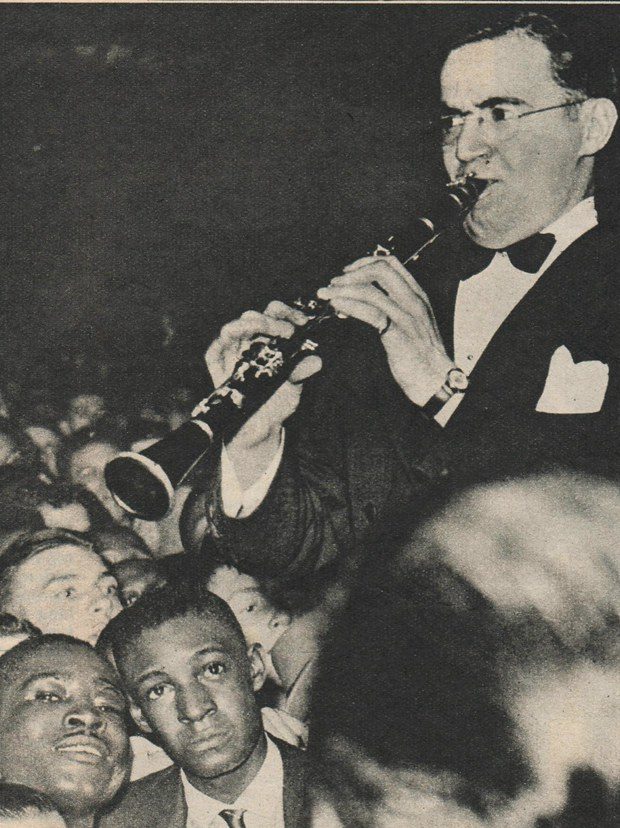
Benny Goodman would not sleep where his Brothers could not stay. He paved the American way before it was the American Way. For the color of music’s the color of God: the color of his quartet! So I hold no truck with movie stars, but I play the clarinet.
*****
James B. Nicola writes: “Hattie McDaniel was the first American woman of African ancestry to win an acting Oscar. It was for Gone with the Wind, Best Picture of 1939, which starred Clark Gable, the #1 movie star at the time, known as the ‘King of Hollywood’. McDaniel was not allowed to sit with her fellow nominees. Her acceptance speech, nonetheless, overflowed with grace and gratitude.
“Benny Goodman, clarinet player and band leader, was so popular he was known as the ‘King of Swing’. His quartet included two players of African ancestry. When on tour, Goodman, true to his name, only booked overnight accommodations that accommodated all four of his players. The film The Green Book gave us a good look at these hotel policies in America. It won the Oscar for Best Picture of 2018.”
James B. Nicola’s poetry has appeared internationally in Acumen, erbacce, Cannon’s Mouth, Recusant, Snakeskin, The South,Orbis, and Poetry Wales (UK); Innisfree and Interpreter’s House (Ireland); Poetry Salzburg (Austria), mgversion2>datura (France); Gradiva (Italy); EgoPHobia (Romania); the Istanbul Review (Turkey); Sand and The Transnational (Germany), in the latter of which his work appears in German translation; Harvests of the New Millennium (India); Kathmandu Tribune (Nepal); and Samjoko (Korea). His eight full-length collections (2014-2023) include most recently Fires of Heaven: Poems of Faith and Sense,Turns & Twists, and Natural Tendencies. His nonfiction book Playing the Audience won a Choice magazine award.
now we, the people, willingly obtuse and largely satisfied with self-abuse
elect a narcissistic psychopath who rules with lies, incompetence, and wrath;
accept a healthcare system that’s a mess and limp from life to death with less and less;
continue to dismiss without a care the shit we dump in water, land, and air;
allow the filthy rich to have their way, to run the world, to bleed us day by day;
abandon logic, reason, vital news and swallow whole all sorts of crackpot views —
we piss away our brains, our soul, our nerve and get the fucked up country we deserve
*****
Richard Meyer writes: “Current cultural and political circumstances have me feeling ornery, so I hammered out this verse about the great American democratic experiment. My caustic verse was partly inspired by the comments of various prominent writers throughout history, including Thomas Jefferson who said, “The government you elect is the government you deserve”.”
Richard Meyer, a former English and humanities teacher, lives in Mankato, MN. A book of his collected poems,Orbital Paths, was a silver medalist winner in the 2016 IBPA Benjamin Franklin Awards. He was awarded the 2012 Robert Frost Farm Prize for his poem “Fieldstone” and was the recipient of the 2014 String Poet Prize for his poem “The Autumn Way.” His poetry has appeared in a variety of print and online journals and has also received top honors several times in the Great River Shakespeare Festival sonnet contest. His most recent book, Wise Heart, is a memoir of his mother Gert who was born in poverty, came of age during the Great Depression, enlisted in the army during World War II, served overseas, and was awarded the Bronze Star for meritorious service performed during the Battle of the Bulge. His books are available through Amazon.
I hope you will forgive me for having given you hope— Too late for youthful indiscretion, though I believed my story and felt young in it until the metal facts fell.
I’d still like to imagine some god would help, but that line looks broken like the water, the gas and electricity.
What we have is hours, and in them you should have the bread and fruit before they feed the rats. I am keeping the wine for myself. It is piss-poor, anyway, and I have far more to forget.
J.D. Smith, ‘Slant Psalm’
My right hand has never known cunning, yet I remember thee, O Jerusalem, not as others’ sacred city but capital and emblem of loss, origin of far wandering without prophecy of return.
My right hand has never known cunning. May I have, as recompense, forgetting.
Michael R. Burch, ‘Starting from Scratch with Ol’ Scratch’ for the Religious Right
Love, with a small, fatalistic sigh went to the ovens. Please don’t bother to cry. You could have saved her, but you were all tied up complaining about the Jews to Reichmeister Grupp.
Scratch that. You were born after World War II. You had something more important to do: while the children of the Nakba were perishing in Gaza with the complicity of your government, you had a noble cause (a religious tract against homosexual marriage and various things gods and evangelists disparage.)
Jesus will grok you? Ah, yes, I’m quite sure! Your intentions were noble and ineluctably pure. And what the hell does THE LORD care about Palestinians? Certainly, Christians were right about serfs, slaves and Indians. Scratch that. You’re one of the Devil’s minions.
Gail Foster, ‘On The Heights Above Jezreel’
War’s harvest then is of these bitter fruits Hot shards of shrapnel buried in the flesh Of children, olives ripped up from the roots The horrid cries that fly from the nephesh And blinded eyes. Who benefits from this? Warmongers, metal forgers, men who plan Whole cities while still smoking ruins hiss Black marketeers and strategists. Who can Sleep peacefully while others have to hide Their families beneath their mothers’ skirts And bury them before their tears have dried? When will this harvest of these bitter hurts Be over? On the heights above Jezreel The storm clouds gather. Over soon I feel
Martin McCarthy, ‘The Unkillables’
There’s no great reason here to sing, but still they sing and play once more … the filthy, ragged children of the poor, who shall, as always, inherit nothing.
There’s no beckoning paradise beyond these war-torn streets of dirt, where chalked slogans outline their hurt, and yet, the unkillables rejoice!
Robin Helweg-Larsen, ‘Photo of a Dead Palestinian’
Hard to describe blown-off-ness of a head: no head, neck, shoulder – only flopping flesh, unfinished ending of a smooth-limbed, fresh, strong, naked body on white-sheeted bed; a tangled, mangled churning; then, instead of the anticipated face (serene as marble statue, Christmas figurine) instead, disorganised meat, spilling red.
No face or brains or hair. We’re sick, confused. The torn-off torso seems to have the calm proportions of an adult – look again: the genitalia of a boy of ten. “Collateral damage” is the term that’s used. Beside the body, on the sheet, an arm.
Marcus Bales: Right-Wing Semite-Murderer’s Song
Netanyahu: I am the very model of a right-wing Semite-murderer, Since I’m a Semite, too, the thing cannot get much absurderer. My people were abused by every tribe and nationality, So I, instead of empathy, embraced provinciality. Because we were oppressed I’m now oppressing weaker other folks, It gives me cover that we’re killing our Semitic brother-folks. It isn’t ethnic cleansing if I swear that in my piety I’m killing and I’m maiming only folks of my variety.
Nazi Chorus: It isn’t ethnic cleansing if we swear that in our piety We’re killing and we’re maiming only folks of our variety. We’re killing and we’re maiming only folks of our varie- riety.
Netanyahu: The same way each religion has its zealots kill for true-ishness Islamic zealots have declared that they’ll erase all Jewishness, And we have trained our own to act with criminal lethality To counterbalance enemies of lethal criminality.
Nazi Chorus: And we have trained our own to act with criminal lethality To counterbalance enemies of lethal criminality. To counterbalance enemies of lethal criminali- nality.
Netanyahu: I play the left against the right. My politics are strenuous. I say “If you hate one Jew …” Well, the rest is disingenuous. That propaganda works so well is not much of a mystery By pointing out how badly Jews were treated throughout history. We’ve rarely had an easy time, with ghettos, rape, and slavery, Our holidays still celebrate the mass of unmarked gravery. But we survived because we had our own ulteriority — And now we’re in a place at last where I am the authority.
Nazi Chorus: But we survived because we had our own ulteriority, And now we’re in a place at last where we are the authority. And now we’re in a place at last where we are the authori- thority.
Netanyahu: The Stern Gang and the Irgun were the Hamas of their day and time They killed and maimed the British, and they justified dismaying crime, And now my brave Israeli right-wing zealots take that bow for theirs, And use exactly those excuses Hamas uses now for theirs.
Nazi Chorus: And now our brave Israeli right-wing zealots take that bow for theirs, Exactly with the same excuses Hamas uses now for theirs. Exactly with the same excuses Hamas uses now for now for theirs.
Netanyahu: When everyone is furious that everyone is furious, And injury is contemplating things yet more injurious; When money spent on arms and planning how to break the breakerage Could buy opponents whole, including buildings, stock, and acreage; When every group is cheering zealots’ grim religiosity And everyone is trembling with the fear of new atrocity, I stay in office by appealing to the prejudicial dumb — While filling my Swiss bank accounts just like Hamas officialdom.
Nazi Chorus: I stay in office by appealing to the prejudicial dumb — While filling my Swiss bank accounts just like Hamas officialdom. While filling my Swiss bank accounts just like Hamas official- licialdom.
Netanyahu: No policy’s absurd enough that mine is not absurderer. I am the very model of a right-wing Semite-murderer. It isn’t ethnic cleansing if I say that in my piety I’m killing and I’m maiming only folks of my variety.
Nazi Chorus: It isn’t ethnic cleansing if we say that in our piety We’re killing and we’re maiming only folks of our variety. We’re killing and we’re maiming only folks of our vari- variety.
Robin Helweg-Larsen, ‘Roots of Terrorism’
Step back a moment, and reflect: not saying that it’s good or right that chained, starved, beaten dogs would bite– but what did you expect?
*****
Michael R. Burch, ‘Starting from Scratch with Ol’ Scratch’, first published in The HyperTexts Martin McCarthy, ‘The Unkillables’, first published in The HyperTexts Robin Helweg-Larsen, ‘Photo of a Dead Palestinian’ and ‘Roots of Terrorism’ first published in The HyperTexts




 Form in Formless Times