Category Archives: Robin Helweg-Larsen

Sonnet: RHL, ‘Your Lot’

From prairie city to an island town;
from city festivals to empty sea;
from continental seasons, white, green, brown
to changeless warmth and high humidity.
No one could hope for love more fierce, more loyal,
more honest, constant through good times, harsh tests,
raising our varied children as they boil
off along individual paths and quests
with a fierce love for them in their success
and even more, their fulfilled happiness.
You miss the north’s reliable forethought,
but not your parents, siblings and cold strife.
There’s always trade-offs, getting where you’ve got.
Just don’t look back. You chose your lot in life.

*****

Two questions: Is it a “sonnet” if the rhyme scheme is non-standard and there’s no real volta? And is it better to accept the unconventional form that the poem was comfortable in, or to try to beat it into more standard shape?

Obviously, I chose to leave it with its imperfections as I wrote it; but that might be from laziness more than anything else. Yes, I *do* work on poems after the first draft… usually… but once I’ve got something halfway acceptable I tend to stop. If I’ve got it to the point where I could easily learn to recite it, then it’s good enough.

But non-traditional sonnets are simply not as engaging, as well-balanced, as rhetorically forceful, as either the Petrarchan or the Shakespearean can be. Those forms have an elegance, a beauty, a structure that leads to a sudden insight or a punchline in a way that at its best (partly due to the rhyme scheme and partly due to the unbalanced “halves” separated by the volta) feels not just well-phrased but unquestionably true.

So this sonnet, if it is a sonnet, is second best. Still good enough to have been published recently in Pulsebeat – thanks, David Stephenson!

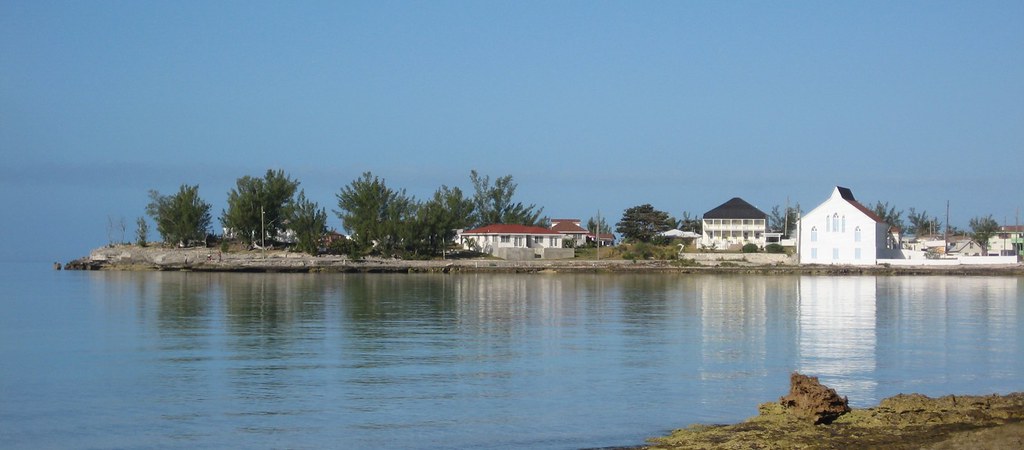
Photo: “Part of Governor’s Harbour, Across the Bay” by tylerkaraszewski is licensed under CC BY 2.0.

Light verse: RHL, ‘Question the Universe’

Odin wrote runey verse
Rumi wrote Sunni verse
Edward Lear? Loony verse.
Question the universe
with your buffoony verse.

*****

Sometimes you jot down a little light piece inspired more by wordplay than anything else, and the more you look at it the more it resonates. This is one such. The characters are diverse, coming from pre-literate Scandinavia, Renaissance-inspiring Islam, and Victorian England – they touch the roots of my cultural identity. They are from the past, but their searches are timeless, fully modern, quintessentially human. And I fully subscribe to the idea that we should question everything, and that the Fool‘s tools of succinct and enigmatic wordplay may be as good an approach as any in trying to formulate – let alone answer – all questions, physical and existential.

It further resonates for me in being published (which I find important); in being published just now in Light (which is a wonderfully reassuring place to be); in having been improved in response to Light’s editorial comments (meaning, yes, I am proud that sometimes I am open to criticism and it’s useful); and in being my 400th poem published (by one of my conflicting counts).

Nothing is definite, not the historical reality of historical and semi-historical figures, not the permanence of printed words, not the definition of a poem, not the count of things hard to define, not the nature of physical reality. So though we have to make prosaic choices based on appearances and best guesses, that should be balanced by questioning everything. Preferably in verse.

TL;DR: Even short poems can be unpacked.

Illustration: DALL-E by RHL, ‘Rumi, Odin and Edward Lear are writing poetry to question the universe’

Short poem: RHL, ‘Friendship, Not Passion’

I had a friendship, more than passionate love, for you;
we could have been so good, easy, together.
But there’s that issue of your strong religious thoughts,
whereas I let my thoughts change with the weather.

I… well, and who’s the I you think that you address?
I ramble, googly-eyed, my arms elastic.
There are so many sweet but sadly firm believers.
I’m – more than atheist – iconoclastic.

*****

If you’re used to iambic pentameter the meter of this poem feels just a little off, with its lines of alternating 12 and 11 syllables, i.e. alternating hexameters and feminine-ending pentameters… not quite comfortable. Which is perfectly in keeping with the relationship described. And I don’t remember precisely which long-ago not-quite-girlfriend I had in mind when I wrote it; I’ve been attracted to more than one charming female, wonderfully calm and sane except for some unfortunate religious orientation or other.

I’m reminded of the 19th century Punch cartoon of the two guests at a dinner party:
She: “And what is your religion, sir?”
He: “Madam, all men of sense are of the same religion.”
She: “And which religion is that, pray tell?”
He: “Madam, men of sense never say.”

Which is all very well for friendship, but hardly a solid basis for a deeper relationship. You’re better off if you hold out for someone philosophically compatible, unless you (and they) really don’t care. In which case, you’re philosophically compatible!

‘Friendship, Not Passion’ was originally published in Lighten Up Online, edited by Jerome Betts.

Illustration: “Friendship” by h.koppdelaney is licensed under CC BY-ND 2.0.

Sonnet: RHL, ‘Halloween’

I sing the changing seasons of the year
And, as leaves fall, I celebrate my death.
Each inhalation may be my last breath;
Each year I lose another near and dear.
So many people live life in Death’s fear,
The very word <cough> Dead’s a shibboleth –
Paint on false youth like old Elizabeth –
Yet half the planet’s Spring, while it’s Fall here.

Eternal life is ever to be felt,
For death, rebirth, are always intertwined
In pious hopes, in science still unseen.
The pagan in me – Viking, Druid, Celt –
All celebrate when Life’s return’s divined.
It’s Halloween, so I will dress in green.

*****

This sonnet with its Petrarchan rhyme scheme (ABBA ABBA CDE CDE) was originally published in The Lyric a couple of years ago. “Founded in 1921, The Lyric is the oldest magazine in North America in continuous publication devoted to traditional poetry.”

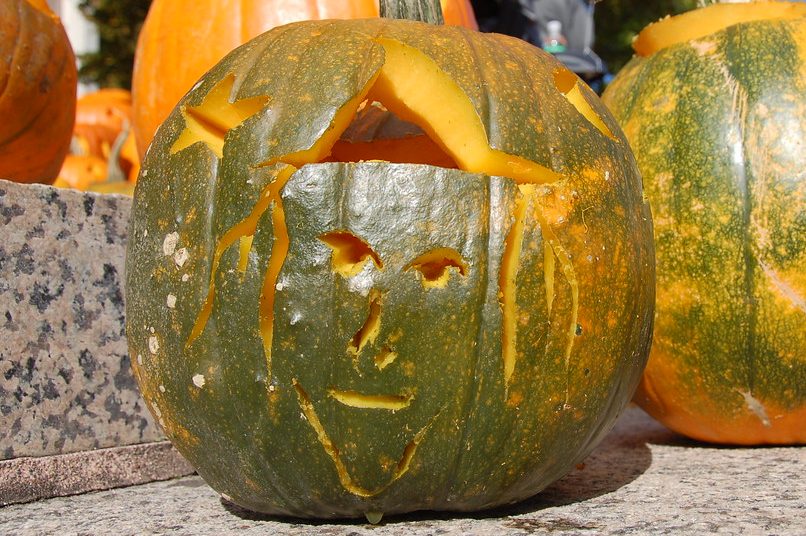
Green pumpkin carved into witch face jack-o-lantern” by Chris Devers is licensed under CC BY-NC-ND 2.0.

Poem: RHL, ‘On Doing Nothing’

Here where the royal poinciana’s blaze
pales to haze in the full midday craze
of light on shallows stiller than you can see
and all time stops, worn out from timeless sun
in a land and season where nothing’s to be done,
futility stretching to eternity,
and nothing is, except for heat and light…
accept the heat and light, the dazzling green and blue,
do nothing: for there’s nothing here to do.
Although elsewhere the world’s a ruin of smoke—
democracy and leadership a joke—
I unapologetically sit out the war
(whether on virus, climate change, or rich v. poor),
I’m Swede or Swiss to their corrupted plight.
A fish, a coconut—I don’t need more.
And so I sit and think, and read, and write.

*****

I should probably write a little about this poem’s form (iambic pentameter and rhyme, and could have had more shape if I had put more effort into it) or inspiration or whatever… but that would be work, and who needs that?

Published this month along with two others in Shot Glass Journal, anyway… thanks, Mary-Jane Grandinetti!

Photo: “Lazy Afternoon” by cybertoad is licensed under CC BY-NC-ND 2.0.

Non-traditional sonnet: RHL, ‘The Range of Change’

In times of no change, the advantage lies
with those who are receptive to being taught.
Parents and teachers may seem truly wise,
avoiding dangers with which life is fraught;
the stories of the old none would despise
when they hold all the answers that are sought.

In times of constant change, advantage shifts
to those who, hating school, go and explore.
Old answers fail. Fresh questions cause great rifts
with parents who are seen as wise no more;
questions now turn up unexpected gifts
in crossing unknown seas to virgin shores.

Remain alert that there’s a range of change
from none, to gradual, to fast, to strange.

*****

A sonnet, or not? 14 lines of iambic pentameter, rhyming regularly and with a final couplet. Though not in either of the standard English forms, it has the organised, compressed, reflective sense of the sonnet. Recently published in Shot Glass Journal, Online Journal of Short Poetry. Thanks, Mary-Jane Grandinetti!

Climate change icon” by Tommaso.sansone91 is marked with CC0 1.0.

Sonnet: ‘Sad, Actually’

Unreconstructed, with unhealthy heft—
the image of uncivilised great ape—
a fraud who tries to win by lies and theft,
a man who’d propagate by power and rape,
racist extoller of his genes alone,
a would-be genocidal patriarch,
successful in some twilight Darwin zone,
uncultured as a mugger in the park…
But note, behind the thin success veneer,
the shallow love of gold and gilt and glitz,
gloating dismissals and the bloated sneer,
the self-aggrandisement that never quits:
an unloved child’s in some deep down recess,
the secret of the man’s unhappiness.

*****

I can’t help feeling sorry for people who were raised so badly that they have never learnt to find security, inner peace, personal meaning. On the other hand I can’t help rejoicing when some destructive, selfish racist is exposed as a cheat and a fraud under the control of a foreign power, and is removed from positions of authority. I think of that sympathy/schadenfreud dichotomy as a healthily balanced contradiction; but then, I’m a Libra…

This sonnet (Shakespearean, being in iambic pentameter and rhyming ABAB CDCD EFEF GG) has just been published in Shot Glass Journal, an online journal of short poetry. Most of what they publish is not formal verse, but most of mine is.

Photo: “File:Vladimir Putin and Donald Trump (2019-06-28) 06.jpg” by Presidential Press and Information Office is licensed under CC BY 4.0.

NSFW Sonnet: ‘Restaveks’

Illegals, both of us; married last year,
now she cleans houses, I cut grass, sweep decks,
for superrich who see us as mere specks
while their big spaceship exit they prepare.
Earth will be fishless, treeless, plastic, bare.
They’ve offered us both jobs as restaveks,
but I said No, they just want us for sex.
She said Then suck them off, why should you care?
I said, We’ll stay. She said, I said I’d go.
I said, You’d leave me? She said, Stay, be dead.
I said, That makes you nothing but a whore.
She said, I fucked him for your job, you know;
I go to space, I’ll live, have food, have bed,
and, if I’m good, oh maybe so much more…

*****

“Restavek” is normally a term for a child of an impoverished Haitian family, sent to live as a domestic servant for a wealthier (or less poor) family. There are an estimated 300,000 in Haiti, mostly girls; and an unknown number in the Haitian communities in the US.

This sonnet (Petrarchan, rhyming ABBA ABBA CDE CDE) was recently published in the frequently NSFW Rat’s Ass Review – thanks, Roderick Bates!

Illustration: “Tiny Empires 3000” by Daniel Voyager is licensed under CC BY 2.0.

Excerpt: ‘You, Yes You’

You, yes you, contain multitudes, conflicted mobs-–
the adroit who holds two jobs,
the maladroit who fails and sobs,
the shortcut thug, dacoit, who simply robs-–
you’ve urges to protect and to exploit:
be just! (but help yourself when you’ve the chance
and no one’s there to look at you askance.)
Priests educate, instruct and rape their flock
as farmers care for, milk and eat their herd
and statesmen love the country they extort.

*****

This is (apparently) the most interesting excerpt from a longer rant that was more than the Rat’s Ass Review wanted. Thanks Roderick Bates for selecting this piece!

Disagreement” by Petri Damstén is licensed under CC BY-NC-ND 2.0.

Poem on Poetry: ‘Poets Do Tricks With Words’

Poets do tricks with words,
play games, weld rhyme,
but we don’t do this nicely all the time–
we’ve also anger at unfairness, anger hot-white
at wasteful power, at greed and spite,
where fear meets selfishness, drives right and left
to persecution, torture, war and theft.

Each trick sticks bricks, fixed and unfixed,
into an apartheid verbal wall
that warbles claims to separate
sense from nonsense–though we appreciate
all’s one, all’s all the same,
word walls are just a Jenga game,
and all bricks fall.

We can play games with words,
thread and unthread them in a silly tangle,
loom and illuminate light warp, dark weft,
wrong them and wring them ringing through a mangle
as sometimes the only way
to find a new way to say
things said ten thousand times before:
how brightness has a rightness,
whether in the sky, the sea, a face or an idea.

So cook with words, mix, bake,
packing in raisins, nuts, half cherries for a cake
with flour just enough for a pretence
that it’ll hold together and make sense.

*****

Formal? Free? The arguments about the appropriate structure for poetry in English never seem to end. The semi-formal compromise has been around for a long time: take the rhythmic, rhyme-rich ramblings of Arnold’s ‘A Summer Night’ from 170 years ago, or Eliot’s ‘Prufrock’, written in 1911. To me, the test of good verse is that it is easy to memorise and recite: the ideas and imagery have to be memorable, but so does the expression, word for word. The tricks may vary by language and culture, but whatever tricks the poet can manage to achieve memorableness are legitimate.

‘A Summer Night’ was in my English A Level curriculum <cough> years ago, and the middle section which I still know by heart encouraged me to run away from school. (I was found trying to sleep in a phone booth while waiting for a morning train, and brought back to school at 2 in the morning.) The poem’s semi-formal structure has always appealed to me with its rhetorical power, and over the years I’ve often used that freedom when writing about poetry, as in ‘Some Who Would Teach‘ and ‘Inspiration 2‘ and ‘Memorableness‘.

‘Poets Do Tricks With Words’ has just been published in Orbis, edited by Carole Baldock.

Photo: “National Fruitcake Day” by outdoorPDK is licensed under CC BY-NC-SA 2.0.