Category Archives: sonnets

Potcake Poet’s Choice: Marcus Bales, ‘Cleveland Krater’

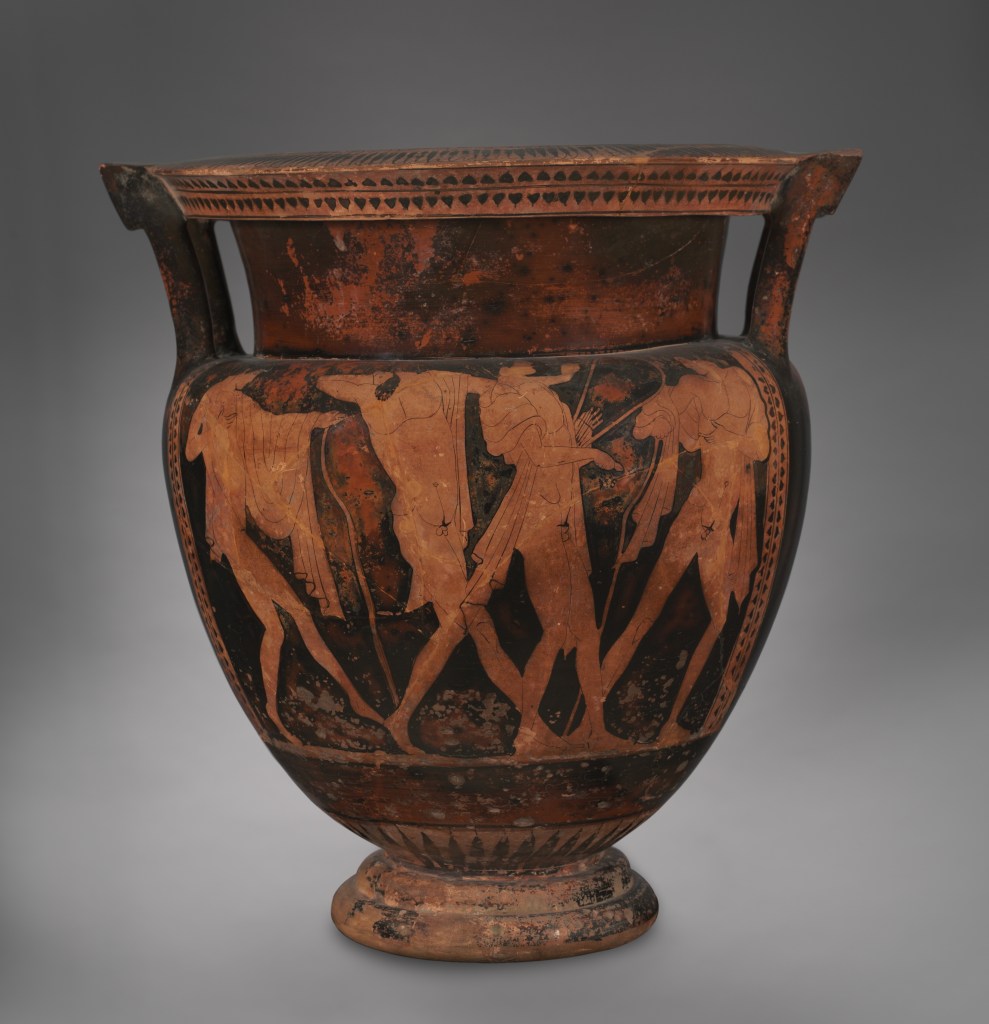
This column krater once held watered wine,
Its figures, red on black, an illustration
Of how it served the daily and divine.
On one side Hera offers a libation
With Artemis, Apollo, and their mother,
While three nude athletes and a bearded man
Are drunk with more than liquor on the other.
I stare through all four panes of glass that ban
All but my eyes from learning every curve,
And I can only dream that luck and nerve
And my own art may earn a chance to feel,
As one of few who cares to understand
That ancient try to make one ideal real,
To feel it push through time with my own hand.

*****

Marcus Bales writes: “A poem is language in meter that evokes emotion in the reader. Those who write to express themselves are doing something other than writing poetry. No reader accomplished enough to be engaged in reading poems is in it for the writer’s blurt. It may be that the writer is trying to evoke the same emotion in the reader that the writer felt in the poem’s circumstances, but the goal remains to evoke that emotion in the reader, not merely recount the writer’s emotion.

Poems that fail to evoke emotion in the reader are failed poems and, alas, every poet has several. They wait patiently like the mythic swordsman in fairytales to keep the protagonist from going through the door behind them. Our hero or heroine arrives in the room, the swordsman puts down Kant’s ‘Critique of Pure Reason’ – in the original German – and smiles, drawing a sword. The writer, however already wounded or tired from the effort of getting there, engages and soon enough, after an elaborate exploration of the waiting swordsman’s skills, is disarmed. The swordsman bows, kicks the writer’s sword back to him, sheathes his own, picks up his book, and sits down again, angles it to the light from the only window, nods goodbye, and resumes his perusal. The writer picks up the disgraced weapon, and trudges back out the way they came in. That poem still does not do what the writer intended to do: evoke emotion in the reader; all it remains as is an account of his or her own emotion.

It is the strength of that felt emotion that keeps the writer coming back to the failed poem, ever hopeful that it is an exception to the unyielding rule that the poem is for the reader, not the poet. Some poets make careers out of performing such things, their agents guaranteeing that the poet will cry during the performance, sure that the promoters are only interested in the performance, not in its effects on the audience. And there are audiences for whom watching the performer fail in their presentation is the point. No one involved in that scenario is there for poetry.

Unfortunately, this poem, ‘Cleveland Krater’ is one of those failed poems. Absent the actual krater, I have finally come to realize, the reader is not going to experience the emotion I did. I have come back and back to this piece, always after having visited the krater again, examining it closely through its Plexiglas box, looking for the clues that moved me and still move me, to try to shove them into words that will bring that impact I felt to the reader. Maybe if I just admit my failure I will get free of the draw of its blade when I arrive at it, again, hoping that this time I’ll do better than the dismissive kick of my sword clattering across the stone floor.”

Not much is known about Marcus Bales except that he lives and works in Cleveland, Ohio, and that his work has not been published in Poetry or The New Yorker. However his ’51 Poems’ is available from Amazon. He has been published in several of the Potcake Chapbooks (‘form in formless times’).

An extensive review of the Cleveland Krater and its creator can be found at https://www.academia.edu/12708103/The_Cleveland_Painter. You don’t need to log in or register, you can simply scroll down to read the entire pdf.

Photo: provided by the Cleveland Museum of Art https://www.clevelandart.org/art/1930.104#

Sonnet: ‘Zombies and Wolves’

Women I’ve failed or wronged or left behind
Approach my thoughts like zombies for the kill;
I’ve literary walled defences – still,
Given the chance, they’ll eat my brains, my mind.
Through forest, orchard, farmyard in decay,
A shadow of a wolf slips greyly in,
My thoughts of death, grim, wasted, ill, rib-thin,
Tracking my weak resolve, hungry to slay.

Mountaintops blown apart, forests clear-cut,
Where’s there to hide? Nature doesn’t exist;
Her landscapes crushed in patriarchal fist.
This former farmland hides my ruined hut.
Impotent, I still write, thus giving birth
To future wolves and zombies of the earth.

*****

What on earth triggered this sonnet 15 years ago? I have no idea. What’s it really about? Well, it seems the volta between the octave and the sestet moves the narrative from purely personal regrets to our current planetary destruction. More than that, I can’t say. Your suggestions are welcome!

Anyway, the poem was published in that now-defunct British beacon of formal verse, Candelabrum.

Photo: “Wolves in Action” by iam_photography is licensed under CC BY-NC-SA 2.0.Copy text

Potcake Poet’s Choice: Helena Nelson, ‘On Gloom and Proper Respect’

He doesn’t exactly blame her for it. No,
it’s not her fault. She is the way she is—
incorrigibly optimistic. But
the strain of her unbridled cheerfulness

must tell. His gloom requires due diligence.
It’s there to serve a need, and needs a slow
and proper processing. That’s it—a proper pro-
cessing. To this he must commit, and hence

his necessary isolation. No,
he is not depressed. He’s just process-
ing. Some ‘thing’ is passing through. It will go
eventually, but it must run its course.

The weight of doom would be a minor stress
if she would just dispense with cheerfulness.

Helena Nelson writes: “This poem is part of a book-length sequence telling the story of an ordinary, conventional marriage (albeit a second marriage for each partner). It’s about love that struggles to survive the difficulties of aging, loss and illness. The husband, Mr Philpott, has always suffered from anxiety but he has bouts of depression too, when he withdraws into himself. In fact, he might fairly be described as a ‘difficult’ man, though he can’t help it. Here the sonnet form reflects his need for tight control, repressing his anxiety about depression, which gets squeezed uncomfortably across the line breaks. There’s humour here, too. Because how absurd it is, surely, to wish your wife were less cheerful? And yet he does. He certainly does.” 

Helena Nelson runs HappenStance Press and sometimes writes poems, one of which appears in the soon-to-be-released latest Potcake Chapbook, ‘Lost Love’. She has been writing the story of Mr and Mrs Philpott for over twenty years, and it can finally be found in its complete form as Pearls (The Complete Mr and Mrs Philpott Poems). 

Sonnet: “What Will You Be When You Grow Up?”

Historically, this never was a thing.
You did what you were born to do, were told,
Fitting yourself into your parent’s mold,
A farmer’s son a farmer, king’s son a king,
A girl to be a mother and a wife.
But then came education, travel, choice,
Awareness of the wishes you could voice,
Countries, careers, sex partners — it’s your life!
And though just who you are you cannot know,
Nor what you want, yet all is your decision.
You’ll make mistakes, find failures and derision,
But life is long: so have another go . . .
Retry, and then try something else; take; give.
Do what you love. You die, regardless. Live!

This sonnet is a mirror of the short poem I posted most recently – and I’m happy to see that my outlook has a certain consistency, even over a 50 year period.

The sonnet has just been published in the formal verse section of the current Better Than Starbucks – thanks, Vera Ignatowitsch!

Photo: “career choices” by Jerome T is marked with CC BY-NC-ND 2.0.

Sonnet: ‘We Know We Will Be Dead’

We know we will be dead, who are alive.
But should some element of us survive –
fragment of consciousness or memory –
what value could it have? What should it be
that the whole universe might benefit?
The atom matters – what’s not made of it?
And we’re not large – not like a conscious star
(if time will let us all evolve that far).
You’re not much different in real magnitude
from an ant crushed for going for your food,
a gnat rubbed out, its tiny consciousness
a dot… but does it build the universe?
If that gnat can’t, I don’t see how you can:
there’s not much difference between gnat and man.

Does a poem of 14 lines, rhymed in pairs, count as a sonnet? Perhaps, but it doesn’t feel quite right. Petrarchan and Shakespearian sonnet structures, with more complex structures of rhyme, produce a much greater impact with the final line–a sense of revelation, inevitability, an impression of absolute truth–purely by the successful rounding out of the pattern. I like this poem’s ending couplet… but it would be stronger if the previous 12 lines were better structured.

‘We Know We Will Be Dead’ was published in the most recent Allegro, edited by British poet Sally Long.

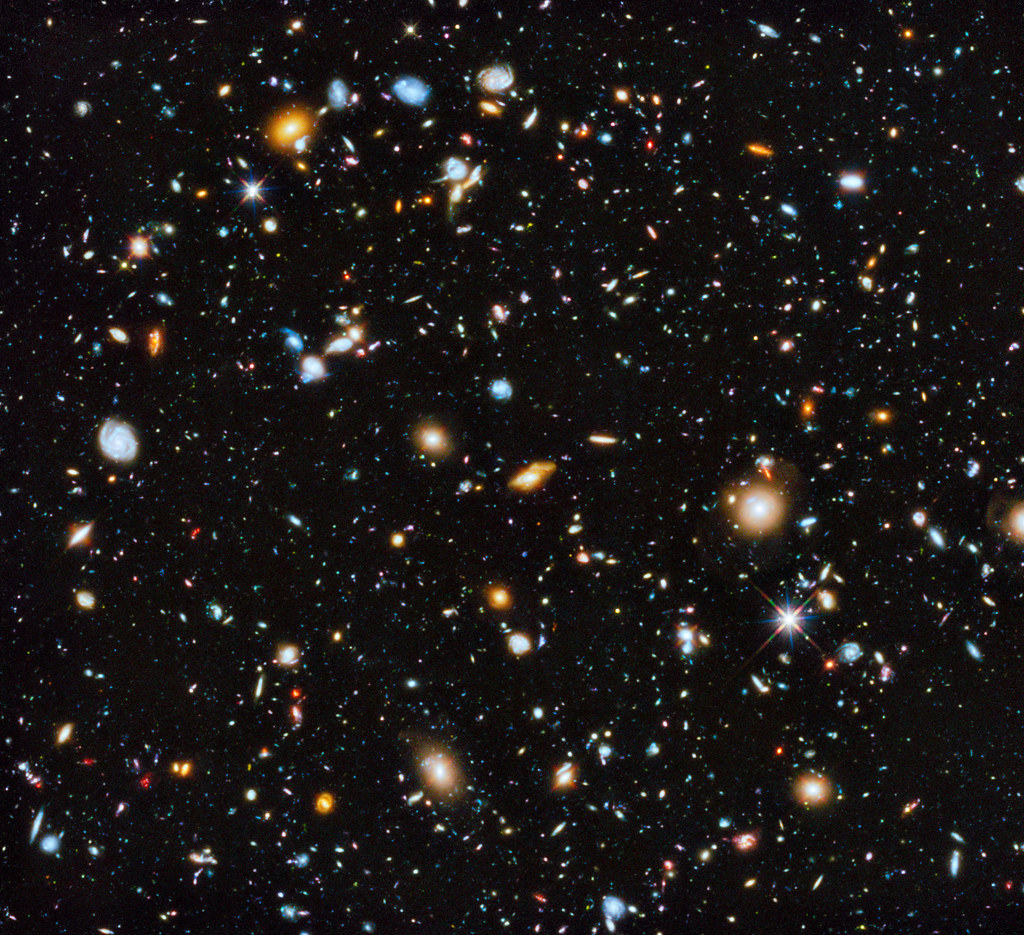
“Hubble’s colourful view of the Universe” by Hubble Space Telescope / ESA is marked with CC BY 2.0.

Sonnet: ‘Voyage’

Some watch the widening, receding wake
On life’s long voyage. Others at the bow
Scan ahead, wondering what route we take.
(But Past and Future point to one end, Now.)
When disembarked, what will your story be?
“I looked back, couldn’t tell where we’d begun…”
“I tried to look ahead, but couldn’t see…”
“I read lots.” “Slept.” “I made friends.” “I made none.”
“Sunsets were nice.” “The food was just so-so.”
“I helped someone.” “I tried, but got in fights.”
What’s next?
Aboard Earth round the sun all go,
Each spinning whirl hundreds of days and nights,
Through scores of rounds. How’d we get here? Don’t know.
Then each, some unknown -day and -where, alights.

This poem was originally accepted for Contemporary Sonnet but, as far as I understand, when Charlie Southerland took over from the previous editor all the online passwords had been lost, and the magazine folded. So the poem went to Verse-Virtual instead. Given that its subject matter is the unpredictability of life, such changes for the poem’s own voyage are quite in keeping.

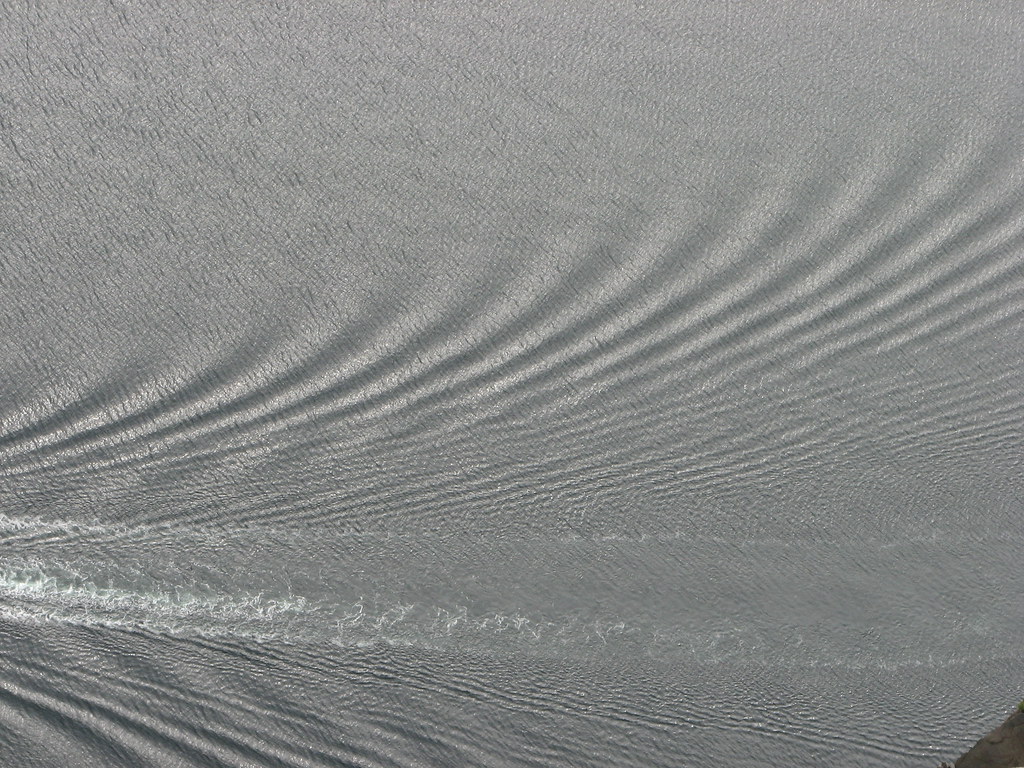
“Ship’s wake” by Dany_Sternfeld is marked with CC BY-NC-ND 2.0.

Sonnet: ‘Thunderclouds’

Lightning connecting heavens to the Earth
When heat, humidity grow thunderclouds–
Blackening, building to torrential floods–
Is how the Singularity will birth.
Then our new thunderous AI gods appear,
Growing and killing, Shiva-like, their wards.
(I, for one, welcome our new Overlords…)
Their lightning flashes blind, freighted with fear.
From rising mists and steams of consciousness
Poetry stormclouds, too, flash and connect.
When humans by our own AI are wrecked–
Our own connected selves and selflessness–
The Jovian bolts of electricity
Will be posthuman–and pure poetry.

No, this doesn’t have anything to do with Vlad the Bad‘s invasion of Ukraine. It is just part of my decades-long fascination with the way that technology is laying the foundations for AI that will be more powerful than humans, and for brain-to-brain communication that will move us to a Borg-like condition. And then what? It’s unknowable, but it will be the end of the world as we know it. And I feel fine. Nature is in a permanent state of change and replacement and development, and humans are not exempt from being obsoleted. Not this year or next. But in 100 years, who knows what transitions will be happening?

This sonnet was first published in the Shot Glass Journal.

“Thunderhead” by Nicholas_T is licensed under WordPress Creative Commons

Potcake Poet’s Choice: Claudia Gary, ‘Phonograph’

Remember, dear, when this was the one way
to make a disk sing? Full-size, not compact—
and both the disk and player would obey
only if you possessed your share of tact:
You’d lift the tone arm, puff a bit of air
across its fragile needle to remove
new dust, or use a brush of sable hair
to coax it out. After each vinyl groove
was polished with the softest chamois cloth,
you’d spin a record on its table, place
the needle over it, light as a moth—
you must remember! For the way you trace
the path of every melody I store
shows gentleness I’ve never known before.

Claudia Gary writes: “In case anyone still thinks art and science belong in different categories, it may help to remember that long before there were computer nerds, there were music nerds (audiophiles). Back then, enjoying high fidelity sound at home required paying close attention to detail and taking good care of fussy, sensitive machines. They may not have been as cavalier as today’s machines that demand upgrades at their own convenience; but yesterday’s machines did need a lot of TLC in exchange for beautiful music. And so does love.”

Claudia Gary lives near Washington, D.C., in Northern Virginia, and teaches workshops on Villanelle, Sonnet, Natural Meter, Poetry vs. Trauma, Poetry for Musicians, etc., at The Writer’s Center (writer.org) and elsewhere, currently via Zoom teleconference. Author of Humor Me (David Robert Books, 2006, in which Phonograph was published), and of chapbooks including Genetic Revisionism (2019) and Bikini Buyer’s Remorse (2015), she is also a health science writer, visual artist, and composer of tonal chamber music and art songs. See pw.org/content/claudia_gary; follow her on Twitter at @claudiagary.

Photo credits:
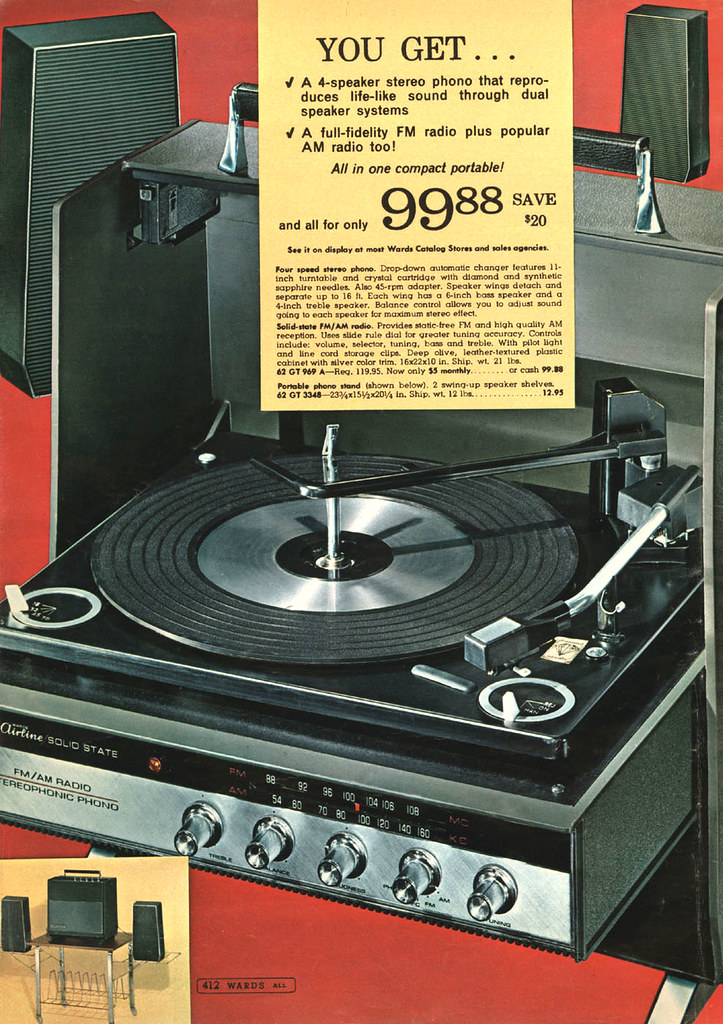
“1968 … all in one portable stereo phonograph!” by x-ray delta one is licensed under CC BY-SA 2.0
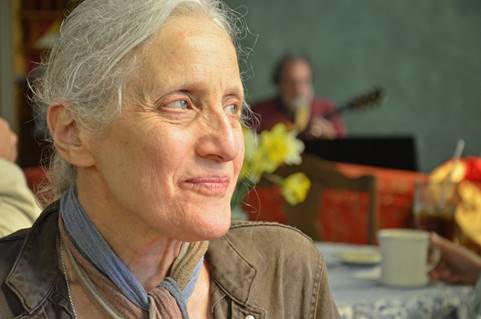
Claudia Gary photo by John Flannery

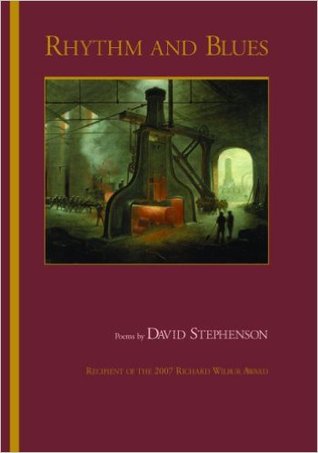
Review: ‘Rhythm and Blues’ by David Stephenson

David Stephenson’s ‘Rhythm and Blues’ was the 2007 Richard Wilbur Award winner, and contains some excellent poems. Its back-cover blurbs are accurate–as Kim Bridgford states, the collection has “wisdom, a plain-spoken, convincing style, and a sense of irony… all the time with impressive technical skill.”

Several of the sonnets are excellent: ‘Pilate’ meditates on the harshness of the law,
But why waste breath? In six months, who will mourn
This insect, or recall that he was born?

The ‘Geologist’ speaks of his passion for the history of rocks, ending:
The present is a world of dirt and sand
And people–they of the immortal soul–
Whom I do not pretend to understand,
Though I admire them in their long-term role
As precursors to limestone, chalk, and coal.

And beyond the sonnets are villanelles, and longer blank verse monologues in the voices of a toll collector, a housebreaker, a corporate hatchet man, and so on; and poems with various structures of stanza.

But there is a problem: the ruthless, relentless, metronomic use of iambics. The entire collection is in either iambic pentameter or iambic tetrameter. In general, the shorter pieces are good; the longer pieces are thematically interesting, but I find pages of blank verse unappealing. Stephenson can obviously think easily in iambic pentameter; but that skill tends towards blather. As the book title suggests, there is rhythm; but with insufficient variety for the claim of music.

But maybe this is expecting too much. Stephenson is a committed formalist, to the extent of having started his own Pulsebeat Poetry Journal for formal verse. His sonnets in particular are very good. And the book is highly readable and rereadable–though in small doses, not straight through in one go.

And there is actually one break in the unremitting use of iambics, in the shortest and most whimsical poem in the book–and for all those reasons perhaps my favourite. It is ‘To a Garbage Truck’:

Stop for me, romantic sloop,
When all your cargo is on board
And your ride low upon the waves,
For I would cast my lot with yours

And put forth on the open street
En route to some strange orient
Full of exotic ports of call
Beyond the gray horizon.

Potcake Poet’s Choice: David Galef, ‘Justification’

And malt does more than Milton can
To justify God’s ways to man.
—A. E. Housman

When I am beaten down by work and love,
And others head for local dives to drink,
I clench my soul and strive to rise above,
For stimulating words to make me think.
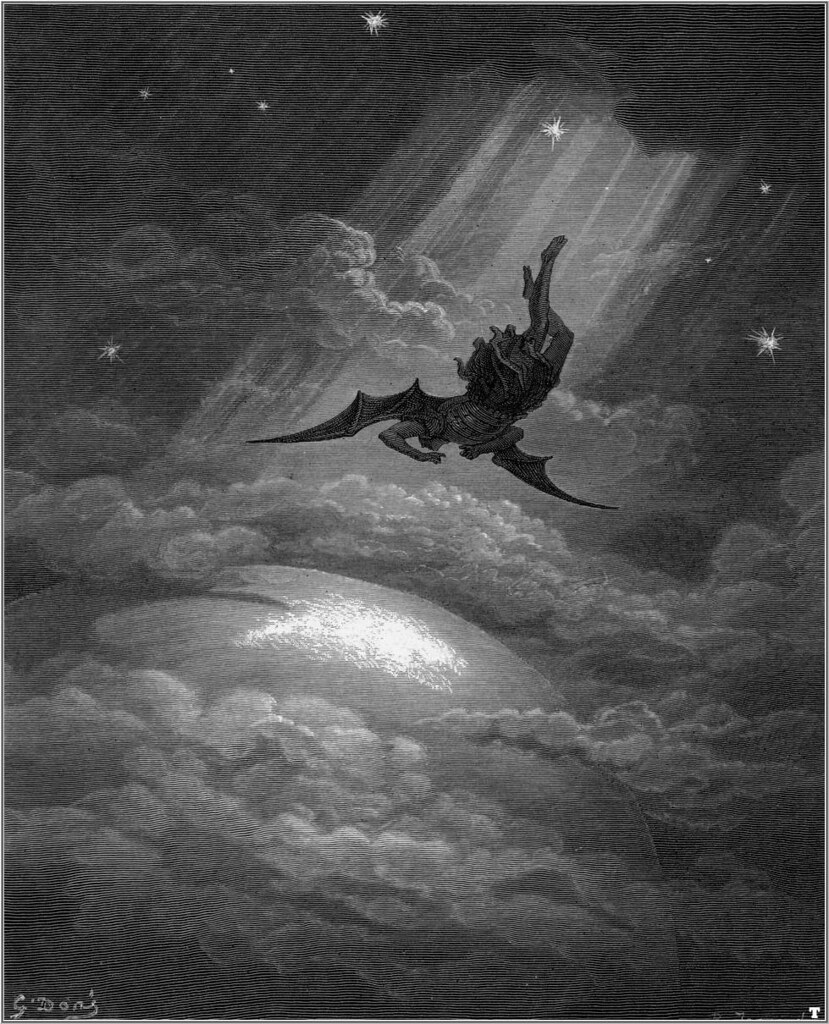
O show me Milton’s paradisial route,
Far airier than the foamiest of stout.
Of man’s first disobedience and the fruit
Are all I need and all I care about.
A bottled brew’s sufficient for the poor
In spirits, not for spirituality.
How can a tankard filled with beer quench more
Than slaking drafts of a theodicy?
I’d bring it to the bar, but I get looks
When I enact the fall from all twelve books.

David Galef writes: “Justification is both an appreciation and dig at Milton, an attitude older than Samuel Johnson’s comment about Paradise Lost, ‘None ever wished it longer than it is.’ It came out in Light.”

David Galef has published over two hundred poems in magazines ranging from Light and Measure to The Yale Review. He’s also published two poetry volumes, Flaws and Kanji Poems, as well as two chapbooks, Lists and Apocalypses. In real life, he directs the creative writing program at Montclair State University.
www.davidgalef.com

“DORÉ, Gustave Illustration for John Milton’s Paradise Lost 1866” by carulmare is licensed under CC BY 2.0