Tag Archives: freedom

Narcisse Tardif, ‘Acquitted on All Charges’

At six o’clock, I wake,
And plod down to the kitchen table
In time to greet the sun,
And hear the news on cable
But focus on my sugar flakes;
I don’t watch it none.

At eight, I hit the tees—
I’m done faster without a foursome—
And watch the wheeling hawks—
At times, the game is boresome—
And leave the club at ten oh three,
In time for business talks.

At three, I call my mom,
Who asks keenly about my meetings;
I don’t have much to say.
She wants to know I’m eating;
I tell her yes to keep her calm.
We do this every day.

At six I disconnect
And meet friends at my favorite diner
And drink a single glass.
At eight, in my recliner,
I grab my clicker to select
The way the time will pass.

By nine, I’m back in bed,
My teeth brushed and my body showered.
The bed is soft and deep,
My screens unplugged, unpowered.
The pillow yields beneath my head.
At four, I fall asleep.

*****

Narcisse Tardif writes: “I watch some crime documentaries here and there, and I’m struck whenever the murderer or would-be murderer just seems like a normal person. I wanted to use my poem to explore what life could be like for a “normal-person” murderer who got away with it. OJ was a big inspiration, but the poem is not meant to just be a retelling of the OJ story.

“The form is an ad hoc invention. I liked the double stress of “plod down” because of its evocative nature, so I built the second line around that, using a trochaic substitution in the second foot of each second line. The rest of the form is meant to be somewhat conversational, mimicking the ebb and flow of daily life, with some variation here and there, but the repetition of the exact form in every stanza still leaves enough sameness to evoke routine. I don’t know whether you have a policy regarding overexplaining poems on your blog, but the line about drinking a single glass is supposed to be a hint, as well as the more obvious sleepless night. On a more subtle note, the complete absence of a romantic partner is a bit of subtext throughout the whole poem.”

‘Acquitted on All Charges’ was previously posted in Substack: https://substack.com/@narcissetardif

Narcisse Tardif self-describes as “Poet grappling with the ironies and incongruities of heartbreak, religion, meditation, and mortality. I write mostly in English, but also in French and sometimes other languages. First person ≠ autobiographical.”

Freedom” by Josef Grunig is licensed under CC BY-SA 2.0.
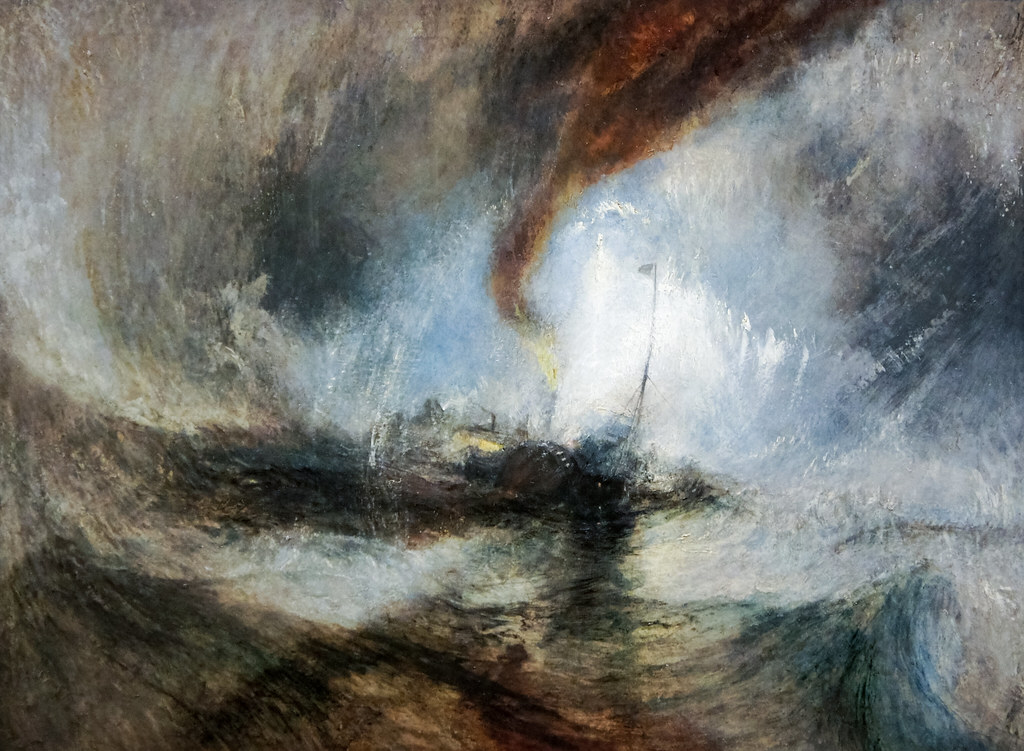
Excerpt, semi-formal: Matthew Arnold, ‘A Summer Night’ (2)

And the rest, a few,
Escape their prison and depart
On the wide ocean of life anew.
There the freed prisoner, where’er his heart
Listeth, will sail;
Nor doth he know how there prevail,
Despotic on that sea,
Trade-winds which cross it from eternity.
Awhile he holds some false way, undebarred
By thwarting signs, and braves
The freshening wind and blackening waves.
And then the tempest strikes him; and between
The lightning-bursts is seen
Only a driving wreck,
And the pale master on his spar-strewn deck
With anguished face and flying hair
Grasping the rudder hard,
Still bent to make some port he knows not where,
Still standing for some false, impossible shore.
And sterner comes the roar
Of sea and wind, and through the deepening gloom
Fainter and fainter wreck and helmsman loom,
And he too disappears, and comes no more.

*****

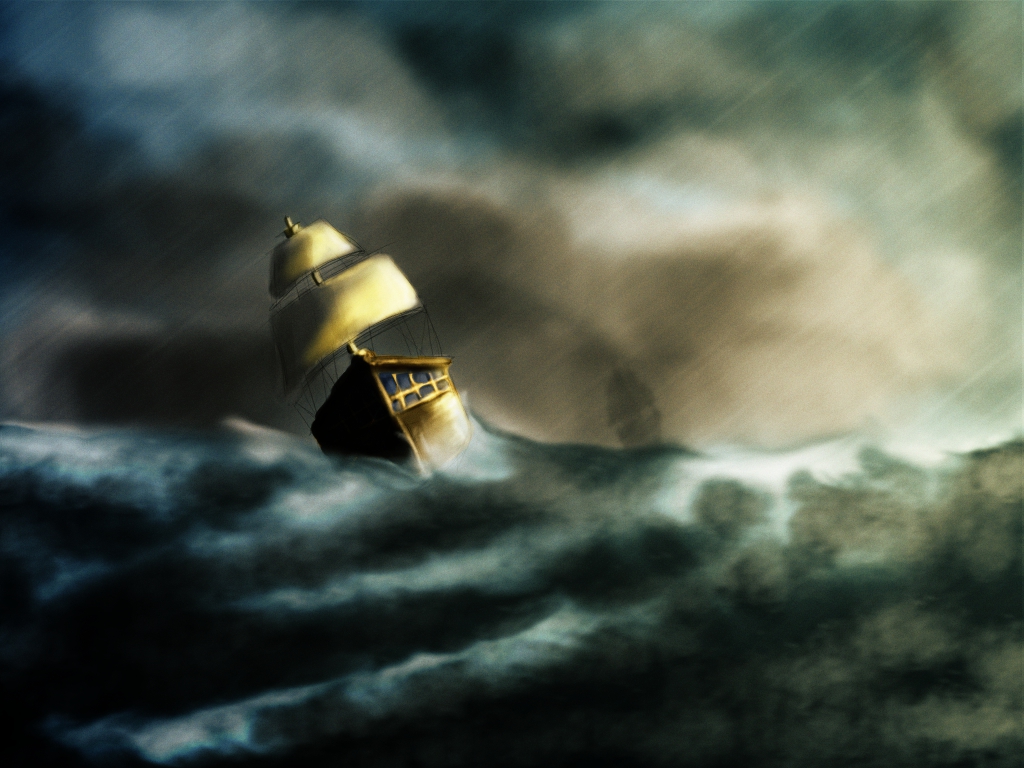
This fragment is the response to the previous excerpt from Matthew Arnold’s ‘A Summer Night’ that I blogged two days ago. As a teen in a well-regimented boarding school I found that previous fragment terrifying with its prospect of living as a bored wage-slave forever, and this second fragment exhilarating in its freedom despite the expectation of catastrophe. Altogether a very subversive poem, and I thank my schooling for including such works. For the next couple of decades I followed the wild path, failing to earn a degree at universities in three countries, never holding a job for more than 18 months, frequently moving. Eventually I found an occupation that was constantly changing, where Eliza and I were our own bosses, and that took us to dozens of countries to teach business seminars. So that successfully combined the wage-slave and the freed prisoner, and it all worked out.

Arnold originally ended his poem:

Is there no life, but these alone?
Madman or slave must man be one?

But ten years later he added a much more wishy-washy piece about learning from the pure heavens and seeing what a nice life you could make for yourself. I always thought he should have stopped with the original “madman or slave” view of life: much more dramatic! But his later addition was probably justified…

Snow Storm—Steam-Boat off a Harbour’s Mouth” by hyperion327 is licensed under CC BY-NC-SA 2.0. (Note: the painting is by J.M.W. Turner, of course.)

Tom Vaughan, ‘One of Us’

A starter British passport,
now with a French one too,
I can vote in both and put down roots
in either, and stroll through

eGates and customs checks
head high, as one of us,
legitimately pukkah, blessed
by birth/life/luck, and thus 

with paperwork in order
should copper or gendarme
ask me who on earth I am:
I smile and keep my calm

and my right to an annual break
upon a sunlit beach
where seas digesting some who yearned
my paradise to reach

lap peacefully as though
the summer days could last
as far into the future as
they failed to in the past . . .

*****

Tom Vaughan writes: “The older I get, the more I ask myself the question: ‘Where would we be without our (double) standards?’.”

‘One of Us’ was first published in Snakeskin.

Tom Vaughan is not the real name of a poet whose previous publications include a novel and three poetry pamphlets (A Sampler, 2010, and Envoy, 2013, both published by HappenStance; and Just a Minute, 2024, from Cyberwit). His poems have been published in a range of poetry magazines, including several of the Potcake Chapbooks and frequently in Snakeskin and Lighten Up Online. He currently lives in Brittany.
https://tomvaughan.website

Illustration: RHL and ChatGPT

Sonnet: RHL, ‘Walls of Work’

With walls of work that never wear away
my house is halfway hilled above a plain;
ghosts of unwritten books moan and complain;
I step out on to scree, sloping and grey.
I’ve tried for thirty years to build up high,
raising five kids free of smog, vice and town;
the treacherous slope of scree slips, I fall down,
am shown – kids grown and gone – more work’s a lie.

Now I’m spreadeagled on the eager shale,
not daring move, gripping at slipping fears
of sliding down to sneered-at country vale
where poor folk pick, don’t buy, fresh fruit from trees
and I could go, unknown, to known warm seas,
run barefoot on the beach of my ideas.

*****

First published in The Road Not Taken – The Journal of Formal Poetry in Summer 2016 (but written a decade before that); thanks, Dr. Kathryn Jacobs!

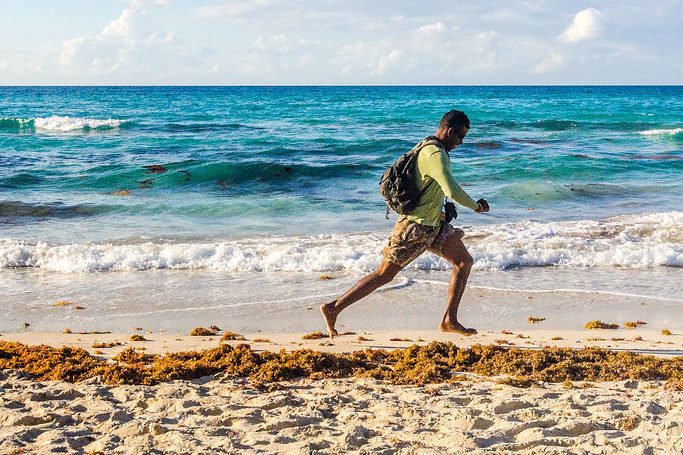
While everybody on the beach is relaxing, this chap runs by like he stole running.” by Gerald Lau is licensed under CC BY-NC-ND 2.0.

Short poem: ‘Land of the Free’

Homicide, suicide, what’s it to me?
We all carry guns in the Land of the Free.
Free to be Christians and free to be whites –
The rest ain’t included in our Bill of Rights.
The rest want to come here (or blow us sky high),
They get smuggled in, so they cheat, steal and lie.
Servants and slaves since the US begun:
Tell ’em: Sit! and shut up! and don’t carry no gun!

*****

This short poem was published minutes ago in the Allegro Poetry Journal, put out by Sally Long in the UK. The spring edition is always unthemed, the autumn edition themed; and this time the theme is ‘Freedom’ – a word which means many things to many people.

Charlottesville ‘Unite the Right’ Rally” by Anthony Crider is licensed under CC BY 2.0.

Sonnet: “What Will You Be When You Grow Up?”

Historically, this never was a thing.
You did what you were born to do, were told,
Fitting yourself into your parent’s mold,
A farmer’s son a farmer, king’s son a king,
A girl to be a mother and a wife.
But then came education, travel, choice,
Awareness of the wishes you could voice,
Countries, careers, sex partners — it’s your life!
And though just who you are you cannot know,
Nor what you want, yet all is your decision.
You’ll make mistakes, find failures and derision,
But life is long: so have another go . . .
Retry, and then try something else; take; give.
Do what you love. You die, regardless. Live!

This sonnet is a mirror of the short poem I posted most recently – and I’m happy to see that my outlook has a certain consistency, even over a 50 year period.

The sonnet has just been published in the formal verse section of the current Better Than Starbucks – thanks, Vera Ignatowitsch!

Photo: “career choices” by Jerome T is marked with CC BY-NC-ND 2.0.

Evocative Fragments: from Arnold’s ‘A Summer Night’ (2)

And the rest, a few,
Escape their prison and depart
On the wide ocean of life anew.
There the freed prisoner, where”er his heart
Listeth, will sail;
Nor doth he know how there prevail,
Despotic on that sea,
Trade-winds which cross it from eternity.
Awhile he holds some false way, undebarred
By thwarting signs, and braves
The freshening wind and blackening waves.
And then the tempest strikes him; and between
The lightning-bursts is seen
Only a driving wreck,
And the pale master on his spar-strewn deck
With anguished face and flying hair
Grasping the rudder hard,
Still bent to make some port he knows not where,
Still standing for some false, impossible shore.
And sterner comes the roar
Of sea and wind, and through the deepening gloom
Fainter and fainter wreck and helmsman loom,
And he too disappears, and comes no more.

This fragment is the response to the previous fragment from Matthew Arnold’s ‘A Summer Night’ that I blogged a few days ago. As a teen in a well-regimented boarding school I found that previous fragment terrifying with its prospect of living as a bored wage-slave forever, and this second fragment exhilarating in its freedom despite the expectation of catastrophe. Altogether a very subversive poem, and I thank my schooling for including such works. For the next couple of decades I followed its path, failing to earn a degree at universities in three countries, never holding a job for more than 18 months, frequently moving. Eventually I found an occupation that was constantly changing, where I was my own boss, and that took me to dozens of countries to teach business seminars. So it all worked out.

Arnold originally ended his poem:

Is there no life, but these alone?
Madman or slave must man be one?

but ten years later added a much more wishy-washy piece about learning from the pure heavens and seeing what a nice life you could make for yourself. I always thought he should have stopped with the original “madman or slave” view of life. Much more dramatic – even though I have to admit his addition may have been justified.

“Storm at Sea” by gentlemanbeggar is licensed under CC BY-NC-SA 2.0

Poem: ‘The Moon’

The birds of dawn
Sing Come out on the lawn.

Flowers
Say Seize the hours.

The day, the sun
Say Don’t stay – look, laugh, run.

Warm rain
Says More! Again!

A tree
Simply says Be.

Beyond the trees, the beach
Rumbles Extend your reach.

A cliff
Asks: If?

The sand
Calls for a handstand.

A wave
Says Misbehave.

Sunset
Asks you, Done yet?

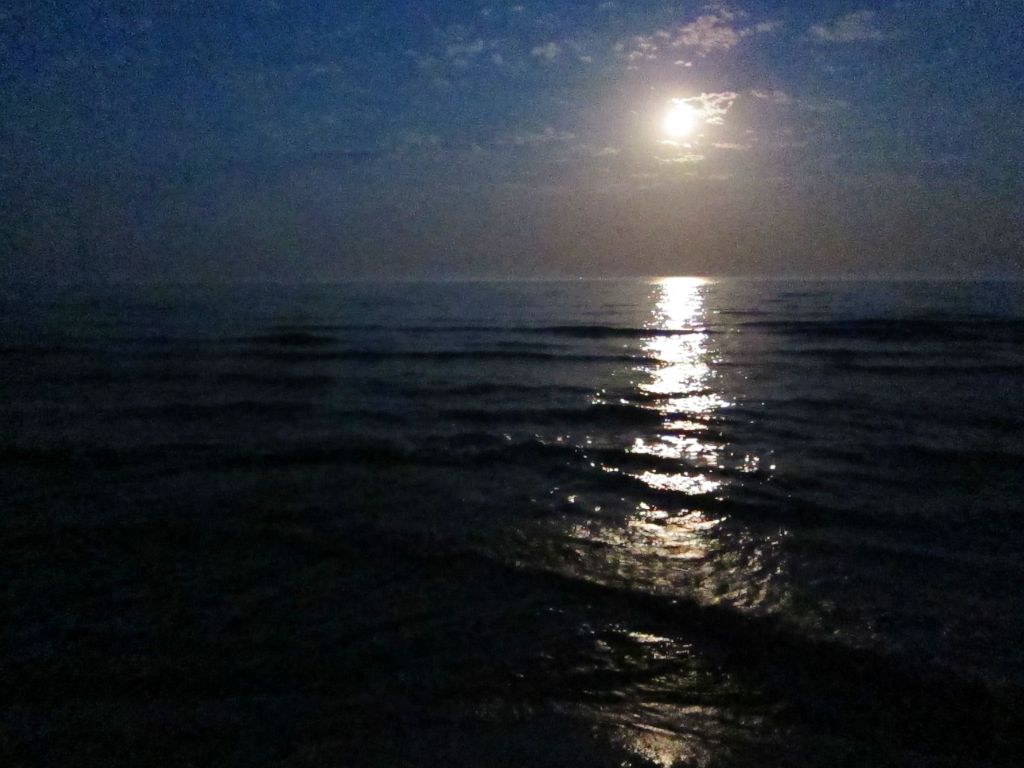
The moon, that overhanging stone…
The moon says You’re alone.

This poem was originally published in Snakeskin. It was an attempt to capture the bittersweetness of living in–or perhaps specifically growing up in–a rural or isolated environment. It’s wonderful to be wild in the wilderness except that, almost by definition, you’re likely to be on your own. And that’s fine, a lot of the time…

Anyway, that freedom is what my childhood and stretches of my 20s were like, and what I came back to after decades away–the difference being that now I’m no longer alone! 🙂 

Photo: “Full Moon Beach Ride July 2012” by gasmith is licensed under CC BY-NC-ND 2.0