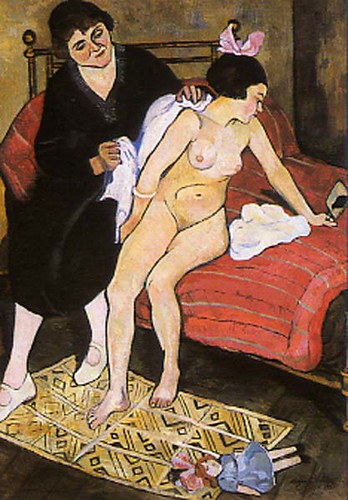
Dear Stomach, … Look, we’ve really had enough. Your job is simply to digest the stuff supplied by Hands and Tongue, to move it through, not chuck it up. Spurned food is déjà vu and hurts Oesophagus; she’s frankly pissed, and Face says please forget The Exorcist, because projectile vomits are not fun and bloody heartburn hacks off everyone. Lungs say they’re worried by a niggling cough and Guts say if you won’t perform: Sod off! That’s not my phrase–I’m mediating here, but want to stress the general atmosphere.
Please see these hiccups don’t occur again. I sign myself, sincerely, … Upper Brain
*****
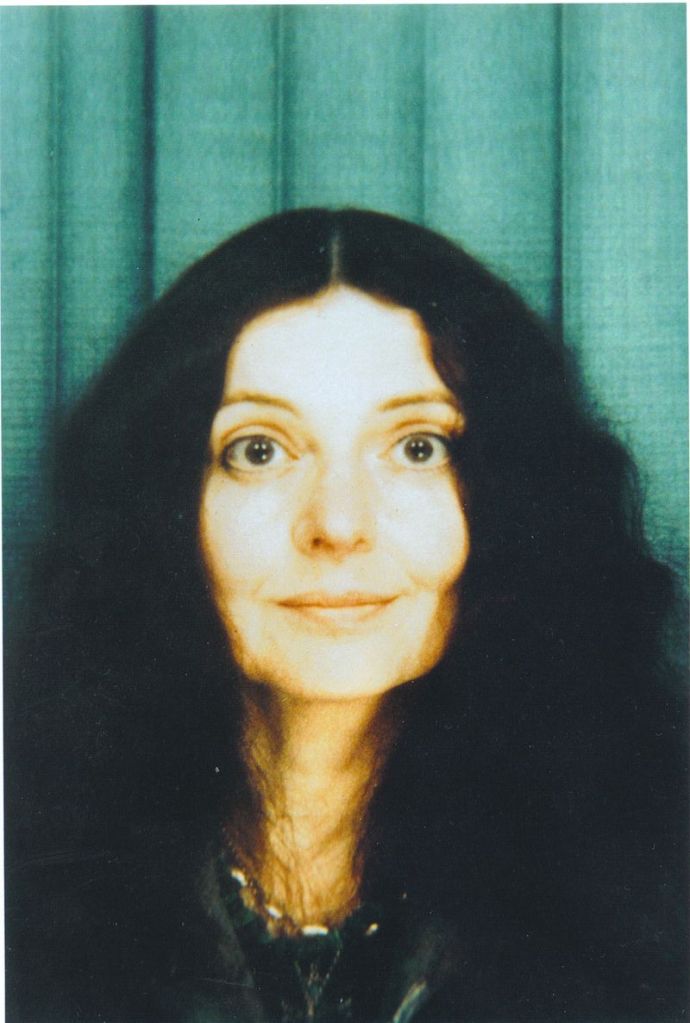
Margaret Ann “Maz” Griffiths, born in 1947, suffered for years from a stomach ailment which finally killed her in 2009. Her frankness, good humour, range of interests and insights and her technical skill make her one of the very best English language poets of the early 21st century.
I recommend ‘Grasshopper‘, the 350-page compilation of her known verse, to anyone interested in modern poetry. It is one of those rare books that I reread every couple of years. I would be glad to hear of any more of her verse that has turned up since 2011.
Do you know where now or in what lands Are the voices that sang of vibrant Mars? Of slender spires on iron-red sands And canals, night-necklaces with stars? They sang of visions that once seemed clear. Who sings of the Mars of yesteryear?
Does sadness tinge new Eden’s rainbows Or the sin-abrading void of space? Close now, does Mars now close Its alien, inviting face? Today we hear triumphant fear. Who hears the Mars of yesteryear?
Man, covet not the power of stones Nor jails, nor ruins. Mars draws near. It once gave flesh to now-dry bones: Return to the Mars of yesteryear.
*****
Don Webb writes: “I wrote this poem in 2003. That happened to be a special time in astronomy, when Mars was closest to Earth. The ‘yesteryear’ reference was prompted by fond memories of the literature of Ray Bradbury and C.S. Lewis, among others. The poem’s relevance to today’s world is explained in Bewildering Stories’ series of review articles: ‘Cassandra’s Voices: Warnings to the Modern Age‘ ( https://www.bewilderingstories.com/includes/toc/cassandra_toc.html). All of the works discussed shine important light on 21st-century civilization and continue to be of immediate interest in U.S. and world politics. The nostalgia of Mars invading Earth seems preferable to Trusk & Mump’s earthly imperialism and dreams of an Invasion of Mars.”
Don Webb is a teacher of French language and literature. B.A., Dartmouth College; Ph. D., University of Wisconsin. Major: French; minor: German. Thesis: Jean Jacques Rousseau’s La Nouvelle Héloïse. Most of his career was spent at California State University, Sacramento. Ten years moonlighting as a professional translator of French and Italian. He is currently retired and has taught an on-line course in French for Reading Comprehension for several years and, occasionally, French for Listening Comprehension at the University of Guelph, in Ontario.
For a more complete (and highly amusing) bio with reflections on the various people he has been mistaken for – and the doppelgänger who has been mistaken for him – visit www.bewilderingstories.com/bios/donbio.html
To Anyone who still may be attentive from Infinity, we bless you from our dot in space and thank you for our privileged place.
Give us this day on which to feed a bit more gluten than we need, and when we’re adequately fed, help us to get and stay ahead and save for our retirement enough plus twenty-five per cent.
May old age find us cheerful still, our life in order like our will, with neither pain nor care nor debt. Thy kingdom come, but not just yet.
*****
Gail White writes: “Religion and irony are not incompatible I find that a good deal of poetry comes from taking a speculative or questioning view of Bible stories (e.g, how did Adam and Eve react to the murder of Abel by Cain? We don’t hear a peep out of them about it.) And I’ve often said that if God hadn’t wanted at least one cynical feminist poet, I wouldn’t exist.”
‘Prayer Updated’ was published in the current issue of Lighten Up Online.
Gail White is the resident poet and cat lady of Breaux Bridge, Louisiana. Her books ASPERITY STREET and CATECHISM and the chapbook SONNETS IN A HOSTILE WORLD are available on Amazon. She is a contributing editor to Light Poetry Magazine. “Tourist in India” won the Howard Nemerov Sonnet Award for 2013. Her poems have appeared in the Potcake Chapbooks ‘Tourists and Cannibals’, ‘Rogues and Roses’, ‘Families and Other Fiascoes’, ‘Strip Down’ and ‘Lost Love’.
Just past the new development’s array, beyond the parking lot, the flowers, the fence, the land becomes uneven, falls away into an area of no pretence, abandoned cars, some rocks, some weeds, a bog. Here are drawn children and eccentrics both, searching for wild flowers, or a snake, a frog, to nature lurking in the undergrowth, beyond the ordered asphalt, lineal law; drawn by our lower brain of hunter, ape, where food is found or killed and eaten raw, life is survival, and sex may mean rape. Bricks, debris, rubble, condoms, empty beer… yet, strangely, life-long loves have started here.
*****
I subscribe to the Nietzschean view of humans as a rope stretched over an abyss, animal on the one side, posthuman on the other. I think the ape is very alive within us, as is the drive to reach beyond ourselves to something vastly greater.
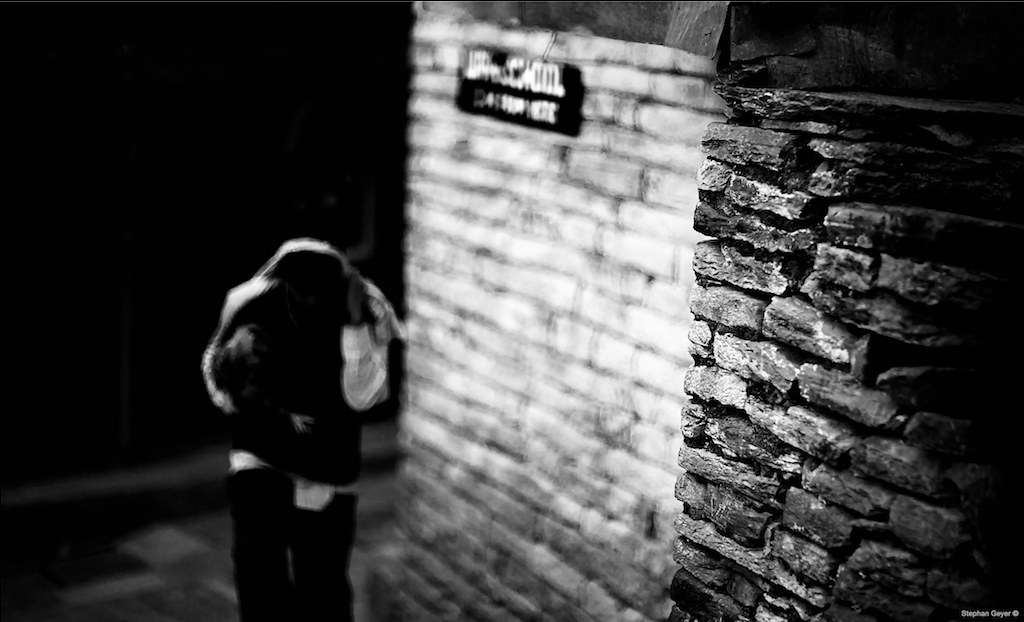
This sonnet was originally published in Rat’s Ass Review (thanks, Roderick Bates) but I’ve modified one line here to match the photo I found for illustration.
His weaving adds up to a hapless cloth on both sides of the street: just short of falling, he staggers, with a stop to vomit froth. He’d go far safer if he took to crawling. A brace of cans, though, and a paper sack are taking up the hands his legs could use, as gales inside his head tell him to tack and sway but hold his cargo fast, to choose the service of his thirst above all pride or fear that he might offer easy prey. The spirits he has taken as his guide make him loop back to take another way.
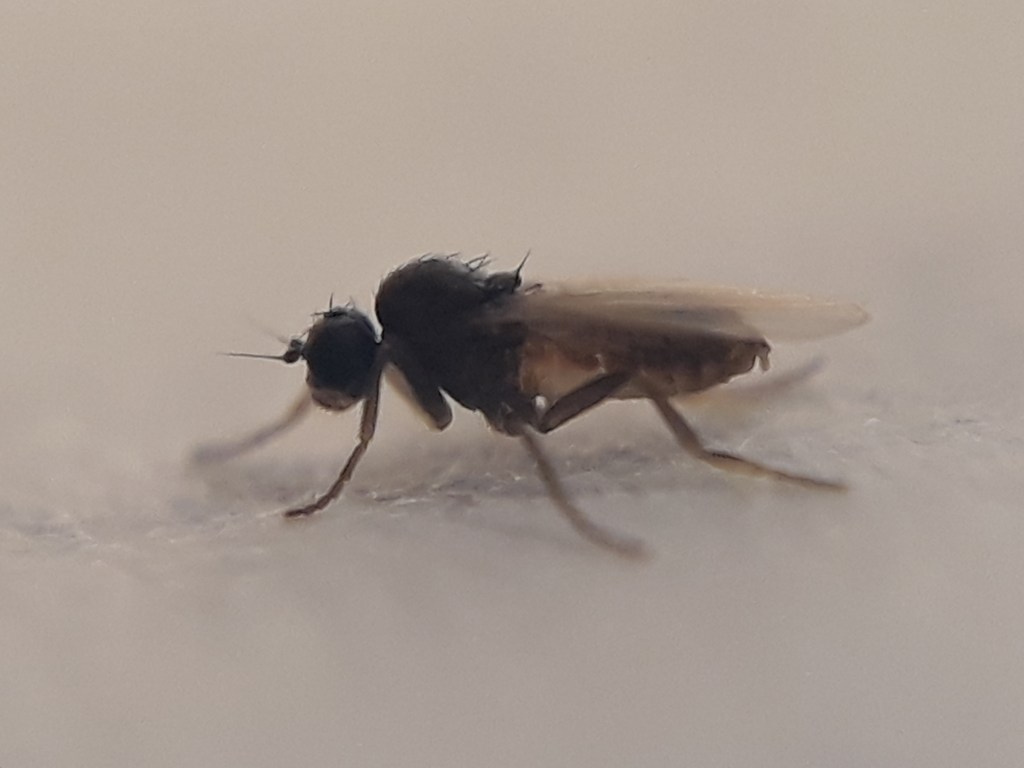
Ten minutes pass. He’s near where he began, reminding me of when I’ve been that man.
*****
J.D. Smith writes: “Between typical youthful indiscretions and self-medicating for untreated depression in earlier life, I have had some tipsy times. The obvious negatives aside, recalling those experiences has made me more sympathetic than I would naturally be in contemplating others’ frailty. The rhetoric of the Elizabethan sonnet structure, moreover, compelled me to bring precision to the experience of seeing oneself in another.”
J.D. Smith has published six books of poetry, most recently the light verse collection Catalogs for Food Lovers, and he has received a Fellowship in Poetry from the United States National Endowment for the Arts. This poem is from The Killing Tree (Finishing Line Press, 2016). Smith’s first fiction collection, Transit, was published in December 2022. His other books include the essay collection Dowsing and Science, and his seventh collection, The Place That Is Coming to Us, will be published by Broadstone Books in 2025. Smith works in Washington, DC, where he lives with his wife Paula Van Lare and their rescue animals. X: @Smitroverse
She was the one who went off on her own. She was the one who filed for the divorce. You gave her what she wanted in due course. Still she will never leave your life alone.
Available through email more than phone, You have remained a favorite resource. She contacts you supposedly perforce, Less for herself than for a son long grown.
She seeks a certain something left behind, A sterling ladle or an antique chest, A recipe or record you must find. Your common past has yet to enter rest Since fire so often burns within her mind. For smoke fly’s sake, you try to do your best.
A native Virginian, Jane Blanchard lives and writes in Georgia. Her collections with Kelsay Books include Metes and Bounds (2023) and Furthermore (forthcoming, 2025).
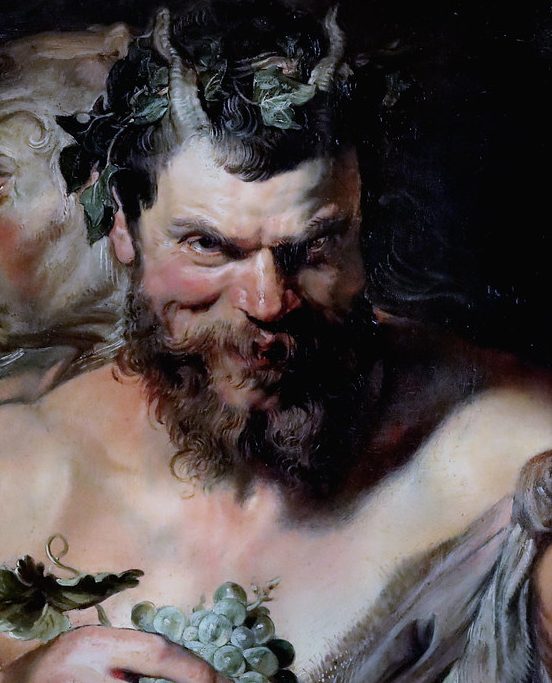
He looked at me as if I ought to know just who he was but I did not. I looked away, then so did he. Alas I didn’t recognize the Great God Pan in human form. I simply thought he was another man. I felt a warm gaze inviting me once more. I turned to see him changed. A God again, hooves and furry legs, horns grew. He gestured “Hey?” I was too dumbstruck to do more than stare. He shook his curls and sprinted off somewhere.
*****
Juleigh Howard-Hobson writes: “I wrote this when I lived off-grid on ten acres up in rural Washington State.The forest that made up half my property was dark and creepy. The Great God Pan was no more out of place than BigFoot or werewolves. All of which I imagined I saw/heard from time to time (I use italics as I am not absolutely convinced it was all imagination). Nothing out there ever hurt me, so all’s well that ends well–I’ve since moved back to civilization, which is far more frightening in many ways. As for the form–well, that just was how the poem decided to be.”
Juleigh Howard-Hobson’s work can be found in Think Journal, Able Muse, New Verse Review (including this poem), The Deadlands, Autumn Sky Poetry and other venues. She has been nominated for “The Best of the Net”, Pushcart, Elgin & Rhysling Awards. Her latest book is Curses, Black Spells & Hexes (Alien Buddha). A member of the HWA and the SFPA, she lives on the coast of the Pacific Northwest. In a poetically haunted house. X: poetforest
What, you haven’t heard of me, despite my art and stormy life? There’s much to tell of pride and bitterness, of bliss and hell— but not regret. I’ll fill my pen and write.
I was born a bastard. Maman worked, a laundress, while I’d roam Montmartre, spying through café and whorehouse doorways, trying to snitch some fruit or francs. I laughed and lurked. With lumps of coal I loved to draw on streets. Ditching convent school at puberty, I learned to earn my way. I felt free in circus work, curvaceous and petite and daring on the high trapeze, strong until I hurt my back—I fell headlong.
That set me back, but new work came along— also daring, deemed risqué—being painted, a model for men. Few were sainted . . . nor was I. I didn’t think it wrong to give a man some pleasure and to claim my own. For one artiste I posed unclad and soon became his favorite lover. I had his child, and kept my word: I didn’t name that man on papers with a ‘Father’ line and kept on working. Maman tended him, my son, Maurice Utrillo—a pseudonym so he would not be stigmatized by mine, that of the saucy urchin shedding clothes— and budding painter, watching men compose.
I watched the colors bloom as men composed. Toulouse-Lautrec’s hues, both somber and bright, would join or jar to make a mood just right. He’d talk of wealthy clients and gallery shows while I could study his techniques with paint. He studied me and loved my breasts, my hair, my thighs, my openness to him. I dared to love that rich midget with no restraint. When he refused to marry me, my feigned suicide didn’t change his mind. But what I learned while posing, I combined with my good eye, instinctive and untrained. I’d use my wits (and likely my libido) to paint in oils, with honesty my credo.
I painted nude women by my credo. When I showed Degas my work, he praised me with, “Madame, you’re one of us!” That raised my nerve; like those Montmartre men, I’d show my art—although I’d wish my name need not be printed next to ‘woman artist,’ a tag suggesting Other like a warning flag. I’m already Other in my lot as Bastard-with-a-Bastard history. Will I be known for art or just my life of scandal? I never stayed a bougeois wife, as two would always tangle into three; our pacts permitting infidelity could not prevent one partner’s jealousy.
His cryptic music vented jealousy; Eric Satie was moody, odd, hysteric— and amusing, in and out of bed. Eric and Paul Mousis loved me zealously and it was bound to chafe, our double link. Mousis was rich; Satie holed up in one squalid room. He slowly came undone without me to himself—he took to drink till drink took him. Maurice, by then eighteen, also drank. Since he was prone to rage and smashing things since an early age, Maman would feed him wine to calm such scenes. When briefly sober, it was to me he came— I treasured hearing Maman as my name.
Of course Maurice Utrillo made his name with me his mother-teacher and his Papa (I tell you now) Pierre-Auguste Renoir! Maurice was barely sane, but all the same, prolific and successful in his art. His painter colleague André, with brains and flair, had tireless desire in our affair; our turbulent trio could not live apart. With André as our agent, income flowed— I once took fifty children to the circus . . . Montmartre beggars crowded round to work us . . . we’d help out any artist friend who owed. The stream of money later dried to drought, but while it flowed I bloomed by giving out.
Too soon I knew my bloom was giving out— I missed men’s wide-eyed stares, their swiveled heads. André, still youthful, strayed to other beds; Maurice would drink or sit around and pout. We three unraveled into separate ways. Instead of painting nudes I painted flowers; they didn’t sell but brightened up the hours of living alone, inviting in malaise, till I found Gazi. This young, exotic man takes care of me and listens to my stories, roughly true—my slights, successes, glories. I’m seventy-two. I’ll end where I began, a bastard bitch whose art was bold and right. My pride and grit leave little room for spite.
*****
Here is what the judge for the 2024 Kim Bridgford Memorial Sonnet Contest wrote: Praise for the winning sonnet crown: Among a strong group of finalists, “Roughly True” distinguished itself across the board—in form, in voice, in message, in grace. After reading these seven sonnets in the voice of French painter Suzanne Valadon, I felt as if I had just taken short courses in poetic form, meter, rhyme, and art history, all expertly and candidly delivered by the fully realized persona of an accomplished, but overshadowed figure, one exquisitely resurrected here in verse. ~Dan Albergotti, Judge
Barbara Lydecker Crane writes: “I was surprised and thrilled to win this contest, and further pleased that the judge seemed to recognize the same strength of character in Suzanne Valadon that I did. The more I researched her life and work, the more I felt I actually knew this gritty woman a bit, despite our wildly different lives. As I get older I find I am more interested in writing about others than myself. My latest book, You Will Remember Me (Able Muse), is a collection of persona poems about portrait artists and their works. I am currently writing a new series of persona poems, this time about landscape artists and their works. This time, rather than writing all sonnets, each poem takes a different form; but all (so far) are in rhyme and meter. That seems fitting both for older times and for the craft and musicality I strive for, to befit the art that I hope to see with these poems one day, perhaps in a new book. And there is something about writing in form that, to me, is exactly like framing a picture. What a difference that makes; it says “completed,” and adds its own panache to the art.”
A billboard seen in Toronto read Sonnet Insurance.
Dear Sonnet staff: I’m eager for your plan! I’ll want an underwriter old-school-based, Petrarchan or like Larkin in his taste: he’ll speak my terms. I’ll benefit from your man adjusting rhymes, making meter strict, assuming the risk of an errant anapest. Does your firm ensure I’ll stand time’s test? Do you pull strings to have each effort picked by a premier publication? One quick draft in the condition of a pre-existing sonnet, and the English-speaking world might dote upon it. But truth be told, my first attempts aren’t craft. Sonnet Insurance, kindly file this letter; insure me later, when it’s written better.
*****
Barbara Lydecker Crane write: “I am a shameless pun lover; seeing this billboard, though, certainly begged for some. “My Letter to Sonnet Insurance” was published a few years back in Light.“
In 2024 Barbara Lydecker Crane won the Kim Bridgford Memorial Sonnet Crown Contest and First Prize in the Helen Schaible Contest, modern sonnet category. She has twice been a finalist for the Rattle Poetry Prize. Able Muse recently published her fourth collection, You Will Remember Me. She enjoys making and looking at art, travel, and her family, which includes four fast-growing grandchildren and one near-perfect husband: he does not read poetry.
Without black tea, his mornings never start. The newspaper should be upon his bed; Not finding it will make his eyes all red. As if examining a piece of art, He reads each page. Loud oohs such as ‘My heart!’, ‘Another swindle!’, or ‘So many dead!’, Are heard as if the earth’s weight’s on his head. Harrumphing, he jumps to the Cultures part. A pensioner today, back in those days, He was a banker. Now, he saunters, plays Carom with me, or spends the noontimes planting Camellias —- a work he finds enchanting. At times, he sits before some dusty files, Puts on the glasses, thumbs through them, and smiles.
Shamik Banerjee is a poet from Assam, India. Some of his recent publications include Spelt, Ink Sweat & Tears, Modern Reformation, San Antonio Review, The Society of Classical Poets, Third Wednesday, and Amethyst Review among others.