Category Archives: Uncategorized

Weekend read: Maryann Corbett, ‘An Orientation’

If, in the midst of this elated day,
someone took him aside with the stern warning,
Most of your life will not be like this morning,
he’d never hear it. How–while fountains play
beside clipped lawns and walkways arched with green
maples that move to stipple white and gold
on paths he and his harried parents have strolled
laden for move-in–how could he hear? He’s seen
Arcadia now, where classical facades
put a straight face on tanglements of thought,
and edgy spears of light and color, wrought
in steel and glass, look daggers at the gods.

The whole week’s strewn with glittering temptations
and parti-colored parties for the eyes:
gown-sleeves aflap like tropical butterflies,
professors float along in convocations.
Some one of them, someday, and over a drink,
will show him grittier visions: Rumor. Snark.
Administrative bloat. Nowhere to park.
How only summers bless you with time to think.
How even the mind’s beauties fester, vexed
by deadlines, balky software, budget hassle.
How research builds its turreted air-castle,
gorgeous for one day, rubble on the next.

But here, today, does anybody give
a bleep for realness? Let us cleave to form,
leaving him to his roommate and his dorm
and whispering, Here’s the poison. Drink and live.

*****

Maryann Corbett writes: “A few years ago, I happened to be on the campus of a nearby university on move-in day during freshman orientation week. It was an experience that gave me poem-provoking nostalgia.
“Orientation week is an institution I know well; I’ve lived my own college orientation and each of my children’s, and I’ve worked as a university staffer conducting such events. Freshman orientations usually take place in the week before classes begin in the fall and before other students return to campus. They’re meant to give new students everything they need to settle in and become part of the university community.
“But in addition to practicalities like moving young people into their dormitories — and dealing with parents’ emotional goodbyes — orientations will always involve hype and hoopla. Beautiful campuses are part of that hoopla, part of the seduction of academe. There will also be welcoming events that overpraise what students have achieved just by being admitted, tours that overpraise the campus’s buildings and amenities, and academic convocations with professors in full regalia delivering speeches that overpraise everything about the academic world.
“How true is all this as a picture of the scholarly life? I’ve been close enough to the facts of that life to know that the picture needs some correcting pessimism. The poem offers that but says it can wait. Let’s let the students fall in love with the vision before we tell them the truth.”

Maryann Corbett earned a doctorate in English from the University of Minnesota in 1981 and expected to be teaching Beowulf and Chaucer and the history of the English language. Instead, she spent almost thirty-five years working for the Office of the Revisor of Statutes of the Minnesota Legislature, helping attorneys to write in plain English and coordinating the creation of finding aids for the law. She returned to writing poetry after thirty years away from the craft in 2005 and is now the author of two chapbooks and six full-length collections, most recently The O in the Air (Franciscan U. Press, 2023). Her work has won the Willis Barnstone Translation Prize and the Richard Wilbur Award, has appeared in many journals on both sides of the Atlantic, and is included in anthologies like Measure for Measure: An Anthology of Poetic Meters and The Best American Poetry. ‘An Orientation’ is from her collection In Code.

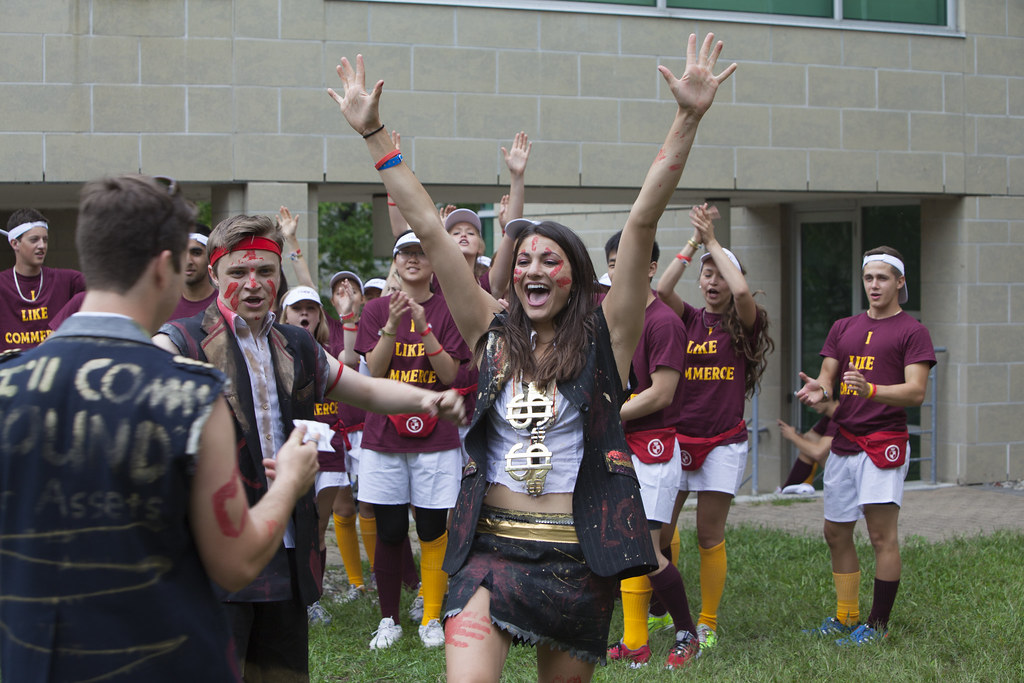
Photo: “Orientation week” by queensu is licensed under CC BY-NC-ND 2.0.

Light verse: Melissa Balmain, ‘Lament’

Mama never horsewhipped me
or shoved things up my fanny.
She wasn’t hooked on PCP
and didn’t bump off Granny.
Daddy never climbed in bed
to open my pyjamas.
He read me Charlotte’s Web instead;
the bed he shared was Mama’s.
In college, I did not turn tricks
or date warped literati.
I haven’t starved myself to sticks,
joined cults, or loved John Gotti.
The guy I married doesn’t drink,
or French-kiss other fellers.
It really makes me sad to think
I’ll never write best sellers.

*****

From Walking in on People © Melissa Balmain, 2014. Used by permission of Able Muse Press.

Melissa Balmain writes: “This is the first poem I ever published outside of a school journal–in Light, then known as Light Quarterly. Thanks in no small part to the encouragement of Founding Editor John Mella, I never looked back.”

Melissa Balmain’s third poetry collection, Satan Talks to His Therapist, is available from Paul Dry Books (and from all the usual retail empires). Balmain is the editor-in-chief of Light, America’s longest-running journal of light verse, and has been a member of the University of Rochester’s English Department since 2010.

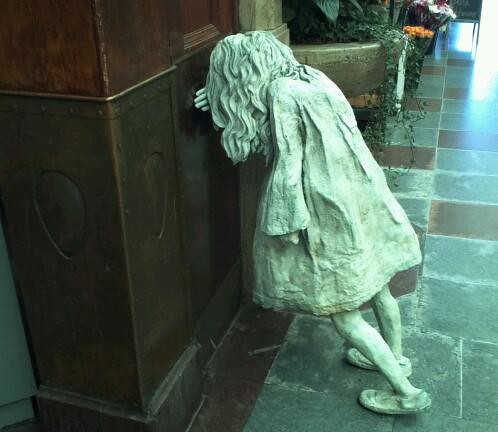
Photo: “Sad child” by Lejon2008 is licensed under CC BY-NC-SA 2.0.

RHL, ‘In Praise of Pride’

Why do the humble always bumble?
They stumble and their projects tumble,
their thoughts a jumble. So they mumble
and grumble, while their drear works crumble.
Why can’t they stand, speak, be unbowed?
Say it aloud. Be proud! 

*****

Gay Pride” by Dave Pitt is licensed under CC BY-NC-ND 2.0.

Shamik Banerjee, ‘In a Family Gathering’

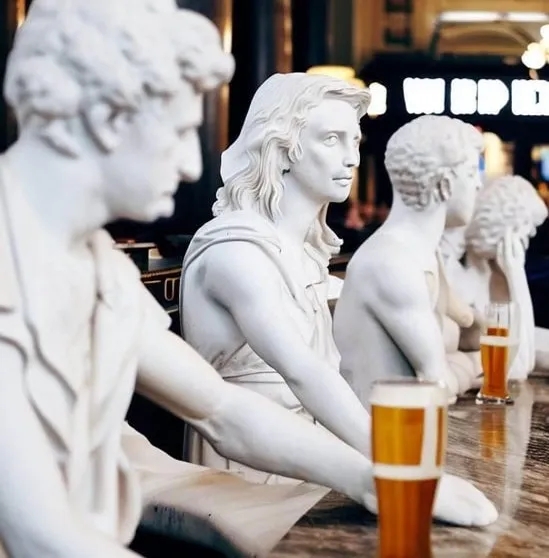
Before the booze-up session, all are statues.
Their prior falling-outs lodge doggedly
Upon their mouths like pillars of a building.
The visit’s just a plain formality.
But when the drinks are served, all lips begin
To open slow like rusty dungeon doors.
A glow of cheer unfolds upon their cheeks
Like dawn illuminates night-darkened shores.
Once they have reached the point of being swacked,
Then one by one they clear the awful air
Infected with self-pride, distaste, and spite.
The daftest cousin turns into Voltaire.
The silent uncle starts to sing his praises
Of how he’d saved three bullocks in a flood.
The two-faced aunt becomes a freedom fighter:
I’ll kill and die for us! We are one blood!
And I, the teetotaller, sit and weigh
If they’ll return to stone the coming day.

*****

Shamik Banerjee writes: “The absurd, ridiculous, and perennial drama between my relatives’ families inspired me to write this poem.”

Shamik Banerjee is a poet from India. He resides in Assam with his parents. Some of his recent works will appear in York Literary Review, Willow Review, Thimble Lit, and Modern Reformation, to name a few.

Photo: from original publication of the poem in Dear Booze: https://dearbooze.com/cocktales/f/in-a-family-gathering

Using form: Susan Jarvis Bryant, ‘A Monosyllabic, Monorhyme, Valentine Villanelle’

I ache to take your hand. My head says no –
You’ll sway me, play me, then you’ll let me go.
My heart says take a chance. Dance long and slow.

Which one (my head or heart) is in the know?
Fazed by your blaze, I melt like sun-soaked snow.
I ache to take your hand. My head says no.

Your wish, it heats the breeze. I hear it blow.
Your beat thrums though my veins. I feel the flow.
My heart says take a chance. Dance long and slow

Through moon-licked hues of blue as night skies glow
And gleam in scenes that steal the bright-star show.
I ache to take your hand. My head says no.

In dreams neath cream silk sheets you are the beau
Who draws my lips and hips to yours and oh…
My heart says take a chance. Dance long and slow.

But still my thoughts are skipping to and fro.
The dos and don’ts won’t stop. They grow and grow.
I ache to take your hand. My head says no…
My heart says take a chance. Dance long and slow.

*****

Susan Jarvis Bryant writes: “I like to set myself challenges when writing poetry. I’m fascinated by French lyric poetry and love a good villanelle. My Muse couldn’t resist this challenge… it was a little tricky, but I enjoyed every minute of composition.” The poem was published in this month’s Snakeskin.

Susan Jarvis Bryant is originally from the U.K., but now lives on the coastal plains of Texas. Susan has poetry published on The Society of Classical Poets, Lighten Up Online, Snakeskin , Light, Sparks of Calliope, and Expansive Poetry Online. She also has poetry published in The Lyric, Trinacria, and Beth Houston’s Extreme Formal Poems and Extreme Sonnets II anthologies. Susan is the winner of the 2020 International SCP Poetry Competition and has been nominated for the 2024 Pushcart Prize. She has just published her first two books, Elephants Unleashed and Fern Feathered Edges.

Photo: Snakeskin

Joshua C. Frank, ‘The Adventures of Verb’

At six, I had a dictionary
Where I would meet a man named Verb,
Superb and quite extraordinary,
In every definition’s blurb,
Right at the finish, did while doing,
For example: “Verb chewed, chewing.”

In my mind, I saw Verb clearly,
With brown hair, mustache, thin, and tall.
“Verb smiled, smiling” sincerely
And “Verb told, telling” me of all
That “Verb did, doing” through his days
Within a sentence or a phrase.

“Verb ran, running,” “Verb swam, swimming,”
“Verb vaulted, vaulting,” “Verb gave, giving,”
“Verb bought, buying,” “Verb trimmed, trimming,”
“Verb flew, flying,” “Verb lived, living,”
One day I came real close to crying:
The day I read that “Verb died, dying.”

I looked up “verb,” and then I knew,
It’s not a man who lived and died;
It’s just a word that means to do.
Relieved, I put the book aside
And ran outside, where I “played, playing”
The things Verb did that still “stayed, staying.”

*****

Joshua C. Frank writes: “The poem was based on a children’s dictionary I remember from childhood.” It was first published in The Society of Classical Poets.

Joshua C. Frank works in the field of statistics and lives in the American Heartland.  His poetry has been published in The Society of Classical PoetsSnakeskinThe LyricSparks of CalliopeWestward QuarterlyNew English ReviewAtop the CliffsOur Day’s EncounterThe Creativity WebzineVerse VirtualMedusa’s KitchenThe Asahi Haikuist Network, and LEAF Journal, and his short fiction has been published in Nanoism and The Creativity Webzine.

https://www.newenglishreview.org/authors/joshua-c-frank/

Graphic: “moustache man” by A_of_DooM is licensed under CC BY 2.0.

Michael R. Burch, ‘Redolence’

Now darkness ponds upon the violet hills;
cicadas sing; the tall elms gently sway;
and night bends near, a deepening shade of gray;
the bass concerto of a bullfrog fills
what silence there once was; globed searchlights play.

Green hanging ferns adorn dark window sills,
all drooping fronds, awaiting morning’s flares;
mosquitoes whine; the lissome moth again
flits like a veiled oud-dancer, and endures
the fumblings of night’s enervate gray rain.

And now the pact of night is made complete;
the air is fresh and cool, washed of the grime
of the city’s ashen breath; and, for a time,
the fragrance of her clings, obscure and sweet.

*****

Michael R. Burch writes: “I wrote the poem as the sun was going down over my son Jeremy’s pee-wee football practice. The first stanza is a pretty accurate description of the scene. However, by the second stanza I was letting my imagination run free. By the last four lines it was pure imagination. Or my wife would have killed me!”

Michael R. Burch is an American poet who lives in Nashville, Tennessee with his wife Beth and two outrageously spoiled puppies. Burch’s poems, translations, essays, articles, reviews, short stories, epigrams, quotes, puns, jokes and letters have appeared in hundreds of literary journals, newspapers and magazines. Burch is also the founder and editor-in-chief of The HyperTexts, a former columnist for the Nashville City Paper, and, according to Google’s rankings, a relevant online publisher of poems about the Holocaust, Hiroshima, the Trail of Tears and the Palestinian Nakba. Burch’s poetry has been taught in high schools and universities, translated into 17 languages, incorporated into three plays and two operas, set to music by 27 composers, and recited or otherwise employed in more than a hundred YouTube videos. To read the best poems of Mike Burch in his own opinion, with his comments, please click here: Michael R. Burch Best Poems

Photo: “Ferns at night” by ikewinski is licensed under CC BY 2.0.

Odd poem: 19th century Science Fiction by Tennyson

For I dipt into the future, far as human eye could see,
Saw the Vision of the world, and all the wonder that would be;

Saw the heavens fill with commerce, argosies of magic sails,
Pilots of the purple twilight dropping down with costly bales;

Heard the heavens fill with shouting, and there rain’d a ghastly dew
From the nations’ airy navies grappling in the central blue;

Far along the world-wide whisper of the south-wind rushing warm,
With the standards of the peoples plunging thro’ the thunder-storm;

Till the war-drum throbb’d no longer, and the battle-flags were furl’d
In the Parliament of man, the Federation of the world.

There the common sense of most shall hold a fretful realm in awe,
And the kindly earth shall slumber, lapt in universal law.

This excerpt from Tennyson’s ‘Locksley Hall’ has a steampunk feel to it–“the nations’ airy navies grappling”–what exactly did he imagine? The hot air balloons that had been developed in the previous century, now using grappling hooks and rifles in their battles? And it ends not with a talking-shop United Nations, but with a World Federal Government… It is quite a vision from the young Tennyson; and this slice of the poem has taken on a life of its own, quite distinct from the general ranting about his failed love affair which is the theme of ‘Locksley Hall’.

The full poem contains well-known lines such as

In the Spring a young man’s fancy lightly turns to thoughts of love;

and the poet foresees his former lover, now married to a man he dislikes, in a poor relationship:

He will hold thee, when his passion shall have spent its novel force,
Something better than his dog, a little dearer than his horse
.

A situation which he thinks she deserves, and which brings out his (pre-)Victorian misogynism:

Woman is the lesser man, and all thy passions, match’d with mine,
Are as moonlight unto sunlight, and as water unto wine—

So we can leave all that alone, and just look at his science fiction passage: the skies filling with commerce and warfare, before the world achieves global peace and quiet. A nice vision of a young man in his mid-20s, writing two years before Victoria became queen. 1835 is quite early. For comparison Jules Verne, often called “the Father of Science Fiction”, was only seven years old when Tennyson wrote ‘Locksley Hall’. But that hardly makes Tennyson unique as a prophet: Mary Shelley had published ‘Frankenstein’ in 1818, and her apocalyptic dystopian ‘The Last Man’ in 1826. And fantastical speculation goes back a lot further, to at least the 2nd century with the bizarre work of Lucian of Samosata, an Assyrian who wrote A True Story. But at least compared with Lucian, Tennyson was on the right track, with a little more science to back his fiction.

Photo: “steampunk attack” by tom.keil is licensed under CC BY-NC-SA 2.0

Poem: “Warrior”

His armor is silver, his ’chute is khaki,
A grenade on his belt, and a shield on his arm;
And she thinks of the kiss by the loom and TV
And his camouflaged, war-painted lost face’s charm.

He went off with his pals in the longship and jeep,
As brave as his rockets in the boat prow.
And disease, gas and tomahawk put him to sleep….
What is his mouth, to laugh or kiss now?

‘Warrior’ was first published in Ryerson Free Press in Toronto.

It’s nice that anti-war poems don’t feel as relevant in early 2020, with another of the Four Horsemen making all the running at the moment. It’s some compensation, anyway.

Poem: “Said Poor Mrs. Owen”

Wilfred Owen

(“Futility” by Robbie Kerr) 

Said poor Mrs. Owen
To her son Wilfred
Why must you always
Write of the trenches?
Why can’t you write
Like that nice Mr. Wordsworth
Of flowers?

Said Mrs. Picasso
To her son Pablo
Why must you always
Paint so distortedly?
Why can’t you paint
Like that nice Mr. Monet
Some flowers?

Because we don’t always
Create what we celebrate,
Sometimes we model the
Things that we’d like to change,
Things we don’t like, or just
Things that we think about –
Thoughts of ours.

This poem was published in The Road Not Taken – a journal of formal poetry that is edited by Kathryn Jacobs in connection with Texas A&M University at Commerce, TX.

Technically the poem lacks some aspects of what we tend to assume is “form”, notably extensive rhyme, alliteration or assonance. But each of the stanzas has the same seven-line form, with two stressed syllables in each of the first six lines and a shorter seventh line. The first two stanzas have virtually identical structure, though one deals with poetry and the other with painting, and the third stanza answers them. The last lines repeat and rhyme.

It is really the natural rhythm of the poem that allows it to be included in a journal of formal poetry. In the sense that “form” is any trick of verse that allows it to be remembered word for word, form can be a lot broader than some of the narrow definitions of formal verse.