Tag Archives: Amit Majmudar

Sonnet: Amit Majmudar, “The Only Holy War”

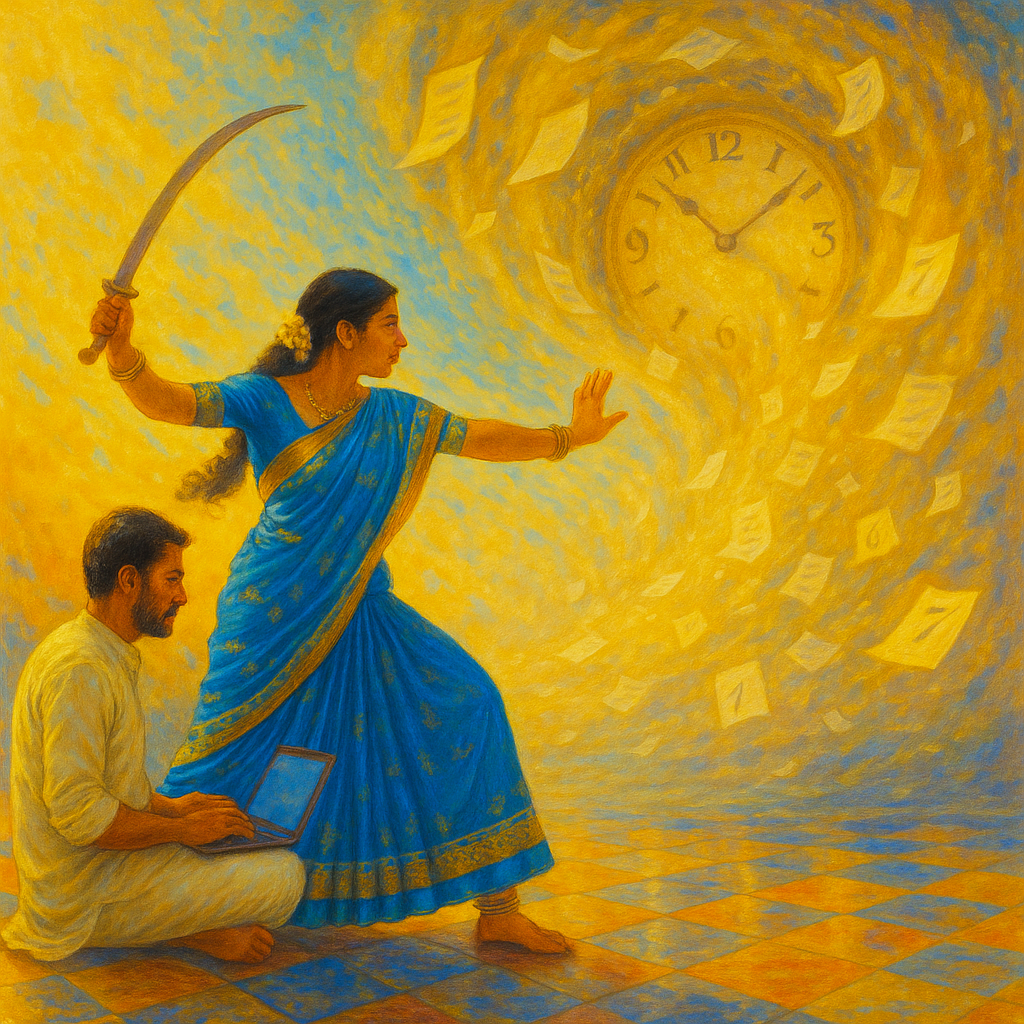
Oh what a glorious war we waged on time,
you in your peacock pleats and jasmine braid
and ankle bells portraying a warrior goddess,
me at my laptop redeploying rhyme
like roving arrows on a map of fate.
We fought our Passchendaele, entrenched in bodies,
my dugout deep in yours. We woke up, ate,
went on our morning walks, we made love, played
old board games, ditched our iPhones, stormed the beachhead,
kamikazed straight into the sun
while knowing we would likely never reach it,
while knowing no Great War was ever won,
each night, each decade together one more mission
prolonging this timeline, this lifegiving war of attrition.

*****

Amit Majmudar writes: “My twin sons, so recently in diapers, just submitted their college applications. My beard has now more white hairs than black. How did this happen? At the cellular level, at the level of fast-twitch muscular contractions and verbal elan, time causes depletion, the radioactive decay of the youthfully glowing complexion, the degradation of collagen, the degradation of memory…. Sophocles, Goethe, and Yeats wrote beautifully into their later lives. Shakespeare stopped writing, voluntarily, when he was less than a decade older than my current age. Two things take me out of time: love, and the creative flow state. This poem represents (both in its subject matter, and as an example of my creativity) the intersection of the two. Yet time really doesn’t stop during that interval. I just cease to register it. The aging goes on, unchecked: the piecemeal conquest of the body, follicle by follicle, neuron by neuron; the tick-tock wastage of love’s remaining years together…. It demands a war effort, and total war at that, all one’s resources of spirit and body utilized to fight it: a Crusade to retake one’s youth, the war against time a Manhattan Project, a veritable Mahabharata: “the only holy war.”

‘The Only Holy War’ was originally published in the New Verse Review.

Amit Majmudar’s recent books include Twin A: A Memoir (Slant Books, 2023), The Great Game: Essays on Poetics (Acre Books, 2024), and the hybrid work Three Metamorphoses (Orison Books, 2025). More information about his novels and poetry collections can be found at www.amitmajmudar.com.

Illustration: RHL and ChatGPT

Amit Majmudar, ‘Poem that Almost Rhymed’

Sometimes I visit bodies where I almost roamed
and the curves are made of clouds I almost dreamed,

a consummation missed by just a touch,
an air-to-air refueling broken off,

the hose retracted and the thirst abandoned
as both planes bank in opposite directions.

I hold my almosts in a contact list
of hands I never held, and never lost,

my store of acorns, little lids on ache,
my unmates boarding, one by one, an ark

that sails them, as it must, away from this life,
where I have these three kids, this house, and this wife,

although it could have been somebody else,
a past I passed on quickening my pulse.

When I pull my present closer by the waist,
almost wears the skin of never was.

*****

Amit Majmudar writes: “Poem That Almost Rhymed operates by slant rhymes, mimicking phonetically the speaker’s romantic near-matches that ended up being near-misses. “Close but no cigar,” as the saying goes: the  speaker reflects on friends who almost made love using words that almost chime in melodiously coupling couplets. Incomplete. The sexual imagery is clear but hopefully sophisticated enough not to seem vulgar–particularly the coitus interruptus implicit in the image of mid-air refueling. The last slant rhyme “waist” almost consummates with “was”–two more letters, and the rhyme would fulfil itself as “waste,” the word that epitomizes the underlying regret of the speaker, who acknowledges his happiness but knows, too, that his happiness could have taken another form, perhaps (sigh) one that would have been an ever-so-slightly better match….”

Amit Majmudar is a poet, novelist, essayist, and translator. He works as a diagnostic nuclear radiologist in Westerville, Ohio, where he lives with his wife and three children. Recent books include Twin A: A Memoir (Slant Books, 2023), The Great Game: Essays on Poetics (Acre Books, 2024), and the hybrid work Three Metamorphoses (Orison Books, 2025). “Poem That Almost Rhymed” was first published in Bad Lilies. Majmudar’s next collection, Things My Grandmother Said, is scheduled for early 2026. 
More information at www.amitmajmudar.com

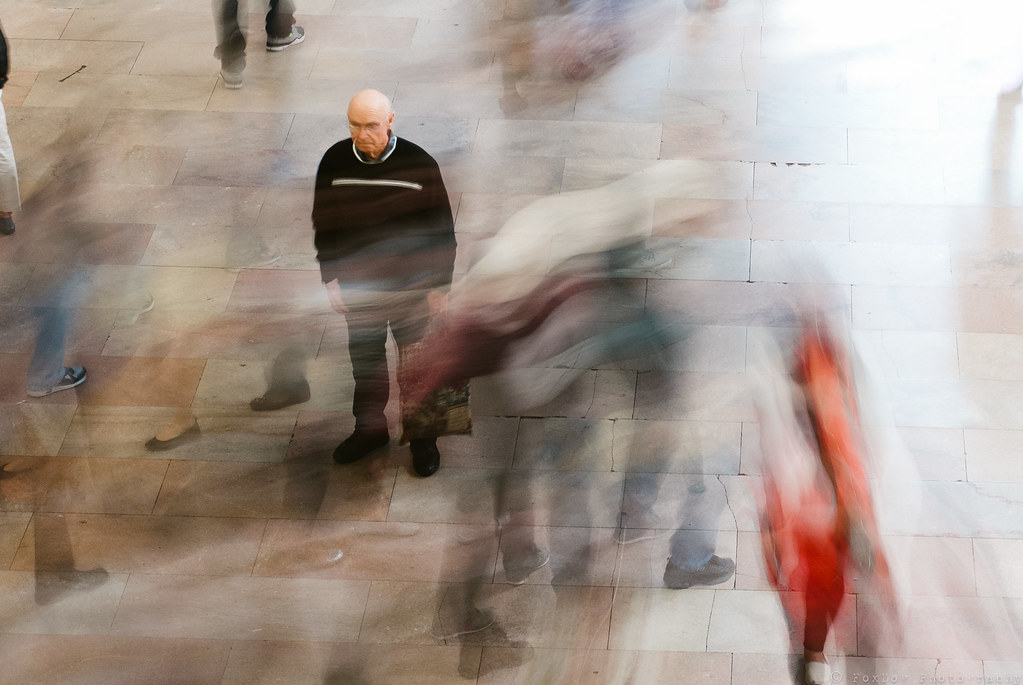
Missed Connection [day 111 of 366]” by Wondermonkey2k is licensed under CC BY-NC-ND 2.0.

Sonnet Crown: Amit Majmudar, ‘Recourse’

1.

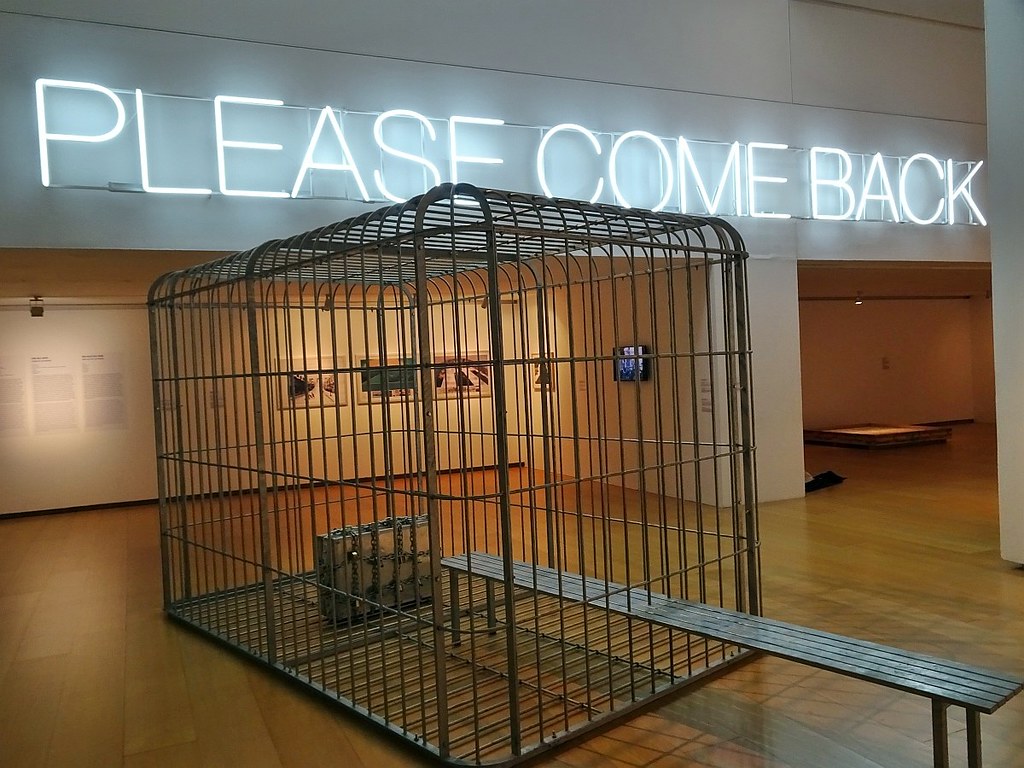
Time, like love, is cyclic. Please come back
to me. I’ll stand here waiting, wanting while
the mare without her rider rounds the track.
I want to weave a crown for you, design
a daisy chain whose threaded stems become
a bracelet that handcuffs your wrist to mine.
My shadow’s gnomon tilts like a sun dial’s.
I know you’re somewhere close. I feel a thrum,
a thrill beneath the stillness of the earth,
the way a woman, days before the birth,
places her husband’s hand on the sea swell
that rises out of her and passes through her,
and, touching so much vastness, he can tell
for all their time as one, he never knew her.

2.

For all our time as one, I never knew you—
but doesn’t learning come from repetition?
I’ll do this better if I do it over.
I’ll know your every need by heart, pursue you
like truth. I’ll learn to be a truthful lover.
I’ll circle back to freshman year and woo you.
No song’s recorded in a single session.
No sinner’s shriven after one confession.
It’s time that grows the pearl. Nacre layers
the sand grain, like a secret in the mouth.
Repentance grows, too—grows by daily prayers
into a faith whose trigger seed was doubt.
I am a pearl diver in your depth.
I never left. I just came up for breath.

3.

I never left, I just came up for breath,
but now I am ready to follow you all the way down.
I’ve read we get euphoric as we drown.
Samsara swirls us under. When we break
the whitecaps for an instant, that is death.
Don’t make us wait to be reborn before
we love again. You know me—I’ll just make
the same mistakes. Or make things even worse.
So what if time’s a circle? Doesn’t mean
we have enough of it. The now we’re in
will never come again. So come again
into my life, and love me sight unseen.
We’re both at sea, and no good at dead reckoning.
A burning town’s the only lighthouse beckoning

4.

Our house of light is burning down. It beckons in
the gloaming. The road I’m roaming is a ring.
All time is circular. We’re only seconds in.
All reasoning is circular. I sing
the seasons all the way around the year.
There was a chemist once whose dream disclosed
benzene’s atomic structure. What appeared
before him was a serpent swallowing
its tail—aroma’s O, ouroboros.
I’m wise at last to what the image knows.
I see my answer now, my big mistake.
A ring! Why couldn’t it have been this clear
back then? I see it best when I’m awake.
I’ve circled back. But there is no one here.

5.

I’ve circled back, but there is no one where
the ring road ends. It ends in newfound ruins,
a shell-flecked nest, a rain-worn blade that bears
a message for us. Who can read the runes?
Nietzsche proclaimed the eternal return
and threw his arms around a bleeding horse
to feel the centuries reversing course.
His gooseflesh rose like spores that pock a fern.
Let vultures circle, only widdershins
above the ring road where I wait alone,
knifing in bark a promise of my own.
I know the ring road ends where it begins.
Time is a circle I can put to use:
a wheel to roll things back, a crown, a noose.

6.

A wheel to roll things back, a crown, a noose:
My own Venn diagram of rings to choose
from. Fill its center up with hourglass sand,
and that’s where Archimedes, kneeling, draws.
This is the Roman siege of Syracuse;
he’s hard at work on time, its shape and laws.
He looks up from a boot. A soldier stands
above him, dripping gladius in hand.
Do not disturb my circles, says the Greek.
The soldier studies them, then runs him through—
and so reveals what Archimedes seeks,
the circle, like a circuit, broken, weeks
and months and centuries and aeons spilling
in slow, concentric circles from the killing.

7.

In slow, concentric circles from the still-pink
narcotic kiss print of the cupping glass,
let your memories ripple outward, killing
the pain I’ve caused you. We are not our past,
though time is cyclic. Cycles can be broken,
souls reborn in this life, sleepers woken.
Not that I can sleep beneath this star.
Horizon, magic circle, boxing ring—
time is the space, the spell, the place we spar,
the dome in which your name is echoing.
It’s where I pray the theory into fact
that love, like time, is cyclic. Please come back.

*****

Amit Majmudar writes: “The sonnet crown is a naturally recursive form of forms. The beginning of each sonnet is also an ending, and vice versa. A candle tilts to light a candle that tilts to light a candle, until the occult circle of flame is complete, and the poet sits inside it, meditating the next line, which may well be the line just written.

“This sonnet crown took, as its subject, the tendency of lovers, or at least their memories, to relapse. “Relapse” means to fall back, etymologically. To fall back in love; to fall back out of love. The sonnets enact through form and content alike the recrudescence of the past. The last line of the overall crown matches the first line of the overall crown. The reappearance of the old pain makes it a crown of thorns.

“I wrote this sonnet crown first line to last. I had never even attempted one before, but I relinquished myself to the music-making. I could do that because I circled around a theme–recursion in love–rather than trying to tell a story or present a philosophical argument or any such prosaic thing. Just pure pursuit of the right sounds. This crown came at the end of a sonnet-writing tear so my hand was in practice, as it were.

“Close readers will notice that the crown is imperfect, however. In the final, truncated sonnet, the speaker makes haste to return to the beginning, to break the process of endless recursion. Accordingly, the rhyme word of the line where the deviation begins is “broken”–and it’s there that the formal pattern–the “cycle”–itself is broken. Broken/woken collapses the separated rhyme sounds into a couplet, with a second couplet to conclude the 12-line ending–a couplet of couplets, the original pair formation and the hoped-for repeat pair formation, embodied in the music of the ending that is, at last, a new beginning. “

*****

Amit Majmudar is a poet, novelist, essayist, and translator. He works as a diagnostic nuclear radiologist in Westerville, Ohio, where he lives with his wife and three children. Recent books include Twin A: A Memoir (Slant Books, 2023), The Great Game: Essays on Poetics (Acre Books, 2024), and the hybrid work Three Metamorphoses (Orison Books, 2025). “Recourse” was first published in Plume Poetry, and will be appearing in Majmudar’s forthcoming collection, Things My Grandmother Said, in early 2026. 
More information at www.amitmajmudar.com

Photo: “0103-IVAM – Please Come Back 05” by gibbix1 is licensed under CC BY-NC 2.0.

Using form: sonnet variation: Amit Majmudar, ‘List of Demands’

All the twists in all the tongues, all
the zeroes, all the ones, all the arms of all the goddesses, all
the names of the nameless and bodiless, all the ways the all-
one embodies, all at once, the alls there are, all
our alleles and alphabets, all the forms, yes all,
even the sestina, all our alternating lives and deaths, all
the kingdoms, phyla, classes, orders, all
the peoples borderless as breaths, all the altars, all the all,

none of the zealots with knives for minds, none
of the wars, proxy, holy, shadow, cold, none
of the for-profit prophets in pulpits of gold, none
of the land grabs in the names of the long lost, none
of the one true anything, book or way or son, none
of that nonsense, absolutely none.

*****

Amit Majmudar writes: “The monorhymed sonnet (each line of the octet ending with the same word, each line of the sestet ending with another) is a chance to goad one’s creativity with a constraint just light enough. You have to come up with lines that stay interesting to the reader even though the reader knows how each line is going to end. In that, the line resembles, say, a formulaic genre novel where the hero gets the girl and defeats the villain at the end. Or one of Conan Doyle’s detective stories: You know that Holmes is going to solve the mystery. The number of characters is so low in a Holmes short story that the culprit has to be one of the few people introduced. But the delight is all in how he figures it out. Poems can work like that, too. The foregone conclusion of all, all, all, all, all, all, all, all, none, none, none, none, none, none is the equivalent of the certainty that Holmes will crack the case. The internal rhymes and alliteration, the images, the poem’s message exalting pluralism over zealotry—these are, collectively, the equivalent of the mystery and the ingenious solution to the mystery, the Sherlock-unlock, the puzzle (hopefully) satisfyingly worked out.”

‘List of Demands’ was first published in Plume.

Amit Majmudar is a poet, novelist, essayist, and translator. He works as a diagnostic nuclear radiologist in Westerville, Ohio, where he lives with his wife and three children. Recent books include Twin A: A Memoir (Slant Books, 2023), The Great Game: Essays on Poetics (Acre Books, 2024), and the hybrid work Three Metamorphoses (Orison Books, 2025). A new poetry collection, Things My Grandmother Said, is forthcoming in 2026. 
More information at www.amitmajmudar.com

Photo: “Inclusive community (citation needed) (2205859730)” by Matt Mechtley from Heidelberg, Deutschland is licensed under CC BY-SA 2.0.

Short poem: Amit Majmudar, ‘Charmed Life’

Destiny blessed me. Kismet kissed me.
Accident aimed, but the meteor missed me.
Fate did me favors. Luck had my back
For a leisurely picnic between the tracks.
Joy was a contract I printed and inked.
How could I know
In the mountaintop snow
Nemesis tiptoed behind me and winked?

*****

‘Charmed Life’ appeared in Literary Matters, and also in The Best American Poetry 2024, selected by Mary Jo Salter. That BAP volume carries Amit Majmudar’s statement on the poem in the back matter:

“Count no man lucky until he is dead,” said Solon, a lawgiver in ancient Greece. You never know when a friendly universe might turn on you: The monthlong dry cough that turns out to be a lung mass, the backache that turns out to be a bone met; a quick trip in the car to get bread and bananas that takes a left at the light into lifelong quadriplegia. Just days before that catastrophe: A wedding, or a book deal, or a Disney trip with the kids…. It’s not a tightly enforced law, but things do tend to cancel out when it comes to good luck and bad luck, good times and bad times. (At least that holds for those of us who crowd the middle of the luck distribution; certainly some people at either extreme have only one sort of luck in abundance.)

This dashed-off charm of a poem, ‘Charmed Life,’ reflects that sense of yin and yang, of scooping slop and caviar with the same spoon. The speaker plays life on easy mode until that turn at the end, but the first word of the last line embeds the idea. “Nemesis” comes from the Greek for giving someone what they deserve, and before that, from the Indo-European root *nem-, which means “distribute.” Everyone deserves hell yeah and oh no in roughly equal measures. And for the most part, that is what we get.

*****

Amit Majmudar is a poet, novelist, essayist, and translator. He works as a diagnostic nuclear radiologist in Westerville, Ohio, where he lives with his wife and three children. Recent books include Twin A: A Memoir (Slant Books, 2023), The Great Game: Essays on Poetics (Acre Books, 2024), and the hybrid work Three Metamorphoses (Orison Books, 2025). More information at www.amitmajmudar.com

Photo: “Nemesis Roman goddess of retribution Marble 150 CE” by mharrsch is licensed under CC BY 2.0.


Amit Majmudar, ‘Nocturne’

“A healthy man can expect to get hard three to five times per night….Doctors call these erections while you sleep “nocturnal penile tumescence.” — Men’s Health

Why do they happen at all, much less
five times a futile night—
nested, within the circadian, their
sprung rhythm of delight?

Unless delight misreads the message.
Unless they choke and strain
against their loneliness like starved
Rottweilers on a chain.

Who visits in the witching hour
as REM begins
and slides her darkling mouth around
his hardening and grins?

Lascivious sylph or cocktease yakshi
or ex from some past life,
coaxing a husband into sin
at arm’s length from his wife.

Or else someone that when awake
he would not dare to daydream,
verboten body, evanescent
pelvis figure-eighting,

or maybe all his fantasies
since age twelve coalesce,
voluptuous ghosts that flash him their
aurora borealis.

A hundred mayflies in his blood
take wing at once above
the hushed and shingled houses, seeking
the ones they shied to love,

desperately swooping down and left,
back up, around, and right,
a minute to mate, then drift and fade
on a humid summer’s night.

*****

Editor’s note: I see this poem, which was first published in Only Poems, as existing where one’s various worlds overlap: the body, the mind, work (Amit Majmudar is a medical doctor), family… Amit Majmudar wisely provides no comment on his poem.

Amit Majmudar is a poet, novelist, essayist, translator, and the former first Poet Laureate of Ohio. He works as a diagnostic and nuclear radiologist and lives in Westerville, Ohio, with his wife and three children. He is the author of twenty books so far in a variety of categories, with different bodies of work published in the United States and in India.
His poetry collections include 0’, 0’ (Northwestern, 2009), shortlisted for the Norma Faber First Book Award, and Heaven and Earth (2011, Storyline Press), which won the Donald Justice Prize. These volumes were followed by Dothead (Knopf, 2016) and What He Did in Solitary (Knopf, 2020). His poems have won the Pushcart Prize and have appeared in the Norton Introduction to LiteratureThe New Yorker, and numerous Best American Poetry anthologies as well as journals and magazines across the United States, UK, India, and Australia. Majmudar also edited, at Knopf’s invitation, a political poetry anthology entitled Resistance, Rebellion, Life: 50 Poems Now.
One of Majmudar’s forthcoming volumes is a hybrid of prose, drama, and poetry, entitled Three Metamorphoses (Orison Books, 2024). A new poetry collection is forthcoming from Knopf in 2026.

For links to Majmudar’s Nonfiction, Fiction, Mythology and Translations, please see his website.

Photo: “I Dream Of Love” by toddwshaffer is licensed under CC BY-NC-ND 2.0.

Amit Majmudar, ‘To the Hyphenated Poets’

Richer than mother’s milk
is half-and-half.
Friends of two minds,
redouble your craft.

Our shelves our hives, our selves
a royal jelly,
may we at Benares and Boston,
Philly and Delhi

collect our birthright nectar.
No swarm our own,
we must be industrious, both
queen and drone.

Being two beings requires
a rage for rigor,
rewritable memory,
hybrid vigor.

English herself is a crossbred
mother mutt,
primly promiscuous
and hot to rut.

Oneness? Pure chimera.
Splendor is spliced.
Make your halves into something
twice your size,

your tongue a hyphen joining
nation to nation.
Recombine, become a thing
of your own creation,

a many-minded mongrel,
the line’s renewal,
self-made and twofold,
soul and dual.

*****

Editor’s comments: Being Anglo-Danish from birth and with the subsequent acquisition of other passports, I am naturally biased in favour of multiculturalism. It was interesting a couple of months ago to hear Britain’s Home Secretary Suella Braverman say “Multiculturalism has failed.” As one commentator noted, “She’s descended from Goan Indians from Mauritius and Kenya, married to a Jewish husband, and is in a senior cabinet position in a government headed by Britain’s first Hindu PM, himself the son of immigrants… Hello???” Suella Braverman left the cabinet shortly after.

Indians in particular, having been invaded and occupied by the Portuguese, French and British in the past couple of centuries, have used those connections to move out into the world – not just as entrepreneurs, but also in the arts, sciences… and politics. In mid-2023 the Prime Ministers of Ireland, Mauritius, Portugal and the UK, and the Presidents of Guyana, Mauritius, Seychelles, Singapore, Suriname and Trinidad & Tobago, all had Indian origins.

Amit Majmudar is a poet, novelist, essayist, translator, and the former first Poet Laureate of Ohio. He works as a diagnostic and nuclear radiologist and lives in Westerville, Ohio, with his wife and three children. He is the author of twenty books so far in a variety of categories, with different bodies of work published in the United States and in India.
His poetry collections include 0’, 0’ (Northwestern, 2009), shortlisted for the Norma Faber First Book Award, and Heaven and Earth (2011, Storyline Press), which won the Donald Justice Prize. These volumes were followed by Dothead (Knopf, 2016) and What He Did in Solitary (Knopf, 2020). His poems have won the Pushcart Prize and have appeared in the Norton Introduction to LiteratureThe New Yorker, and numerous Best American Poetry anthologies as well as journals and magazines across the United States, UK, India, and Australia. Majmudar also edited, at Knopf’s invitation, a political poetry anthology entitled Resistance, Rebellion, Life: 50 Poems Now.
One of Majmudar’s forthcoming volumes is a hybrid of prose, drama, and poetry, entitled Three Metamorphoses (Orison Books, 2024). A new poetry collection is forthcoming from Knopf in 2026.

For links to Majmudar’s Nonfiction, Fiction, Mythology and Translations, please see his website.

Photo by Ami Buch Majmudar.

Poem: ‘City! Oh City!’

Cities–once all smeared with grime,
rich but dirty, full of crime–
clear the excess cars and dust
if their governments are just,
house the homeless, and among
their cares: clean water, healthy young.
Gorgeous buildings grow and twist
through a river’s gentle mist;
trees in leaf for urban hikes:
sculptures, cafes, books and bikes…
children run wild in the park
till theatre signs light up the dark;
music spills from bars at night–
the well-run city’s a delight.

*****

This poem was published (in 2021 or 2022, the Bahamas Post Office seems to have lost my copy so I’m not sure yet) in The Lyric Magazine, Jean Mellichamp calling it “a breath of fresh air”. I wrote it to be an upbeat view of the modern world in contrast to a lot of the more worrying future issues that I’m often concerned with; and when I put together the ‘City! Oh City!’ Potcake Chapbook, I included the poem to balance some of the less rosy views of urban life–though my poem is nowhere near as skilled as the pieces in the chapbook by Maryann Corbett, Amit Majmudar and others.

Photo: “le quai river cafe on seine” by grahamdale74 is licensed under CC BY-NC-SA 2.0.

Using form: sonnet variation: Amit Majmudar, ‘A Pedestrian’

He window shops. He yawns. He checks his watch.
He sips his Starbucks through a spillproof lid.
No one knows who he is or what he did
except a black van loitering down the block.
He buys a pack of gum. Briefly he stops
to crouch and read the headlines of the Times
before continuing up 12th and Vine.
His neck prickles. He slows. The coffee drops

and before it has landed he’s off like a hound at the races
he is hurdling strollers and ducking a chilidog raised
to the mouth checkered taxis grow fists as he cuts
into oncoming traffic our cellular phones snap shut
in amazement look billowing trenchcoats give chase
fleshcolored earpieces dangling a flush to their faces

*****

Amit Majmudar writes: “The actor Alfred Molina recorded ‘A Pedestrian‘ for the Poetry Foundation many years ago: https://www.wnyc.org/story/52133-poetry-off-the-shelf-amit-majmudar/ . It’s an excellent rendition. I remember feeling, when I heard that recording back in 2006 (at the tender age of 27), that I had finally “arrived” as a poet—after all, the guy from the opening sequence of Raiders of the Lost Ark had spoken my words! I don’t often write sonnets, but ‘A Pedestrian‘, with its metrical shift from walking to running at the volta (dovetailing with the idea of metrical “feet”), was a fun poem to write.”

Amit Majmudar is a poet, novelist, essayist, translator, and the former first Poet Laureate of Ohio. He works as a diagnostic and nuclear radiologist and lives in Westerville, Ohio, with his wife and three children. 
      Majmudar’s poetry collections include 0’, 0’ (Northwestern, 2009), shortlisted for the Norma Faber First Book Award, and Heaven and Earth (2011, Storyline Press), which won the Donald Justice Prize, selected by A. E. Stallings. These volumes were followed by Dothead (Knopf, 2016) and What He Did in Solitary (Knopf, 2020). His poems have won the Pushcart Prize and have appeared in the Norton Introduction to Literature, The New Yorker, and numerous Best American Poetry anthologies as well as journals and magazines across the United States, UK, India, and Australia. Majmudar also edited, at Knopf’s invitation, a political poetry anthology entitled Resistance, Rebellion, Life: 50 Poems Now. 
      Majmudar’s essays have appeared in The Best American Essays 2018, the New York Times, and the Times of India, among several other publications. His forthcoming collection of essays, focusing on Indian religious philosophy, history, and mythology, is Black Avatar and Other Essays (Acre Books, 2023). Twin A: A Life (Slant Books, 2023) is the title of a forthcoming memoir, in prose and verse, about his son’s struggle with congenital heart disease. 
      Majmudar’s work as a novelist includes two works of historical fiction centered around the 1947 Partition of India, Partitions (Holt/Metropolitan, 2011) and The Map and the Scissors (HarperCollins India, 2022). His first children’s book also focuses on Indian history and is entitled Heroes the Colour of Dust (Puffin India, 2022). Majmudar has also penned a tragicomic, magical realist fable of Indian soldiers during World War I, Soar (Penguin India, 2020). The Abundance (Holt/Metropolitan, 2013), by contrast, is a work of contemporary realism exploring Indian-American life. Majmudar’s long-form fiction has garnered rave reviews from NPR’s All Things Considered, the Wall Street Journal, Good Housekeeping, and The Economist, as well as starred reviews from Kirkus and Booklist; his short fiction won a 2017 O. Henry Prize.   
      Majmudar’s work in Hindu mythology includes a polyphonic Ramayana retelling, Sitayana (Penguin India, 2019), and The Mahabharata Trilogy (Penguin India, 2023). His work as a translator includes Godsong: A Verse Translation of the Bhagavad-Gita, with Commentary (Knopf, 2018).

Photo: “a hot drink” by [ embr ] is licensed under CC BY-NC-SA 2.0.

Amit Majmudar: ‘The Last Meditation of Marcus Aurelius’

Among the Quadi, on the river Gran
I hate no one, love no one, am no one,
My armor hollow, crumpled, a tumbling can
Among the Quadi, on the river Gran.
River awash with bodies, rinse my hand.
I neither love nor hate what it has done.
Among the Quadi, on the river Gran
I neither love nor hate what I’ve become.

I neither love nor hate what I’ve become
Among the Quadi, on the river Gran
Slaughtering boys with long hair spun of sun.
I neither love nor hate what I have done
Galloping after stragglers on the run.
Rinse, rinse my hand, as only a river can.
I love no one, hate no one, am no one
Among the Quadi, on the river Gran.

*****

This poem originally appeared in The Classical Outlook, Vol. 97, No. 3

Amit Majmudar writes: “I am a fan of Marcus Aurelius, and I wrote this little poem around the same time I wrote an essay about harmonics between the Meditations and the Bhagavad-Gita, which I published my translation of in 2018.
Yet the original idea—a triolet that plays with that oddly pentametric subtitle of one of the chapters of the Meditations—occurred to me years ago. I am pretty sure I wrote, or tried to write, a triolet with this refrain maybe fifteen years ago. I lost it, never sent it out, one of the literally hundreds of poems I write but never send out. (Creatively I am like a fish, laying a superabundance of eggs, expecting only a small percentage to survive.)
When I reread the Meditations recently, getting my thoughts together for the essay, I saw that subtitle and had the same idea a second time, or remembered having had the idea (and hence inadvertently had it again). These two triolets are my attempts at reconstructing a poem I wrote and forgot years ago. I could not recall if I had made “Among the Quadi, on the river Gran” the first or second line of that ur-triolet. So I blundered around and found my way into this “double triolet.”
The image of Marcus Aurelius as a reluctant Stoic warlord is irresistible to me. I think the best commentary on this poem is the essay I wrote at the same time, published over at Marginalia at the Los Angeles Review of Books. This is the link to that essay:
https://themarginaliareview.com/the-gita-according-to-marcus-aurelius/

Amit Majmudar is a poet, novelist, essayist, translator, and the former first Poet Laureate of Ohio. He works as a diagnostic and nuclear radiologist and lives in Westerville, Ohio, with his wife and three children. 
      Majmudar’s poetry collections include 0’, 0’ (Northwestern, 2009), shortlisted for the Norma Faber First Book Award, and Heaven and Earth (2011, Storyline Press), which won the Donald Justice Prize, selected by A. E. Stallings. These volumes were followed by Dothead (Knopf, 2016) and What He Did in Solitary (Knopf, 2020). His poems have won the Pushcart Prize and have appeared in the Norton Introduction to Literature, The New Yorker, and numerous Best American Poetry anthologies as well as journals and magazines across the United States, UK, India, and Australia. Majmudar also edited, at Knopf’s invitation, a political poetry anthology entitled Resistance, Rebellion, Life: 50 Poems Now. 
      Majmudar’s essays have appeared in The Best American Essays 2018, the New York Times, and the Times of India, among several other publications. His forthcoming collection of essays, focusing on Indian religious philosophy, history, and mythology, is Black Avatar and Other Essays (Acre Books, 2023). Twin A: A Life (Slant Books, 2023) is the title of a forthcoming memoir, in prose and verse, about his son’s struggle with congenital heart disease. 
      Majmudar’s work as a novelist includes two works of historical fiction centered around the 1947 Partition of India, Partitions (Holt/Metropolitan, 2011) and The Map and the Scissors (HarperCollins India, 2022). His first children’s book also focuses on Indian history and is entitled Heroes the Colour of Dust (Puffin India, 2022). Majmudar has also penned a tragicomic, magical realist fable of Indian soldiers during World War I, Soar (Penguin India, 2020). The Abundance (Holt/Metropolitan, 2013), by contrast, is a work of contemporary realism exploring Indian-American life. Majmudar’s long-form fiction has garnered rave reviews from NPR’s All Things Considered, the Wall Street Journal, Good Housekeeping, and The Economist, as well as starred reviews from Kirkus and Booklist; his short fiction won a 2017 O. Henry Prize.   
      Majmudar’s work in Hindu mythology includes a polyphonic Ramayana retelling, Sitayana (Penguin India, 2019), and The Mahabharata Trilogy (Penguin India, 2023). His work as a translator includes Godsong: A Verse Translation of the Bhagavad-Gita, with Commentary (Knopf, 2018).

Photo: “File:0 Marcus Aurelius Exedra – Palazzo dei Conservatori – Musei Capitolini (1).jpg” by Unknown artist is licensed under CC BY-SA 3.0.