Tag Archives: Anglo-Saxons

Martin Briggs, ‘Saxon’

From forefathers’ farmstead hunger me hounded
With woman and bairns and some wretched remains:      
Leaping alone on the deep, our boat bounded
Away from the homeland of Angles and Danes.      

For days the deck dandled on wastes of grey water,
And shivered and shook in the growl of a gale
While sea monsters daunted my wife and my daughters
And I drew deep draughts from an ox-horn of ale.                 

The strong ones – the heroes – they breasted and braved
Those terrible fathoms of fearfullest depth,
And steadily steered us through wind and through wave
While cursing all cowards, disdainful of death.

But Njord sent a silver-winged gannet to guide us.
Impatient for cornlands by weal or by war,
We raced with the wind and the sunrise behind us,                    
And sure was our way to a grey wooded shore. 

On the flood, up a watercourse muddily canting  
Through marshes where mist devils wreathed among reeds,
Where pastures awaited our ploughing and planting
We oared ourselves bravely, emboldened by need.

But furtive eyes followed our struggle upstream
As we ventured our vessel in menacing silence.
The landscape seemed empty, yet sometimes the gleam
Of a blade in the coverts of blackthorn spoke violence.

Whoever they were, they were ready for raiders;
And we, to contest our new home to the last.
Still no-one molested, still no-one waylaid us.
At length we approached apprehensive, and passed,

As we warily, wearily rieved up the river,
A barrack abandoned, a half-ruined hall.
Within arrow’s reach but wavering never
While Britons looked on from those broken-down walls

Some long-vanished Legion had left there, and stared
From their crumbling defences of rubble and stones.
We were outnumbered, but though we prepared
For foray or ambush, they left us alone.

Where the shallows gave out and we grounded the keel   
At a bend in the vale, shipped oars and dropped sail,  
An auspicious white egret wheeled over the field
Where we sit by this hearth where I tell you this tale.

So here we sowed barley, roots, rye and wheat;
Brewed strong Saxon beer, baked good Saxon bread;
Our sheep grazed and grew, gave us wool, milk and meat.
Brides were my daughters for Britons – both wed                  

Sons of the tribe we had troubled when first
Setting foot on their dale in that dangerous dawn.
Then you came along, with lungs fit to burst,
Your grandfather’s joy from the day you were born.

Well, we followed the fashion for Cross and for Christ,
Acknowledged His kingship to keep a calm life,                    
Forswore the old gods, and got us baptised.                 
I bowed to His will when He took my young wife….

Your grandmother’s happy in heaven, they say,
Spinning and weaving a wool of pure gold
Where angels sit feasting and drinking all day.
Another turf on the fire, boy, these evenings are cold.

Yes, I, a dull peasant, she thought me so grand,           
Me, shy of adventure and frightened of pain….       
But these fields were fertile, four cows bore my brand,
And I, a true Saxon, lived up to my name

Of Earth-Brother.  They’ll tell you in our mother tongue
That heroes are warlike, wield swords, win more land,
Yet I was content among swine and their dung.
The ploughshare I chose; but, boy, understand:              

All-Fatherly fortune has favoured my choice.
You wonder, wide-eyed, would I do it again?
The ocean, the fear?  Hear an old voice: 
The heart in the breast of my broodiest hen

Beats brave as the heart of a hero – but then,
No courage is needed to counter the new.        
Heroes are merely a notion of men.
The future must happen; will happen to you.

*****

Martin Briggs writes: “Saxon” began as an experiment.  I wanted to think myself into the frame of mind of men forced by circumstances to seek out and colonise new lands – a situation being re-enacted tragically today in response to environmental and other pressures.  The heavy alliteration reflects the Anglo-Saxon predilection for the same, and the persistent rhythm is intended to convey a sense of bardic tradition.”

“Saxon” was first published in Pulsebeat Poetry Journal.  This version has been subject to very minor revision.

Martin Briggs only began writing in earnest after retiring from a career in public administration, since when his work has appeared in a variety of periodicals and formats on both sides of the Atlantic.  He regards form, rhyme and metre as a liberating force rather than a constraint, and as a means of perpetuating a tradition which is as old as poetry itself.  He lives in Suffolk, a part of England where Anglo-Saxons settled quite densely. 

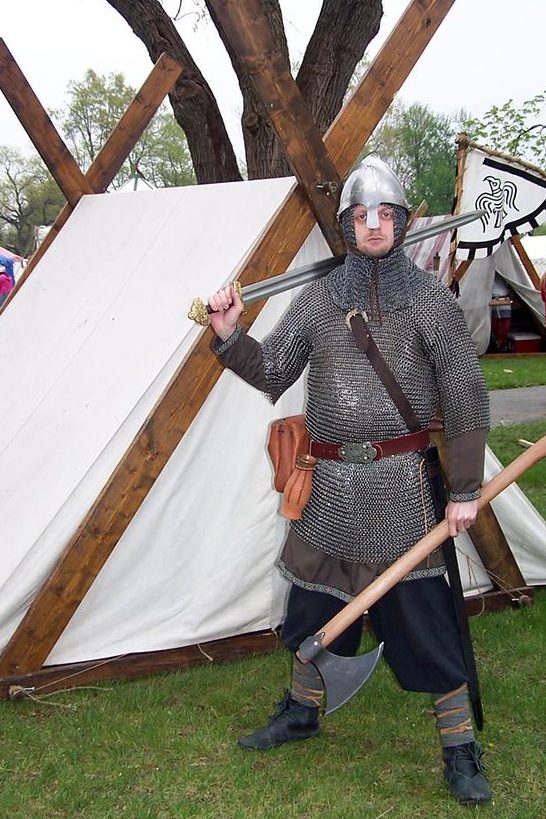
Photo: “The Saxon Huscarl” by One lucky guy is licensed under CC BY-NC-SA 2.0.
Review: ‘Beowulf’, translated by Seamus Heaney

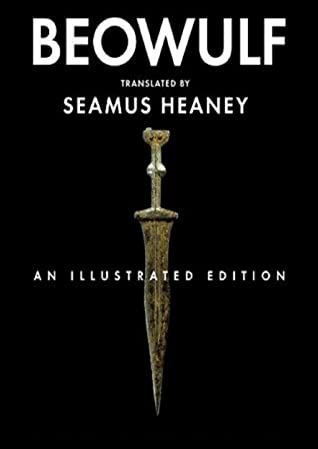
I can’t imagine a better version of Beowulf than this brilliant rendition into appropriately alliterative verse by Nobel prizewinning poet Seamus Heaney, with full colour photographs on alternating pages of the massive 3,000-line poem. It has the rhythm of the original, it is essentially faithful to the original, and the illustrations (even more than the notes) give a sense of landscape, ships, weapons, jewelry, halls, etc that helps bring the entire story to life.

The story itself is in three parts: Beowulf travels from what is now Sweden to help the king of the Danes against a monster, Grendel, that is attacking and devouring his people, and Beowulf defeats Grendel by tearing an arm off. Gifts are given, and everyone relaxes. However Grendel’s mother comes the next night seeking revenge, and Beowulf goes after her the next day, diving into her murky pool and killing her with a sword. More gifts are given, and Beowulf returns home. Fifty years later Beowulf, now himself a king, goes to fight a dragon that has been roused and is pillaging the countryside; he fights the dragon and they kill each other; the dragon’s hoard is buried with Beowulf in the tomb that is built for him.

The historical persons in the tale, and the Danish king’s hall at Lejre, date to the mid-6th century. Then and for the next 500 years Scandinavia was innocent of Christianity, and the warrior society and the constant blood-feuds are a part of the story. But the poem as we have it have it was apparently composed in the 9th century in Christiansed England, and the will of a very Old Testament God is referenced throughout as overruling the abilities of humans. This feels like no more than an unimportant veneer of a modern religion over a Scandinavian sense of weird, wyrd, or destiny.

The poem is important as the beginning of English poetry, and its place and relevance is heightened by Heaney’s long and delightful introduction in which he details how he, as a Northern Ireland Catholic who felt deprived of his Gaelic birthright, came to fuse Gaelic, Old English and modern English into a sense of community and identity.

So because of the Introduction and the photos and illustrations as well as the superbly rhythmic and semi-alliterative translation, this is the Beowulf if you want a Beowulf!

Poem: “From the Heart of Europe”

Warning, it’s long: 140 lines. And it’s a rant, a chant, with formal passages only towards the end. It is published in the current issue of Snakeskin, whose editor George Simmers expressed reservations, calling it “your monster of a poem. It’ll be interesting to see if there are indications that anyone gets to the end of it. My suspicion is that 24 lines is about the maximum most people are willing to read online. But I like having an occasional long poem in Snakeskin – gives readers a challenge.

So here it is… “From the Heart of Europe

Europe

I am the Celt, westering across Doggerland
Into the wilds – in me live
The stories of the monsters, dragons, ogres
I found as I struggled through trackless wilderness
Fighting off the wolves, bears and cavemen.
If you would see me, look to Ireland and to France,
To Scotland, Wales, Cornwall and Brittany.
When verbs are forming complicated trains you’re seeing my Gaelic grammar.

And I am the Roman, bringing engineers,
Underfloor heating, square buildings and straight roads.
Ten generations of the Middle Sea –
Italians, Greeks, Egyptians, Libyans –
Braving the cold and damp, our children British…
Until the Empire falls, and some go “home”
To warmer seas, to citrus trees, and Rome.
Look for me in the priestly words,
As in the black Irish who fled the Saxons.

For I am the Angle, Saxon, Jutlander,
Displacing Britons, making Angle-land.
Like ours, all tribes move west and south as Rome succumbs.
Clearing the forests, making free men’s farms,
Avoiding ruins of the Roman towns,
Avoiding ruins of the great square buildings.
Look for me in the fields and farms
Of Essex, Sussex, Saxony,
Of Anglia in England and Anglia in Germany,
And in the daily words of common folk.

Then I am the Viking, avenging Christian slaughter,
Avenging Verden’s massacre, five thousand dead.
Looting and raiding for slaves and wives, and –
Hey, that’s nice land on a quiet river…
Let’s stay here with our meetings and our laws.
Look for me in the Yorkshireman of the Danelaw
And all across the north lands to the east.

I am also the Northman who settled in France –
Where Romans had ruled Celts 500 years –
And now claim the rights of the Viking,
The rights of the Saxon,
Under Roman religion
To rule Angle-land.
I come with the Conqueror, follow the Bastard,
The Builder of Castles and Cities,
With renaissance of learning,
Enlightenment, Parliament,
Even including the poor, and then even women…
Look for me where I continued to conquer –
Where I fought other Europeans to control the world –
My branches spread everywhere – North America, India –
Hong Kong, Australia, Kenya, Jamaica –
But my roots… my roots are in Europe,
From Northlands to Rome and from Ireland to Greece.
You can prune back the branches,
But don’t think of cutting the roots.

When I see a wishing well – my roots
When I see an aqueduct – my roots
When I see men wear trousers – my roots
When I see women’s braids – my roots
When I eat bread and cheese – my roots
When I drink wine and beer – my roots
When I see people vote – my roots
When I hear legal judgement – my roots
When I smell farms and forests – my roots
When I hear waves and seagulls – my roots

And my roots are not without warfare.

In the Great War my grandfather died, so too both his brothers, all in their 20s.
This was not unusual in that war.
Then came a second world war. Europe said “Enough!”
The end of the war. Twin towns were an answer, building links.
Their history begins with Paderborn, Germany, and Le Mans, France.. in 836.
(The UK was a little late to the table, its first twin town was in 1905…)
Coventry now twinned with Dresden and Stalingrad.
The end of the war. The Treaty of Paris of ’51 for the European Coal and Steel Community,
The Treaty of Rome, the EEC of the western 6.
(The UK joined a little late in ’73.)
With Denmark and Ireland in the north, then adding 3 more in the south,
Then 3 more in the north, then 14 in the east,
Until almost Turkey, almost Russia, almost Morocco, Israel…
The Eurovision Song Contest, building links from ’56
(The UK joined late, ’57).
The It’s A Knockout! silly sports on TV (De Gaulle’s idea) from ’65
(The UK joined late, ’67).

Ah, that Europe of 50, 60 years ago…
When north and west and south worked to build links,
And you could wander freely, even go
Into the east (with bureaucratic waits and stamps and inks)…

And I have stood
Under the Transylvanian full moon
And eaten moon-green apples in a smooth wet field
And the lorry-driver spoke no English.

I have hitched
A ride from a Cologne motorway stop
With a limping German who spoke no English
In a fine car with leather seats
Over 250 miles to Hamburg in 2½ hours! – as if he said
“You only think you won the war.”

I have sat
In front of Goya’s Cowherds – Duel with Cudgels –
In the Prado in Madrid, and cried
For me, for us, for Europe, for the world.

I have slept
On the top steps of a Greco-Roman amphitheatre
In the tourist-Turkey fishing village summer nights,
And tourists took my picture.

I have eaten
In the impounded lorries of the smuggling Swiss
At the Turkish-Bulgarian customs zone
And got a ride to Munich.

I have seen
There is one street in Copenhagen no one knows but I.
Invisible, unless you watch those using it go by;
It winds above the buildings, up and down about the sky,
In single file ten thousand go by each day, and no lie! –
(The seagulls heading for the City Dump from out at sea.)

I have walked
South from Glasgow illegally on the motorway
With my thumb out as the snow began to fall.
The Police said “Get in”. They drove in silence 30 miles
And dropped me at a service station.

And still I think of that long night
When through and through the lorry-park
Rutted six inches deep in mud
The madman prowled, distraught and barefoot
Under the full moon, running his fingers through his hair,
Muttering and complaining, shouting aloud,
And the lorry-driver talked with him,
Explained to me
(And I through sparse Spanish guessed at his Romanian)
That the madman in the mud
Had killed someone
Or run him over
Or was on the verge of suicide,
Perhaps all three together…
And the madman muttered barefoot through the mud
Until the sun rose and we went our way.

That was my Europe, yesterday,
as still the British Isles today:
we are where the world meets.
We came, long past, from far away –
and more still come, some go, some stay…
the heart of Europe beats.

-.-.-.-.-

For what it’s worth, instead of those last 6 lines the poem originally had six 4-line stanzas. George Simmers was kind enough to critique them, attacking them from several directions and giving me the opportunity to write something better. They were the most formal section of the entire piece, and in being rejected they help people like Mike Burch make the case that “formal” isn’t the be-all and end-all of poetry.  🙂

Here is the original ending, giving a slightly different meaning and direction to the poem… Anyway, better or worse? What do you think?

But now England may
(Yes, I say May)
Go, with Wales, its own way –
(Though Scotland and Northern Ireland said stay.)

The peace we’ve been blest
With, the growth we’ve possessed
Has led the obsessed
To stoke enmity. Laws were transgressed

In winning the vote.
Weasel words, like a stoat
Changing colour of coat,
Were all lies. May they stick in their throat.

Our Europe is one:
Celt, Roman and Hun
May be how it’s begun,
But now, like the UK, everyone

From all round the globe,
In a suit, in a thobe,
In blue jeans, in a robe,
Has their place – each distinct as in strobe

Light, is lit as a part
Of the waves of fresh start
That newcomers impart
With, like all Europeans, their heart.