Tag Archives: art

Using form: Ottava Rima: Max Gutmann, ‘Life, That Hack!’ (from Don Juan Finish’d)

If we could but instill in Life–that hack!–
The element’ry rules of composition,
Prevent the crude and sloppy maniac
From spoiling every scene with his tradition
Of shouting in our faces like a pack
Of drunken sailors wailing their rendition
Of “Captown Races” or “My Drawlin’ Clementime,”
Their rhythmic belching almost keeping them in time.

For Life to utilize the art of Art
Could help in many ways that we could mention.
Some structure and suspense would be a start.
To get us upright in our seats, fists clenchin’,
A little rising action would be smart
(Or something that would help us pay attention,
Instead of simply zoning out a lot
And missing half the details of the plot).

But Life, I fear, shall never learn to craft
A decent tale. (It hasn’t that ambition.)
It uses characters extremely daft,
And wastes far too much time in exposition.
It never bothers to revise a draft,
Too taken with its own first thoughts. Perdition!
Each aspect of the story is a shame–
And worst, the ending’s always just the same.

Max Gutmann writes: “Don Juan Finish’d fancifully completes Lord Byron’s unfinished comic epic. Excerpts have been contributed to Light, Lighten Up Online, Orbis, Slant, Think, the website of the Byron Society, and Pulsebeat, where ‘Life, That Hack!’ is among the excerpts to have appeared. The complete poem is still unpublished, though I privately printed some copies to share with friends and colleagues.
Like Byron’s poem, Don Juan Finish’d is often philosophical, at times facetiously, as here.”

Editor’s note: As with Byron’s original, Gutmann’s Don Juan Finish’d is written in ottava rima: eight-line stanzas in iambic pentameter rhyming ABABABCC, with the final line or two typically used to humorously deflate whatever more high-sounding statements were made earlier in the stanza.

Max Gutmann has worked as, among other things, a stage manager, a journalist, a teacher, an editor, a clerk, a factory worker, a community service officer, the business manager of an improv troupe, and a performer in a Daffy Duck costume. Occasionally, he has even earned money writing plays and poems.

Photo: “comedy/tragedy masks, waterfall” by milagroswaid is licensed under CC BY-SA 2.0.
Odd poem: Henri Rousseau, ‘Inscription pour La Rêve’

Yadwigha dans un beau rêve
S’étant endormie doucement
Entendait les sons d’une musette
Dont jouait un charmeur bien pensant.
Pendant que la lune reflète
Sur les fleuves [or fleurs], les arbres verdoyants,
Les fauves serpents prêtent l’oreille
Aux airs gais de l’instrument.

Yadwigha in a beautiful dream
Having fallen gently to sleep
Heard the sounds of a reed instrument
Played by a well-intentioned [snake] charmer.
As the moon reflected
On the rivers [or flowers], the verdant trees,
The wild snakes lend an ear
To the joyous tunes of the instrument.

*****

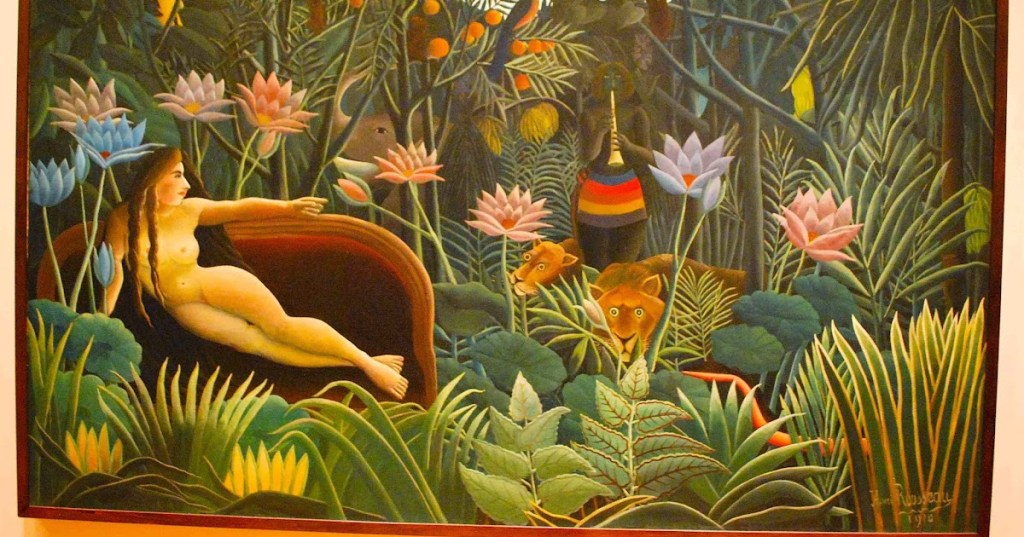
Henri Rousseau‘s last completed work, ‘The Dream‘ is huge – almost 7′ x 10’ – and is remarkable for a couple of reasons: it features his Polish mistress of decades before, and it was the first of his pieces to bring him wide-spread acceptance. Completed and sold in early 1910, it was exhibited for six weeks in the early spring, was praised by poet and critic Guillaume Apollinaire, and gave him long-sought recognition. He died in September of that year.

Picasso and Matisse understood and admired Rousseau’s work, but many people did not. Rousseau wrote the poem to help viewers understand the painting; he also wrote in a letter to art critic André Dupont, “The woman asleep on the couch is dreaming she has been transported into the forest, listening to the sounds from the instrument of the enchanter.”

‘The Dream’ is one of the most striking pieces of art on display in MoMA, the Museum of Modern Art, in New York.

Marcus Bales, ‘Air Guitar’

Bit by bit they deconstruct the thing:
no frets, no pegs, no bridge, removing its
harmonic parts until at last each string
is slack, and lacking resonating bits.
They put the rest, the body, neck, and head,
aside as too much like a prop for those
whose earnestness is all they need instead
of craft and art to fake that they can sing.
So there they are, on either stage or page:
The foremost poets of the modern age,
Who, writing their relineated prose,
Will swagger as they grimace, strut, and pose
Pretending they are better than they are
While playing nothing but an air guitar.

*****

Marcus Bales writes: “Back in the day I spent more time than I should have arguing that freeverse was prose, and that freeversers are prose writers, not poets at all. Of course, when you strike at the core of a belief-system those who believe it feel you are attacking them personally, and respond with insults. They cannot address the reasoning of the arguments, so they resort to ad hominem. I was searching for a metaphor to substitute for argument, something that would reveal the fundamental paucity of the entire freeverser credo that prose is poetry if only they say it is. What I was looking for was something to demonstrate the posers as mere posers. What, besides writing prose and then arbitrarily or whimsically relineating it to resemble the ragged-right look of poetry on the page and calling it poetry, was an even more ridiculous example of that pose? Here it is.”

Not much is known about Marcus Bales except that he lives and works in Cleveland, Ohio, and that his work has not been published in Poetry or The New Yorker. However his ’51 Poems’ is available from Amazon. He has been published in several of the Potcake Chapbooks (‘Form in Formless Times’).

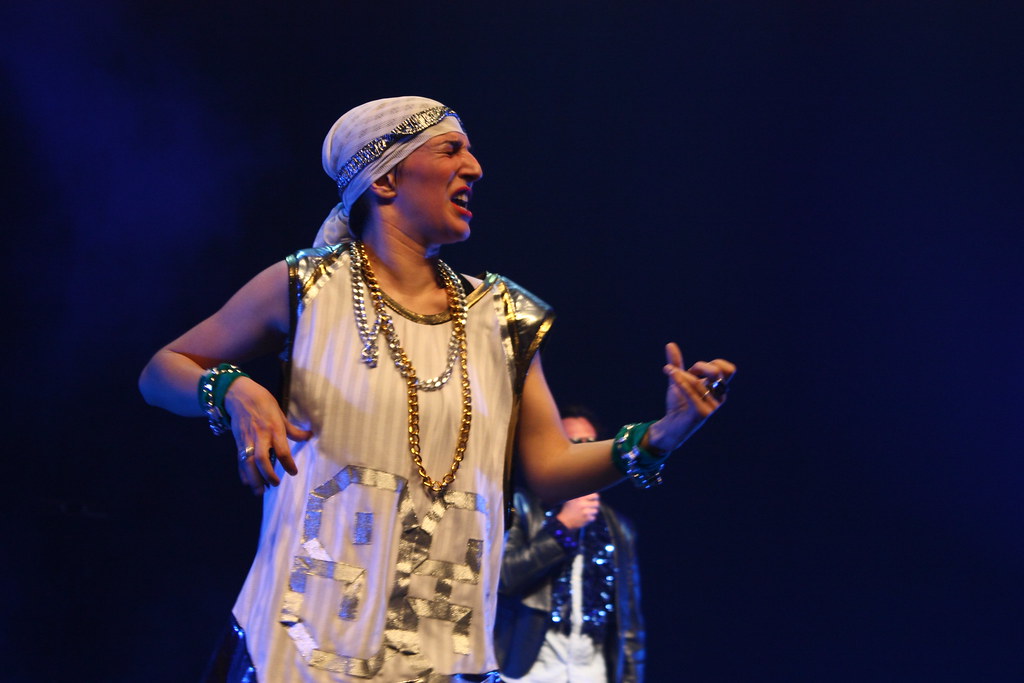
Photo: “Airnadette: Air Bass Guitar” by DocChewbacca is licensed under CC BY-NC-SA 2.0..

Poem: ‘What Lasts?’

Munch’s Scream fades, and the Taliban
blow up the grandest statues that they can.
Safer are spoken treasures of the mind:
poems and songs outlast objects that rust,
or bust, or slowly crumble into dust.
Until from cave or dig comes some strange find…
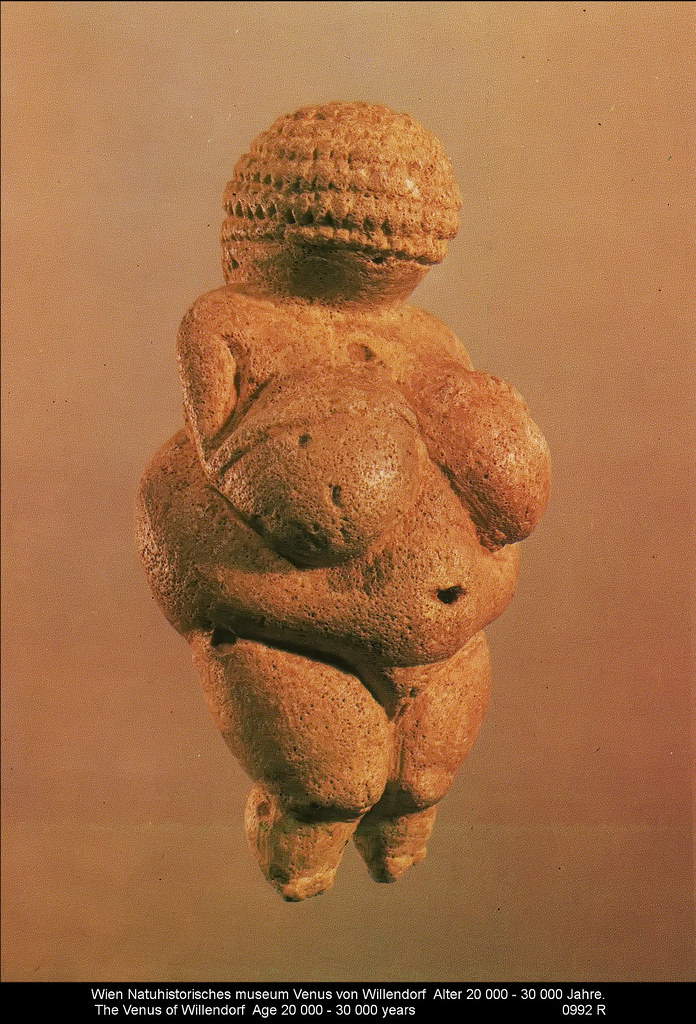
but when Lascaux and Willendorf were young,
what was recited, or what songs were sung?

As regards “immortal” works of art… anything that is still respected in a hundred years is pretty good, anything still talked about after a couple of thousand years is doing very well… Songs and poems can manage that length of time, especially if connected a religion or other social ritual; but there is very little oral survival beyond that, and the survival of physical artifacts from tens of thousands of years ago is of the luckiest, perhaps of the lost or the most overlooked, not necessarily the best.

How wonderful if in the future we can recapture sounds from the Stone Age! At present there is no way to see how it could ever be done. But at least we have a few cave paintings and small carvings…

This poem was just published a short while ago in The Asses of Parnassus. Thanks, Brooke Clark!

“Austria. Wien Naturhistorisches museum Venus von Willendorf. Die Venus von Willendorf ist eine Venusfigurine aus der jüngeren Altsteinzeit (Jungpaläolithikum), dem Gravettien, und ist als Österreichs bekanntestes Fundstück heute im Naturhistorischen Museum” by Morton1905 is licensed under CC BY-NC-ND 2.0