Just ask the poet, life’s a dumb thing. Button, button, eating, swilling. Life isn’t much but, still, it’s something.
Existence is a rule-of-thumb thing. Buying now with later billing. Just ask the poet, life’s a dumb thing.
To dream, to sleep, a ho-and-hum thing. Boring, boring, mulling, milling. Life isn’t much but, still, it’s something.
Mum’s the word, the word’s a mum thing. Button lips and no bean spilling. Just ask the poet, life’s a dumb thing.
Life, of course–the known-outcome thing. Death and taxes. God is willing. Life isn’t much but, still, it’s something.
Life is short, a bit-of-crumb thing. Dormouse summer, daddies grilling. Just ask the poet, life’s a dumb thing. Life isn’t much but, still, it’s something.
*****
In his 2021 collection ‘That Shakespeherian Rag‘, Ed Conti threads poetic references throughout (the title is from Eliot); ‘Button, Button’ appropriately begins with:
When one subtracts from life infancy (which is vegetation),–sleep, eating and swilling, buttoning and unbuttoning–how much remains of downright existence? – The Summer of a Dormouse, Byron’s Journals.
Much of ‘That Shakespeherian Rag’ (including Button, Button) was first published in Light. The collection is divided into 11 sections, organised from youth through adulthood to the prospect of mortality, and each prefaced with a quote from Shakespeare. The preface for the final Section reads:
Make no noise. Make no noise. Draw the curtains– – King Lear, Act II Scene 6
There is no poem after it.
The charming, delightful, witty and tolerant Edmund Conti died on November 12th, aged 96.
You sages aren’t surpris’d to learn that cowardice Is courage. Truths illumine and conceal. The dulcet affirmation and the sour diss Can equally be true. That’s no big deal. The world is full of paradox — and now word is That even space and time may not be real. We only think we see and smell and touch things. The “world” is like, say, Donkey Kong and such things.
It’s all just icons on an interface: The sound of rain, that contract you just sign’d, The microbe on a slide, the feel of lace, The smell of skunks, the corner you were fined For parking at, your arm, the very space You (think you) move through — products of your mind. And even little quarks, atomic particles, Are not, as thought, the fundamental articles.
No, “conscious agents” are what’s fundamental. The theory says it’s they and they alone We’re sure of. Space? Time? Objects? Incidental. They hint at some reality unknown. The dawn, the dung, the breeze, the brain, the lentil: In all of these, our faith is overblown. Those conscious agents compass us and we Create those things — though not, um, consciously.
*****
Max Gutmann writes: “Don Juan Finish’d fancifully completes Lord Byron’s unfinished comic epic. Excerpts have been contributed to Light, Lighten Up Online, Orbis, Slant, Think, the website of the Byron Society, and Pulsebeat, where ‘Conscious Agents’ is among the excerpts to have appeared. Formalverse has also reprinted another excerpt. ‘Conscious Agents’ is part of a digression from the plot, digression being an aspect of Byron’s epic mimicked in Don Juan Finish’d.”
Max Gutmann has contributed to dozens of publications including New Statesman, Able Muse, and Cricket. His plays have appeared throughout the U.S. and have been well-reviewed (see maxgutmann.com). His book There Was a Young Girl from Verona sold several copies.
If we could but instill in Life–that hack!– The element’ry rules of composition, Prevent the crude and sloppy maniac From spoiling every scene with his tradition Of shouting in our faces like a pack Of drunken sailors wailing their rendition Of “Captown Races” or “My Drawlin’ Clementime,” Their rhythmic belching almost keeping them in time.
For Life to utilize the art of Art Could help in many ways that we could mention. Some structure and suspense would be a start. To get us upright in our seats, fists clenchin’, A little rising action would be smart (Or something that would help us pay attention, Instead of simply zoning out a lot And missing half the details of the plot).
But Life, I fear, shall never learn to craft A decent tale. (It hasn’t that ambition.) It uses characters extremely daft, And wastes far too much time in exposition. It never bothers to revise a draft, Too taken with its own first thoughts. Perdition! Each aspect of the story is a shame– And worst, the ending’s always just the same.
Max Gutmann writes: “Don Juan Finish’d fancifully completes Lord Byron’s unfinished comic epic. Excerpts have been contributed to Light, Lighten Up Online, Orbis, Slant, Think, the website of the Byron Society, and Pulsebeat, where ‘Life, That Hack!’ is among the excerpts to have appeared. The complete poem is still unpublished, though I privately printed some copies to share with friends and colleagues. Like Byron’s poem, Don Juan Finish’d is often philosophical, at times facetiously, as here.”
Editor’s note: As with Byron’s original, Gutmann’s Don Juan Finish’d is written in ottava rima: eight-line stanzas in iambic pentameter rhyming ABABABCC, with the final line or two typically used to humorously deflate whatever more high-sounding statements were made earlier in the stanza.
Max Gutmann has worked as, among other things, a stage manager, a journalist, a teacher, an editor, a clerk, a factory worker, a community service officer, the business manager of an improv troupe, and a performer in a Daffy Duck costume. Occasionally, he has even earned money writing plays and poems.
The Head was ambitious and nobody’s fool, A big man, efficient, and proud of his school.
At the start of the term, as he sorted his post, The item of mail that intrigued him the most
Was a piece puffing National Poetry Day, Including a list of the poets who’d stay
And workshop and somehow persuade the whole school That poets were ‘groovy’ and poems were ‘cool’.
‘Here’s status,’ the Head thought. ‘It’s not to be missed.’ The one problem, though, was the names on the list;
Though doubtless they wrote quite respectable stuff, Not one of them, frankly, was famous enough.
His school deserved more; his ambition took wing, And so he decided to do his own thing.
With his usual flair, and with chutzpah exquisite, He invited the whole English canon to visit.
Geoffrey Chaucer came first, on an equable horse, And Spenser, and Marlowe, and Shakespeare, of course
(Who was grabbed by the teachers of English, imploring ‘Do come and persuade the Year Nines you’re not boring.’)
Keats arrived coughing, Kipling marched vigorously; Matthew Arnold began to inspect the school rigorously –
Which delighted the Head, who with pride and elation Showed the bards of the ages today’s education.
Vaughan was ecstatic, though Clough was more sceptical. Ernest Dowson puked up in a litter receptacle.
Coleridge sneaked off to discover the rates Of an unshaven person outside the school gates;
Soon he’d sunk in a private and picturesque dream, While Auden was ogling the basketball team.
Plath lectured the girls: ‘Get ahead! Go insane!’ Algernon Swinburne cried: ‘Bring back the cane!’
Dylan Thomas soon found the head’s cupboard of booze, And Swift was disdainfully sniffing the loos.
And then the Head twigged, with a horrified jolt, That something had sparked a Romantic revolt.
Shelley’d gathered the students out in the main quad, And roused them to rise against school, Head, and God.
Byron soon joined him, and started to speak. (He showed his best profile, and spouted in Greek.)
The bards of the thirties were equally Red, And Milton explained how to chop off a head.
Decadents undermined all the foundations. Surrealists threw lobsters and rancid carnations.
Pre-Raphaelites trashed the technology room And the First World War poets trudged off to their doom.
Sidney with gallantry led a great charge in (Tennyson cheering them on from the margin).
The Deputy Head, who was rather a dope, Got precisely impaled on a couplet by Pope
(Who, while not so Romantic, was never the chap To run from a fight or keep out of a scrap).
Then the whole solid edifice started to shake As it was prophetically blasted by Blake.
Soon the School was destroyed. Eliot paced through the waste, And reflected with sorrow and learning and taste,
Which he fused in a poem, an excellent thing, Though rather obscure and a little right-wing.
He gave this to the Head, who just threw it aside As he knelt by the wreck of his school, and he cried
Salty tears that went fizz as they hit the school’s ashes. He said words that I’d better imply by mere dashes:
‘——– Poets! ——– Poetry – rhyme and free verse! Let them wilt in the face of a Headmaster’s curse!
‘Let poetry wither! How sweet it would be If all of the world were prosaic as me!’
*****
George Simmers writes: “Poets in Residence was written as a celebration of National Poetry Day many years ago. Several people had been mouthing blandly off about how lovely poetry was in contrast to that horrible pop music young people listen to. Schools were being encouraged to give children a lot of poetry because it was nice and beautiful, and would make them nice. ‘Do these people have no idea of how incendiary the English canon is?’ I wondered. I really enjoyed demolishing the school around the ears of the pompous and pretentious head. I was a teacher at the time.”
George Simmers used to be a teacher; now he spends much of his time researching literature written during and after the First World War. He has edited Snakeskin since 1995. It is probably the oldest-established poetry zine on the Internet. His work appears in several Potcake Chapbooks, and his recent diverse collection is ‘Old and Bookish’.
Posterity will ne’er survey a Nobler grave than this: Here lie the bones of Castlereagh: Stop, traveller, and p*** !
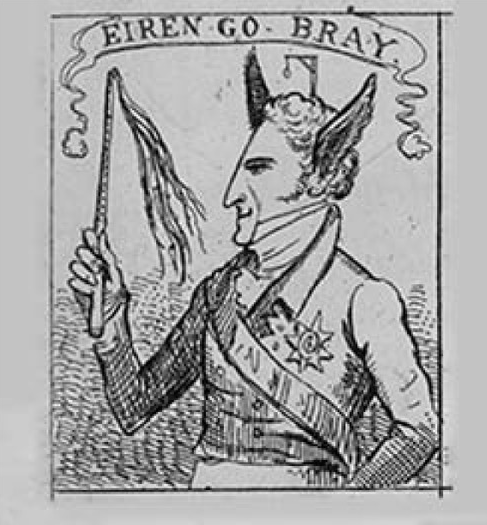
Robert Stewart, Viscount Castlereagh(which rhymes with “pray”, if you choose to have that, rather than “piss”, as the last word of Byron’s little poem) was an Anglo-Irish politician who managed to make himself throughly hated.
Though generally in favour of concessions to the Irish he did not support Catholic Emancipation from the discrimination and civil disabilities they suffered under as disenfranchised second-class citizens. He took the lead in suppressing the Irish Rebellion of 1798; he advocated leniency to the common people but had leaders executed – including a Presbyterian minister who had canvassed for him in an election. From 1812 to 1822 he was the British Foreign Secretary, instrumental in managing the alliance that defeated Napoleon; and then at the Congress of Vienna, with the conservative Bourbons back on the throne of France, he advocated leniency for France and non-intervention by the UK in European affairs – which was seen as siding with the repressive Eastern European powers. This is from the ‘Dedication’ to Byron’s ‘Don Juan’:
Cold-blooded, smooth-faced, placid miscreant Dabbling its sleek young hands in Erin’s gore, And thus for wider carnage taught to pant, Transferred to gorge upon a sister shore The vulgarest tool that Tyranny could want, With just enough of talent, and no more, To lengthen fetters by another fixed, And offer poison long already mixed.
Castlereagh’s suicide in 1822 further occasioned this from Byron:
Oh, Castlereagh! thou art a patriot now; Cato died for his country, so didst thou: He perish’d rather than see Rome enslaved, Thou cutt’ st thy throat that Britain may be saved! So Castlereagh has cut his throat!–The worst Of this is, – that his own was not the first. So He has cut his throat at last!–He! Who? The man who cut his country’s long ago.



 Form in Formless Times