I who am dead a thousand years, And wrote this sweet archaic song, Send you my words as messengers The way I shall not pass along.
I care not if you bridge the seas, Or ride secure the cruel sky, Or build consummate palaces Of metal or of masonry.
But have you wine and music still, And statues and a bright-eyed love, And foolish thoughts of good and ill, And prayers to them who sit above?
How shall we conquer? Like a wind That falls at eve our fancies blow, And old Maimonides the blind Said it three thousand years ago.
O friend unseen, unborn, unknown, Student of our sweet English tongue, Read out my words at night, alone: I was a poet, I was young.
Since I can never see your face, And never shake you by the hand, I send my soul through time and space To greet you. You will understand.
*****
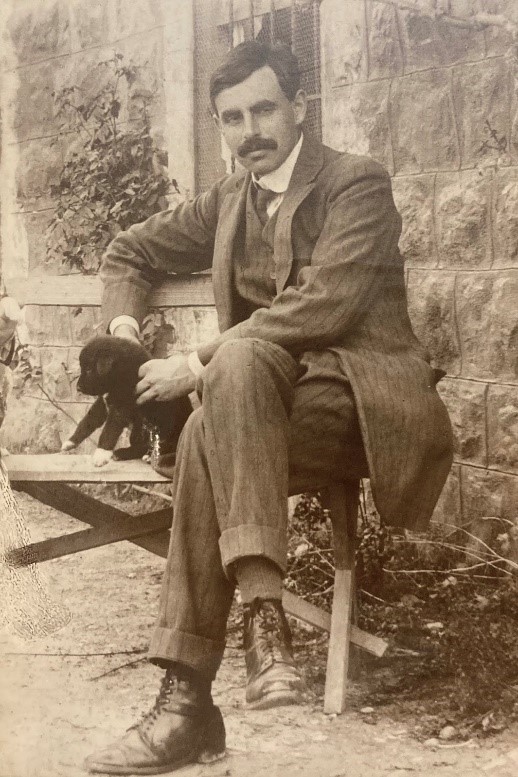
Herman Elroy Flecker – who switched his first name to James – was born in England in 1884 and died in Davos, Switzerland in early 1915. Flecker is one of those poets with 4 or 5 memorable poems, with the rest being very dated stylistically and thematically. ‘To a Poet a Thousand Years Hence’, ‘The Piper’ (barely), ‘War Song of the Saracens’ (for the rollicking rhyme), ‘Yasmin’, ‘The Old Ships’… but, especially, ‘The Golden Journey to Samarkand’ (Prologue and Epilogue, part of a stage play produced after the poet’s death in 1915). If you don’t like those poems, don’t even bother with the rest. He worked in the British consular services in the Eastern Mediterranean, and his work is loaded and larded with Greek, Ottoman and Arabic influences.
Photograph of James Elroy Flecker [c.1911-1914], Oxford, Bodleian Libraries, MS. 21234/1
“This was Mr Heaney’s room. The peat’s From off his boots. It got into the rug And won’t be Hoovered out. Likewise the sheets And pillow case.” Solemn, I nod and shrug,
Expecting little better, as I note The sad brace of dried heads, the shards of flint, The coprolites and drafts that Heaney wrote Lying untidied here. “He liked his pint,
Did Mr Heaney, but you know the Irish. That and a roasted spud. He didn’t pay The last two weeks and more. You know the Irish.” And so it is I lie where Heaney lay
And watch the twilight dripping with the murk Lurking beyond short curtains. Left alone, I ponder what she’d said: “He’d often work My bit of bogland like it was his own–
He liked the muck and suck. But then one day He got some kind of letter from the Swedes, Got all excited and he went away. Now the whole plot is given over to weeds.”
Such cause for wonderment: Did Heaney ask No better than a spade or pen or hoe To kill his time? Nothing to ease the task– Girls, say? Or hurling pools? I just don’t know.
*****
R.S. (Sam) Gwynn writes: “It just came out of the similarity between the two names. With Heaney I always think of him out digging in a peat bog, etc.”
*****
The poem plays off Philip Larkin‘s description of himself moving into a boarding house, renting a room formerly lived in by ‘Mr Bleaney‘:
‘This was Mr Bleaney’s room. He stayed The whole time he was at the Bodies, till They moved him.’ Flowered curtains, thin and frayed, Fall to within five inches of the sill,
Whose window shows a strip of building land, Tussocky, littered. ‘Mr Bleaney took My bit of garden properly in hand.’ (…)
(But if) at his age having no more to show Than one hired box should make him pretty sure He warranted no better, I don’t know.
What happened to Bleaney? He stayed there “till they moved him”. As for Heaney, he got that letter from the Swedes and went off to collect his Nobel Prize. – Editor
*****
R. S. (Sam) Gwynn was born in Leaksville (now Eden), North Carolina, in 1948. After attending Davidson College, he entered the graduate program at the University of Arkansas, where he earned his M. F. A. From 1976, he taught at Lamar University, where he was Poet-in-Residence and University Professor of English. He retired in 2016. His first two collections were chapbooks, Bearing & Distance (1977) and The Narcissiad (1980). These were followed by The Drive-In (1986) and No Word of Farewell: New and Selected Poems 1970-2000. His latest collection is Dogwatch(2014) from Measure Press (which includes this poem). His criticism appeared regularly in the Hudson Review and other publications, and he was editor of the Pocket Anthology Series from Pearson-Longman. He lives in Beaumont, Texas, with his wife, Donna. They have three sons and seven grandchildren.
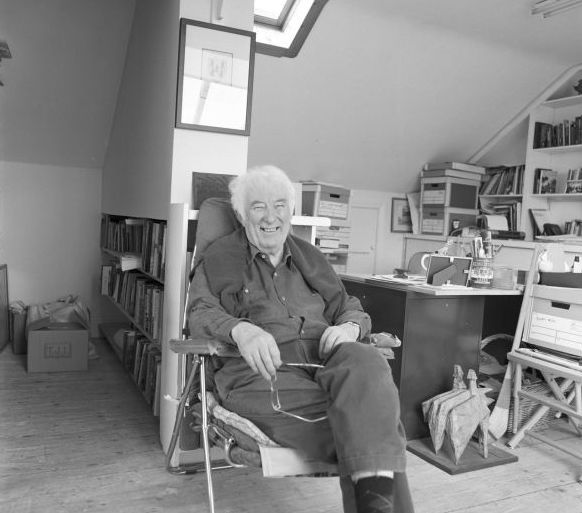
Photo with thanks to the Bobbie Hanvey Photographic Archive/Boston College.
When all the bright young women studied law and medicine, I thought a PhD in Women and the Novel would unthaw the frozen heart of Academe for me. When all the bright girls married, where was I? Still shacking up with poets that I met in bars, convinced that genius and rye would write us into fame and out of debt. The bright girls made investments by the rules. I kept on writing novels in my mind. They sent their handsome kids to private schools and I became the girl they left behind. Bright girls got married and ahead and rich, while I’m in debt again, and life’s a bitch.
*****
Gail White writes: “The Girls Who Got Ahead is a poem from the 90’s. Yes, everyone was in the professions or in graduate school but me. I was a poet and that means taking a vow of poverty. I thought I might as well make a sonnet out of it.”
Gail White is the resident poet and cat lady of Breaux Bridge, Louisiana. Her books ASPERITY STREET and CATECHISM are available on Amazon. She is a contributing editor to Light Poetry Magazine. “Tourist in India” won the Howard Nemerov Sonnet Award for 2013. Her poems have appeared in the Potcake Chapbooks ‘Tourists and Cannibals’, ‘Rogues and Roses’, ‘Families and Other Fiascoes’, ‘Strip Down’ and ‘Lost Love’. ‘Money Song’ is collected in ‘Asperity Street‘. Her new light verse chapbook, ‘Paper Cuts‘, is now available on Amazon.
The Head was ambitious and nobody’s fool, A big man, efficient, and proud of his school.
At the start of the term, as he sorted his post, The item of mail that intrigued him the most
Was a piece puffing National Poetry Day, Including a list of the poets who’d stay
And workshop and somehow persuade the whole school That poets were ‘groovy’ and poems were ‘cool’.
‘Here’s status,’ the Head thought. ‘It’s not to be missed.’ The one problem, though, was the names on the list;
Though doubtless they wrote quite respectable stuff, Not one of them, frankly, was famous enough.
His school deserved more; his ambition took wing, And so he decided to do his own thing.
With his usual flair, and with chutzpah exquisite, He invited the whole English canon to visit.
Geoffrey Chaucer came first, on an equable horse, And Spenser, and Marlowe, and Shakespeare, of course
(Who was grabbed by the teachers of English, imploring ‘Do come and persuade the Year Nines you’re not boring.’)
Keats arrived coughing, Kipling marched vigorously; Matthew Arnold began to inspect the school rigorously –
Which delighted the Head, who with pride and elation Showed the bards of the ages today’s education.
Vaughan was ecstatic, though Clough was more sceptical. Ernest Dowson puked up in a litter receptacle.
Coleridge sneaked off to discover the rates Of an unshaven person outside the school gates;
Soon he’d sunk in a private and picturesque dream, While Auden was ogling the basketball team.
Plath lectured the girls: ‘Get ahead! Go insane!’ Algernon Swinburne cried: ‘Bring back the cane!’
Dylan Thomas soon found the head’s cupboard of booze, And Swift was disdainfully sniffing the loos.
And then the Head twigged, with a horrified jolt, That something had sparked a Romantic revolt.
Shelley’d gathered the students out in the main quad, And roused them to rise against school, Head, and God.
Byron soon joined him, and started to speak. (He showed his best profile, and spouted in Greek.)
The bards of the thirties were equally Red, And Milton explained how to chop off a head.
Decadents undermined all the foundations. Surrealists threw lobsters and rancid carnations.
Pre-Raphaelites trashed the technology room And the First World War poets trudged off to their doom.
Sidney with gallantry led a great charge in (Tennyson cheering them on from the margin).
The Deputy Head, who was rather a dope, Got precisely impaled on a couplet by Pope
(Who, while not so Romantic, was never the chap To run from a fight or keep out of a scrap).
Then the whole solid edifice started to shake As it was prophetically blasted by Blake.
Soon the School was destroyed. Eliot paced through the waste, And reflected with sorrow and learning and taste,
Which he fused in a poem, an excellent thing, Though rather obscure and a little right-wing.
He gave this to the Head, who just threw it aside As he knelt by the wreck of his school, and he cried
Salty tears that went fizz as they hit the school’s ashes. He said words that I’d better imply by mere dashes:
‘——– Poets! ——– Poetry – rhyme and free verse! Let them wilt in the face of a Headmaster’s curse!
‘Let poetry wither! How sweet it would be If all of the world were prosaic as me!’
*****
George Simmers writes: “Poets in Residence was written as a celebration of National Poetry Day many years ago. Several people had been mouthing blandly off about how lovely poetry was in contrast to that horrible pop music young people listen to. Schools were being encouraged to give children a lot of poetry because it was nice and beautiful, and would make them nice. ‘Do these people have no idea of how incendiary the English canon is?’ I wondered. I really enjoyed demolishing the school around the ears of the pompous and pretentious head. I was a teacher at the time.”
George Simmers used to be a teacher; now he spends much of his time researching literature written during and after the First World War. He has edited Snakeskin since 1995. It is probably the oldest-established poetry zine on the Internet. His work appears in several Potcake Chapbooks, and his recent diverse collection is ‘Old and Bookish’.
There’s shouting by the stove (it’s Plath & Hughes) as Wystan wanders off without his shoes and Whitman picks the Cheetos off his beard. The Larkin-Ginsberg chat is getting weird, for after countless hours they have found bizarre pornography is common ground. Old Emily is not As prim as billed— When Dylan finds her bra-hooks— She is thrilled. Poe strokes his bird; Pound yawps that it’s a pity Eliot can’t sleep without his kitty. Rimbaud’s on eBay searching for a zebra while sneering, “Oui, a cheemp can write vers libre!” The Doctor’s soggy chickens start to smell and Stevens has insurance he must sell. The readings are spectacular, I know, but is there any way to make them go?
*****
A.M. Juster writes: “This was first published in The Barefoot Muse. It looks like I wrote it in late 2008, it was a fairly prolific period for me and I was a little distracted because I was running the Social Security Administration. (Under his unpoetic name, Michael J. Astrue. – Editor). I don’t remember now the impetus for writing it, but I did enjoy taking these poetry idols off their pedestals and making them more human for a few laughs. This was about the time that I finished my translation of Horace’s Satires in something like 1850 heroic couplets, so I was much more comfortable with the form than I would have been five years before. I think the imitation of Emily Dickinson’s form is an amusing touch for the reader, although it is undetected when I read it because it remains in rhymed iambic pentameter.”
A.M. Juster’s poems and translations have appeared in Poetry, The Paris Review, The Hudson Review and other journals. His tenth book is Wonder and Wrath (Paul Dry Books 2020) and his next book will be a translation of Petrarch’s Canzoniere, which W.W. Norton will release in early 2024. He also overtweets about formal poetry @amjuster.