Tag Archives: China

Sonnet: RHL, ‘Mirror Shades’

Trust’s been essential to our global rise,
and humans have a unique way to build trust:
we’ve left all other primates in the dust
because, alone, we have whites to our eyes.

With dark eyes, what they look at they disguise,
whether they see it with disgust or lust.
Why we look may leave other folks nonplussed,
but that they know what we’ve seen stops some lies.

We’ve sacrificed a natural secrecy
to raise our social aspects several grades.
Hiding your eyes now means active deceit.
So, those upholding laws and decency
can’t be allowed sunglasses; mirror shades,
especially, alienate and self-defeat.

*****

I guess this isn’t a good example of a sonnet. There’s no real turn, it’s just an essay beating on the same point over and over: the eyes being the windows of the soul (even to an agnostic), if you are trying to build trust and community you have to be able to see each other’s eyes. If you are just trying to dominate, then sure, go ahead, hide behind shades and mirrors and blinds and curtains… but you’re giving up one of the greatest innovations that let our species of ape achieve social complexity.

The poem was recently published in the weekly ‘Bewildering Stories‘.

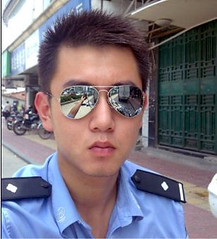
As for the photo, it appears to be a selfie by a young Chinese police officer, more concerned with style and image than with making his community safer. But who knows what is important in his life and for his career.

Cutie Police” by Beijing Patrol is licensed under CC BY 2.0.

Odd poem: Xi Jinping, ‘In Memory of Jiao Yulu’

Ten thousand miles away your soul has flown;
the rivers, mountains and land yearn for your return.
The people mourn the loss of a caring official,
tears flooding under the empress trees you planted.
Having dedicated your life to the desert,
to the betterment of people’s lives, your legacy lives on
no matter how many years come and go.

The moon shining bright as always,
I think of you and your life’s work.
You toiled long and hard, claiming no credit.
Serving and benefiting the people:
such was your ambition and is also mine.
Many a trickle will add a touch of green to the desert
and create a wellspring of hope.”

*****

Xi Jinping, born in 1953, has been the general secretary of the Chinese Communist Party and chairman of the Central Military Commission, and thus the paramount leader of China, since 2012. Since 2013, Xi has also served as the president of China.

Jiao Yulu was a Chinese politician, highly respected for his hard work even as he was dying of liver cancer in his early 40s.

From the Chinese Embassy in the US:
Xi Jinping has always held Jiao Yulu in high esteem and regarded him as a role model. At the time of writing this poem, Xi was the Party Secretary of Fuzhou. One night in July 1990, he read an article entitled “People Yearn for the Return of Jiao Yulu.” The poem was inspired as literary thoughts surrounding the deceased upright man welled up in Xi’s heart. When he inspected Lankao in 2014, Xi recalled emotionally how he learned from the example of Jiao Yulu more than 40 years ago. “On February 7, 1966, the People’s Daily carried a long article by Comrade Mu Qing and others entitled ‘Jiao Yulu: A Model County Party Secretary.’ Back then, I was a grade one student in junior high school. The teacher of political education choked with sobs while reading the article to us. I was deeply moved when I heard Comrade Jiao Yulu kept on working even in the late stage of liver cancer, pressing a stick against his liver to relieve the pain. The pressure from the stick wore a hole into the right side of his rattan chair over time.”

Jiao Yulu is no stranger to the Chinese people. After being appointed Party Secretary of Lankao County, he mobilized the local residents in a great struggle to tackle water-logging, sandstorm, and alkaline soil. Leading by example, he was always at the frontline at the height of sandstorms and in torrential rainfalls to identify the wind corridor, forecast quicksand and gauge flood waters. Amid blinding blizzards, he visited poor families to deliver food and financial relief to their homes. He was devoted entirely to all the people of his county but himself. Despite severe illness, he carried on work till the last moment of his life, and is revered as the “model county Party secretary.”

Odd, political poem: Emperor Qianlong, ‘My Feelings After the Ambassador of the Red-Haired English King, Macartney, Came to Pay Tribute and Give Offerings to Me’

Formerly Portugal presented tribute, now England is paying homage.
They have traveled further than Shu Hai and Heng-zhang;
My ancestors’ virtue must have reached their distant lands.
Though their tribute is nothing special, my heart approves sincerely.
Curios and their ingenious devices I do not prize.
Though what they bring is meager,
in my kindness to men from far away I make generous recompense –
Wanting to preserve my good health and power.”

*****

Original Poem:

《红毛英吉利国王差使臣马嘎尔尼奉表贡至,诗以志事》

  博都雅昔修职贡,英吉利今效荩诚。

  竖亥1横章输近步,祖功宗德逮远瀛。

  视如常却心嘉焉,不贵异听物翊2精。

  怀远薄来而厚往,衷深保泰以持盈。

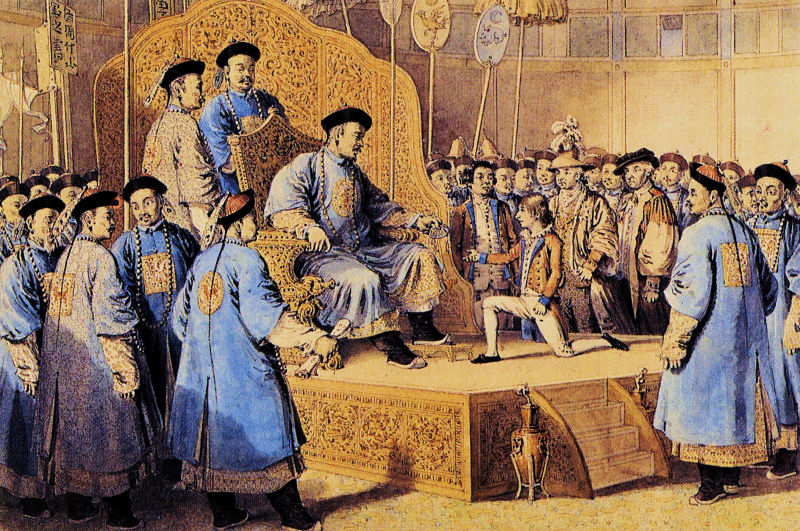
This poem was written by the Qianlong Emperor (25 September 1711 – 7 February 1799; also known by his temple name Emperor Gaozong of Qing, personal name Hongli) after his meeting with the British ambassador Lord Macartney at the Emperor’s grand tent in his Summer resort at Jehol (Chengde) on September 14th, 1793. The embassy was then sent back to Beijing, the Emperor followed and saw the previously prepared British gifts on September 30th. The gifts and embassy did not impress and so they were ordered home on the following day. The whole two-year expedition is detailed here.

Lord Macartney was not impressed either, and wrote: “The Empire of China is an old, crazy, first rate man-of-war, which a fortunate succession of able and vigilant officers have contrived to keep afloat for these 150 years past, and to overawe their neighbors merely by its bulk and appearance, but whenever an insufficient man happens to have the command upon deck, adieu to the discipline and safety of the ship. She may perhaps not sink outright; she may drift some time as a wreck, and will then be dashed to pieces on the shore; but she can never be rebuilt on the old bottom.”

Illustration: William Alexander’s drawing of the reception of the Macartney embassy to China. Young Thomas Staunton (kneeling not kowtowing) receives a gift from the Emperor. Image by William Alexander available under a Creative Commons License

Teaching ESL with Songs and Poems

Babies learn by play and imitation. Children learn by play and imitation. There is no reason this isn’t the easiest way for adults to learn, as well (and I speak as someone who has made a successful career of using board games to teach business finance rapidly and enjoyably).

The imitation of language, with a baby learning to speak, is enhanced by repetition–not just simple sentences and phrases used again and again, but also lullabyes and nursery rhymes. The advantages to songs and poems are that they are engaging to the ear (even if the words are not understood); that they are repeated virtually identically each time the same person sings or recites them; that the repetition and music, the rhythm and rhyme, make it easy to learn; learning then moves from passive (understanding) vocabulary to active (speaking) vocabulary; and the word-for-word learning teaches the structure of the language, the syntax, the grammar, as well as basic vocabulary and playful other words.

The principles are no different for someone learning a second language, whether as a child or an adult. To make the process engaging, to develop active use of the language with a confident vocabulary and grammar, there is nothing better for the beginner than songs and poems. Recorded music is fine–then the repetition will always be exact, and learning to sing simple songs (The Beatles’ ‘Hello Goodbye’ comes to mind) will contribute to developing a native speaker’s accent. With ESL–English as a Second Language–you may need to decide if you want the Queen’s English, or Liverpool, or Nashville, or what.

But singing isn’t always a practical solution. In that case, look at the resources developed for ESL teachers. Here is a webpage developed by the British Council and the BBC. And here for teens and adults is an excellent website with ‘Popular Poems to Teach‘. Note that most of the poems (though not all) whether British or American are using rhyme and metre. And this, again, is because those factors make it easier to learn things by heart–and that is what songs and poems will achieve: learning not just words and rules, but rather entire sentences with their grammar and vocabulary, learnt by singing or reciting, far more enjoyably than by studying lists and charts.

And the advantage is universal. Songs and poetry are part of the human experience, whether you come from China, India, Saudi Arabia, Nigeria or Brazil. Learning to sing or recite in English is not to start again from scratch, but to enjoyably refresh a childhood experience, a skill that has already been mastered.

Photo: “Wittenberg International Student Party” by Matt Cline is licensed under CC BY-NC-ND 2.0