Tag Archives: christianity

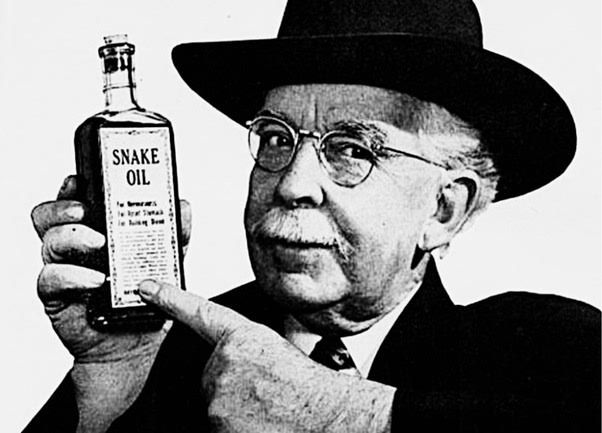
Michael R. Burch, ‘Funding Fundamentals’

“I found out that I was a Christian for revenue only and I could not bear the thought of that, it was so ignoble.” — Mark Twain

Making sense from nonsense is quite sensible! Suppose
you’re running low on moolah, need some cash to paint your toes …
Just invent a new religion; claim it saves lost souls from hell;
have the converts write you checks; take major debit cards as well;
take MasterCard and Visa and good-as-gold Amex;
hell, lend and charge them interest, whether payday loan or flex.
Thus out of perfect nonsense, glittery ores of this great mine,
you’ll earn an easy living and your toes will truly shine!

*****

Originally published by Lighten Up Online. NOTE: A flex loan is a payday loan with a “personal line of credit” that makes it even harder to pay off than traditional payday loans. Caveat emptor.

Michael R. Burch writes: “Living in allegedly ‘Christian America’ where 80% of evangelicals voted for the Antichrist Trump, I am forced to resort to foxhole humor. ‘Funding Fundamentals’ is tongue-in-cheek foxhole humor, but I think we would be better off forming our own religions than donating money to false profits like the bible-hawking Trump and his cronies.”

Michael R. Burch’s poems have been published by hundreds of literary journals, taught in high schools and colleges, translated into 22 languages, incorporated into three plays and four operas, and set to music, from swamp blues to classical, 61 times by 32 composers. He is also the founder and editor-in-chief of The HyperTexts.

Semi-formal: RHL, ‘Terminal’

Christian culture’s crucifixation
nails us to our seats as, station by station,
we travel the trammelled line
until we find
that terminal
more primal.

The humanstrain’s end-of-line stop
is Ragnarok.
Everyone please disembark
into the dark–
no light, no map.
Mind the Ginnungagap.

*****

This is as close as I get to religion: existential uncertainty. I’m a Militant Agnostic: “I don’t know… and neither do you!” Yet this attitude is apparently compatible with religion, being not that different from Eliot’s ‘East Coker‘:
O dark dark dark. They all go into the dark,
The vacant interstellar spaces, the vacant into the vacant,
The captains, merchant bankers, eminent men of letters

(…)
I said to my soul, be still, and let the dark come upon you
Which shall be the darkness of God.

But Christianity? I think not. Altogether too unlikely, with so many impossibilities packed into such a small understanding of the cosmos. We don’t know where we are headed, not just as individuals with finite lives, but as a species that is simultaneously developing space travel and genetic modifications… the possibilities are endless and the future, dark as well as light, is unknowable.

The poem is semi-formal with its loose iambics and paired rhymes or slant rhymes, but no structure beyond its natural flow. It was originally published in the Experimental section of a 2019 issue of Better Than Starbucks, and republished as part of work being spotlighted in The HyperTexts in August 2024.

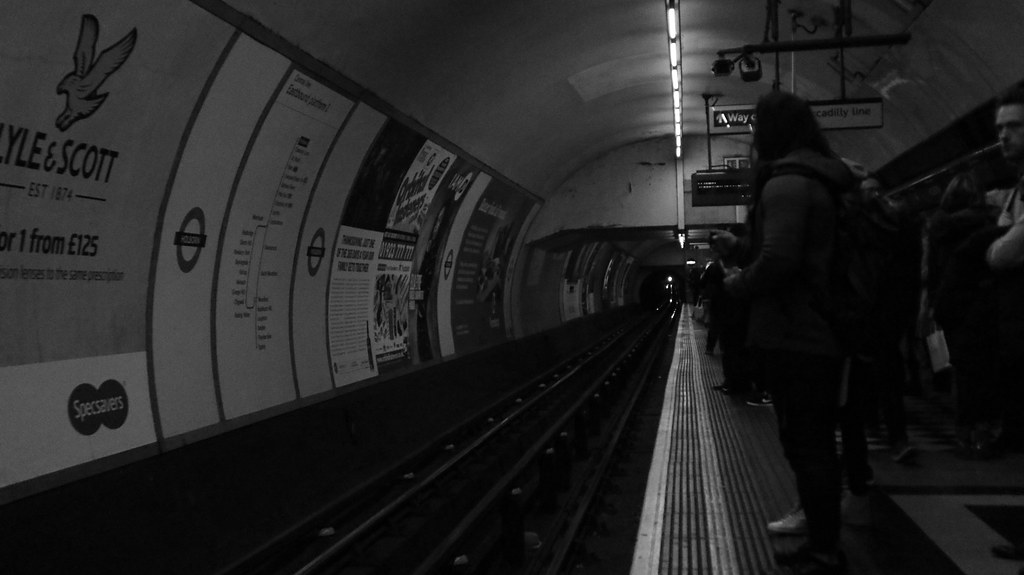
Photo: “London Holborn tube station in Black and White effect” by Patrick Cannon Tax Barrister is licensed under CC BY 2.0.

Poem: ‘Zippori Story’

Context, people, context! Remember that
Herod was building his new royal city
Zippori some four miles from Nazareth
when Jesus was a child. And Joseph would
have walked there, worked there, daily; Jesus too.

When Judas of Galilee raised his revolt,
captured and burned it–Roman legions came,
defeated him, cast him in the Sea
of Galilee, a millstone round his neck,
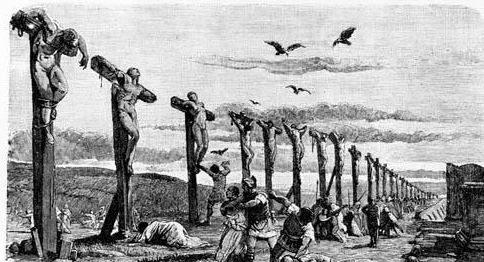
and crucified two thousand rebel Jews.

This was the year that Joseph disappears
from Gospel narratives, all unexplained.
When Jesus chased two thousand Legion pigs
over a cliff into that selfsame sea,
think retribution; think guerrilla strike.

The lack of stories and legends about Jesus’ step-father is one of the great Christian mysteries. He simply disappears from the narrative in the year of Judas of Galilee’s revolt, and is never mentioned again in polite society. Nor is Zippori ever mentioned in the Bible, either by that name or the Romanized Sepphoris, although it was the local capital of Galilee. I have laid out what seem to me obvious suspicions in The Gospel According to the Romans, and blogged about it here and there.

This poem was just published in The Road Not Taken, a Journal of Formal Poetry, in the section themed on ‘Replies’. My thanks to Dr. Kathryn Jacobs.

Poem: “4 Guru Limericks”

A wealthy young prince called Gautama
Loathed worship of Krishna and Rama;
“It’s inside you,” he said
But, once he was dead,
He was worshipped…. That’s interesting karma!

A radical rabbi called Jesus
Assumed if he loved us he’d please us;
Though he loved Mary Magdalene,
John, and small children,
His power was no match for Caesar’s.

A second-rate father, Karl Marx
Let his kids die while writing remarks
On Struggle and Might
And the duty to fight
For state-owned newspapers and parks.

Hitler, son of a half-Jewish bastard
Dreamed of occult power; Europe, aghast, heard
Race-hate psychodrama;
His unending trauma
Destroyed the whole state that he’d mastered.

I love limericks. Their elegant form, rhythmic and rhyme-rich, and their frivolous and chatty anapestic feet, allow you to be rude and insulting without causing more offence than a well-dressed wit who has had one too many drinks at a party. And as such, they say things with very few words in a way that is very easy to remember.

As for gurus… well, it’s always good to be able to listen to people with more experience and wisdom than oneself, but that doesn’t necessarily make them correct in their analysis, infallible in their prescriptions and proscriptions. They’re still only human, full of half-aware dreams and unconscious bias. And if they have swarms of devotees and go off the rails, well, they really go off the rails.

Poem: “Religions”

If it’s Sunday, maybe I should post a religious poem… Of course, the trouble is my

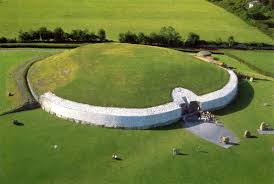
Newgrange

Newgrange – prehistoric Irish site aligned with the winter solstice

ambivalence about religion. I side with US statesman and orator Henry Clay: “All religions united with government are more or less inimical to liberty. All, separated from government, are compatible with liberty.” And if there’s a difference between history and religion, I’ll take history any time.

So this one was originally published in Snakeskin, August 2016…

Religions

Judaism

Genocide in Canaan
Gave God’s land to the Jews;
But genocides in other lands
Are Yahweh’s big taboos.

Buddhism

All life is suffering,
Yes, all our life is pain;
Then I must be a masochist –
I’d love to live again.

Norse religion

The first gods killed a giant,
From his skull to make
The sky, and mountains from his bones –
What lies! No talking snake?!

Christianity

Jesus wasn’t Jewish
And his killers weren’t from Caesar;
At least, so Paul said after
An epileptic seizure.

Islam

There is no God but One,
Perfect in every way;
All creatures do His unknown will –
So there’s no need to pray.

Mormonism

To teenage Joseph Smith
An angel showed gold plates
On which he read ‘Jesus Was Here’ –
It got him lots of dates.

Modern Paganism

Pretentious modern pagans
Confused by mystic spoof
Have got no clue what Stonehenge was
With its old Newgrange roof.

Atheism

I don’t see gods on clouds,
I don’t hear angels sing;
There’s just one question bothers me –
How come there’s anything?

About the use of form here: flippant comments, as in the above poem, are well served by simple quatrains with a bit of bounce to them. Iambics are not in themselves bouncy, but in this pattern of 3 feet, 3 feet, 4 feet, 3 feet they work fine. There’s not a lot of thought in any of the verses, just a set-up and a quick jab. The form works well for its purpose.