Tag Archives: end of the world

Happy 2025… RHL, ‘The Sun is Always Setting’

The sun is always setting, always setting on your day;
you sense the dark approaching, wish that it would stay away.
Do you want a life unchanging? Wish to still be a newborn?
Don’t you know life’s not a rosebud, but has root and leaf and thorn?

The sun is always setting and the black drapes are unfurled;
but notice that the sun sets on your world, not on the world:
it’s rolling into brightness in another’s happy land,
and the dark is evanescent and the brightening is grand.

The sun is always setting on the dinosaurs, but birds
are flocking into being, as are Serengeti herds;
and the sun that lights humanity? Of course it’s going to set,
and elsewhere light new tales of which we’ll just be a vignette.

The sun is always setting, but that view is just your choice;
I say the world is turning and evolving; I rejoice.

*****

The winter solstice and the turning of the calendar drive a feeling of sunset that I can’t shake. I may be fit, still climbing trees and running on beaches, but at 74 there is both an awareness of gradual decline and a recognition that you can only hope for another 20 years with a fair amount of luck. “And of my three score years and ten, / None of them will come again…” as it were. That’s the personal bit.

Add to that the strongest country in (and quondam leader of) the world, breaking everything into pieces and throwing them all up in the air with no idea of how anything will land and what will be broken; taking all branches of the federal government (including unfortunately the Supreme Court) and those of half the states and just piling them up for a bonfire.

Add the possibility of runaway AI (such as concerns Harari) being jumpstarted by the Luciferic billionaire firestarter… and it feels like the End of the World.

But let’s be reasonable: it always feels like the end of the world, at least to those no longer in their youth. Because it is, for them. (For us. For me.) Jesus saying the end of the world would come within that generation… Last Days prophecies bubbling up in all religions… Preppers expecting nuclear war, ethnic uprising, climate catastrophe overnight… Doomsday is always imminent, and yet things keep going; just not as before… This is the End of the World as we know it, but will not be as we expected it. (And always the unfortunate eternal evils, regardless of era: Israelis committing genocide on Palestinians since the days of Deuteronomy, and so on.)

I swear there is a highly ambivalent poem in there somewhere, but I haven’t dug it out yet. But hey… Happy 2025!

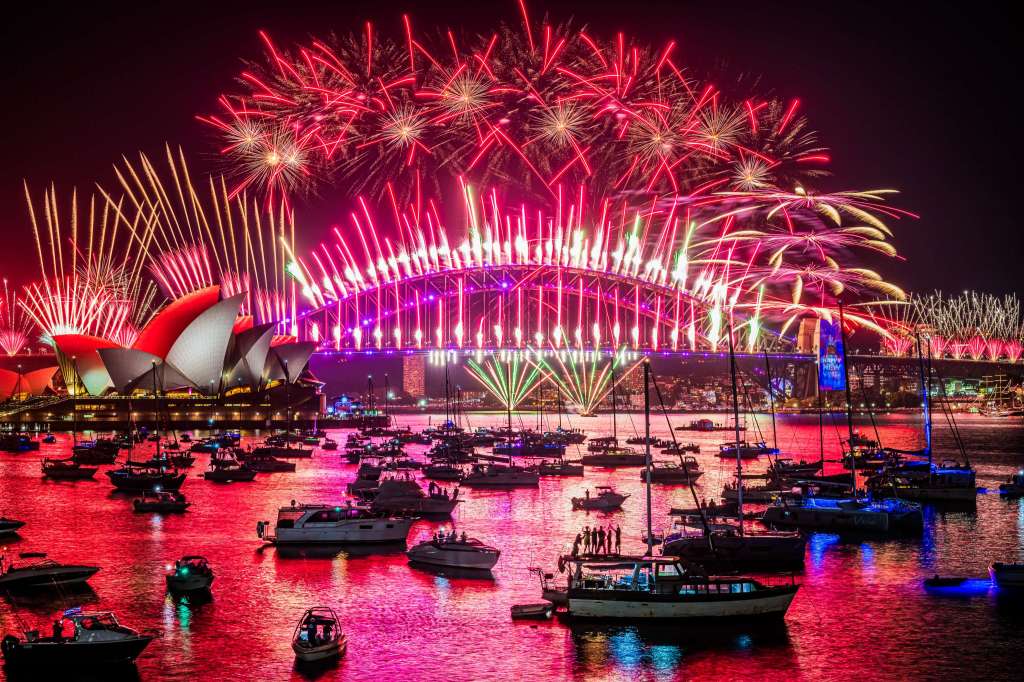
Photo: Keith McInnes | City of Sydney
Sonnet: “Bring on the Violins”

Bring on the violins, the falling leaves,
the wistful ending to a misty day.
The long game’s over and we ride away
to sunset Heaven that no one believes.
Our world is dying, yet here no one grieves:
Earth warms, seas rise, but Wall Street’s still in play…
and we ourselves are aging anyway.
We all face death, and there’ve been no reprieves.
And yet, and yet…robotics and AI,
gene therapy, unlimited life span,
promise an almost-here-and-now sublime,
an unknown life, with our old life gone by.
Trumpet a fanfare for the Superman,
music for dancing to the end of time.

This sonnet has just been published in the Amsterdam Quarterly, this spring’s issue being on the theme of Beginnings and Endings. That may be relevant for our Covid-19 catastrophe, but of course the theme was determined a year ago, and life and death have merely decided to smile on AQ ironically.

But we were all facing death before this latest coronavirus came along. As the saying goes, “Perfect health is simply the slowest rate at which you can die.” And interwoven with death is always new life, never an exact repetition of the old life and often dramatically better. The real issue is, will the new life come at the expense of the old, or can the old reform and regenerate itself, renew itself without needing to die? The avoidance of death has been the quest of religion and medicine since those disciplines (or that discipline) originated. It is great driver of culture, and the pot of gold at the foot of the never-quite-reached rainbow.

Technically this is a correctly structured Petrarchan sonnet, with an initial octave (in this case of existential doom and gloom) rhyming ABBAABBA, followed by a volta (in this case a reversal to hope) for the sestet that rhymes CDECDE.

The sonnet is a marvellous structure for expressing an argument in a compact way.

Sonnet: “We’ve Reached Earth’s Edge”

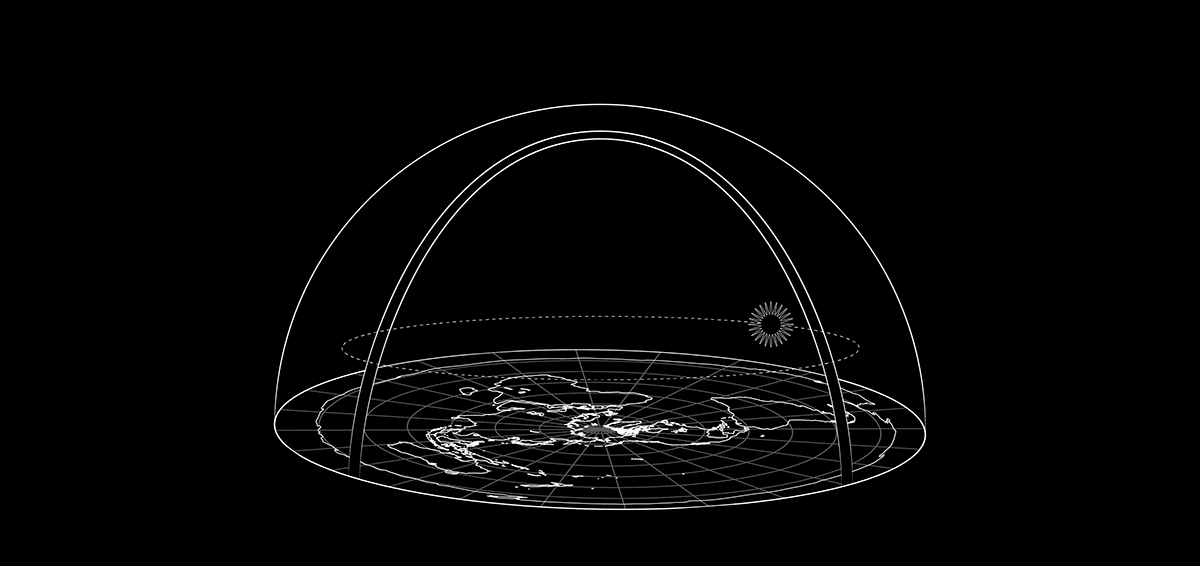
The Earth’s explored, and flat. And I know this
despite Earth’s shadow in lunar eclipse,
and how horizons hide the hulls of ships.
We’ve reached Earth’s edge, stare into the abyss
with Branson, Musk, NASA and the Chinese,
toppling into blackness, falling prey
with Kurzweil, CRISPR, Google, Bostrom, de Grey,
businesslike scientists battling disease,
entrepreneurs with dark unearthly schemes:
the outer darkness space’s endlessness,
the inner darkness immortality.
Pushing and leaning into stellar space,
the event horizon of our thoughts and dreams,
the black hole of our post-humanity.

Published in the Formal & Rhyming Poetry section of this month’s Better Than Starbucks, the “Earth’s edge” idea is just another way of trying to express my ongoing fascination with the end of humanity-as-we-know-it, and the beginning of something that we can’t even visualize yet, let alone make confident predictions about. Close to the idea of the “posthuman god” at the bottom of the Wikipedia page.

Technically, this is a poorly-structured sonnet (ABBA CDDC EFG FEG), with a really weak rhyme of endlessness / space. Sorry about that. But I hope you can enjoy it for the ideas, anyway!


Poem: “Zombie Apocalypse”

Zombie Apocalypse –
humans have always had
end-times fear: Ragnarok,
Judgement Day, World War III,
comet strike, Y2K,
supervolcano – well,
you get my drift.

Zombie Apocalypse –
there’s a pandemic and
AI has run amuck –
this is no practice round,
this is for real!

Zombie Apocalypse –
head for a tropic isle,
live on fish, coconuts –
solar will last a few
years, then corrode.

Zombie Apocalypse –
walls can be built without
concrete or plastering,
fight infestations of
zombies and dogs.

As the world splits in two
all the Enhanced are gone,
gone to the Cloud and space;
only the Left Behind
scrabble, deteriorate,
left in the dirt and ash,
left on the Earth.

I, the last poet am
here on Earth’s farthest beach,
toweled, not panicking,
waiting for Branson and
Musk in their ships.

Yes, humans love the threat of the end of the world, the collapse of civilisation, all apocalyptic disasters. We don’t want the disasters to be inflicted on us… but we love thinking about them. Perhaps it’s a way of thinking about our own mortality, without actually thinking that it is we who will die one day.

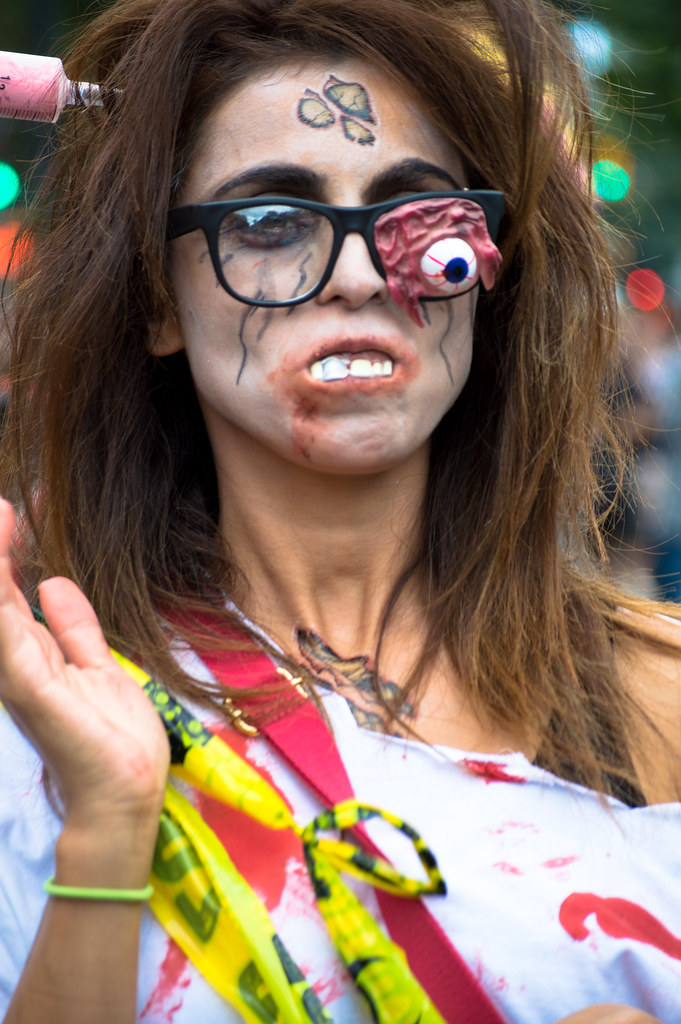
The Zombie Apocalypse is wonderful because it is both a complete fantasy (as in the photo) and an image for the kind of catastrophic real-world disaster that an out-of-control plague can inflict–a medieval Black Death killing a third of the population… an early 20th century Spanish Flu infecting a third of the world’s population (but “only” killing maybe 50 million)… or, of course, a coronavirus leaping out of a food market in Wuhan and spreading around the world before anyone can get a proper handle on it. Death is real. Around the world, 150,000 people die every day. What can you do but work to minimize death–and laugh at it?

And then there’s the fantasy of being one of the lucky few survivors, faced with the difficulties of a post-apocalyptic world, a post-nuclear Wasteland, a flooded Waterworld, a Biblical Left Behind, reminiscent of Nevil Shute’s On The Beach, John Christopher’s The Death of Grass (No Blade Of Grass in the US), even Ursula Le Guin’s post-alien-invasion City of Illusions. Carrying a towel like Ford Prefect to hitchhike through the galaxy, away from doomed Earth. Dramatically, heroically, surviving the destruction of the world as we know it. As though you can dramatically, heroically, survive the time-driven destruction of your body…

The poem itself (yet another one published in Bewildering Stories) is unrhymed, but written in a form inspired by double dactyls. Technically double dactyls are eight-line poems with a few additional requirements–the form was created by Anthony Hecht, Paul Pascal and Naomi Pascal in 1951, and popularized by Hecht’s and John Hollander’s collection Jiggery Pokery… the name of the book being a double dactyl, naturally. So this poem is only “inspired by” double dactyls. But, as with limericks, the bouncy rhythm adds to a mood of flippancy, frivolity, which is always suitable (in my mind) when discussing existential catastrophe. I tip my hat to Country Joe and the Fish for the I Feel Like I’m Fixin To Die Rag, and to all political cartoonists everywhere.

Life is short; enjoy each day.