Tag Archives: Facebook

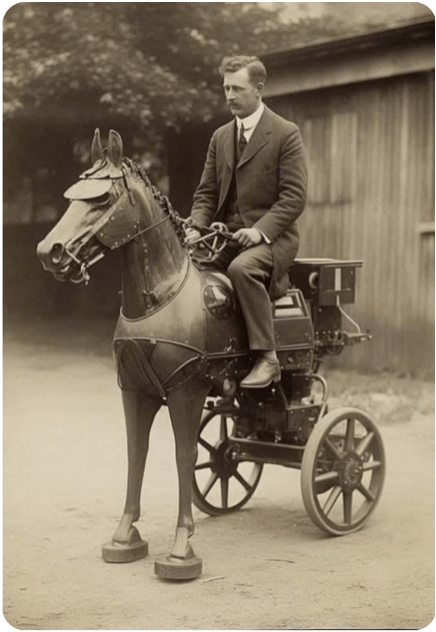
Odd poem: Light verse: Richard Fleming, ‘The Equestropede’

George, wishing to proceed at speed,
built the world’s first Equestropede.
This fusion of a horse and cart,
a tribute to the welder’s art,
had a strong engine, 12 hp,
which meant George travelled speedily.
It ran on oats and gasoline,
a strange concoction, unforeseen
by Elon Musk and the X folk
who would have seen it as a joke.
George, Michelangelo reborn,
treated the neigh-sayers with scorn.

*****

Richard Fleming writes: “The Equestropede, when it was first unveiled at the Exposition Universelle in 1901, proved to be the centaur of attraction. I post a rhyming poem every day on my Facebook page https://www.facebook.com/richard.fleming.92102564/ and accompany it with a quirky image that I’ve found online. Does the poem precede the image or vice versa? That depends. In the case of ‘The Equestropede’ the strange image definitely preceded the rhyme and fairly begged to be ‘poeticised’. The Equestropede name, however, is purely my invention as is its unveiling at the Exposition Universelle.”

Richard Fleming is an Irish-born poet (and humorist) currently living in Guernsey, a small island midway between Britain and France. His work has appeared in various magazines, most recently Snakeskin, Bewildering Stories, Lighten Up Online, the Taj Mahal Review and the Potcake Chapbook ‘Lost Love’, and has been broadcast on BBC radio. He has performed at several literary festivals and his latest collection of verse, Stone Witness, features the titular poem commissioned by the BBC for National Poetry Day. He writes in various genres and can be found at www.redhandwriter.blogspot.com or Facebook https://www.facebook.com/richard.fleming.92102564/

Political poem: appallingly bad verse apparently in favour of Liz Truss

Bizzy lizzy will win by a.mile
She has got a lovely smile
Brians to match her lovely face.
She will win this pm race
Sunaks a snake
A back stabbee he is
He turned on boris
And will turn on liz
She will be a great pm
Not as good.as maggie but no one could be
Mrs thartcher mach 3
Liz will stand proud over our lands
Holdinh out her hand
If we wotk to gether we can
Get rid of the woke
And watch them. Cry into there cornflakes
As liz makes our country great.
In liz we trust god speed to our new pm

*****

In honour of Liz Truss’s trip to Balmoral Castle to be named Queen Elizabeth’s Prime Minister, I looked for poems by or about the new PM. The above is the best I could find, reposted in the Yorkshire Bylines by Jimmy Andrex under the heading Has the emergence of Liz Truss stimulated a new type of poetry?

Jimmy does a good serious job of discussing modern political poetry… sort of. But he fails to note that the quoted “poem” by “Bill Sutton” originated as a post to the Facebook group ‘Liz Truss Supporters (no trolls)‘ which is loaded with sarcastic commentary on the British Conservative Party in general and Liz Truss in particular.

So the answer to Jimmy’s question is No, of course. Scathing poetry, good or deliberately bad, has long been used as a political weapon. Bill Sutton’s post may be amusing, but is unlikely to resonate for as long as, say, Shelley’s rant the year before George III died: “An old, mad, blind, despised, and dying king, –

Good luck, Liz; hope you’ve got a thick skin.

Resources: Trish Hopkinson’s blog about poetry

When so many poetry magazines are one-or two-person operations, it is hard to know of all of them, harder still to sort through and find the ones that you would enjoy reading and, as a poet, would like to submit work to. How wonderful, then, when someone like Trish Hopkinson comes long to inform us of magazine openings and closings, of different editorial requests and requirements, and of calls for submission!

For a general introduction to her blog, go to https://trishhopkinson.com/blog-tour/. She is also active on Facebook, and can be found at https://www.facebook.com/trishhopkinsonpoet.

As a formal poet living in our current wasteland of unstructured material, I am especially grateful that she has put together a list of Where to Submit Formal Verse. Her list of 53 magazines is extremely useful, but it does have some drawbacks:

First, it (understandably) focuses on the Anglo-Canadian-American market. In today’s online world, such restrictions should not necessarily apply. I have had English-language verse published in Australia, India, Netherlands, Nigeria and Turkey. English is very much a global language, and not just in the areas of business and Hollywood.

Second, some of the more difficult prospects, but the most desirable, are not mentioned–for example Poetry Magazine and the New Yorker. Yet they publish just as large a proportion of formal verse as some of the others in her list. (For example, Marilyn Taylor is sometimes the only formal one of over 50 poets published in an issue of Verse-Virtual.)

And lastly, the list is unfortunately four years old. In the world of poetry magazines, this means many will have disappeared, many others will have arisen. The Rotary Dial, Sliptongue, Unsplendid… each unique, excellent in its way, but disappeared along with several others in her list.

But as, obviously, you start by looking at a magazine and its website and its samples and requirements before you submit, little time is lost in identifying the defunct. The list remains invaluable for finding well-established magazines that will publish formal verse.