Tag Archives: Ireland

Weekend read: Sonnet variation: Michael R. Burch, ‘Erin’

All that’s left of Ireland is her hair—
bright carrot—and her milkmaid-pallid skin,
her brilliant air of cavalier despair,
her train of children—some conceived in sin,
the others to avoid it. For nowhere
is evidence of thought. Devout, pale, thin,
gay, nonchalant, all radiance. So fair!

How can men look upon her and not spin
like wobbly buoys churned by her skirt’s brisk air?
They buy. They grope to pat her nyloned shin,
to share her elevated, pale Despair …
to find at last two spirits ease no one’s.

All that’s left of Ireland is the Care,
her impish grin, green eyes like leprechauns’.

*****

Michael R. Burch writes: “My poem is set in the present and really has nothing to do with poverty. All that’s left of Ireland of yore is the young mother’s red hair, fair skin, a tendency toward melancholy (“despair), and her train of children. She’s a practicing Catholic except for a few affairs. Otherwise she’s a modern woman, drinking and flirting in a pub. I was trying to capture a bit of Ireland in a young mother, very loosely inspired by one of my Irish cousins who was a bit of a “wild child” in her youth.”

(Editor’s aside: My bad for thinking that “All that’s left” implied poverty, which was not in Michael R. Burch’s mind at all. True, Ireland goes through enormous swings of fortune, but the Ireland of even some years ago no longer matches the fabulously rich Ireland of today – the people are 50% richer than Americans or Norwegians…

2024 top GDP.png

… putting the UAE and Switzerland in the shade as well.)

Michael R. Burch’s poems have been published by hundreds of literary journals, taught in high schools and colleges, translated into 22 languages, incorporated into three plays and four operas, and set to music, from swamp blues to classical, 61 times by 32 composers. He is also the founder and editor-in-chief of The HyperTexts.

Photo: “Irish Fire at the Barn” by Trey Ratcliff is licensed under CC BY-NC-SA 2.0.
Marcus Bales, ‘Down-sizing’

I will retire and go to buy a ranch-house home,
And a fenced yard build there, for the dogs to roam around,
And raised beds, full of easier-weeding loam,
And cultivate my garden’s ground.

And I shall have my wife there, who knows the signs of stroke.
Morning and night, we’ll take the pills our doctors gave us,
And cook our meals of beans and rice because we’re broke —
And hope the kids vote blue, and save us.

I will retire, and maybe write and, when I’ve napped,
Cruise the internet, perhaps, and lament the loss
Of civility, and watch the fascists arrive, wrapped
In the flag, and holding a Bible and cross.

*****

Marcus Bales writes: “Yeats‘s ‘The Lake Isle of Innisfree‘ irritates me. Its narrator, left to live on an isle, would be dead in a week. Yeats’s mode of life was a series of retreats from country-home to country-home, sponging off the wealthy. Retreat is his vade mecum, and ‘The Lake Isle’ is only his most famous one. So I thought, well what the hell am I doing differently? And the answer is, not much. I made a career out of selling expensive things to rich people, too. And my retirement will be a retreat as well. Where’s my Lake Isle? In the suburbs, funded by Social Security instead of Lady Gregory, perhaps, but no less a throwing up of the hands and leaving it to the next generation to try to straighten out what mine has done.

“So Yeats’s narrator retreats to the high-fantasy farming of an isle in a lake, as if farming weren’t hard enough but it needed the difficulties of getting supplies across water. My narrator retreats to the suburbs without enough money to sustain his prior lifestyle. Two silly poets writing silly stuff.”

Not much is known about Marcus Bales except that he lives and works in Cleveland, Ohio, and that his work has not been published in Poetry or The New Yorker. However his ‘51 Poems‘ is available from Amazon. He has been published in several of the Potcake Chapbooks (‘Form in Formless Times’).

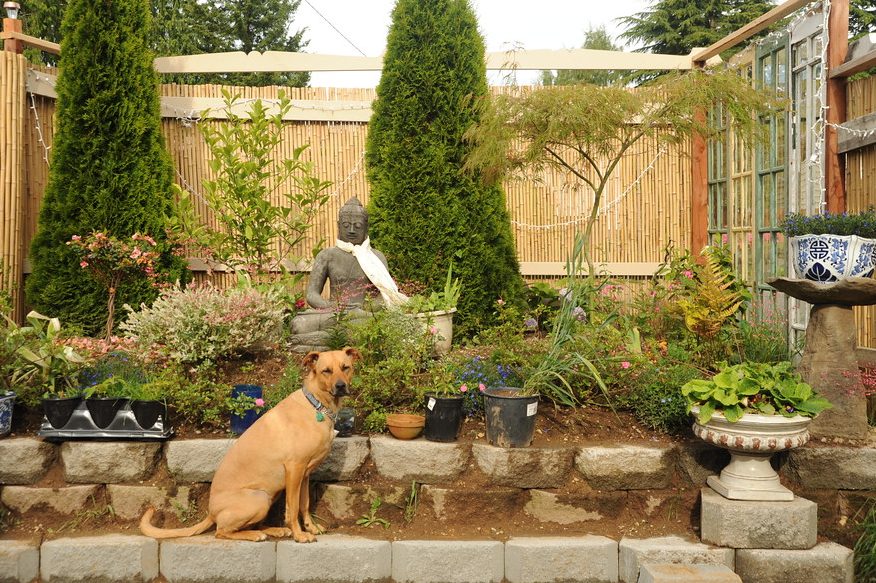
Photo: “Rosie poising with the garden Buddha, plants, raised bed, bamboo fence, Garden for the Buddha in progress, front yard, Seattle, Washington, USA” by Wonderlane is marked with CC0 1.0.

Political poem: Bono’s St. Patrick’s Day poem on Zelenskyy

Oh, St Patrick he drove out the snakes
With his prayers but that’s not all it takes
For the snake symbolises
An evil that rises
And hides in your heart, as it breaks

And the evil has risen my friends
From the darkness that lives in some men
But in sorrow and fear
That’s when saints can appear
To drive out those old snakes once again

And they struggle for us to be free
From the psycho in this human family
Ireland’s sorrow and pain
Is now the Ukraine
And St Patrick’s name now Zelenskyy

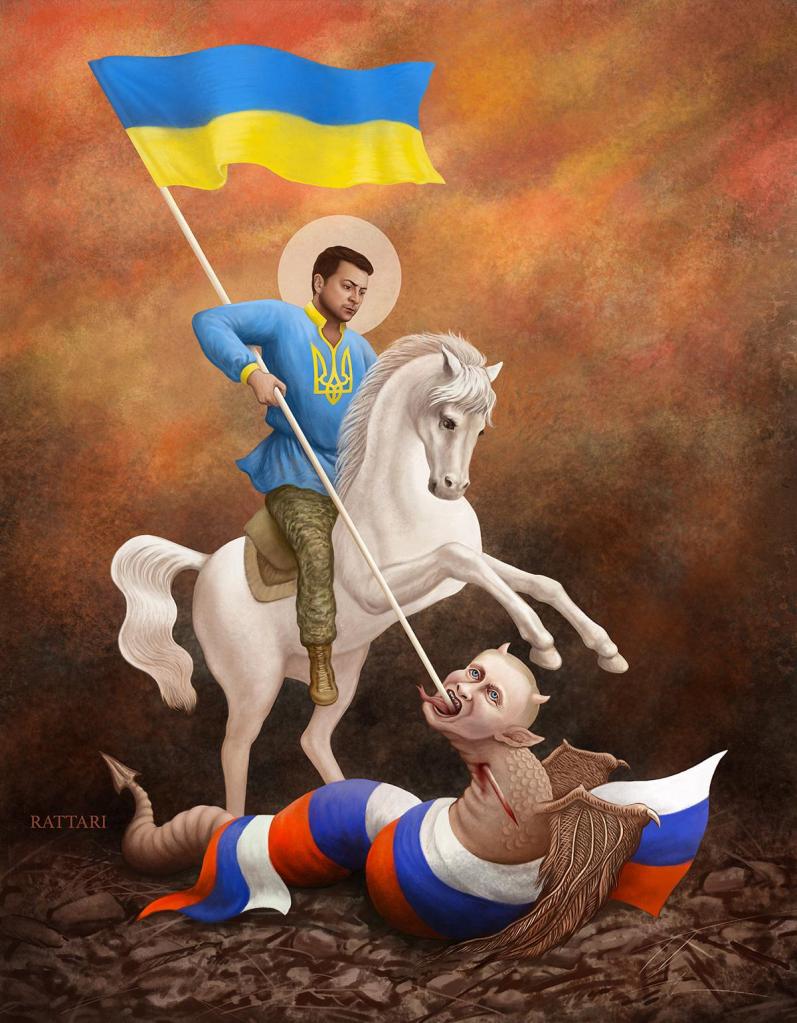
OK, first of all I recognise that the Saint Zelenskyy artwork by Liliya Rattari is a complimentary parody of either St Michael or St George, not St Patrick – but who cares? Putin is a big enough snake to rate as a dragon, and Zelenskyy is heroic enough to be any saint you want.

U2 frontman Bono‘s three-limerick poem was sent by him to Nancy Pelosi for her to use on St Patrick’s Day this year, and she read it at the Annual Friends of Ireland Luncheon in Washington to the assembled guests including the particularly Irish Joe Biden. The poem may not be good enough to be revered eternally, but nor is that snake Putin. Hopefully St Zelenskyy will chase Putin out of the country soon, and the sorrows of Ukraine will become as distant as the sorrows of Ireland.

Review: “A Joy Proposed” by T.H. White

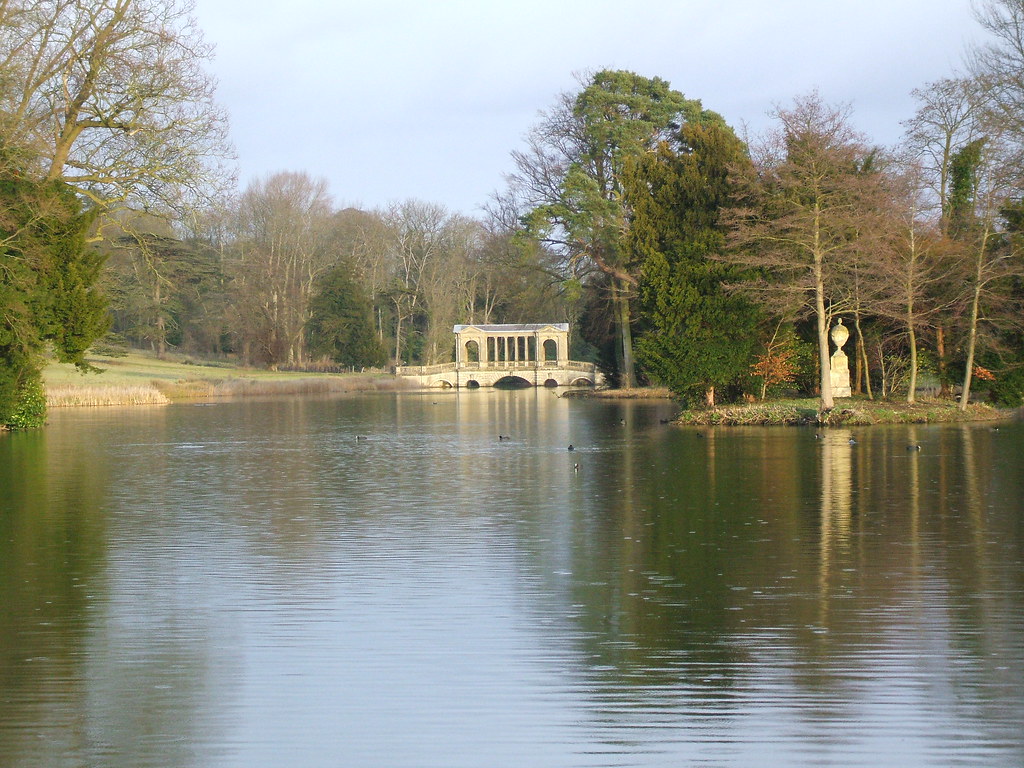
‘A Joy Proposed’ is a nice, somewhat strange, assembly of 57 often derivative poems from across the life of T.H. White. Many of the pieces were written in Ireland where White lived as a Conscientious Objector throughout the Second World War. His love of the countryside and his previous experiences as a schoolmaster (including at Stowe, a boarding school in rural Buckinghamshire with 600 acres of grounds) shine through in the constant juxtaposition of poems about game birds, dogs and landscapes alongside anger and bitterness about innocent lives lost to war.

The style varies from extreme simplicity, as in ‘A Choirboy Singing’:

Know not, but sigh.
Think not, but die.
Hope not, but high
Ache against ill.

to outpourings evocative of Whitman or Hopkins, as in ‘A Dray Horse’:

Meek Hercules – passion of arched power bowed in titanic affection,
Docile though vanquishing, stout-limber in vastness, plunging and spurning thy road –
Tauten thy traces, triumph past me, take thy shattering direction
Through misty Glasgow, dragging in a tremendous beer-waggon thy cobble-thundering load.

His pessimism, or perhaps mere sadness, at the human condition comes through again and again in the sense of the young lives he has been educating that will now be thrown away:

When I look at your comely head
And the long fingers delicately live
And the bright life born to be dead
And the happy blood to be shed
(…)
I die within me. And I curse
The witless fate of man without all cure.
Music I curse, and verse,
And beauty worse,
And every thing that helps us to endure.

… but mitigated always by his love of Nature, both hunting (as in kestrels and dogs he owned) and hunted (as in game birds he shot).

White is primarily known for his ‘Once and Future King‘ retelling of the Arthurian legends, and those novels soon went to stage and screen as the musical ‘Camelot’ and the Disney animation ‘The Sword in the Stone’. If it wasn’t for those novels, his other novels would probably be forgotten today and his poetry would be unknown. It isn’t great poetry, and yet I have read it and reread it. He was a writer and with it he was lonely, alcoholic, bitter, witty, learned, compassionate, and alive to the natural world. All of that comes through in these verses, with his self-awareness of who he was and what he was achieving. As he wrote in ‘Lines Cut on the Cottage Window’:

A bitter heart lay here and yet
It was not bitter to the bone.
It made what Time does not unmake
All hopeful, and alone.

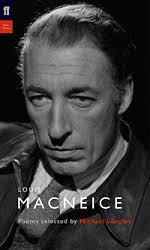
Poetry of Louis MacNeice

Louis MacNeice wrote one perfect poem, “The Sunlight on the Garden”. Insightful, wistful, tightly rhymed in a pattern maintained for four stanzas, easy to memorise, it is frequently anthologised and rightly so:

Louis MacNeice, Selected Poems

The sunlight on the garden
Hardens and grows cold,
We cannot cage the minute
Within its nets of gold,
When all is told
We cannot ask for pardon.

Others of his poems are easy to find, “Bagpipe Music”, “The Truisms”, and so on. They and a lot more, including good excerpts from his longer works, are in this excellent selection.

The similarity of much of his work to Auden is clear (for example in “Postscript to Iceland” after their shared journey there), but the thing that intrigued me unexpectedly was the similarity to the poems of T.H. White. The Irish background, English education, writing of cities and countrysides and cultures of both places, the being in Ireland at the outbreak of World War II… the rhyming, the frequently loose structures, the general tone of many of the character sketches… all those aspects of White’s “A Joy Proposed” echoed as I read MacNeice.

MacNeice, however, is without question the superior poet. After all, he wrote one of the most elegant poems in the English language.