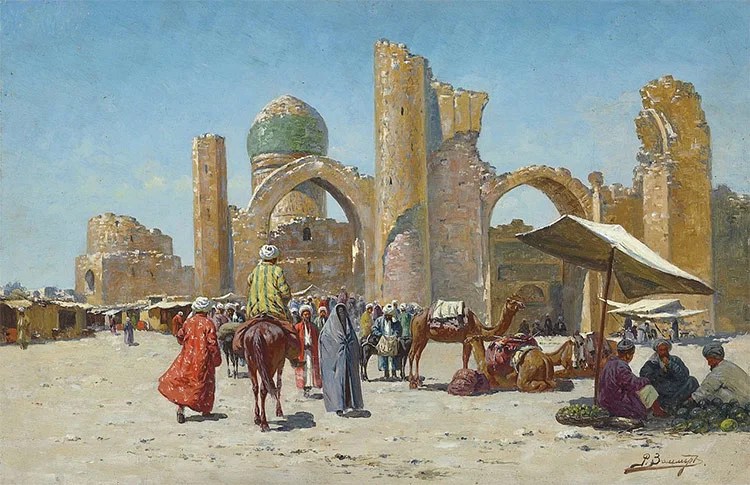
At the Gate of the Sun, Bagdad, in olden time
THE MERCHANTS (together)
Away, for we are ready to a man!
Our camels sniff the evening and are glad.
Lead on, O Master of the Caravan:
Lead on the Merchant-Princes of Bagdad.
THE CHIEF DRAPER
Have we not Indian carpets dark as wine,
Turbans and sashes, gowns and bows and veils,
And broideries of intricate design,
And printed hangings in enormous bales?
THE CHIEF GROCER
We have rose-candy, we have spikenard,
Mastic and terebinth and oil and spice,
And such sweet jams meticulously jarred
As God’s own Prophet eats in Paradise.
THE PRINCIPAL JEWS
And we have manuscripts in peacock styles
By Ali of Damascus; we have swords
Engraved with storks and apes and crocodiles,
And heavy beaten necklaces, for Lords.
THE MASTER OF THE CARAVAN
But you are nothing but a lot of Jews.
THE PRINCIPAL JEWS
Sir, even dogs have daylight, and we pay.
THE MASTER OF THE CARAVAN
But who are ye in rags and rotten shoes,
You dirty-bearded, blocking up the way?
THE PILGRIMS
We are the Pilgrims, master; we shall go
Always a little further: it may be
Beyond that last blue mountain barred with snow,
Across that angry or that glimmering sea,
White on a throne or guarded in a cave
There lives a prophet who can understand
Why men were born: but surely we are brave,
Who make the Golden Journey to Samarkand.
THE CHIEF MERCHANT
We gnaw the nail of hurry. Master, away!
ONE OF THE WOMEN
O turn your eyes to where your children stand.
Is not Bagdad the beautiful? O stay!
THE MERCHANTS (in chorus)
We take the Golden Road to Samarkand.
AN OLD MAN
Have you not girls and garlands in your homes,
Eunuchs and Syrian boys at your command?
Seek not excess: God hateth him who roams!
THE MERCHANTS (in chorus)
We make the Golden Journey to Samarkand.
A PILGRIM WITH A BEAUTIFUL VOICE
Sweet to ride forth at evening from the wells
When shadows pass gigantic on the sand,
And softly through the silence beat the bells
Along the Golden Road to Samarkand.
A MERCHANT
We travel not for trafficking alone:
By hotter winds our fiery hearts are fanned:
For lust of knowing what should not be known
We make the Golden Journey to Samarkand.
THE MASTER OF THE CARAVAN
Open the gate, O watchman of the night!
THE WATCHMAN
Ho, travellers, I open. For what land
Leave you the dim-moon city of delight?
THE MERCHANTS (with a shout)
We make the Golden Journey to Samarkand.
[The Caravan passes through the gate]
THE WATCHMAN (consoling the women)
What would ye, ladies? It was ever thus.
Men are unwise and curiously planned.
A WOMAN
They have their dreams, and do not think of us.
VOICES OF THE CARAVAN (in the distance, singing)
We make the Golden Journey to Samarkand.
*****
Yes, it’s laden with archaic stereotypes; yes, there are plenty of women who would go, and plenty of men who would not; yes, the world has moved on… But I make no apology for loving this poem, colourful, vibrant, a call to adventure, an anthem, a true romance.
The Wikipedia entry on James Elroy Flecker deals with his life, and with this poem in the context of his play Hassan, and the influences and references the poem spawned: a lovely mix of Saki, Borges, Agatha Christie, Flashman, Nevil Shute, Neil Gaiman, Vikram Seth… and memorials in England, India and New Zealand.
This is my third blog post on Flecker’s poems. Don’t worry, I’ll stop now.
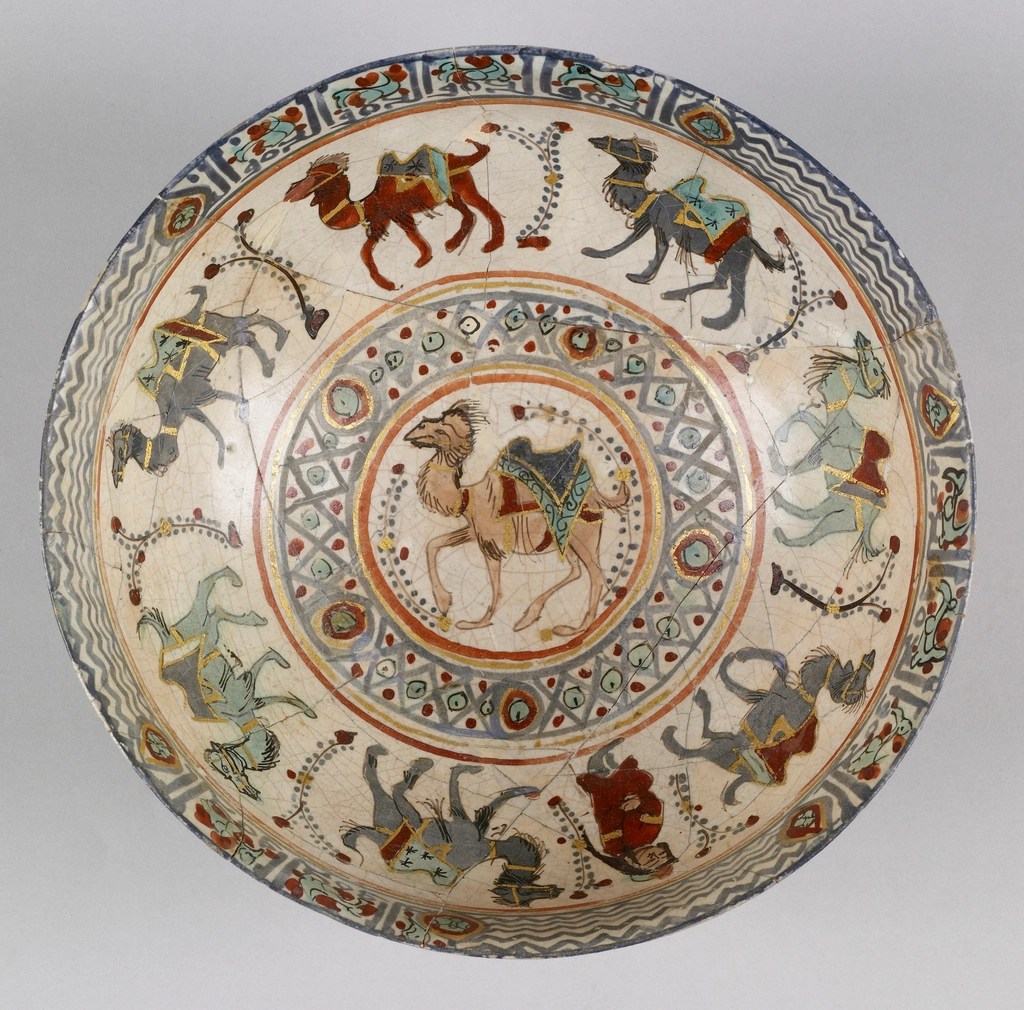
“Bowl Camel Caravan (late 12th-early” is marked with CC0 1.0.
 Form in Formless Times