Tag Archives: Jam Jar

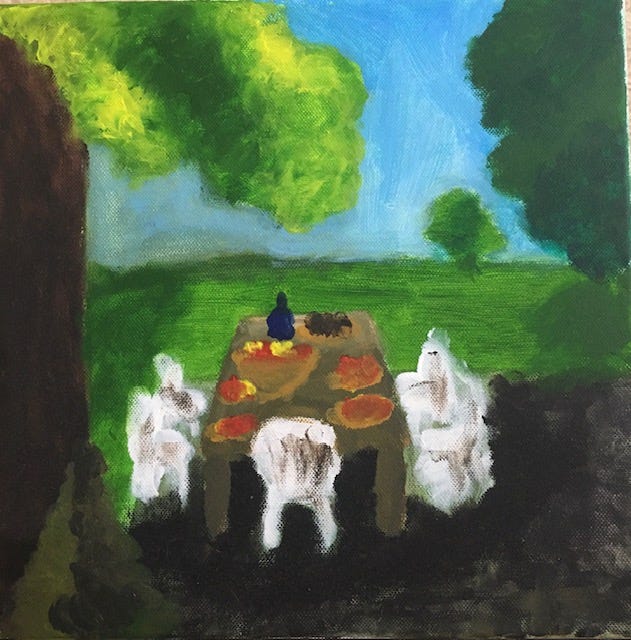
Ekphrastic sonnet: RHL, ‘Ghosts of Dead Parents’

Her ashes spread on Skirrid that she loved;
and his bones buried by the Harbour bay…
Why choose views for the dead? Once in earth shoved,
dirt in the dark is all they’d see, not day,
even if they lived. And if cremated, well…
So is it for our own guilt’s absolution?
Or status, that their graves our standing tell?
Or rites for social change’s resolution?
Those who were always here are here no more –
Their alwaysness runs out when they decease,
and life will now sound different from before,
like insect shrills not heard until they cease.
Dead ghosts sleep twittering in our heads’ domed caves,
waking to fill night skies from dreams and graves.

*****

This sonnet was published by The Wee Sparrow Poetry Press as a response to their ekphrastic challenge for the illustration, a painting by Žofia Katriňáková. It was written for my parents who, although they died decades ago, are still a background to my thoughts. My father is buried by the bay of Governor’s Harbour, my mother’s ashes were scattered on Skirrid Fawr, the Welsh mountain she loved and lived within sight of in Abergavenny. And I have another short poem for them, published in the Amsterdam Quarterly:

In the night’s jam jar of my memory
my long-dead parents live as fireflies.
My thoughts of them worn by time’s emery,
their faint light still suggests where my path lies.

Is it reasonable to hope to be a firefly for your children and grandchildren?

Poem: “Jam Jar” (was “Fireflies”)

In the night’s jam jar of my memory
My long-dead parents live as fireflies.
My thoughts of them worn by time’s emery,
Their faint light still suggests where my path lies.


“Jam Jar” was published last year in the September issue of
Amsterdam Quarterly (as well as in the AQ 2018 Yearbook). I originally titled it “Fireflies”, but AQ editor Bryan Monte had published a piece with that name in the previous issue, and naturally requested a change. Such are the vagaries of the publishing world.

Catching fireflies in a jar is such a childlike activity. And that’s appropriate here: no matter how old you become, you will always be the child of your parents.

Technically: it’s a short, simple poem. Iambic pentameter suits the meditative mood, the ABAB rhyme scheme is a natural for four lines.

Uses of Poetic Structure: Poem: “Jam Jar”

One of the great things about writing formal poetry is that, if you approach it the right way, it can force you to reduce unnecessary words to meet the structural requirements, and simultaneously add more ideas to meet the rhyme scheme. Here is an example:

Jam Jar

In the night’s jam jar of my memory
My long-dead parents live as fireflies.
My thoughts of them worn by time’s emery,
Their faint light still suggests where my path lies.

(This from the Amsterdam Quarterly, which produces three themed issues a year, the current one being related to “Genealogy”.) The original expression of the image behind the first two lines was longer than the end result; tightening it up and finding “emery” as a rhyme for “memory” extended it again, but this time as a regular quatrain.

If you write an outline of a poem that comes out to 15-20 lines, in free verse but with a couple of rhymes showing up, consider condensing it into a sonnet. All the unnecessary words get squeezed out, and the search for additional rhymes will only make the thoughts richer.

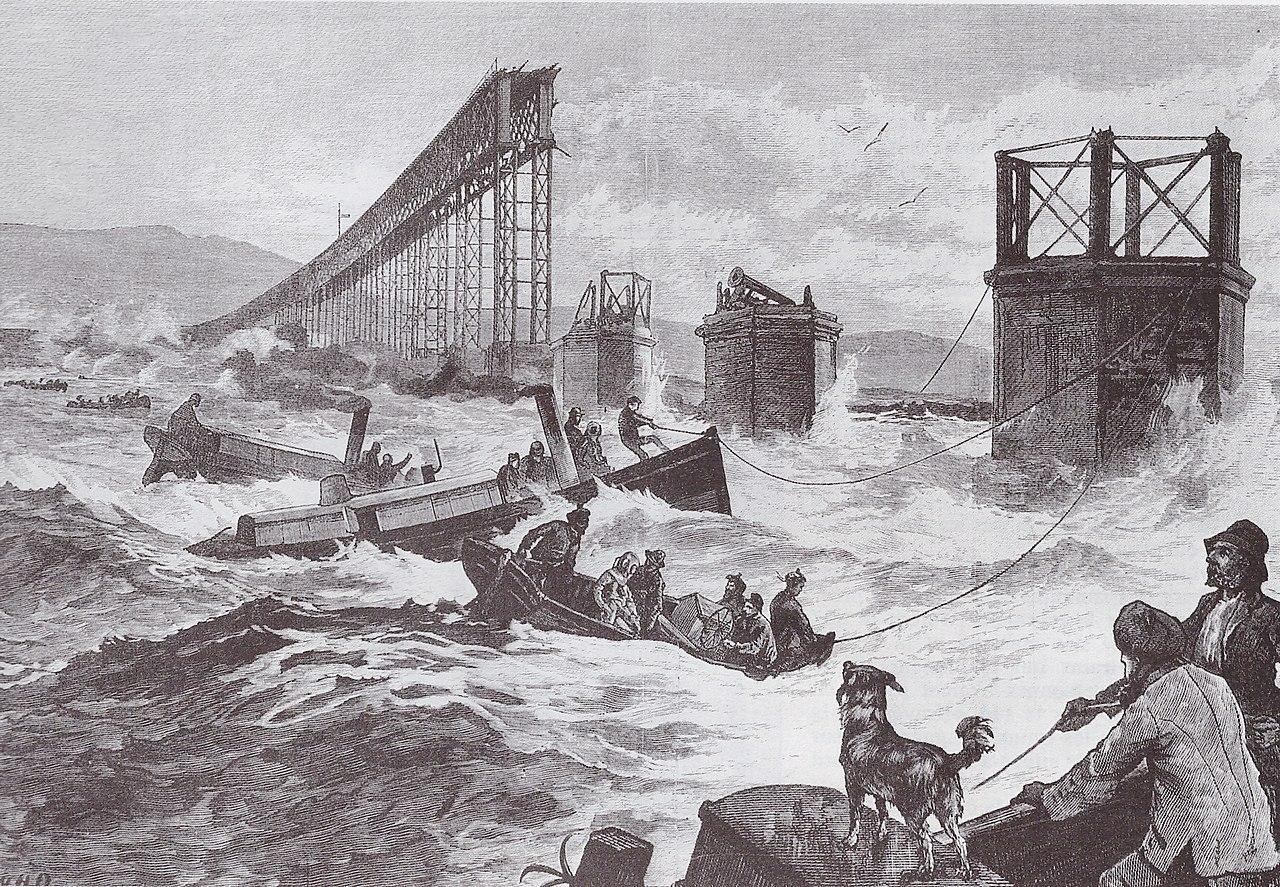
Structure and rhyme can be used to compress, condense, and hopefully intensify the ideas and their expression. But, amusingly, it is also possible to search for rhyme by increasing words, rambling until the rhyme can be tracked down. Scotland’s 19th century William McGonagall comes to mind, his most famous work being “The Tay Bridge Disaster”.

Contemporary illustration of the search after the disaster

The Tay Bridge Disaster

It tells of the collapse of the railway bridge during a storm, while a passenger train was on it:

Beautiful Railway Bridge of the Silv’ry Tay!
Alas! I am very sorry to say
That ninety lives have been taken away
On the last Sabbath day of 1879,
Which will be remember’d for a very long time.
(…)
I must now conclude my lay
By telling the world fearlessly without the least dismay
That your central girders would not have given way,
At least many sensible men do say,
Had they been supported on each side with buttresses,
At least many sensible men confesses,
For the stronger we our houses do build,
The less chance we have of being killed.

The structural requirements of formal verse are only justified when they are at the service of the poem’s aesthetics (or esthetics, depending on your residence). Rhyme, metre/meter and so on should be thought-provoking or relaxing sources of enjoyment, beauty, humo(u)r, memorableness. There is no merit in rhyme that destroys those things.