Tag Archives: politicians

Donald Trump’s favourite poem: ‘The Snake’ by Oscar Brown Jr.

On her way to work one morning
Down the path ‘longside the lake
A tender-hearted woman saw a poor half-frozen snake
His pretty colored skin had been all frosted with the dew
“Oh well,” she cried, “I’ll take you in and I’ll take care of you”
“Take me in, tender woman
Take me in, for heaven’s sake
Take me in, tender woman,” sighed the snake

She wrapped him up all cozy in a comforter of silk
And laid him by thе fireside with some honеy and some milk
She hurried home from work that night, and soon as she arrived
She found that pretty snake she’d taken in had been revived
“Take me in, tender woman
Take me in, for heaven’s sake
Take me in, tender woman,” sighed the snake

She clutched him to her bosom, “You’re so beautiful,” she cried
“But if I hadn’t brought you in, by now you might have died”
She stroked his pretty skin again and kissed and held him tight
Instead of saying thanks, that snake gave her a vicious bite
“Take me in, tender woman
Take me in, for heaven’s sake
Take me in, tender woman,” sighed the snake

“I saved you,” cried the woman
“And you’ve bitten me, but why?
And you know your bite is poisonous and now I’m gonna die”
“Oh shut up, silly woman,” said the reptile with a grin
“You knew damn well I was a snake before you took me in”
“Take me in, tender woman
Take me in, for heaven’s sake
Take me in, tender woman,” sighed the snake
“Take me in, tender woman,” sighed the snake

*****

Donald Trump has repeatedly read this poem in his political rallies as a way of attacking immigrants and the US Government’s immigration policies. The ironies are endless:
– that two of Trump’s wives are themselves immigrants (the current one having a very sketchy background as a “model”);
– that Trump always fails to credit Oscar Brown Jr as the song’s author, consistently naming Al Wilson instead;
– that Oscar Brown was a civil rights activist and for ten years a member of the Communist Party (he left when he decided he was “too black to be red”);
– that the song’s message, a variant on one of Aesop’s Fables, is that kindness can be betrayed;
– that Oscar Brown’s daughters have sent Trump cease-and-desist letters because Trump’s message is antithetical to all their father stood for;
– and as one of the daughters said on CNN, “the elephant in the room is that Trump is the living embodiment of the snake that my father wrote about in that song.

Photo: “JAZZ: Portrait of Oscar Brown, Jr.” by Professor Bop is licensed under CC BY-NC-ND 2.0. (Note: the portrait is by Edwin German.)
Jawaharlal Nehru’s favourite poem: Robert Frost’s ‘Stopping by Woods on a Snowy Evening’

Whose woods these are I think I know.
His house is in the village though;
He will not see me stopping here
To watch his woods fill up with snow.

My little horse must think it queer
To stop without a farmhouse near
Between the woods and frozen lake
The darkest evening of the year.

He gives his harness bells a shake
To ask if there is some mistake.
The only other sound’s the sweep
Of easy wind and downy flake.

The woods are lovely, dark and deep,
But I have promises to keep,
And miles to go before I sleep,
And miles to go before I sleep.

*****

In June 2023 Indian Prime Minister Narendra Modi visited the United States, and President Joe Biden gave him an autographed first edition copy of the ‘Collected Poems of Robert Frost’. (Modi gave Biden a copy of the ‘Ten Principal Upanishads’ by Purohit Swami and William Butler Yeats – the latter being a poet that Biden frequently quotes.)

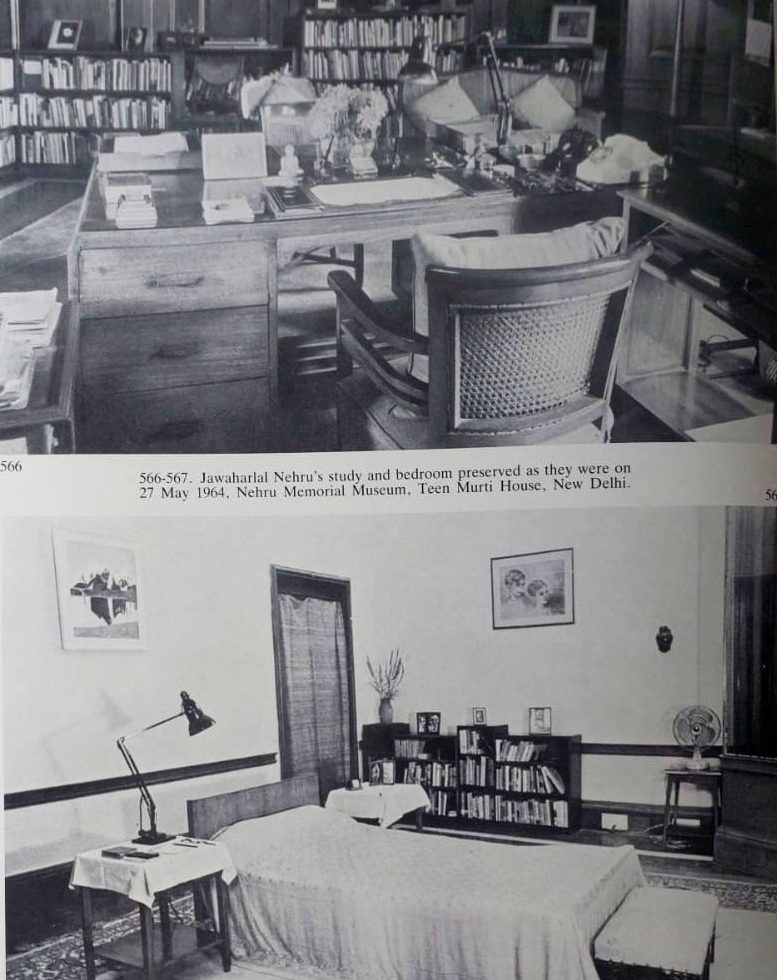
In India the gift of Frost’s work was recognised as a tribute to Jawaharlal Nehru, India’s first Prime Minister. Nehru, apart from being a founding father of Indian democracy, was a prodigious writer with a love of history, poetry and nature; in Himalayan vacations he went horseback riding and exploring woods. Frost’s poetry was a natural for him. Nehru had a particular fondness for ‘Stopping by Woods on a Snowy Evening’. Towards the end of his life he kept a copy of Frost’s poems by his bedside, with the last stanza of “Stopping by Woods” underlined:

The woods are lovely, dark and deep,
But I have promises to keep,
And miles to go before I sleep,
And miles to go before I sleep.

Photos: Jawaharlal Nehru’s study and bedroom, preserved as they were at the time of his death.

Margaret Thatcher’s favourite poem: Charles Mackay, ‘No Enemies’

You have no enemies, you say?
Alas! my friend, the boast is poor;
He who has mingled in the fray
Of duty, that the brave endure,
Must have made foes! If you have none,
Small is the work that you have done.
You’ve hit no traitor on the hip,
You’ve dashed no cup from perjured lip,
You’ve never turned the wrong to right,
You’ve been a coward in the fight.

*****

I’m no fan of the excessive and unproductive trickle-down economics of Margaret Thatcher, other than to say that I’m also no fan of the excessive and unproductive Union bureaucracy that she came to fight. (That just means I’m a centrist, and centrists often have a hard time in Two-party First-past-the-post electoral systems. FPTP encourages dividing the country into Us and Them, and making everything a fight. I think Proportional Representation allows for more constructive government relationships.)

As reported in The Independent, in the docudrama ‘The Crown’, Margaret Thatcher fires half of her cabinet because of their “lack of grit as a consequence of their privilege and entitlement”. In response, Queen Elizabeth tells Thatcher that she’s playing a “dangerous game” making so many enemies, to which the prime minister replies that she is “comfortable” with having enemies, and she then recites Scottish poet Charles Mackay’s ‘No Enemies’. Mackay was a 19th century poet and journalist, now best remembered for his ‘Extraordinary Popular Delusions and the Madness of Crowds‘.

In real life, Thatcher was very fond of the poem, with a 2019 BBC documentary revealing that she kept it on her desk.

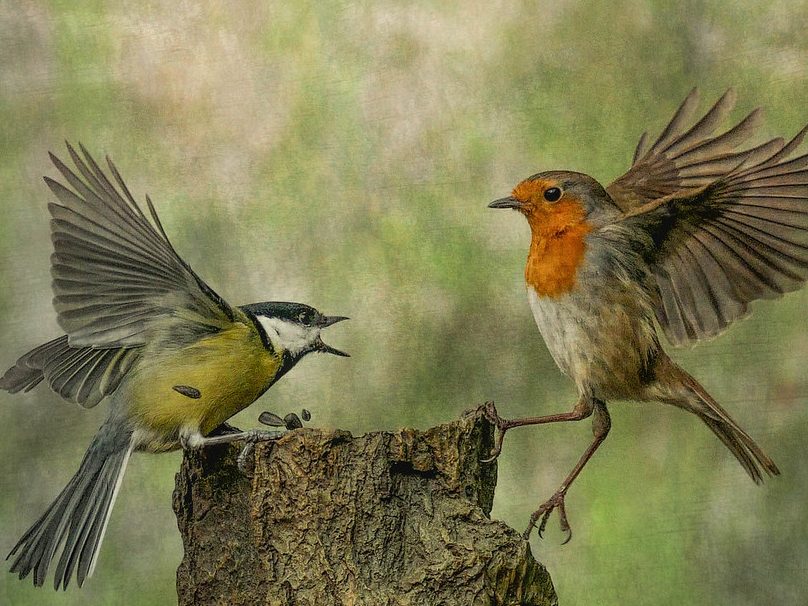
Food fight.” by Free the Image is licensed under CC BY 2.0.

Amit Majmudar, ‘To the Hyphenated Poets’

Richer than mother’s milk
is half-and-half.
Friends of two minds,
redouble your craft.

Our shelves our hives, our selves
a royal jelly,
may we at Benares and Boston,
Philly and Delhi

collect our birthright nectar.
No swarm our own,
we must be industrious, both
queen and drone.

Being two beings requires
a rage for rigor,
rewritable memory,
hybrid vigor.

English herself is a crossbred
mother mutt,
primly promiscuous
and hot to rut.

Oneness? Pure chimera.
Splendor is spliced.
Make your halves into something
twice your size,

your tongue a hyphen joining
nation to nation.
Recombine, become a thing
of your own creation,

a many-minded mongrel,
the line’s renewal,
self-made and twofold,
soul and dual.

*****

Editor’s comments: Being Anglo-Danish from birth and with the subsequent acquisition of other passports, I am naturally biased in favour of multiculturalism. It was interesting a couple of months ago to hear Britain’s Home Secretary Suella Braverman say “Multiculturalism has failed.” As one commentator noted, “She’s descended from Goan Indians from Mauritius and Kenya, married to a Jewish husband, and is in a senior cabinet position in a government headed by Britain’s first Hindu PM, himself the son of immigrants… Hello???” Suella Braverman left the cabinet shortly after.

Indians in particular, having been invaded and occupied by the Portuguese, French and British in the past couple of centuries, have used those connections to move out into the world – not just as entrepreneurs, but also in the arts, sciences… and politics. In mid-2023 the Prime Ministers of Ireland, Mauritius, Portugal and the UK, and the Presidents of Guyana, Mauritius, Seychelles, Singapore, Suriname and Trinidad & Tobago, all had Indian origins.

Amit Majmudar is a poet, novelist, essayist, translator, and the former first Poet Laureate of Ohio. He works as a diagnostic and nuclear radiologist and lives in Westerville, Ohio, with his wife and three children. He is the author of twenty books so far in a variety of categories, with different bodies of work published in the United States and in India.
His poetry collections include 0’, 0’ (Northwestern, 2009), shortlisted for the Norma Faber First Book Award, and Heaven and Earth (2011, Storyline Press), which won the Donald Justice Prize. These volumes were followed by Dothead (Knopf, 2016) and What He Did in Solitary (Knopf, 2020). His poems have won the Pushcart Prize and have appeared in the Norton Introduction to LiteratureThe New Yorker, and numerous Best American Poetry anthologies as well as journals and magazines across the United States, UK, India, and Australia. Majmudar also edited, at Knopf’s invitation, a political poetry anthology entitled Resistance, Rebellion, Life: 50 Poems Now.
One of Majmudar’s forthcoming volumes is a hybrid of prose, drama, and poetry, entitled Three Metamorphoses (Orison Books, 2024). A new poetry collection is forthcoming from Knopf in 2026.

For links to Majmudar’s Nonfiction, Fiction, Mythology and Translations, please see his website.

Photo by Ami Buch Majmudar.

‘Sonnet Found in a Deserted Madhouse (fantasy of an alternative future)’

The winds of winter wind through empty halls,
scraps of abandoned paper blow like leaves
to settle in odd corners of old walls.
Once a community lived here, but no one grieves:
the place was nothing but a wasteful home
for the sick, sad, psychotic and insane
who, locked in rooms or left alone to roam,
babbled their lives away, inept, inane.
All funding for the loonies has dried up;
guards, nurses, admin, tea ladies: dismissed.
And all because Brussels came out on top
and closed this home of British mental mist.
Now Big Ben chimes, tolling a final knell.
Farewell, old Houses; Westminster, farewell.

*****

As an Anglo-Dane raised in a third country, I’m naturally in favour of a borderless world. I loathe Brexit and the lies, greed and social inequities that allowed it to happen. Brexit and Trump were the two big foreign policy successes of Putin, stoking lies and fear and division. Sorry, rant over.

This Shakespearean sonnet was just published in the biannual poetry magazine Allegro, edited by Sally Long.

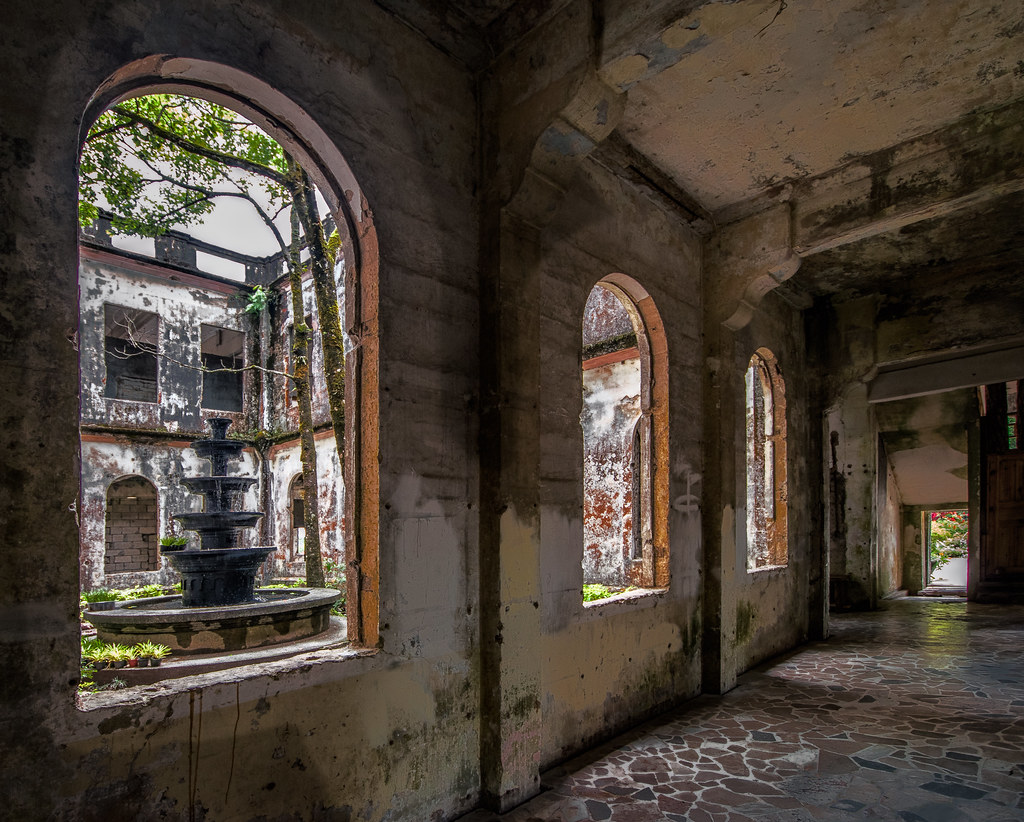
Abandoned Dominican Building #2” by FotoGrazio is licensed under CC BY-NC-ND 2.0.

Political poem: appallingly bad verse apparently in favour of Liz Truss

Bizzy lizzy will win by a.mile
She has got a lovely smile
Brians to match her lovely face.
She will win this pm race
Sunaks a snake
A back stabbee he is
He turned on boris
And will turn on liz
She will be a great pm
Not as good.as maggie but no one could be
Mrs thartcher mach 3
Liz will stand proud over our lands
Holdinh out her hand
If we wotk to gether we can
Get rid of the woke
And watch them. Cry into there cornflakes
As liz makes our country great.
In liz we trust god speed to our new pm

*****

In honour of Liz Truss’s trip to Balmoral Castle to be named Queen Elizabeth’s Prime Minister, I looked for poems by or about the new PM. The above is the best I could find, reposted in the Yorkshire Bylines by Jimmy Andrex under the heading Has the emergence of Liz Truss stimulated a new type of poetry?

Jimmy does a good serious job of discussing modern political poetry… sort of. But he fails to note that the quoted “poem” by “Bill Sutton” originated as a post to the Facebook group ‘Liz Truss Supporters (no trolls)‘ which is loaded with sarcastic commentary on the British Conservative Party in general and Liz Truss in particular.

So the answer to Jimmy’s question is No, of course. Scathing poetry, good or deliberately bad, has long been used as a political weapon. Bill Sutton’s post may be amusing, but is unlikely to resonate for as long as, say, Shelley’s rant the year before George III died: “An old, mad, blind, despised, and dying king, –

Good luck, Liz; hope you’ve got a thick skin.

Poem: ‘Leadership Transition’

Julius Caesar, Antony, King Lear,
Hamlet, Macbeth – corrupted, vain, impure,
Irrational, bombastic, insecure –
He’s no more clarity or veritas
Than the deceptions of a covert war,
All morals blurred.

That tyrant rant, Tyrannosaurus roar,
Forecasts he’ll suffer a dictator’s fate:
His proud obsessed confusion first seems great,
Then grates, unravels at the seams, slips gear,
Loses its moral metaphors, grows crass;
He dies absurd.

Octavius, Malcolm, Edgar, Fortinbras,
Comes from the wings and strides to centre stage –
Competent, measured, reasonable, sane –
To rule the wreckage of the tragic reign;
Restores some structure, closes out the age,
Speaks the last word.

This archetypal character’s strong thump
Will get his nation out of the morass;
The raucous self-styled hero being dead,
A truer leader takes the throne instead.
(How Shakespeare’d end the Tragedy of Trump
Can be inferred.)

The common fate of Shakespeare’s flawed protagonists–death, and replacement by a more worthy ruler–is a story that humans enjoy and wish applied in their own times and countries… although they may naturally disagree on which ruler is disgraceful and which would be more worthy. Speaking for myself, I don’t need to see a death–I’d be happy for Putin and Trump to avoid assassination or jail by going into comfortable exile at a golf hotel in southern Russia. (You read it first here.) But Shakespeare would deal with them more definitively.

This poem is the third of the five poems published this month in The Brazen Head. Its four stanzas are in iambic pentameter with a short 6th line. The rhymes largely carry over between stanzas–the 6th lines only rhyme with each other. The rhymes and the stanza structure are designed to create a sense of satisfactory achievement–exactly what I feel with Biden taking over from Trump. (Similarly I would love to see Navalny take over from Putin, and almost anyone replace Boris Johnson.)

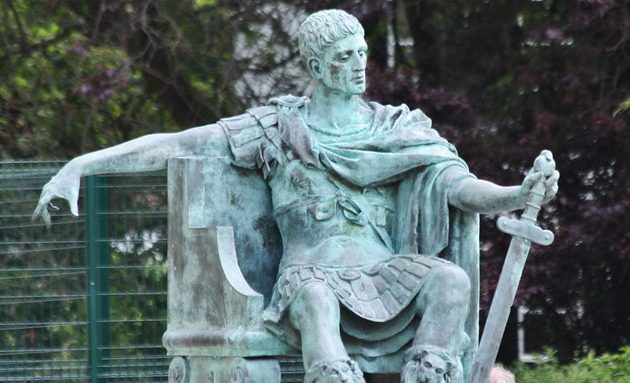
York Minster – June 2013 – Emperor Constantine – One Cool Dude” by Gareth1953 All Right Now is marked with CC BY 2.0.

Odd poem: Abraham Lincoln, ‘The Suicide’s Soliloquy’

Here where the lonely hooting owl
Sends forth his midnight moans,
Fierce wolves shall o’er my carcase growl
Or buzzards pick my bones.

No fellow-man shall learn my fate,
Or where my ashes lie;
Unless by beasts drawn round their bait,
Or by the ravens’ cry.

Yes! I’ve resolved the deed to do,
And this the place to do it:
This heart I’ll rush a dagger through,
Though I in hell should rue it!

Hell! What is hell to one like me
Who pleasures never knew;
By friends consigned to misery
By hope deserted too?

To ease me of this power to think,
That through my bosom raves,
I’ll headlong leap from hell’s high brink,
And wallow in its waves.

Though devils yell, and burning chains
May waken long regret;
Their frightful screams, and piercing pains,
Will help me to forget.

Yes! I’m prepared, through endless night,
To take that fiery berth!
Think not with tales of hell to fright
Me, who am damn’d on earth!

Sweet steel! come forth from out your sheath,
And glist’ning, speak your powers;
Rip up the organs of my breath,
And draw my blood in showers!

I strike! It quivers in that heart
Which drives me to this end;
I draw and kiss the bloody dart,
My last—my only friend!

This poem was published anonymously in the April 25, 1838 edition of The Sangamo Journal of Springfield, Illinois, under this introduction: “The following lines were said to have been found near the bones of a man supposed to have committed suicide, in a deep forest, on the Flat Branch of the Sangamon, sometime ago.” For various reasons it is now commonly assumed that this is the poem that Lincoln’s friend Joshua Speed told Lincoln’s biographer William Herndon about, a poem that the President had written on suicide as he struggled through a period of deep depression.

A full discussion of the identification of the poem with Lincoln can be found in the magazine Shenandoah, and I happily quote their assessment of Lincoln’s merits as a poet:

The poem is similar to other mortality poems of the period, though even more melodramatic than most (the last stanza, in which the speaker continues to narrate his feelings after he has stabbed himself through the heart, is particularly painful). Aside from the historical curiosity of its authorship, the piece—with its glamourizing of suicide and its overwrought morbidity—does little to distinguish itself from other amateur poetry in the school of Poe.

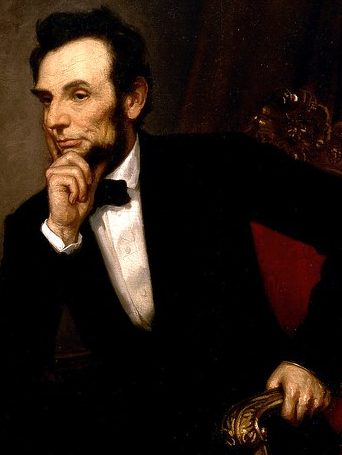
Photo: “16 Abraham Lincoln” by US Department of State is marked with CC PDM 1.0

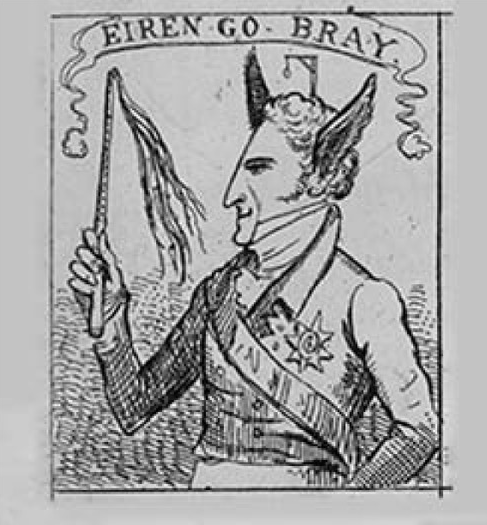
Political poems: Byron on Castlereagh

Posterity will ne’er survey
a Nobler grave than this:
Here lie the bones of Castlereagh:
Stop, traveller, and p*** !

Robert Stewart, Viscount Castlereagh (which rhymes with “pray”, if you choose to have that, rather than “piss”, as the last word of Byron’s little poem) was an Anglo-Irish politician who managed to make himself throughly hated.

Though generally in favour of concessions to the Irish he did not support Catholic Emancipation from the discrimination and civil disabilities they suffered under as disenfranchised second-class citizens. He took the lead in suppressing the Irish Rebellion of 1798; he advocated leniency to the common people but had leaders executed – including a Presbyterian minister who had canvassed for him in an election. From 1812 to 1822 he was the British Foreign Secretary, instrumental in managing the alliance that defeated Napoleon; and then at the Congress of Vienna, with the conservative Bourbons back on the throne of France, he advocated leniency for France and non-intervention by the UK in European affairs – which was seen as siding with the repressive Eastern European powers. This is from the ‘Dedication’ to Byron’s ‘Don Juan’:

Cold-blooded, smooth-faced, placid miscreant
Dabbling its sleek young hands in Erin’s gore,
And thus for wider carnage taught to pant,
Transferred to gorge upon a sister shore
The vulgarest tool that Tyranny could want,
With just enough of talent, and no more,
To lengthen fetters by another fixed,
And offer poison long already mixed.

Castlereagh’s suicide in 1822 further occasioned this from Byron:

Oh, Castlereagh! thou art a patriot now;
Cato died for his country, so didst thou:
He perish’d rather than see Rome en­slaved,
Thou cutt’ st thy throat that Britain may be saved!
So Castlereagh has cut his throat!–The worst
Of this is, – that his own was not the first.
So He has cut his throat at last!–He! Who?
The man who cut his country’s long ago.

Odd poem: ‘Changsha’ by Mao Zedong

Alone I stand in the autumn cold
On the tip of Orange Island,
The Xiang flowing northward;
I see a thousand hills crimsoned through
By their serried woods deep-dyed,
And a hundred barges vying
Over crystal blue waters.
Eagles cleave the air,
Fish glide under the shallow water;
Under freezing skies a million creatures contend in freedom.
Brooding over this immensity,
I ask, on this bondless land
Who rules over man’s destiny?
I was here with a throng of companions,
Vivid yet those crowded months and years.
Young we were, schoolmates,
At life’s full flowering;
Filled with student enthusiasm
Boldly we cast all restraints aside.
Pointing to our mountains and rivers,
Setting people afire with our words,
We counted the mighty no more than muck.
Remember still
How, venturing midstream, we struck the waters
And the waves stayed the speeding boats?

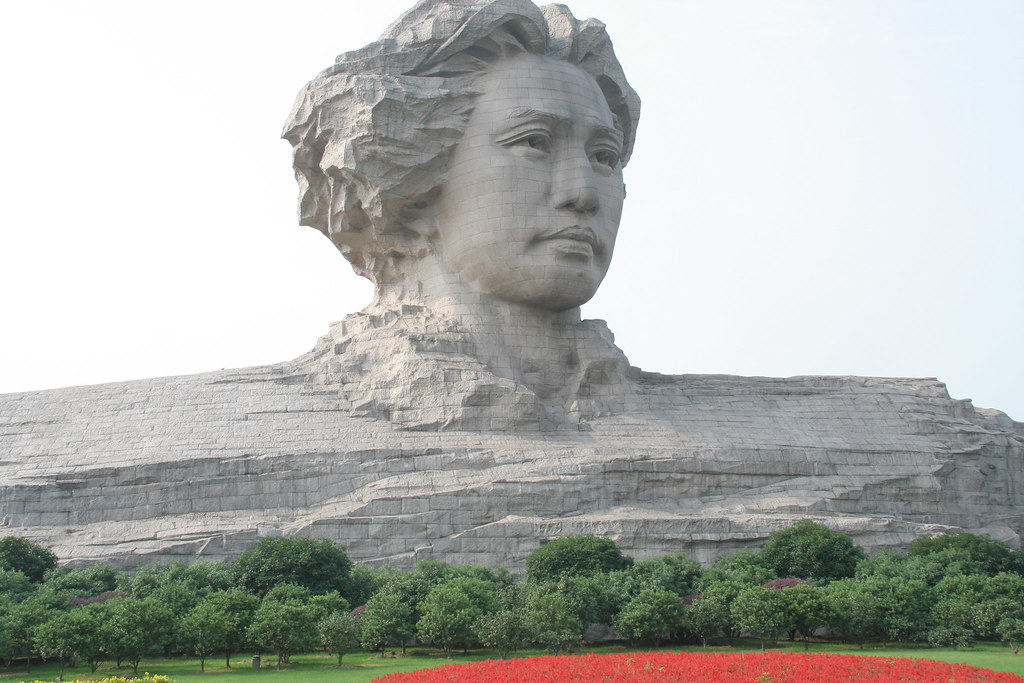
Mao Zedong wrote this poem in 1925, when he was 31. He had previously spent five years in Changsha at university, young, bold and enthusiastic. Now he returned, reflected, remembering his student days, pondering the land’s immensity and the nature of destiny, and he wrote his poem. And today the young Mao gazes again at the river from Orange Island… or would, if it wasn’t just a stone statue of his head.

Despite his revolutionary tendencies in other areas, Mao wrote in Classical Chinese verse. ‘Changsha’ is annotated “to the tune of Chin Yuan Chun”, marking it as belonging to the type of verse called tzu. The tzu originated in the Tang Dynasty (618-907 CE) as lines sung to certain tunes. Each tune prescribes a strict tonal pattern and rhyme scheme, with a fixed number of lines of a standardised varying length. Obviously, a translation into a European language is going to lose the structural form inherent in the original. Mao may not be one of the best Chinese poets, but his poems are generally considered to have literary quality. Arthur Waley, the eminent British translator of Chinese literature, however, described Mao’s poetry as “not as bad as Hitler’s paintings, but not as good as Churchill’s.”

Photo: “A young Chairman Mao” by timzachernuk is licensed under CC BY-NC 2.0