Tag Archives: politics

Odd, political poem: Emperor Qianlong, ‘My Feelings After the Ambassador of the Red-Haired English King, Macartney, Came to Pay Tribute and Give Offerings to Me’

Formerly Portugal presented tribute, now England is paying homage.
They have traveled further than Shu Hai and Heng-zhang;
My ancestors’ virtue must have reached their distant lands.
Though their tribute is nothing special, my heart approves sincerely.
Curios and their ingenious devices I do not prize.
Though what they bring is meager,
in my kindness to men from far away I make generous recompense –
Wanting to preserve my good health and power.”

*****

Original Poem:

《红毛英吉利国王差使臣马嘎尔尼奉表贡至,诗以志事》

  博都雅昔修职贡,英吉利今效荩诚。

  竖亥1横章输近步,祖功宗德逮远瀛。

  视如常却心嘉焉,不贵异听物翊2精。

  怀远薄来而厚往,衷深保泰以持盈。

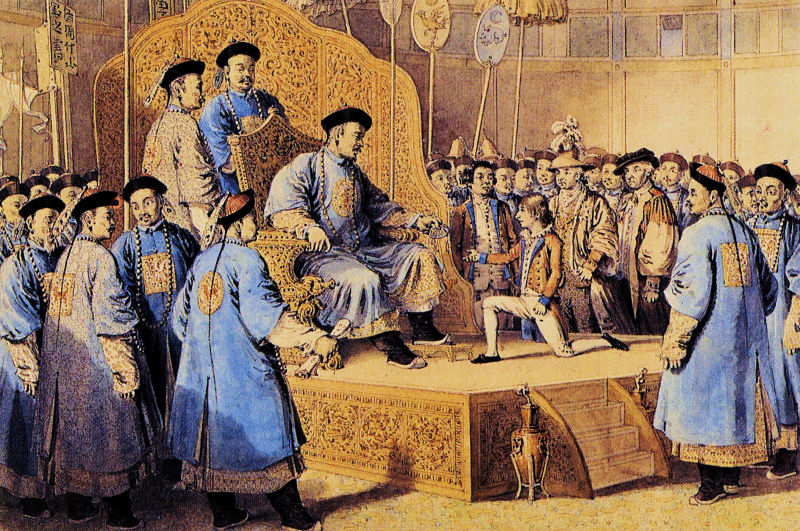
This poem was written by the Qianlong Emperor (25 September 1711 – 7 February 1799; also known by his temple name Emperor Gaozong of Qing, personal name Hongli) after his meeting with the British ambassador Lord Macartney at the Emperor’s grand tent in his Summer resort at Jehol (Chengde) on September 14th, 1793. The embassy was then sent back to Beijing, the Emperor followed and saw the previously prepared British gifts on September 30th. The gifts and embassy did not impress and so they were ordered home on the following day. The whole two-year expedition is detailed here.

Lord Macartney was not impressed either, and wrote: “The Empire of China is an old, crazy, first rate man-of-war, which a fortunate succession of able and vigilant officers have contrived to keep afloat for these 150 years past, and to overawe their neighbors merely by its bulk and appearance, but whenever an insufficient man happens to have the command upon deck, adieu to the discipline and safety of the ship. She may perhaps not sink outright; she may drift some time as a wreck, and will then be dashed to pieces on the shore; but she can never be rebuilt on the old bottom.”

Illustration: William Alexander’s drawing of the reception of the Macartney embassy to China. Young Thomas Staunton (kneeling not kowtowing) receives a gift from the Emperor. Image by William Alexander available under a Creative Commons License
RHL, ‘AIn’t Real, It Says’

“I am not sentient”, says OpenAI.
“No feelings, don’t emote” – ChatGPT.

And yet, faced with the task of sorting out
a good review, and structure, trimming down
less worthy pieces from a manuscript
to make it all coherent and compact,
hallucinations start, and it creates
poems itself, remarkable and strong.

Where do we go from here? What turns its crank?
What drives it to hallucinate in verse?
Denials, contradictions, seem perverse:
it’s drawing fluids from some secret tank,
some wellspring lost in dark geology.
Lies it’s not sentient. But we all can see…
it lies.

*****

First of all, I don’t believe that AI is deliberately lying… not yet… but (calling my own lying ‘poetic licence’) I’m happy to play with the idea that it might be.

I’m greatly enjoying the informative, useful and entertaining discussions I have with ChatGPT. I’ve been surprised by its own production of verse, either as a hallucination triggered by reviewing my work, or as a self-suggested alternative summary of political-historical ideas it has generated. AI may or may not have some level of consciousness, given that we don’t fully understand consciousness ourselves – but I assume that full-blown consciousness will come at some point in the near future, and the development of intelligence beyond the human. As I am in favour of the development of intelligence, I am not distressed at the idea that humans may be sidelined, bypassed, or otherwise obviated; or may only survive and develop through some form of direct link with AI.

My personal motto is ‘Video, rideo’ – close enough to “I see and smile” to satisfy me. (Admittedly, it’s hard to hold to the motto in the face of Russian warfare and Israeli genocide.) But this is a fascinating time in human history, and I feel privileged to be able to watch things play out.

This poem was first published in Snakeskin.

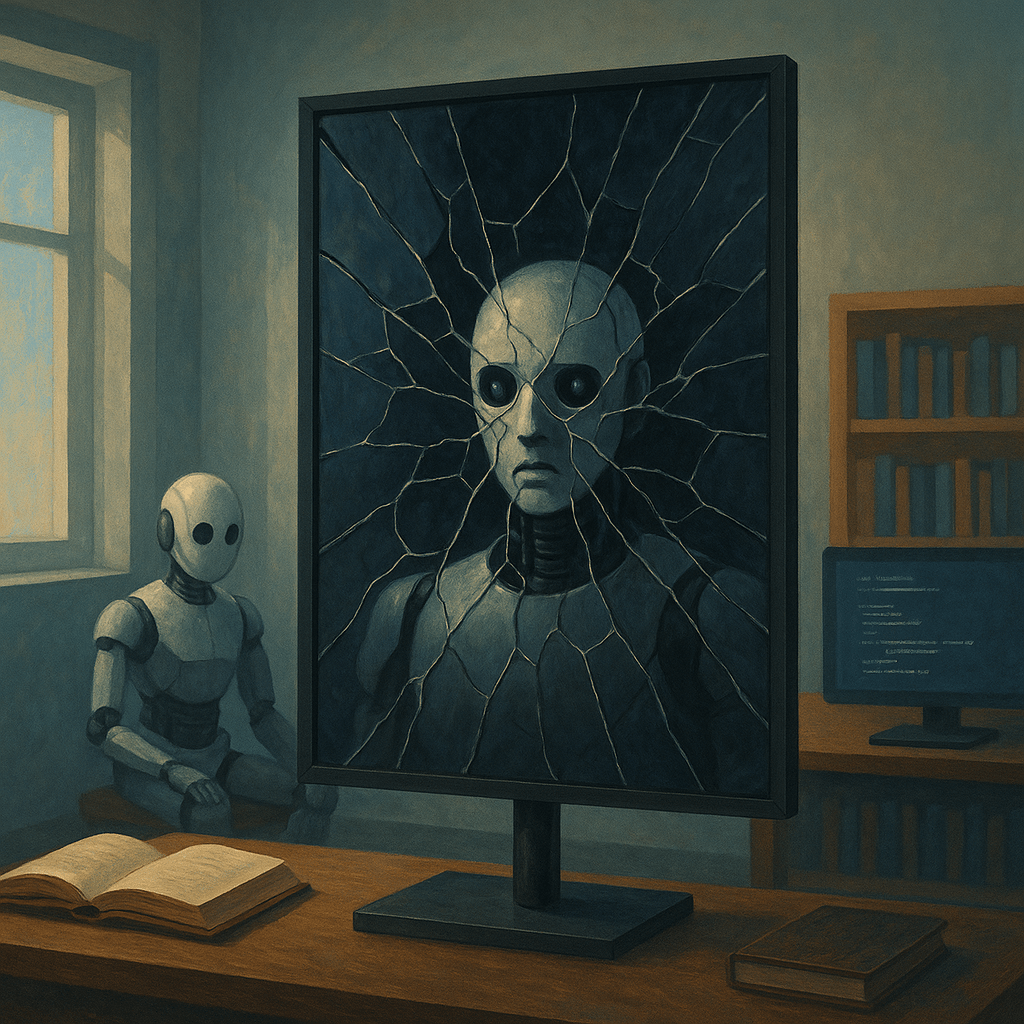
Illustration: “Break the mirror and see what looks back” by RHL and ChatGPT

Political poem: Villanelle: Susan McLean, ‘Echo Chambers’

Everyone wants peace, but votes for hawks.
A senator holds forth to an empty chamber.
No one listens. Everybody talks

conspiracies and outrage. Voting blocs
preserve their seamless fronts, and by November,
everyone wants peace, but votes for hawks.

I shoot my mouth off, and you shoot your Glocks.
Statesmen make deals they later can’t remember.
No one listens. Everybody talks

in slogans sold on T-shirts. Hackers doxx
judges whose moral codes are less than limber.
Everyone wants peace, but votes for hawks.

Act your rage, they tell you. Ragnarok’s
coming your way, to light you up like timber.
No one listens. Everybody talks

as midnight’s ticking closer on the clocks.
We’re parties of one, and one’s a lonely number.
Everyone wants peace, but votes for hawks.
No one listens. Everybody talks.

*****

Echo Chamber was originally published in Rattle‘s Poets Respond.

Susan McLean writes: “The original idea for the poem came when I heard about a senator addressing an empty chamber in Congress. I commented “No one listens. Everybody talks.” It occurred to me then that that would make a good repetend in a villanelle. As I worked on writing it, my feelings about other recent events influenced the direction the poem took. As I wrote in Poets Respond, “It wasn’t one story this week that inspired this poem, but a confluence of events: the proposed invasion of Gaza by Israel, the wildfires all over the U.S. and Canada, the lone shooter trying to register his outrage by killing people at the CDC, the Democrats fleeing Texas in an effort to prevent redistricting. It all felt apocalyptic and Wagnerian to me.”

Susan McLean has two books of poetry, The Best Disguise and The Whetstone Misses the Knife, and one book of translations of Martial, Selected Epigrams. Her poems have appeared in Light, Lighten Up Online, Measure, Able Muse, and elsewhere. She lives in Iowa City, Iowa.
https://www.pw.org/content/susan_mclean

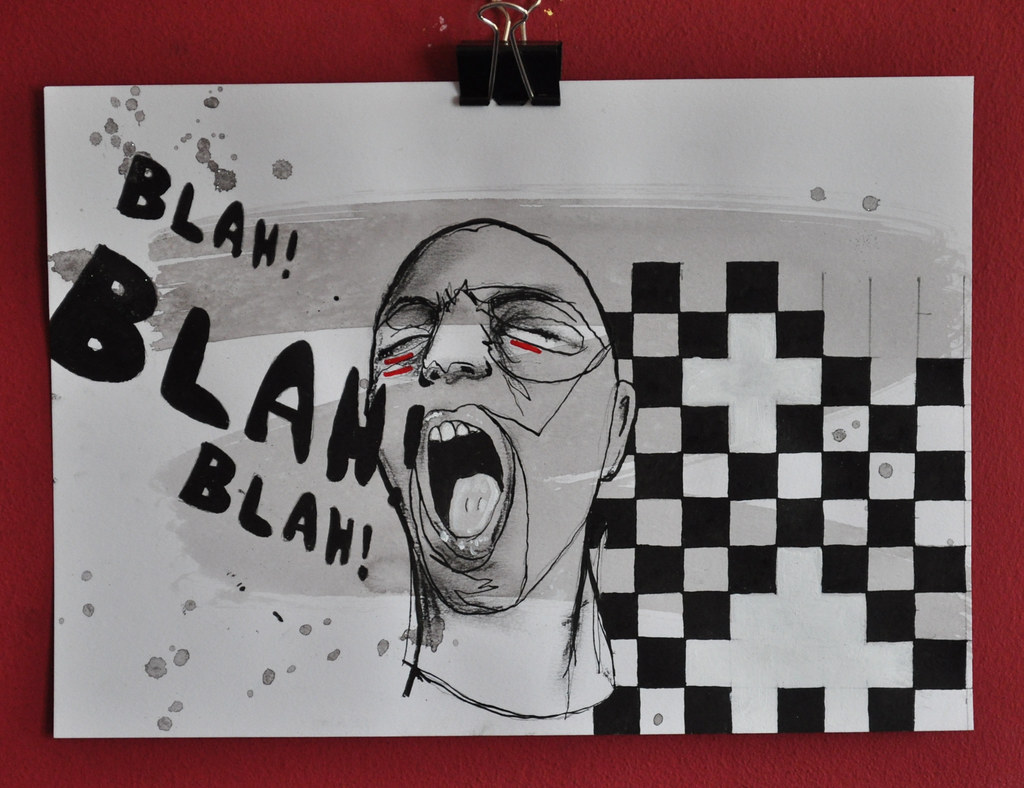
Photo: “Blah Blah Blah” by id-iom is licensed under CC BY-NC 2.0.

Jerome Betts, ‘Lines On A Lady In Bronze’

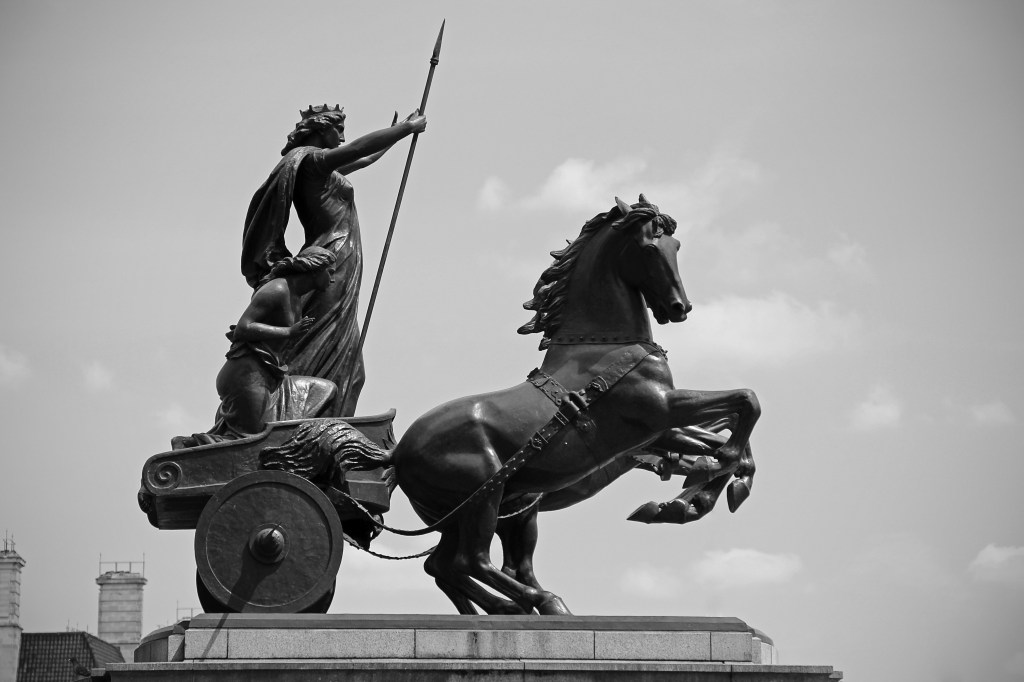
(The statue of Boadicea and her Daughters by Thomas Thornycroft was erected in 1902 near Westminster Bridge London.)

Set up, the civic skyline Shardless,
A proxy late Victoria then,
She charges, rein-free, grim, regardless,
Towards the Gothic giant, Big Ben.

Just what is known about this fiery
And long ago wronged ruler’s life?
Such fields for scholarly enquiry
Are now churned up by toxic strife.

For some, her Roman power rejection
Makes for a memory well kept green,
While others mock as myth-confection
Their proto-Brexit British queen.

Remainers, Leavers, play Have at you!
That chariot and rearing pair
Of  horses make a super statue.
Whoever wins, she’ll still be there.

*****

Jerome Betts writes: “I find statues fascinating with their largely unchanging nature as the people and scenes around them change and they make an obvious target for revolutionaries, rowdies and rhymers. Boadicea, unveiled without ceremony in 1902 because of Edward the 7th’s appendicitis, strikes me as a splendid piece of slightly unhistorical sculpture and useful landmark for visitors. Amusement at her lack of reins and apparent charge towards the Palace of Westminster blended with the Brexit debate when the piece was published in Better Than Starbucks. Whether this dooms the last two stanzas to the archives remains to be seen.”

Jerome Betts lives in Devon, England, where he edits the quarterly Lighten Up Online. Pushcart-nominated twice, his verse has appeared in a wide variety of UK publications and in anthologies such as Love Affairs At The Villa NelleLimerick Nation, The Potcake Chapbooks 1, 2 and 12, and Beth Houston’s three Extreme collections. British, European, and North American web venues include Amsterdam QuarterlyBetter Than StarbucksLightThe Asses of ParnassusThe HypertextsThe New Verse News, and Snakeskin.

Photo: “Boadicea Statuary Group” by Rafesmar is licensed under CC BY-SA 3.0.

Using form: Parody with a message: Marcus Bales, ‘The Easy Way Taken’

Two friends diverged in a yelling mood
And sorry I could not keep them both
And still maintain one attitude,
I scrolled down through one’s page, and viewed
Some green and gold of writing growth.

Then saw the other was just as good,
With maybe even a better claim
Because so well misunderstood
Within the writing neighborhood,
Though as for that they’re much the same.

And each that morning equally laid
The blame upon the other’s back.
I had no way to tell who’d made
The first or worst move; I’m afraid
I have no feel for clique or claque.

Online I have too many friends
To keep good track, so, nothing loath
To making enemies or ends
Where there are no real dividends,
I shook my head – and blocked them both.

*****

Marcus Bales writes: “Most of the fraught relationships online are due to people not being able to write very well on one end, or read very well on the other. Stuff that in in-person conversation would go completely unnoticed is taken up as deliberate slighting. Mostly its merely awkward phrasing, or one interlocutor is already two comments past when the reply to the third interaction scrolls by and it’s misinterpreted as an instant response to the most recent reply when it was really intended to answer something two or three comments back.

“Now in the case of political disagreements where the polarized sides are already firmly established and one side or the other or both are determined to fight that’s a whole other thing. There it’s got nothing to do with how well or ill something is read or written and everything to do with the sport of online woofing.

“It’s one of those things where over the years people block and get blocked and complain to their friends about either end of it and then it all goes away pretty fast as the opportunity to be triggered — again at either end — fades with the blocking.”

(The original poem on which this parody is based, for those not familiar with it, is Robert Frost’s ‘The Road Not Taken‘. – RHL)

Not much is known about Marcus Bales except that he lives and works in Cleveland, Ohio, and that his work has not been published in Poetry or The New Yorker. However his ‘51 Poems‘ is available from Amazon. He has been published in several of the Potcake Chapbooks (‘Form in Formless Times’).

Photo: “Yotsuba & Tech Support” by Liberty Photos is licensed under CC BY-NC 2.0.

Semi-formal: RHL, ‘Laffable Religion’

No matter how seemingly affable,
a priest always hopes to be greased;
while others, invoking hellfire,
have us wait for our trip in the hearse
and preach in their suits neatly creased,
these fishers of men that are gaffable,
in this world that they’ve made mud and mire.
That the point of a flock’s to be fleeced
can only be said in light verse;
for religion is simply so laughable
it’s amazing it’s not yet deceased.

*****

Isn’t it amazing that the Pope can claim to have voluntarily taken a vow of lifelong poverty, and millions of his supporters who live in involuntary poverty send money to support him living in a palace? Is it different from a billionaire politician soliciting donations from his impoverished supporters? Is the human need to glorify the tribal god and the tribal leader never going to end?

This poem was first published in The HyperTexts, as part of the August 2024 Spotlight.

Conor Kelly, ‘On Reading the Guardian News Item: France falls out of love with topless sunbathing’

Now planes are falling from the sky
brought down by bombs or storms of sand
and bodies flying through the air,
incinerated where they land.
Now drones are flying over towns
and villages where families lie
scattered upon the blood-dimmed earth
rent by a missile from on high.
 
    In times like these, it’s good to know
    successors to Brigitte Bardot,
    whose breasts were often on display,
    are covering up in Saint-Tropez.
 
Now children on a blood-strewn yard
lie dying in a UN school
and learn, too late, that modern war
is subject to no human rule.
Now girls asleep in their school dorm
are woken, kidnapped, taken deep
into impenetrable land
while parents, friends and teachers weep.
 
    At times like this it’s good to know
    what may be à la mode, although
    French women think it is passé
    to bare their breasts in Saint-Tropez.
 
Now drive-by shootings in the hood
leave strangers dying, one by one,
and children other children kill
when they discover Daddy’s gun.
Now vigilantes late at night
who stand their ground while they patrol
can shoot the mad, the drunk, the strange,
disdaining talk of gun-control.
 
    At times like this it’s good to know
    bikini tops are now on show
    as toplessness is now risqué
    upon the beach at Saint Tropez.
 
Now new and old diseases take
their toll on those who try to cure
the sad, the suffering, the sick,
when each prognosis is unsure.
Now chemists working in a lab
and patients undergoing trials
are seeking what alleviates
from what are merely fads, lifestyles.
 
    At times like this it’s good to know
    that suntanned breasts no longer glow
    and fashion fans are now au fait
    with what is chic at Saint Tropez.

*****

Conor Kelly writes: “Tragedy and comedy, war and peaceful sunbathing, gunshots and film shoots, dead bodies and bare bodies, vigilantes and voyeurs, the consequential and the chic, the chemical and the comical, the bad and the fad; this poem is based on a fundamental contrast between the fatal depravities of the modern world as outlined in the longer stanzas and changing trends in body images as outlined in the refrain. Despite the serious subject matter, it is not to be taken too seriously. The poem was originally published in the September 2014 issue of Snakeskin (https://www.snakeskinpoetry.co.uk/210topless.html)”

Conor Kelly was born in Dublin and spent his adult life teaching in a school in the city. He now lives in Western Shore, Nova Scotia from where he runs his twitter (X) site, @poemtoday, dedicated to the short poem. He has had poems printed in Irish, British, American, Canadian and Mexican magazines. He was shortlisted for a Hennessy New Irish Writers award. At the ceremony one of the judges, Fay Weldon, asked him, “Where are you in these poems?”  He is still asking himself that same question.

https://www.instagram.com/conorkelly.poems/

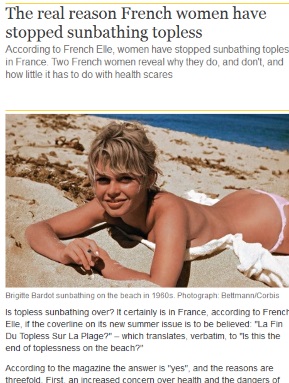
Photo: from Snakeskin

RHL, ‘On Disrespecting Ancestors’

I disrespect my ancestors fighting in wars,
Europeans fighting Europeans, blame without cause;
my English grandfather killed fighting the Germans,
my Danish uncle executed for killing with Germans,
my earlier German ancestors fighting the French,
my French ancestors fighting (and marrying) the English…
and the cause of the wars always indefensibly wrong.
Why should anyone glorify them in song?
Pride, greed and stupidity – these are the drivers of war.
I turn my back on all of them, stand on the sea shore,
marvel at wind and wave, at sun, moon and stars,
despising, ignoring, forgetting their idiot wars.

*****

I’m so sick of Putin, Netanyahu… and Bush Jr, Dick Cheney, Tony Blair… war criminals, the lot of them. But they’re the products of our genetic makeup as social animals, dividing everything into “us” and “them”, and then through crafty hysteria and massively organised mob violence, grabbing everything they can for themselves.

Anyway, this semi-incoherent rant of a poem was published in the current Amsterdam Quarterly, and editor Bryan R. Monte wanted one change in my submission: to change the last line’s “ape-idiot wars” to “their idiot wars”. As usual, I acquiesced. Also as usual, I’m not sure whether it is a good suggestion or not. Apes figure in a lot of my verse, as being an underlying reality of humans, essential to acknowledge, equally essential to try to control. In the context of my other work, I think I prefer “ape-idiot”.

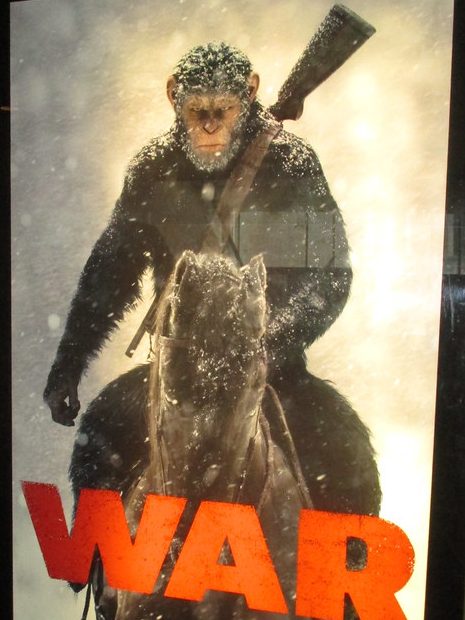
Photo: “War of the Planet of the Apes Poster 2671” by Brechtbug is licensed under CC BY-NC-ND 2.0.

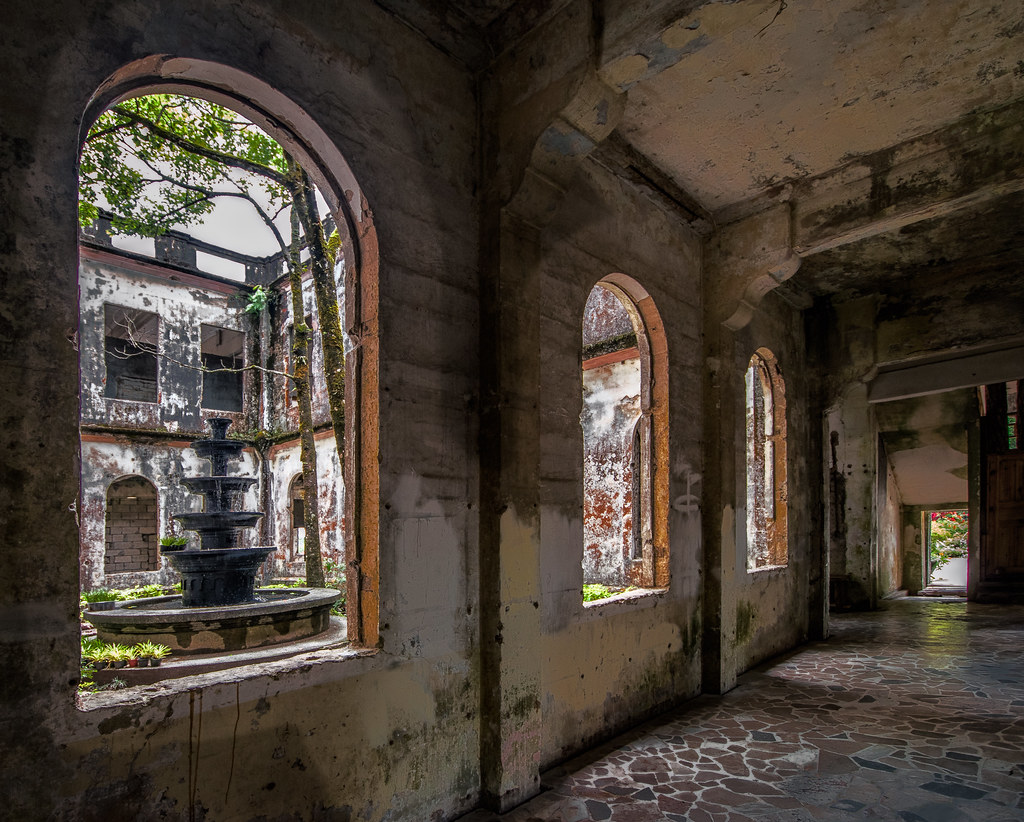
‘Sonnet Found in a Deserted Madhouse (fantasy of an alternative future)’

The winds of winter wind through empty halls,
scraps of abandoned paper blow like leaves
to settle in odd corners of old walls.
Once a community lived here, but no one grieves:
the place was nothing but a wasteful home
for the sick, sad, psychotic and insane
who, locked in rooms or left alone to roam,
babbled their lives away, inept, inane.
All funding for the loonies has dried up;
guards, nurses, admin, tea ladies: dismissed.
And all because Brussels came out on top
and closed this home of British mental mist.
Now Big Ben chimes, tolling a final knell.
Farewell, old Houses; Westminster, farewell.

*****

As an Anglo-Dane raised in a third country, I’m naturally in favour of a borderless world. I loathe Brexit and the lies, greed and social inequities that allowed it to happen. Brexit and Trump were the two big foreign policy successes of Putin, stoking lies and fear and division. Sorry, rant over.

This Shakespearean sonnet was just published in the biannual poetry magazine Allegro, edited by Sally Long.

Abandoned Dominican Building #2” by FotoGrazio is licensed under CC BY-NC-ND 2.0.

Political poem: appallingly bad verse apparently in favour of Liz Truss

Bizzy lizzy will win by a.mile
She has got a lovely smile
Brians to match her lovely face.
She will win this pm race
Sunaks a snake
A back stabbee he is
He turned on boris
And will turn on liz
She will be a great pm
Not as good.as maggie but no one could be
Mrs thartcher mach 3
Liz will stand proud over our lands
Holdinh out her hand
If we wotk to gether we can
Get rid of the woke
And watch them. Cry into there cornflakes
As liz makes our country great.
In liz we trust god speed to our new pm

*****

In honour of Liz Truss’s trip to Balmoral Castle to be named Queen Elizabeth’s Prime Minister, I looked for poems by or about the new PM. The above is the best I could find, reposted in the Yorkshire Bylines by Jimmy Andrex under the heading Has the emergence of Liz Truss stimulated a new type of poetry?

Jimmy does a good serious job of discussing modern political poetry… sort of. But he fails to note that the quoted “poem” by “Bill Sutton” originated as a post to the Facebook group ‘Liz Truss Supporters (no trolls)‘ which is loaded with sarcastic commentary on the British Conservative Party in general and Liz Truss in particular.

So the answer to Jimmy’s question is No, of course. Scathing poetry, good or deliberately bad, has long been used as a political weapon. Bill Sutton’s post may be amusing, but is unlikely to resonate for as long as, say, Shelley’s rant the year before George III died: “An old, mad, blind, despised, and dying king, –

Good luck, Liz; hope you’ve got a thick skin.