Tag Archives: Potcake Poet

Potcake Poet’s Choice: Jean L. Kreiling, ‘The Waves’

Sprawled on a pew of sand, you meditate
on miracles of tide and time. Without
a prayer but apparently devout,
and humbled by the water’s shifting weight,
you watch with wonder, even venerate
this higher power rolling in and out:
omnipotence too obvious to doubt,
authority too awful to debate.
Like salty spray, some blue-green grace may cling
and seep unsanctified into your soul,
without a psalm or sermon—for the sea
makes its own joyful noise: the breakers ring
uncounted changes, and no church bells toll
more faithfully or irresistibly.

Previously published in 14 by 14. 

Jean L. Kreiling writes: “Growing up on the beach, and living on another coast in adulthood, I have never lost the sense of awe and humility that the sea inspires.  And of course I have never succeeded in capturing its magic in words, but I hope I’ve made a start in this poem.  Its form, my favorite, imposes the sonnet’s graceful structure onto what might otherwise have been an amorphous rhapsody; in addition, its meter and rhyme might suggest a bit of the ocean’s own rhythms and harmonies.”

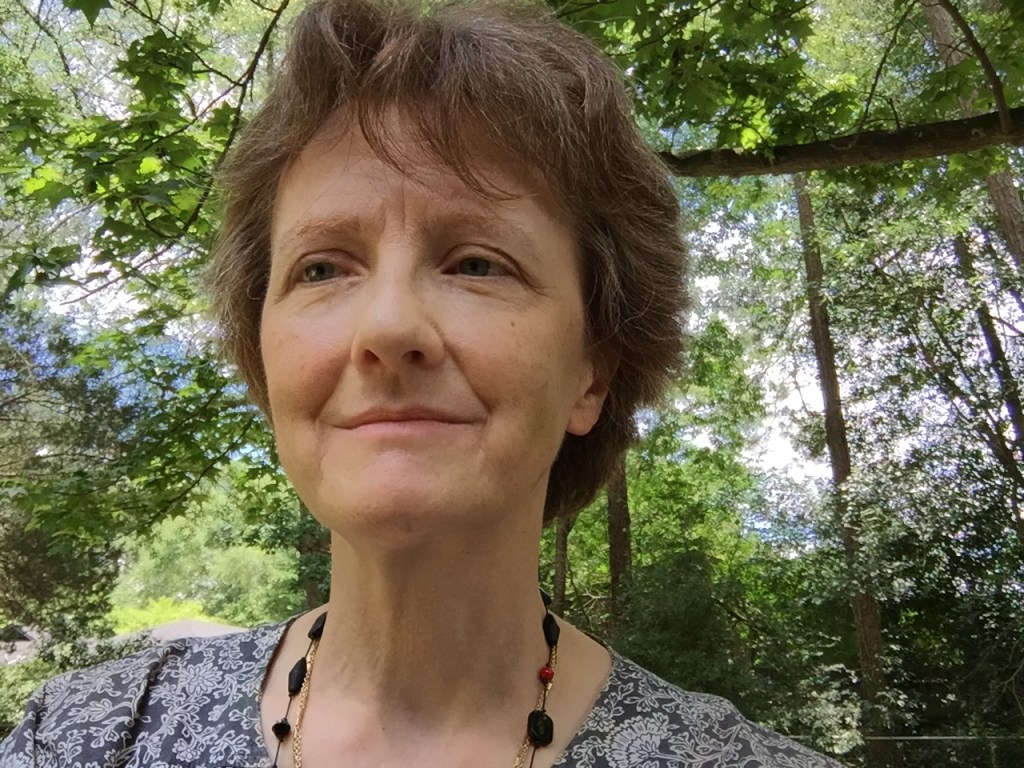
Jean L. Kreiling is the author of two collections of poetry: Arts & Letters & Love (2018) and The Truth in Dissonance (2014). Her work appears widely in print and online journals, and has been awarded the Able Muse Write Prize, three New England Poetry Club prizes, the Plymouth Poetry Contest prize, and several other honors.  She is Professor Emeritus of Music at Bridgewater State University, and an Associate Poetry Editor for Able Muse: A Review of Poetry, Prose & Art.   

Her poem ‘The Salisbury Crags’ which first appeared in the Orchards Poetry Journal, is included in the ‘Travels and Travails’ Potcake Chapbook.

Potcake Poet’s Choice: Marcus Bales, ‘Shore’

They grind across the continental shelf,
enormous in their long, well-muscled swells;
I know their sweaty smells of staling spray
and fishy sand; and oh, all by myself
I’ve heard the tide tell what it always tells:
some things wash up and others wash away.

They rise out there a long way from the beach,
and curl and pitch up face down on the sands
from roaming just too far to make it home,
and try to hold with fingers scrabbling, reach
for us, and fail and, failing, trail their hands
under water backwards in the foam.

Finally, though, the greyest weather clears:
small lapping waves replace exploding spume,
and one deep-breathing moment seems sublime;
sweet breezes sway embroidered window sheers
while pleasant sunlight fills the hospice room,
now empty, clean, and ready for the next time.

Marcus Bales writes: ‘The problem with me choosing or talking about one of my poems is that the impetus behind most of them is the same: a phrase or circumstance became a donnee because it resonated in some instant way, and I used it — and sometimes the actual donnee doesn’t survive the process of writing — to write something. It’s the resonance that interests me to turn the phrase over and look at it, clean it up, smear it with something, make it start, make it finish, bury it in the middle, whatever. The question that strikes me about a phrase with resonance is why does it resonate? The poem is the answer. In my view poetry is what a poet does to make a reader feel that resonance by putting it in a context that moves the reader to a feeling. I reject the notion that poetry is the poet expressing their feelings — at least, I don’t say poets cannot express their feelings, but that that expression must be in the service of making the reader feel the reader’s feelings in a directed way. Poetry is a method to make the reader resonate emotionally in response to the words.. If the best you can do is blurt out your pain or joy or whatever, then you’re doing it wrong. Yes, wrong. Write it in your diary, because poetry has never been about the poet. It’s always been about how the poet can make the reader feel in a directed way by using words, not a therapy-substitute for the poet. If you need therapy, get it, but don’t scatter the resulting words across ragged-margined pages and call it poetry.’

Not much is known about Marcus Bales except that he lives and works in Cleveland, Ohio, and that his work has not been published in Poetry or The New Yorker. However his “51 Poems” is available from Amazon.

Marcus Bales has appeared in several of the Potcake Chapbooks:

Tourists and Cannibals
Rogues and Roses
Careers and other Catastrophes
“Strip down,” she ordered
Wordplayful
Murder!
Houses and Homes Forever
Robots and Rockets

all available at https://sampsonlow.co/potcake-chapbooks/ for the price of a coffee.

Potcake Poet’s Choice: Amit Majmudar, ‘Eyespots’

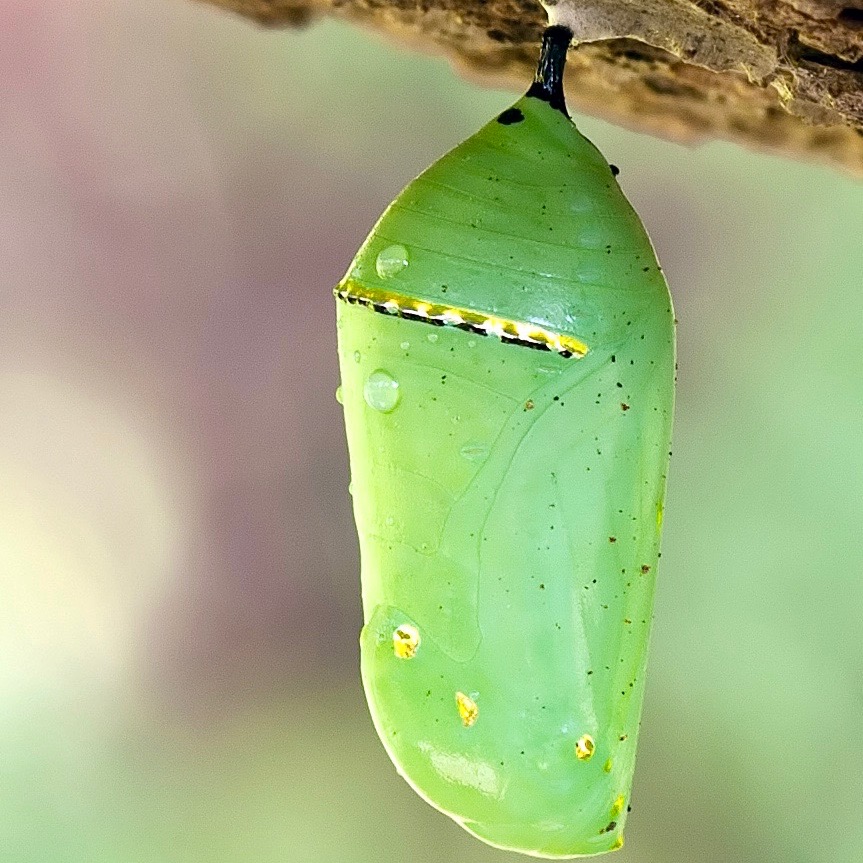
Caterpillars build their bunkers out
of terror. Transformation hunts them, haunts them
as oak leaf peepholes open underfoot
to bare the air, the emptiness that wants them.
I have a measure of infinity
inside me. A is no and mit is measure
in an ancestral tongue that haunts me, hunts me.
I’m half in love with what I have to be.
The other half is looking for a razor
to make of me the Amit who was once me,

my yogi’s beard a clump of Spanish moss
limp at my feet, a piece of furry roadkill.
I’m no ascetic. Half in love with loss,
I’ll seek out beauty, or at least my ode will,
night-blooming jasmines dooming my samadhi,
scenting, resenting my hermetic dark
because they know a yogi, breathing in
his first girlfriend’s perfume, unarchives her body,
and drives her, after dusk, to the vanished park
where memory of sin cocoons the sin.

Caterpillars ravel bunkers into
bodybags—no way for them to know
the moment that they poke themselves a window,
the rebirth they were hiding from will show:
Two stained-glass windows mounted on my back,
two earshaped eyespot petals I can flex
and fold, a flailing that transforms to flight
while all the darkling jasmines that I lack,
past loves that called me onward to the next,
unpetal in the bodybag of night.

In love, or half in love, with mere aesthetics,
I’ve daydreamed Himalayan caves, a hive
that hums with “Aum” from ninety-nine ascetics,
their senses hibernating, half alive.
No one has ever scaled Kailash, the peak
where Shiva sits in bud, in shut-flytrap samadhi
with ashes smeared across his chest and arms.
But that’s just not the changelessness I seek.
I want my language, shapely as a body,
to weave and rive cocoons, enchantments, forms

with giant wings inside their ashgray berries.
I want my transience to live in speech,
if only as a resonance that carries,
like jasmine scent, beyond my voice’s reach.
I tell myself: Old soul, don’t be afraid
of changing. You are old enough to know,
whenever something changes, something dies,
but the dark you flowered in won’t let you fade.
A crack in this cocoon admits a glow.
The blue moon butterfly will wear your eyes.

Amit Majmudar writes: “This poem, ‘Eyespots’, is what I think of as a Keatsian ode, borrowing its stanzaic form and (I hope) something of its musicality. Yet the poem incorporates Hindu religious imagery throughout and sings of self-transformation in a way that isn’t to be found in Keats. This hybridization of Eastern and Western traditions in the poem feels idiosyncratic. There remain elements still opaque to me about it; so I never really delved into the metaphysical significance of the title’s false eyes, these seeming sense organs that are not actually sensing anything, but, given the focus on ascetic imagery, there seems to be something in that. Maybe in another essay? Or another poem….

I feel as though there are poems I have written that someone else could conceivably have written. But not this one; even ignoring that my name hides caterpillar-like inside the cocoon of the poem, I feel that the range of influences and ideas is simply too idiosyncratically “me” for this to have come from any other poet’s hand. Will everyone like it? Probably not, for precisely that reason. But I know that no one else could have produced this sequence of words, so I confess a certain fondness for it. It’s the one of my literary children who most resembles me. And it’s as good a way as any to get to know me as a writer.”

Amit Majmudar is a diagnostic nuclear radiologist who lives in Westerville, Ohio, with his wife and three children. The former first Poet Laureate of Ohio, he is the author of the poetry collections What He Did in Solitary and Dothead among other novels and poetry collections. Awarded the Donald Justice Prize and the Pushcart Prize, Majmudar’s work has appeared in The New York Times, The New Yorker, Best of the Best American Poetry, and the eleventh edition of The Norton Introduction to Literature. Two novels are forthcoming in India in 2022: an historical novel about the 1947 Partition entitled The Map and the Scissors, and a novel for young readers, Heroes the Color of Dust. Visit www.amitmajmudar.com for more details.

‘Eyespots’ was first published in Measure Review.
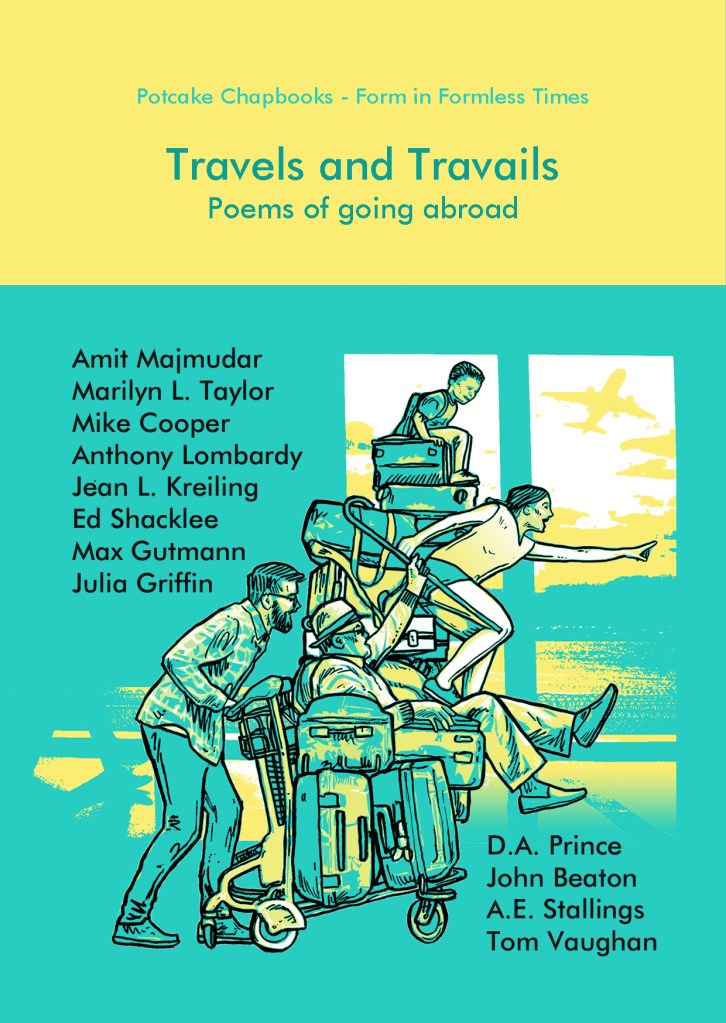
Launch: Potcake Chapbook 10, ‘Travels and Travails’

Maybe it’s just wishful thinking, but surely we’re going to get back to casual international travel again some day soon? The 10th chapbook in the Potcake series is now being mailed out from London, and I trust it augurs well for the happily peripatetic. As usual, the chapbook contains an assortment of the bright (D.A. Prince), the dark (Tom Vaughan) and the flippant (Max Gutmann), with everything in between, and all in rhythm and rhyme–and illustrated of course by Alban Low!

Returning poets are A.E. Stallings, John Beaton, Julia Griffin, Anthony Lombardy, Marilyn L. Taylor, D.A. Prince and Tom Vaughan; joining them are Amit Majmudar, Mike Cooper, Jean L. Kreiling, Ed Shacklee and Max Gutmann. (The links in the names are a mixture of websites, bios, and places to buy their books.) Most, but not all, of the poets are listed on Sampson Low’s webpage of Potcake Poets.

Let’s get everyone vaccinated so we can all start travelling again!

Potcake Poet’s Choice: Julia Griffin, ‘The Buck Stops’

A buck stopped here last Saturday early,
Just as the streets were turning blue.
A fine six-pointer, bronzed and burly:
What had it come for? Nobody knew.

It took its stand at the central bus stop,
Silent, proud-footed, thorny-topped.
There perhaps it had once seen us stop;
All that morning, nobody stopped.

It hardly seemed the thing to confront it.
We’ve little practice with bucks or deer;
Anyway, nobody tried to hunt it;
Anyway, nobody asked it here,

Maimed it, lamed it, blamed or shamed it!
This, in fact, is the most one can say:
A buck stopped here and nobody claimed it.
It waited a while, then it wandered away.

Julia Griffin writes: “I like the central image of a buck stopping. And it seems so widely applicable… I turn everything into an animal poem if I can.”

Julia Griffin lives in south-east Georgia/ south-east England. She has published in Light, LUPO, Mezzo Cammin, and some other places, though Poetry and The New Yorker indicate that they would rather publish Marcus Bales than her.

More of her poetry can be found in Light, at https://lightpoetrymagazine.com/?s=julia+g&submit=Search

Potcake Poet’s Choice: Melissa Balmain, ‘Fluffy Weighs in on the Baby’

It’s hairless as an egg—
why bother petting that?
It doesn’t purr or groom your leg,
and yet you feed the brat.

Instead of catching mice,
it grapples with its socks.
It’s never taken my advice
to use the litter box.

It can’t climb up a tree,
it can’t chase balls of string,
it leaves you zero time for me—
just eat the wretched thing.

‘Fluffy Weighs in on the Baby’ is reprinted from Walking in on People (Able Muse Press)

Melissa Balmain writes: “The great light poet Bob McKenty calls himself ‘an editorial cartoonist who can’t draw.’ Given my fondness for writing persona poems, I think I qualify as a method actor who can’t act. As you might guess, adopting a persona lets me try on fresh points of view and say things I might not think to say (or dare to say) as myself. Plus, it can be a fun vehicle for mockery—as in ‘Fluffy,’ which aims its claws at new parents who ignore their pets. (Yes, I was one of those new parents…) Over the years I’ve attempted to channel not just animals and fellow humans in my poems, but also cartoon characters, plants, water, Satan, a dictionary, and, in my latest book, fairy tale characters. It’s the closest I’ll get to a SAG card.”

Melissa Balmain edits Light, America’s longest-running journal of light verse. Her poems and prose have appeared widely in the US and UK. She’s the author of the full-length verse collection Walking in on People (Able Muse Press), chosen by X.J. Kennedy for the Able Muse Book Award; and the shorter collection The Witch Demands a Retraction: Fairy-Tale Reboots for Adults, new from Humorist Books. She is a recovering mime.

Potcake Poet’s Choice: Juleigh Howard-Hobson, ‘I’ll Keep My Ghosts’

“…presence, if it has been real presence, does not ever leave.”
–May Sarton

I’ll keep my ghosts. Each morning down we go
Through the hallway, where they begin to show
As grey reflections of themselves in frames
That do not answer when I call their names
But swirl and curve around me, to and fro.
Sometimes, in this house that they used to know
So well, their unseen numbers swell and grow
Until I am overwhelmed. All the same,
I’ll keep my ghosts–
By choice–for what else would I have? Hollow
Spaces between walls? Albums? And sorrow
That has no feeling to it left? Who blames
Me for my preference? I make no claims
That they bring only joy, but even so
I’ll keep my ghosts.

Juleigh Howard-Hobson writes: “It’s so hard to name a favorite poem of my own, (after all, they are all my favorite poetic children!) but this one, written a decade ago, is a little closer to my heart than the others.
Over time, I’ve collected quite a few post-card sized Edwardian portrait photographs, with their original frames, so I can hang them on my walls. These stranger’s images mix with my own vintage family photographs and after a while, they stop being photographs of strangers, they become photographs of familiar faces. After a longer while, some join my family ghosts. Which I find inspiring, if slightly unsettling. This rondeau owes its existence to my collection, both related and adopted.
The Rondeau, with its self-imposed restrictiveness that limits how far a poet may go before she or he must return to the refrain and readdress it, is one that I’ve always been fond of. When I was 16 I came across Dunbar’s “We Wear the Mask” and immediately sensed that the Rondeau was the perfect form for conveying the complicated simplicity of life (granted, I was a strange 16 year old). This one first appeared in Poets’ Touchstone 2010 having won 1st Prize in the 2010 Poetry Society of New Hampshire National Contest; later collected in my book The Cycle of Nine (RavensHalla Arts, 2012).”

Juleigh Howard-Hobson’s poetry has appeared in Valparaiso Poetry Review, Mobius, The Lyric, Dreams and Nightmares, 34 Orchard, Capsule Stories, Birds Fall Silent in the Mechanical Sea (Great Weather for Media), Lift Every Voice (Kissing Dynamite) and other places. Nominations include Best of the Net, the Rhysling, and the Pushcart. Her latest book is the Elgin nominated Our Otherworld (Red Salon). English born, US/Australian raised, she currently lives on an off-grid homestead in the middle of a dark woods in the Pacific Northwest USA, with her husband and her ghosts.

Contact: “I maintain an irregular Twitter presence as ForestPoet@PoetForest https://twitter.com/PoetForest where I follow every writer who follows me.”

Potcake Poet’s Choice: Geoffrey A. Landis, ‘If Angels Ate Apples’

If angels ate apples, potatoes and pears
they’d soon be chubby and cheerful as bears
nibbling knishes and other such things,
tickling your face with the tips of their wings.

If seraphim shouted and whistled at girls,
drank drafts from thimbles, all friends with the world
drained the best ale and chased it with rye,
then fluttered in circles while trying to fly.

Angels on tables! (Watch out for your glass!)
Slipping on puddles, right plop on their ass!
Laughing at music that only they hear,
then tweaking the barmaids a pinch on the rear.

Fuzzy fat angels, that’s something to see,
as they dance to the jukebox at quarter to three,
and ace out the pinball, a marvelous feat,
the lights and bells flashing (though sometimes they cheat).

If angels made merry, would that be so odd?
Must they always be solemn, to stay friends with God?
It’s a pity that Heaven is so far away
angels hardly ever come down and just play.

Geoffrey A. Landis writes: “It’s impossible to chose just one poem as a favorite, of course, and even if I could, which poem I’d pick would change from day to day, maybe even from minute to minute. Still, I’ve alway been fond about ‘If Angels Ate Apples’; it’s one that reads well out loud, and I had fun writing it. Mostly I was playing with meter and alliteration. I was happy that Gardner Dozois picked it up for Asimov’s Science Fiction, and since then it’s seen a couple of reprints.”

Geoffrey A. Landis is a rocket scientist who sometimes plays at being a science-fiction writer, and a science-fiction writer who sometimes plays at being a poet. In the process he’s picked up a handful of awards, ranging from science fiction’s Hugo and Nebula awards to the Science Fiction Poetry Association’s Rhysling award, and had his stories and poems appear in twenty languages. He lives in Berea, Ohio, with his wife (who is also a science fiction writer and a poet) and four cats.

Website: http://www.geoffreylandis.com/poetry.html

Potcake Poet’s Choice: F.J. Bergmann, ‘Further’

The hyperspace viewer shows a flowing plane
of treebark, roots; a distorted approximation
of what we aren’t permitted to see. Clearing again
with each rugose transformation,
limited by the speed of post-quantum rendering,
the map of our passage grows:
an icebound dimensional lake thaws, remembering
the hot pulse of its creation, shows
palpable vestiges of times, energies and matters
through which our wake will trace.
The reflection of our ship shimmers, spatters
light back to streaming stars. We race
onward, out to where no atmospheres and skies
of planets can frustrate our vision;
the provocation of empty black where no suns rise
unbearable without acquisition.
Particular silence surrounds us like a felt of absence,
itself the sinuous, tentacular touch
of a void-god whose cult is abstinence,
who meditates on dark too much—
those distances between the stars and galaxies—
and has a singular affection
for black holes and cosmic fallacies.…
Sometimes we overreach. Each direction
(up? down? sideways?) seems different now;
our ship’s brain’s blocked—no ability
to calculate location. We tell it to go back: how—
why these results? We’ve lost mobility,
it says; the only options are charm and strange.
We clear its cache, then re-install the route.
On the viewscreen, no known space in range;
nothing but the false stars of snow. About
fifty-six hours in, the background gigahertz hiss
of relic radiation is finally broken:
our A.I. transmits a mad-dog growl. Something’s amiss.
What does it mean? Unspoken
fears flicker on our faces like shadows cast
by entities we feel but cannot see,
leaving invisible tracks across the vast
cosmic chasm, preceding one more tangibly
manifesting. A small silver embryo afloat
in amnion of atrament, our ship
is dwarfed by tentacles of terror. We’re but a mote
in the eye of a demonic god, a blip
cascading down through superimposed dimensions
to our doom, where something pines
beyond a threshold, longs to enter our attention—
and hungers for the taste of human minds.
Our Earth’s a pale blue memory, a ripe prize
to harvest; our civilization will revert
to a predawn whence no human can ever rise.
The God Void sits in judgment—but won’t convert
one soul. Its vastness grows, membranous and bloody,
slithers back into the open portal of a queer
dwelling where it withdraws to sleep and let the muddy
waters of vacuum clear.

F. J. Bergmann writes: ” ‘Further’ first appeared in the Lovecraft eZine. I selected ‘Further’ because I’m fond of cosmic horror, and I was pleased with being able to maintain the form and narrative at this length. The process I used for this poem is what I call ‘transmogrification’: starting with a text source, which can be anything, from another poem to spam, I write a different poem or story using most or all of the words from the source, generally in reverse order. The source for this poem was ‘Let Muddy Water Sit and It Grows Clear,’ a considerably shorter nature poem by Ted Mathys, whose title is reflected in the last two lines of my poem.”

F. J. Bergmann is the poetry editor of Mobius: The Journal of Social Change (mobiusmagazine.com), past editor of Star*Line, the journal of the Science Fiction & Fantasy Poetry Association (sfpoetry.com), managing editor of MadHat Press (madhat-press.com), poetry editor for Weird House Press (weirdhousepress.com), and freelances as a copy editor and book designer. She lives in Wisconsin with a husband, intermittent daughters and a horse or two, and imagines tragedies on or near exoplanets. Her writing awards include SFPA Rhysling Awards for both long and short poems and SFPA Elgin Awards for two recent chapbooks: Out of the Black Forest (Centennial Press, 2012), a collection of conflated fairy tales, and A Catalogue of the Further Suns, first-contact reports from interstellar expeditions, winner of the 2017 Gold Line Press manuscript competition. She was a 2019 quarter-winner for Writers of the Future. Venues where her poems have appeared include Asimov’s SF, Missouri Review, Polu Texni, Spectral Realms and Vastarien; her speculative fiction has been published in Abyss & Apex, Little Blue Marble (CA), Pulp Literature (CA), Soft Cartel, WriteAhead/The Future Looms (UK), and elsewhere. She has competed at National Poetry Slam with the Madison Urban Spoken Word slam team. While she has no academic literary qualifications,. she is kind to those so encumbered. In a past life, she worked with horses. She thinks imagination can compensate for anything.

Contact F. J. Bergmann: demiurge@fibitz.com

Potcake Poet’s Choice: Kate Bernadette Benedict, ‘The Sureties’

Some things you can still rely on.
Forsythia hedges contribute their usual yellow;
Callery pears exhibit their annual white.
The vernal light is cast as it was cast last year—
Cimmerian, then milky, then bright.
Tulips accrue, woodpeckers adhere
to their nourishing boles, a piccolo.
sounds in the park. Lovers have new grass to lie on.

Some things you can still depend on.
I buried my mother today in the family plot.
Her ashes were housed inside a simple casket—
an easy-to-carry container with little heft,
light as an already plundered Easter basket
when only a couple of elegant eggs are left.
I’d been there before; I’d stood on the very spot.
I’m accustomed to the conditions that lives end on.

Kate Bernadette Benedict writes: “Sureties are few in life yet I feel sure that many of us today are going through our daily motions in an elegiac mood—because of the pandemic, of course, and the illness and deaths we learn of on the news and experience in our lives. Last spring (2020), we were all in a panic and this spring we are, perhaps, inured to loss, at least to some degree. So I feel this poem about spring and death fits my mood perfectly, and perhaps the mood of you, the reader, too.”

Kate Bernadette Benedict may have lost a portion of herself when she took on her pen name; still, she has grown accustomed to its saintly qualities which represent, she well knows, an unattainable goal. She is the author of three full-length collections, the most recent being Earthly Use: New and Selected Poems. Kate has been holed up for a year in her apartment in Riverdale, the Bronx, but is now twice-jabbed and hopes to be re-materializing very soon. Her website suffered a crash but some content is still readable at katebenedict.com, where links to three formal-friendly publications may be found: Umbrella, Bumbershoot, and Tilt-a-Whirl.