Tag Archives: quatrains

Using form: Iambic trimeter: Susan McLean, ‘Danse Macabre’

The dancers, taut as bows,
burn in their joyous fire.
They whirl, entwine, and pose
in friezes of desire.

No skeletons appear
to shock the celebration.
The dancers, bowing, hear
a rapturous ovation.

Outside, the wind blows colder.
Although she’d rather linger,
she senses on her shoulder
the tap of a light finger.

And, though she came alone
and doesn’t need a ride,
a shadow, thin as bone,
attends her, stride for stride,

then leaves her, still denied.
But the end is not in doubt.
The skeleton inside
eventually wants out.

*****

Susan McLean writes: “I wrote this poem after attending a performance of Ailey II, the junior corps of dancers in the company founded by Alvin Ailey. It was on a cold night in autumn around Halloween, and even though there was nothing sinister about the dances I witnessed, I was reminded of the medieval Dance of Death, in which skeletons appear to people in the midst of their daily routine to summon them away to death. One of the most memorable images of that theme occurs at the end of Ingmar Bergman’s film The Seventh Seal, and I have seen it portrayed also on the wooden bridge in Lucerne in Switzerland. The poem is written in three-beat lines of iambic trimeter, which reminded me of a stately waltz.”

‘Danse Macabre’ originally appeared in THINK Magazine.

Susan McLean has two books of poetry, The Best Disguise and The Whetstone Misses the Knife, and one book of translations of Martial, Selected Epigrams. Her poems have appeared in Light, Lighten Up Online, Measure, Able Muse, and elsewhere. She lives in Iowa City, Iowa.
https://www.pw.org/content/susan_mclean

la danse macabre” by a magic monkey! is licensed under CC BY-NC-SA 2.0.
Maryann Corbett, ‘October’

I fail at them, these scenes
where beauty is married to fear.
I have failed before with this one.
How can I make it clear

when the moment itself was a blur?
My son and I, that night,
stepped through the warm, wet air
that had magicked every light

to a wide, all-hallowing halo.
He said–I think he was ten,
still with his clear soprano–
It’s lovely out here.
And then

the edge of every nimbus,
pale gold through a fog scrim,
shivered, knowing that beauty soon
would be bullied out of him.

*****

Maryann Corbett writes: “This poem (first published in Mezzo Cammin) is indeed based on one of those indelible memories, the sort that lodge in a parent’s brain for decades. And I have in fact tried to write about it before without succeeding. I’ve never asked my very adult son whether he remembers this moment at all.”

Maryann Corbett earned a doctorate in English from the University of Minnesota in 1981 and expected to be teaching Beowulf and Chaucer and the history of the English language. Instead, she spent almost thirty-five years working for the Office of the Revisor of Statutes of the Minnesota Legislature, helping attorneys to write in plain English and coordinating the creation of finding aids for the law. She returned to writing poetry after thirty years away from the craft in 2005 and is now the author of two chapbooks and six full-length collections, most recently The O in the Air (Franciscan U. Press, 2023). Her work has won the Willis Barnstone Translation Prize and the Richard Wilbur Award, has appeared in many journals on both sides of the Atlantic, and is included in anthologies like Measure for Measure: An Anthology of Poetic Meters and The Best American Poetry.

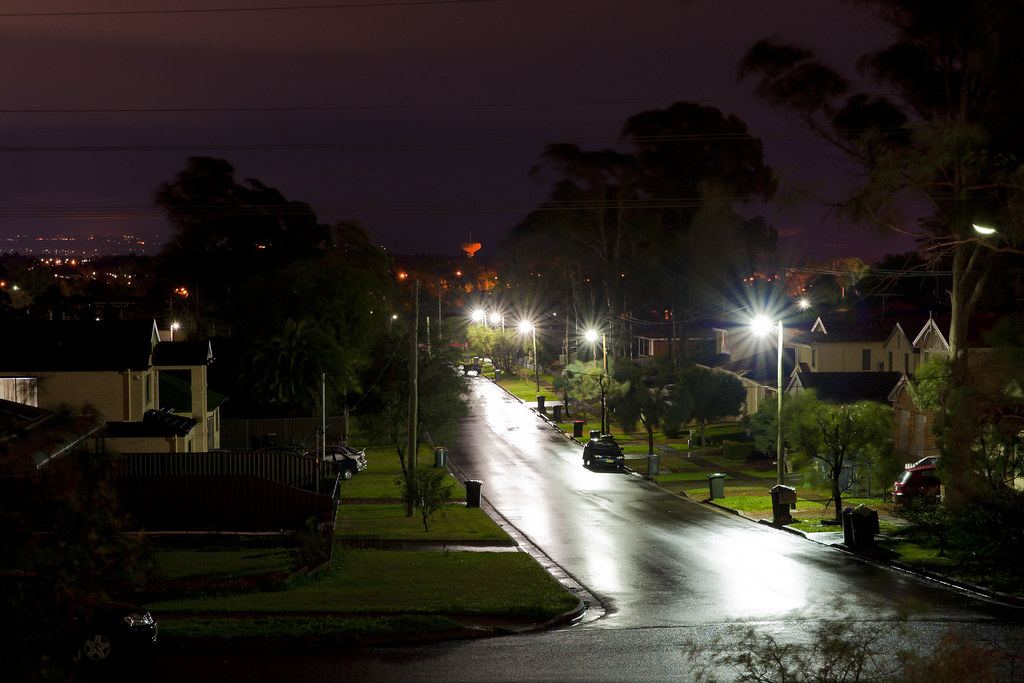
Photo: “Bright Lights of Quakers on a Wet Night” by Frank.Li is licensed under CC BY-NC-SA 2.0.

Anushka Sen, ‘Good Neighborhood’

Another poisoned squirrel hits the street,
stopping short your jaunty midday tread.
The city lays its secrets at your feet.
 
It rots more still and slow than fallen leaves;
the resting pose as definite as lead.
Another poisoned squirrel hits the street.
 
Classic mixup: rat for squirrel, bait for feed.
POISON, posters scold, PROTECT YOUR PET.
The city lays its secrets at your feet.
 
Someone went too far, we all agreed,
and left the vermin running wild instead!
And yet, a poisoned squirrel hits the street,
 
so stiff, so angular, no longer sweet,
the stare indecent on the outsize head.
The city lays its secrets at your feet—
 
you learn how light your step is, how discreet,
how intricate the alleys of your dread.
Another poisoned squirrel hits the street.
The city lays its secrets at your feet.

*****

Anushka Sen writes: “This poem was inspired by a rat-induced furore in Rogers Park, my Chicago neighborhood. Someone (or some people) had finally flipped a switch and started putting out rat poison indiscriminately. The poem takes off from that point. It seems relevant to me all over again, since I’m now encountering a slew of dead birds. Residential life is built on a gnarly underbelly.”

‘Good Neighborhood’ was originally publlished in the current Rat’s Ass Review.

Anushka Sen is originally from Kolkata, India and now teaches English Literature at Loyola University, Chicago. She is drawn to musicality, animals, and a strong sense of place in art. She occasionally translates from Bengali to English and her poems (original and translated) have been published in Rust and Moth the Asymptote blog, and Eunoia Review, among other places.

Photo: “Alvin? Alvin? Alvin?” by lionelvaldellon is licensed under CC BY-NC 2.0.

Quatrains: D.A. Prince, ‘Weeds’

for Helena Nelson

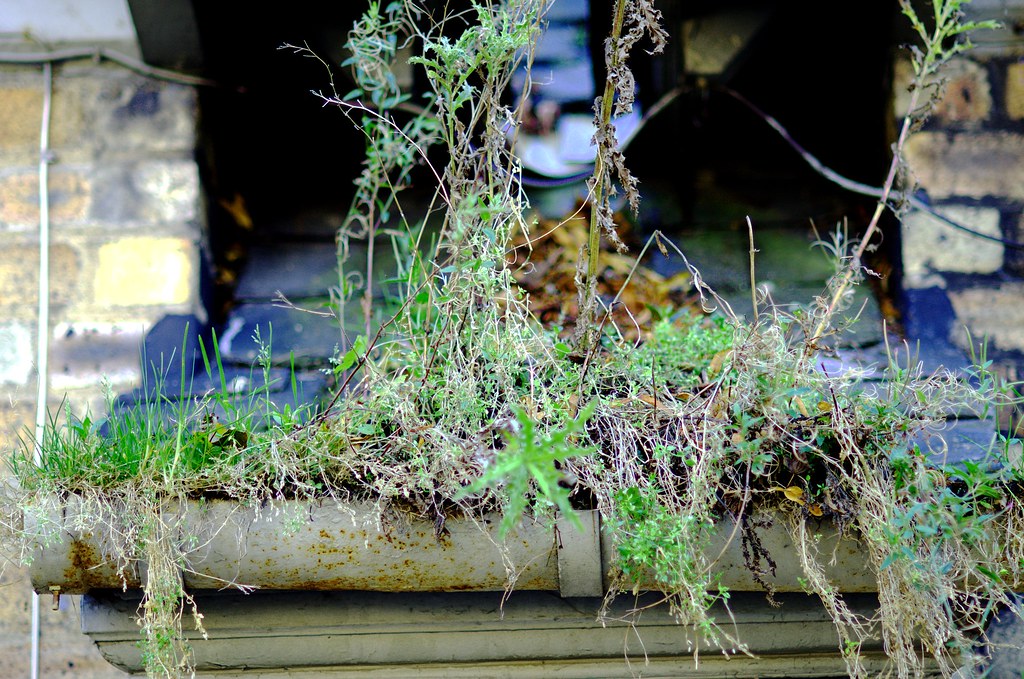
Let’s celebrate those seeded in guttering
high overhead — bird-dropped or wind-blown
in shy, shaded corners, not cluttering
the road-edge like litter or casually sown

on the garden’s margins. Buddleia, birch —
slender and whippy, fretful and restless,
only a small claw-hold on their high perch,
a loose version of themselves in endless

inventive air. No one, much, bothers them,
leaving their roots exploring the secret cracks
between bricks and flashing. Unless a stem
strangles a cable or a branch unpacks

some weathered pointing, troubling it, they’re safe:
every airhead, living only to dance
the delights of lightness, each sinuous waif
born from easy freedom, sun and rain and chance.

*****

D.A. Prince writes: “There’s a tradition of poets printing some of their work privately for circulation to friends. Now that Helena Nelson (aka HappenStance Press) is making more time for her own writing she has created a series of pamphlets about those unregarded — and usually unloved — plants generally dismissed as ‘weeds’, in which each is accorded its own sonnet. Richard Mabey’s Weeds: The Story of Outlaw Plants is the source for the botanical information while she brings a poet’s attention to what makes each one individual. She has sent these pamphlets to friends so, for the moment, only a few of us have seen them.

“I don’t habitually write poems dedicated to named people: this is, I think, the first time I’ve done it but I wanted to respond, as a way of thanking her both for long friendship and for all the poetic ongoings we’ve shared. I asked her, somewhat cautiously, if she’d agree to a dedication, then — later — if she’d agree to the poem appearing in a pamphlet.

“Her poems were sonnets so if I’d written a sonnet it could have looked competitive — and that wasn’t the point. Four quatrains, rhymed, seemed to suit the subject. In its original layout it appeared as a solid sixteen-line block but when we were working on the poems that make up my latest pamphlet (Continuous Present, New Walk Editions, 2025) Nick Everett, my editor, suggested that setting it in quatrains would suit the air and space those rooftop-rooted weeds have around them, and to my mind that’s lifted the poem in a way it needed. 

“As for gardening, I’m now very happy to let the weeds flourish.”

D.A. Prince lives in Leicestershire and London. Her first appearances in print were in the weekly competitions in The Spectator and New Statesman (which ceased its competitions in 2016) along with other outlets that hosted light verse. Something closer to ‘proper’ poetry followed (but running in parallel), with three pamphlets, followed by a full-length collection, Nearly the Happy Hour, from HappenStance Press in 2008. A second collection, Common Ground, (from the same publisher) followed in 2014 and this won the East Midlands Book Award in 2015. HappenStance subsequently published her pamphlet Bookmarks in 2018, with a further full-length collection, The Bigger Picture, published in 2022. New Walk Editions published her latest pamphlet, Continuous Present, in 2025.

*****

Photo: “guttered” by bigbahookie is licensed under CC BY-NC-ND 2.0.

Melissa Balmain: ‘A Super-Subtle Metaphor’

(For my son)

Dear Unruly Backyard Maple:
I’ve been clipping you for years,
convinced that efforts to reshape’ll
pay for one who perseveres.

But now I get it, stubborn maple –
though I’ve trained your docile peers,
my double-bladed snip and scrape’ll
never give you classic tiers.

And I am seeing, steadfast maple,
how your tousled crown endears:
you shelter birds; come spring, your drape’ll
glow just like a chandelier’s.

So please forgive me, patient maple,
if it’s not too late, for here’s
my blessing, solemn as the papal.
Grow your way.
                        Love, Pruning Shears

*****

Melissa Balmain writes: “Looking back at poems I’ve written for and about my family, I realize many are metaphorical. I suspect that metaphor–like rhyme and meter–helps steer me toward interesting thoughts and away from over-sentimentality. (Whether my son agrees has yet to be seen!)”

‘A Super-Subtle Metaphor’ is the lead poem in the current issue of Lighten Up Online.

Melissa Balmain’s third poetry collection, Satan Talks to His Therapist, is available from Paul Dry Books (and from all the usual retail empires). Balmain is the editor-in-chief of Light, America’s longest-running journal of light verse, and has been a member of the University of Rochester’s English Department since 2010. She is a recovering mime.  

Photo: “Red Maple Tree” by Stanley Zimny (Thank You for 52 Million views) is licensed under CC BY-NC 2.0.

Quatrains: Fergus Cullen, ‘Wisdom of Working Men’

“One thing you must accept,”
Said the butcher—”and I don’t intend this meanly:
To live is to get divided up
And to live well is to divide up cleanly.”

“One thought that made sense of things,”
Said the baker—“perhaps even solved life’s riddle:
To live is to harden in the heat
And to live well is to stay soft in the middle.”

“One principle strikes me as ultimate,”
Said the candlestick-maker—“if not downright holy:
To live is to burn down
And to live well is to burn down slowly.”

*****

Fergus Cullen writes: “These stanzas are about that state in which work comes to occupy one’s mind so utterly that one begins to see the rest of life through it. They do not make any statement on the subject: we just hear from some personalities living in this condition.I wanted contrast. On the one hand, the form is so light as to be barely there (speech rhythms in long lines, stanzas only pulled together by trite rhymes); and the characters originate in the world of nursery rhyme. On the other, these characters take on the biggest subject; and what they say may sound rueful, even bitter. It was certainly written that way; though, returning to it after some time, I see that it need not be read that way. This is one of two versions of the poem and was published in The Borough. I hope the other, rather different, shall appear soonish.”

Fergus Cullen is a postgraduate researcher in history at Queen Mary, University of London, and an occasional writer and translator of prose and verse.

https://x.com/FairGoose
https://ferguscullen.blogspot.com/p/about.html

Photo: “Rub-a-dub-dub Three Men in a Tub” by DJOtaku is licensed under CC BY-NC-SA 2.0.
Quatrains: Susan McLean, ‘Pain Management’

The management has gauged how much you’ll take
before you buckle or walk out. They care
about your health—at least until you break,
use up your sick leave, or require repair.

The management endorses your retiring
early. They will help you out the door,
so that they can economize by hiring
fresh blood for half of what they paid before.

The management can’t monetize your gain
in knowledge or experience. They doubt
that anything you’d do if you remain
could beat their savings if you’re shunted out.

They needn’t lay you off, just raise your stress
through higher workloads and adverse conditions,
until exhaustion, strain, and hopelessness
force you to leave, fulfilling their ambitions.

*****

Susan McLean writes: “In my lifetime, I’ve worked in private businesses, government agencies, and academia; most of them abused or exploited workers at some level, which is not surprising when power relations are one-sided. However, I was most shocked by what happened when the business model was applied to education. Education suffers when students are treated as products to be turned out as cheaply as possible, and when teachers are treated as easily replaceable cogs in a machine. But the mistreatment of workers to increase profitability is widespread across many forms of employment, so I did not want to limit the poem’s relevance to the academic world.

“Over the thirty years that I taught at a state university, states reduced the amount they paid for public higher education, shifting the economic burden more and more to the students, and creating budget crises for the universities. In response, university administrators reduced their hiring of professors, often increasing class sizes dramatically, shifting teaching of many classes to ridiculously underpaid grad students or adjunct instructors with no job security, and shutting down departments in order to lay off tenured professors. Students were paying more and getting less; professors were overworked and fearful of losing their jobs at ages at which no one else would be likely to hire them; recent PhDs were unable to find teaching jobs with a livable wage or any prospect of long-term employment. Meanwhile, administrative jobs were burgeoning, adding more deans and assistant deans to bolster the status and shoulder the duties of those in charge.

“The stress and overwork that many professors experienced under the business model of higher education took a physical toll on many, with some disciplines suffering more than others. Those who had to spend endless hours at computers or grading papers tended to develop back pain and a host of other ailments common to sedentary jobs. When administrators offered incentives for them to accept early retirement, so that the university could save money by replacing them with lower-paid workers, many retired. I was one of them.

“This poem got its start when I noticed that “pain management” (usually associated with using analgesics or other methods to reduce pain) could also mean “management by means of pain.” It was published in New Verse Review.”

Susan McLean has two books of poetry, The Best Disguise and The Whetstone Misses the Knife, and one book of translations of Martial, Selected Epigrams. Her poems have appeared in Light, Lighten Up Online, Measure, Able Muse, and elsewhere. She lives in Iowa City, Iowa.
https://www.pw.org/content/susan_mclean

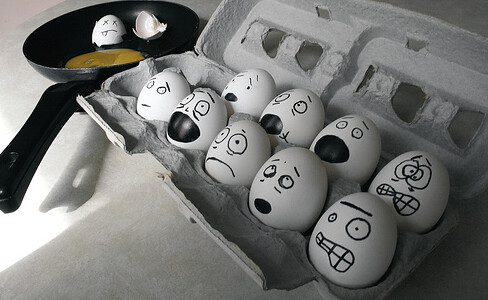
Photo: “Stress” by topgold is licensed under CC BY 2.0.

Odd poem: Brian Bilston, ‘Brie Encounter’

the skies are gruyere since she left me
i’ve never felt so danish blue
caught between a roquefort and a hard cheese
i stilton’t know what to do

don’t give edam about the future
now my babybel’s walked out the door
can’t believe i’ve double gloucester
i camembert it any more

i’ve ricotta get myself together
and build my life back caerphilly
cheddar tear for the final time
say goodbye to us and halloumi

*****

Brian Bilston is “the Banksy of the poetry world”.
You can find a daily poem on Facebook, and his books here.

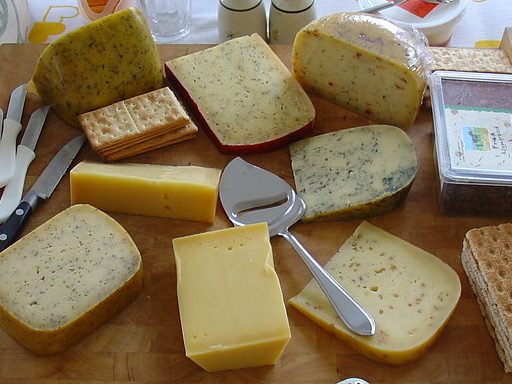
Photo: “Cheese, cheese, cheese” by kurafire is licensed under CC BY-NC 2.0.

Susan McLean, ‘Home Economics’

Like other teenage girls in ‘65,
I learned to knit, embroider, and crochet,
so if I’m teleported back in time
a century or two, I’ll do okay.

I learned the way to wrap a package neatly,
to tie a range of plain and froufrou bows,
to minimize my body flaws discreetly,
using the cut and pattern of my clothes.

I also learned to iron, hem, and baste,
to sew on zippers, trim, and appliqué,
to choose a hairdo that would suit my face—
and nothing that I ever use today.

*****

Susan McLean writes: “In the mid-Sixties, the times were changing, but the education of teenage girls was not. In junior high school home economics classes, which girls were required to take, the girls were trained in sewing and cooking skills as preparation for their future roles as wives and mothers. The ideas that men might need to know any of those skills or that women might have full-time careers were not considered. In addition to teaching girls domestic skills, the classes served to reinforce the gender roles and expectations of the time (which had not changed significantly from those of the previous few centuries).

“I slightly overstate my case when I say that I never use anything now that I learned in the two years of sewing classes I took. I still wrap a package and sew on a button occasionally, but I had learned both of those skills well before I took the classes. And even when I was taking the classes, I was already determined to have a career of my own. I petitioned successfully to be allowed to skip the cooking classes so that I could take art classes in their place (though, ironically or not, I am now an enthusiastic home cook). I didn’t mind learning various sewing skills, which had an artistic side, but I had no interest in spending a lot of time using them afterwards, and the view of my options that the classes conveyed was quite dispiriting. No one foresaw how radically the roles of many women would be changing soon afterwards. But I am very glad that they changed.

“The rhymed quatrains that the poem is written in are a standard poetic form, though the mix of slant rhymes with true rhymes suggests an underlying dissonance that ties in with the poem’s themes. The poem originally appeared in the online journal Umbrella and was later published in my second poetry book, The Whetstone Misses the Knife.”

Susan McLean has two books of poetry, The Best Disguise and The Whetstone Misses the Knife, and one book of translations of Martial, Selected Epigrams. Her poems have appeared in Light, Lighten Up Online, Measure, Able Muse, and elsewhere. She lives in Iowa City, Iowa.
https://www.pw.org/content/susan_mclean

Photo: “Home Economics Class at Elgin Court School, St. Thomas, 1961” by Elgin County Archives is licensed under CC BY-NC-ND 2.0.

Shamik Banerjee, ‘A Summer Evening’

The sky begins to cloak its face,
Removing every streak of red.
Above, two weary fliers trace
The way back to their bough-held bed.

A boy, awash with joy, returns
Soil-vested from a football field.
To celebrate the victory earned,
He swaggers with his pride revealed.

Along the lined tobacco stands,
Pen-pushers at long last release
Workloads with cigarettes in their hands,
Exhaling little rings of peace.

Now earthen lamps begin to glow
In homes–it’s time for evening prayer.
Sweet wafts of scented incense flow,
Cleansing the jaded summer air.

*****

‘A Summer Evening’ was first published in 3rd Wednesday.

Shamik Banerjee is a young poet from Assam, India where he resides with his parents. His poems have been published by The Society of Classical Poets, The Hypertexts, Third Wednesday, Thimble, Ink Sweat and Tears, Shot Glass, and The Pierian, among others.

Photo: “Purity and” by HumanityAshore is licensed under CC BY-NC-ND 2.0.