Tag Archives: Robert Frost

Political poem: Michael R. Burch, ‘Not Elves, Exactly’

after Robert Frost’s “Mending Wall”

Something there is that likes a wall,
that likes it spiked and likes it tall,

that likes its pikes’ sharp rows of teeth
and doesn’t mind its victims’ grief

(wherever they come from, far or wide)
as long as they fall on the other side.

*****

Michael R. Burch writes: “Many people misunderstand the most famous phrase in Robert Frost’s poem ‘Mending Wall.’ In the poem Frost’s neighbor quotes his father’s adage that “Good fences make good neighbors” as they work together to repair an unnecessary wall on the border of their properties. Talk about a misunderstanding: this phrase has even been used by politicians to justify apartheid walls and similar barriers! But Frost did not share his neighbor’s belief and compared him to a stone-armed savage who moved in primitive darkness and could not go beyond his father’s saying. Frost’s own belief about such walls was expressed in the poem: “Before I built a wall I’d ask to know / What I was walling in or walling out / And to whom I was like to give offense.” At the end of the poem, Frost considers teasing his neighbor with the idea that mischievous elves are responsible for the wall falling down, but decides to hold his peace. My title questions who builds such walls: ‘Not Elves, Exactly’ but something much darker and more ominous.”

Michael R. Burch’s poems have been published by hundreds of literary journals, taught in high schools and colleges, translated into 22 languages, incorporated into three plays and four operas, and set to music, from swamp blues to classical, 61 times by 32 composers. He is also the founder and editor-in-chief of The HyperTexts.

The Wall Has Spikes” by Kevan is licensed under CC BY 2.0.

Using form: Parody with a message: Marcus Bales, ‘The Easy Way Taken’

Two friends diverged in a yelling mood
And sorry I could not keep them both
And still maintain one attitude,
I scrolled down through one’s page, and viewed
Some green and gold of writing growth.

Then saw the other was just as good,
With maybe even a better claim
Because so well misunderstood
Within the writing neighborhood,
Though as for that they’re much the same.

And each that morning equally laid
The blame upon the other’s back.
I had no way to tell who’d made
The first or worst move; I’m afraid
I have no feel for clique or claque.

Online I have too many friends
To keep good track, so, nothing loath
To making enemies or ends
Where there are no real dividends,
I shook my head – and blocked them both.

*****

Marcus Bales writes: “Most of the fraught relationships online are due to people not being able to write very well on one end, or read very well on the other. Stuff that in in-person conversation would go completely unnoticed is taken up as deliberate slighting. Mostly its merely awkward phrasing, or one interlocutor is already two comments past when the reply to the third interaction scrolls by and it’s misinterpreted as an instant response to the most recent reply when it was really intended to answer something two or three comments back.

“Now in the case of political disagreements where the polarized sides are already firmly established and one side or the other or both are determined to fight that’s a whole other thing. There it’s got nothing to do with how well or ill something is read or written and everything to do with the sport of online woofing.

“It’s one of those things where over the years people block and get blocked and complain to their friends about either end of it and then it all goes away pretty fast as the opportunity to be triggered — again at either end — fades with the blocking.”

(The original poem on which this parody is based, for those not familiar with it, is Robert Frost’s ‘The Road Not Taken‘. – RHL)

Not much is known about Marcus Bales except that he lives and works in Cleveland, Ohio, and that his work has not been published in Poetry or The New Yorker. However his ‘51 Poems‘ is available from Amazon. He has been published in several of the Potcake Chapbooks (‘Form in Formless Times’).

Photo: “Yotsuba & Tech Support” by Liberty Photos is licensed under CC BY-NC 2.0.

Jawaharlal Nehru’s favourite poem: Robert Frost’s ‘Stopping by Woods on a Snowy Evening’

Whose woods these are I think I know.
His house is in the village though;
He will not see me stopping here
To watch his woods fill up with snow.

My little horse must think it queer
To stop without a farmhouse near
Between the woods and frozen lake
The darkest evening of the year.

He gives his harness bells a shake
To ask if there is some mistake.
The only other sound’s the sweep
Of easy wind and downy flake.

The woods are lovely, dark and deep,
But I have promises to keep,
And miles to go before I sleep,
And miles to go before I sleep.

*****

In June 2023 Indian Prime Minister Narendra Modi visited the United States, and President Joe Biden gave him an autographed first edition copy of the ‘Collected Poems of Robert Frost’. (Modi gave Biden a copy of the ‘Ten Principal Upanishads’ by Purohit Swami and William Butler Yeats – the latter being a poet that Biden frequently quotes.)

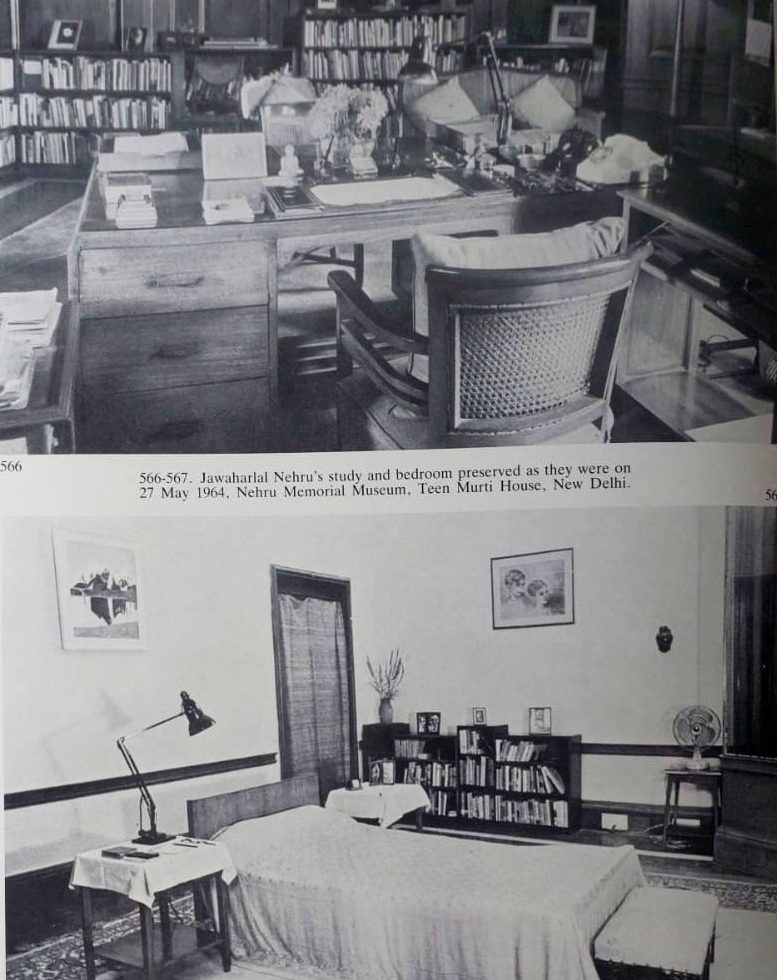
In India the gift of Frost’s work was recognised as a tribute to Jawaharlal Nehru, India’s first Prime Minister. Nehru, apart from being a founding father of Indian democracy, was a prodigious writer with a love of history, poetry and nature; in Himalayan vacations he went horseback riding and exploring woods. Frost’s poetry was a natural for him. Nehru had a particular fondness for ‘Stopping by Woods on a Snowy Evening’. Towards the end of his life he kept a copy of Frost’s poems by his bedside, with the last stanza of “Stopping by Woods” underlined:

The woods are lovely, dark and deep,
But I have promises to keep,
And miles to go before I sleep,
And miles to go before I sleep.

Photos: Jawaharlal Nehru’s study and bedroom, preserved as they were at the time of his death.

Susan McLean, ‘The Only Feminist in High School’

Two roads diverged in high school when a student
chose to study women’s liberation
to write her senior paper. Though imprudent,
that choice provided her an education

in bias, inequality, derision,
The Second Sex, The Feminine Mystique,
historical erasure, long division,
and talent gagged and shackled by physique.

She swore off make-up, wanted a career
but maybe not a family. She read
Kate Millett, Gloria Steinem, Germaine Greer,
and gave a speech on beauty, which, she said,

turned women into objects and betrayed
their goals. She didn’t want to be a mom
or movie star. When she went out, she paid.
Though never asked, she boycotted the prom.

The boys were baffled and the girls disdainful,
for who would want to talk to, much less date her?
And what she lost was obvious and painful,
while what she gained was only clear years later.

*****

Susan McLean writes: “This poem starts with the opening phrase from Robert Frost’s ‘The Road Not Taken‘ and it records a turning point in my own life of the sort that his poem describes. Though I hope that feminists are not such a rarity among high school students anymore, the term “feminist” is still so loaded that I tend to think of it as “the new F-word.” At one level, it still mystifies me that looking for equal opportunity and equitable treatment remains so controversial, but at another level, every society has been built on unequal opportunity and inequitable treatment since recorded history began, so it is not surprising that each step away from that system has made some people feel that the world was ending.

“I learned long ago that what a poem doesn’t say is as important as what it does say, so the ending of this one does not specify what was lost or what was gained. I want the readers to think about those things, so I don’t want to tell them what to think. As for why I wrote this in the third person, these events happened so long ago that it almost feels as though they happened to someone else. I am and am not that girl.

“The poem first appeared in my second poetry book, The Whetstone Misses the Knife.”

Susan McLean has two books of poetry, The Best Disguise and The Whetstone Misses the Knife, and one book of translations of Martial, Selected Epigrams. Her poems have appeared in Light, Lighten Up Online, Measure, Able Muse, and elsewhere. She lives in Iowa City, Iowa.
https://www.pw.org/content/susan_mclean

Photo: “Two Road Diverged…” by wackybadger is licensed under CC BY-SA 2.0.

Odd poem: Robert Frost, ‘The Draft Horse’

With a lantern that wouldn’t burn
In too frail a buggy we drove
Behind too heavy a horse
Through a pitch-dark limitless grove.

And a man came out of the trees
And took our horse by the head
And reaching back to his ribs
Deliberately stabbed him dead.

The ponderous beast went down
With a crack of a broken shaft.
And the night drew through the trees
In one long invidious draft.

The most unquestioning pair
That ever accepted fate
And the least disposed to ascribe
Any more than we had to to hate,

We assumed that the man himself
Or someone he had to obey
Wanted us to get down
And walk the rest of the way.

At a poetry reading in the Library of Congress, Robert Frost apparently described “The Draft Horse” as a poem “that nobody knows how to take“. That’s one way to look at it. Another way is that everyone who reads it seems to quite confidently take it in a different direction.

It has been called an allegory of the atom bomb–but, though first published in 1962, it was actually written in the 1920s, long before the bomb.

It’s been called an allegory of American expansionism.

It has been suggested as “a metaphor for the lives of ordinary citizens in totalitarian states, such as Nazi Germany, Soviet Russia and West Germany.” (West Germany. Really.) “Then the man could be an agent of the government, who does what he deems necessary and then disappears again.

Again, “In many cultures, the horse is traditionally a symbol for power. The horse has played a large role in American history. Robert Frost’s The Draft Horse may be a reflection of the power struggles he saw around him and the senseless actions he perceived in the conflicts.

How about “One analysis of the poem is that fate is unavoidable. Why struggle to stop or question fate when by its very definition it cannot be stopped?

Here’s the complete commentary from one blogger: “I’m on a bit of a poetry moment right now. The Draft Horse by Robert Frost is possibly one of the best poems ever written and well worth sharing with anyone willing to read writing at it’s highest art form.” (“it’s”, sic. Also, he miscopied one of the lines as “Any more than we had to hate,” thereby losing the meaning.) A more extensive commentary is in a comment posted to that blog:

I love this poem ! i think it is a great description of postlapsarian life. Laterns wont burn buggies are frail, the horse is too heavy.the night is so dark …
amidst all that a fellow deliberately stabs your horse.

People of good will are always hesitant to blame problems on hate.
and any way walking is a fine way to get there

And then there’s this thesis towards an M.A.:
WHY I KILLED THE DRAFT HORSE:
THE GOLDEN BOUGH, ROBERT FROST, AND “PROGRESS”
by Eugene Charles McGregor Boyle III

August 2013
The absence of criticism on Robert Frost’s “The Draft Horse” suggests that it is a challenge to Frost scholarship. This reading views Frost’s strange and neglected poem as a return to a monomyth offered by James Frazer’s hugely influential The Golden Bough. In “The Draft Horse,” Frost reconsiders the concept of ceremonial sacrifice that undergirds Frazer’s encyclopedic study of world culture and, by performing ceremony as a kind of modem poesis, Frost complicates the hero/sacrificial object role and critiques the progressive ideology that grounds Frazer’s account to fashion a troubling epic for modern America that implicates its national readers in a kind of savagery.

(Supported with references not just to Frazer’s “Golden Bough” and Eliot’s “Wasteland”, but also Dante’s “Inferno” and Lovecraft’s “Call of Cthulhu”, among others.)

Here is another take on it: “This is a very simple, straightforward story, but the reader cannot just leave it like that. Why would Frost have written this poem if he had only wanted to say “a stranger killed a horse”? The reader is therefore faced with the fact that “The Draft Horse” is a symbolic poem that must be read at another level, otherwise it has no purpose.

Well, why does it have to have a “purpose”? It’s a poem, for god’s sake. Maybe the poem “means” exactly what one or other of the above-quoted commenters thinks… but maybe Frost just had a strange dream. Or maybe someone had told him of an incident. Maybe the rhymes and images just floated around in his head. Who knows? Who cares? It’s a poem and, for some reason, it resonates (differently) with a lot of people. It’s an odd poem. Enjoy!

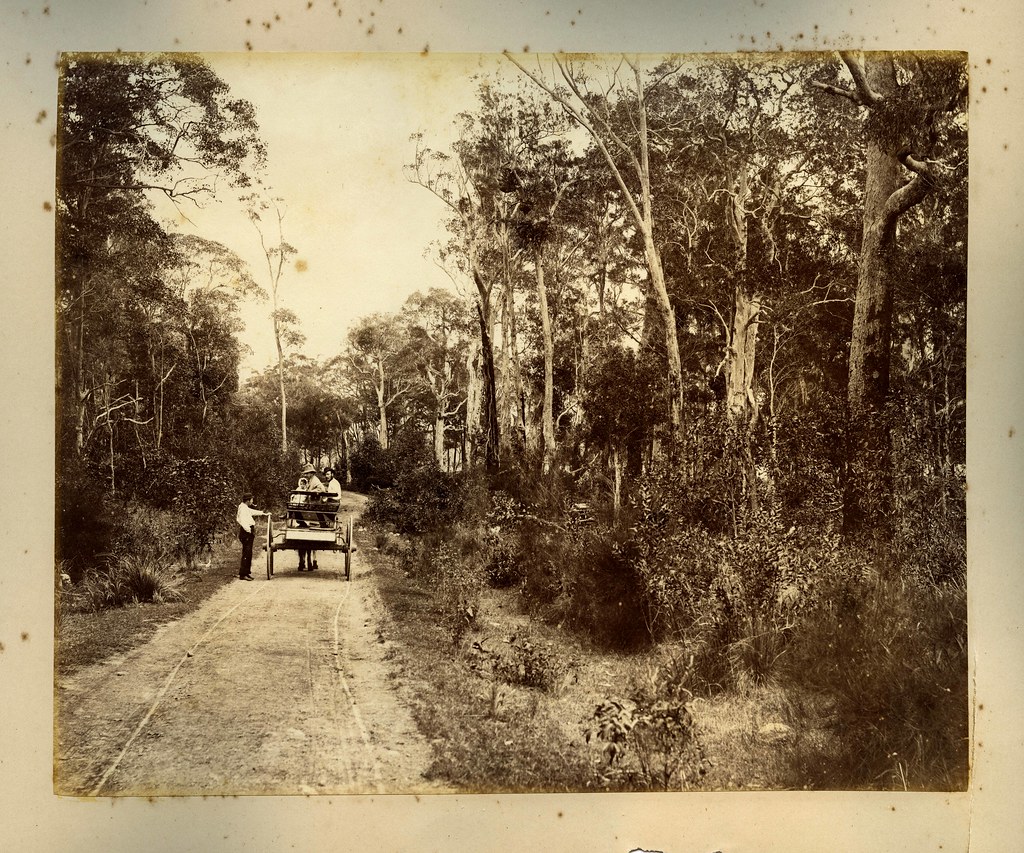
“Horse and Buggy on a Bush Track” by Blue Mountains Library, Local Studies is licensed under openverse from WordPress.org