Tag Archives: Robin Helweg-Larsen

Prose, really: RHL, ‘Time is the Measurement’

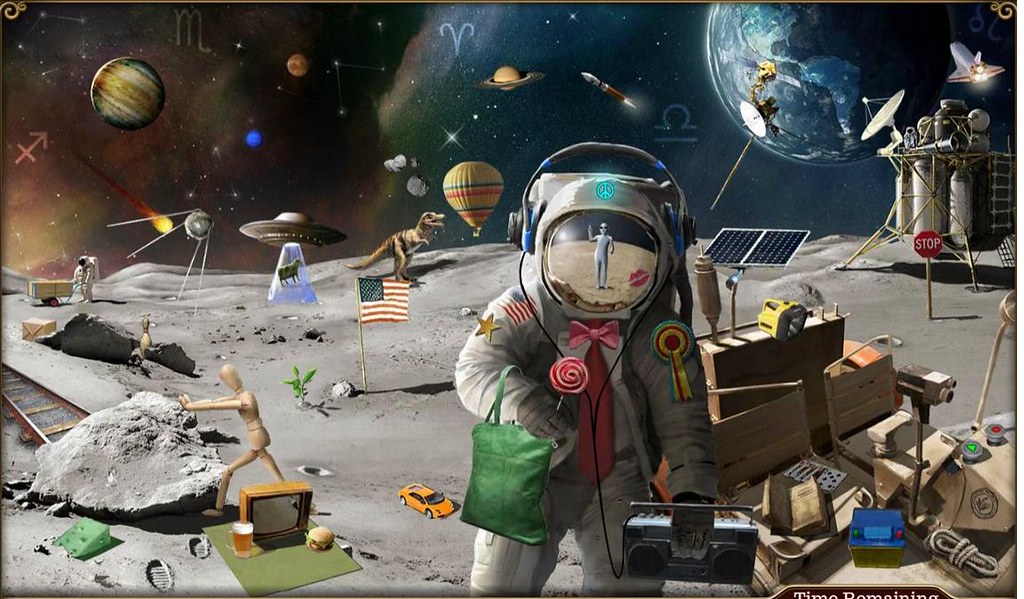
Time is the measurement of rearranging atoms.
Atoms are rearranged like blocks, and that is time.
Putting the blocks back as they were before is not going back in time.
There is no past,
there is no future,
there is only the eternal present.
There was a past, there will be a future… but you can’t get there from here,
except as the atoms rearrange.

A time machine would have to rearrange the atoms
of the world,
of the galaxy,
of the entire universe,
to put every particle back into some prior arrangement.
The calculations, let alone the actions, would be… difficult.

It is no wonder that we have never seen visitors from the future.
They don’t exist. There is no future, and there is no past.
There is only the eternal present.
Enjoy it.

*****

This “poem” was just published in Consilience, “the world’s first peer-reviewed science and poetry journal”. In addition to a poem, the journal requires a comment focusing on the science behind the poem. So here is
“The Science.
Time may be a dimension and a useful concept, but it is not a dimension in the sense of something that one can move back and forth in. We measure time with atomic clocks, which produce electromagnetic radiation that atoms in the clock absorb. Cesium atoms absorb microwaves with a frequency of 9,192,631,770 cycles per second, which then defines the international scientific unit for time, the second. Accurate time like this has helped to prove Einstein’s theories about time moving at different rates when clocks are moving at different speeds. Without accurate clocks and an understanding of Einstein’s theories about the speed of light and space-time, we wouldn’t have the Global Positioning System (GPS), which uses clocks in space and on the ground to show you where you are.”

There are limits to the amount that can be written in the Science section, so I haven’t gone into rambling speculation about the subjective aspect of time which appears to speed up as we get older. My suggestion is that we experience a ‘Subjective Time Unit’ as a constant amount of thought-processing. Say as a teenager you process 100,000 bits of information in a second (that’s a random number, but you get the point). Then as you age and the brain physically deteriorates, perhaps by age 50 it takes you two seconds to process that amount of information. You would feel the external world cycling twice as fast between day and night, because it would happen with the passing of half as many STUs. You would still think as logically, but time would feel like it was speeding up. The use of pharmaceutical uppers and downers will also change how much time you feel passes (by impacting how rapidly you are processing information), as will being half asleep (time slides by rapidly) or being in an adrenaline-enhanced emergency (time will appear to slow down).

But these are all mere speculations about the subjective nature of time, different from the question of the objective nature of time itself.

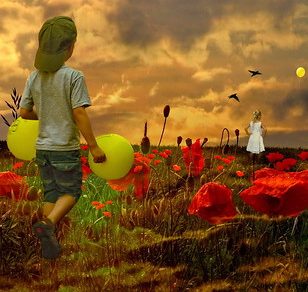
Photo: “LunarLanding – Gardens of Time” by mcscrooge54 is licensed under CC BY-SA 2.0.

RHL, ‘Walking then Running’

Like ants searching randomly across a table
like water dribbling across uneven ground
and pooling here, running to the side,
filling and flowing to the next dip,
so we have walked out of Africa
for a hundred, two hundred thousand years,
over the hills, around the coasts,
seeking the greener grass, the next best land,
glad of a tree, glad of a cave,
catching the lightning for our own hearth,
settling, pooling, then spilling out
over the next hill, round the next headland,
following bird flight, following game herds,
exploring then leading then fetching our families,
finding and fighting with those who were there before,
killing or trading, absorbing or raping,
loving, despising the different, the ogres and trolls,
like a stain spreading out round the world,
and walking then running up as though to take a free kick,
walking then running up as though to bowl,
walking then running as along a diving board to
bounce once, twice in the air and launch into space…
Here comes, there goes the human race.

*****

The future is unknowable beyond the point where AI becomes more intelligent than humans, and autonomous. Enjoy what you have now, you will be nostalgic for it soon enough…

I wrote this piece as a long rambling exploratory sentence which picks up speed and purpose towards the end and a concluding rhyme. This (not exactly formal) poem was first published in Bewildering Stories a few years ago.

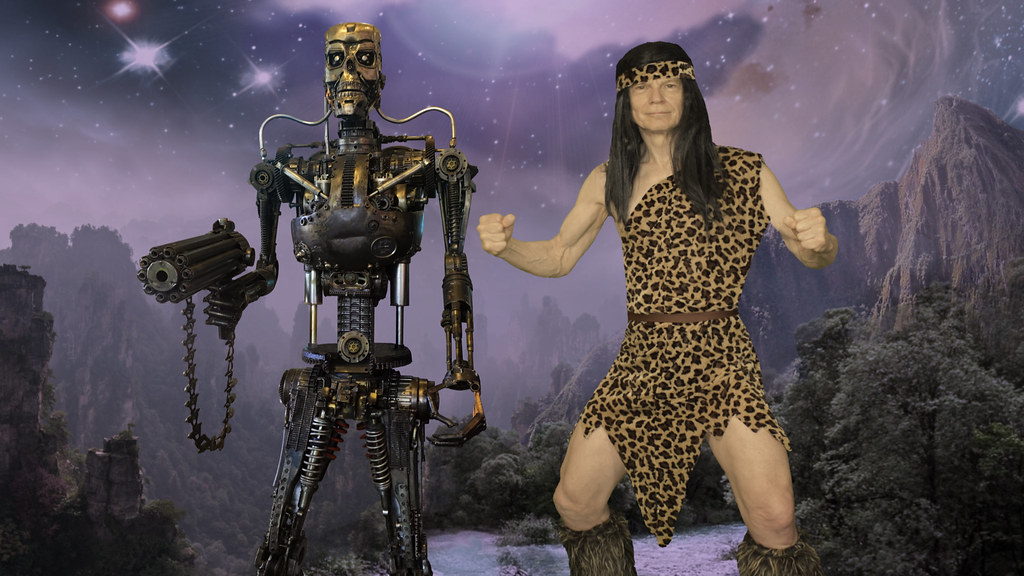
Aboard Starship Hedonian – The Terminators [809]” by TimWB2020 is marked with CC0 1.0.

Using form: Semi-formal: RHL, ‘Hunting’

The Osprey splashes, misses, and flies by
skimming the waves, rising, five yards away.
What’s its success rate? Does it care?
The Stingray searches, gliding, mouth to sand
five yards beyond the shallows where I stand.
Its Roomba-work’s its own affair.
The water splishes, burbles random rhythms.
The sun confuses, over-hot, then hidden.
The Oystercatcher calls. The Osprey rocks
on its branch in a casuarina,
flaps down-beach to another.
Along the margins of the shore, alone, each stalks.
They hunt for food
and I hunt them for what they mean, or could.

*****

There are elements of the sonnet about this semi-formal poem: it’s in iambics (though with uneven lengths of line); it has rhyme (though some only slant rhyme, and not patterned); it has 14 lines and a final couplet (though not with a clear volta where you would hope, after the 8th line). But I think the disjointed nature of the poem, its stop-and-go lines of different length, is suitable for the nature of the hunt: the searching, the sudden swoop, the pause, the restarting. In that sense the form is appropriate for the subject matter, and therefore good. It may be that I was too lazy to beat the whole thing into pentameters with a regular rhyme scheme… but it may also be that this was the right place to stop for this particular poem.

‘Hunting’ was originally published in Obsessed With Pipework, and has just been reprinted in Green Ink Poetry (motto: “We Welcome Chaos, Calamity, And The Natural World. Hope Punks & Witches” in their current collection with the theme of ‘Forage’.

Photo: “Osprey” by Mick Thompson1 is licensed under CC BY-NC 2.0.

Formless poem: RHL, ‘Marty Ravellette’

The man with no arms sat on the stool in the diner;
he was shoeless: How else could he drink his coffee,
eat his scrambled eggs?

The man with no arms parked his truck and got out barefoot.
He fired up his chainsaw; he had a landscaping business.
With the log out of the way, he could cut the grass,
push the lawnmower around with his chest.

The man with no arms saw the woman in the burning van,
barefoot, he kicked in the window, so his wife
could reach in and unlock the door, help the woman escape.

Somewhere Kipling’s Creator of All Things must have told him “Play –
play at being who you are,” and he played.

Somewhere Lear’s Aunt Jobiska must have told him “This is the best.”
And he lived, happy with who he was, glad for no arms
because no arms made him who he was, and he liked who he was.

Nor was the man with no arms alone.
The boy with no hands sat in the laundromat, knitting.
He had metal pincers. His mother was washing the clothes.
The girl with two heads, or rather the twins with only one body,
they live, argue, love, share.
And the men with no legs have a chance to run faster than all,
will require a new type of Olympics.
And the child born to die – does that disturb you, “the child born to die”?
The child born to die is me and is you, is all humans, all life,
all planets, stars, galaxies, all.
Listen to Lear’s Aunt Jobiska: This is the best.
Listen to Kipling’s Creator of All Things, and play.

*****

Marty Ravellette was a highly respected inhabitant of Chapel Hill, North Carolina, where he lived the last 16 years of his life – running his landscaping business, taking a break in a local diner, frequently a guest lecturer in journalism at UNC. He was a Baha’i convert, and a hero.

Occasionally I break my own rules about poetry, and write a poem in a style which I consider to be really flash fiction (or flash non-fiction in this case). The things I had to say didn’t present themselves in anything hinting at traditional verse, and therefore I just said them as best I could. But both Snakeskin and The HyperTexts consider it poetry, so I won’t argue. I’m not sure it should be in the formalverse.com blog, however…

Photo: Figure 8 Films

Sonnet: RHL, ‘Your Lot’

From prairie city to an island town;
from city festivals to empty sea;
from continental seasons, white, green, brown
to changeless warmth and high humidity.
No one could hope for love more fierce, more loyal,
more honest, constant through good times, harsh tests,
raising our varied children as they boil
off along individual paths and quests
with a fierce love for them in their success
and even more, their fulfilled happiness.
You miss the north’s reliable forethought,
but not your parents, siblings and cold strife.
There’s always trade-offs, getting where you’ve got.
Just don’t look back. You chose your lot in life.

*****

Two questions: Is it a “sonnet” if the rhyme scheme is non-standard and there’s no real volta? And is it better to accept the unconventional form that the poem was comfortable in, or to try to beat it into more standard shape?

Obviously, I chose to leave it with its imperfections as I wrote it; but that might be from laziness more than anything else. Yes, I *do* work on poems after the first draft… usually… but once I’ve got something halfway acceptable I tend to stop. If I’ve got it to the point where I could easily learn to recite it, then it’s good enough.

But non-traditional sonnets are simply not as engaging, as well-balanced, as rhetorically forceful, as either the Petrarchan or the Shakespearean can be. Those forms have an elegance, a beauty, a structure that leads to a sudden insight or a punchline in a way that at its best (partly due to the rhyme scheme and partly due to the unbalanced “halves” separated by the volta) feels not just well-phrased but unquestionably true.

So this sonnet, if it is a sonnet, is second best. Still good enough to have been published recently in Pulsebeat – thanks, David Stephenson!

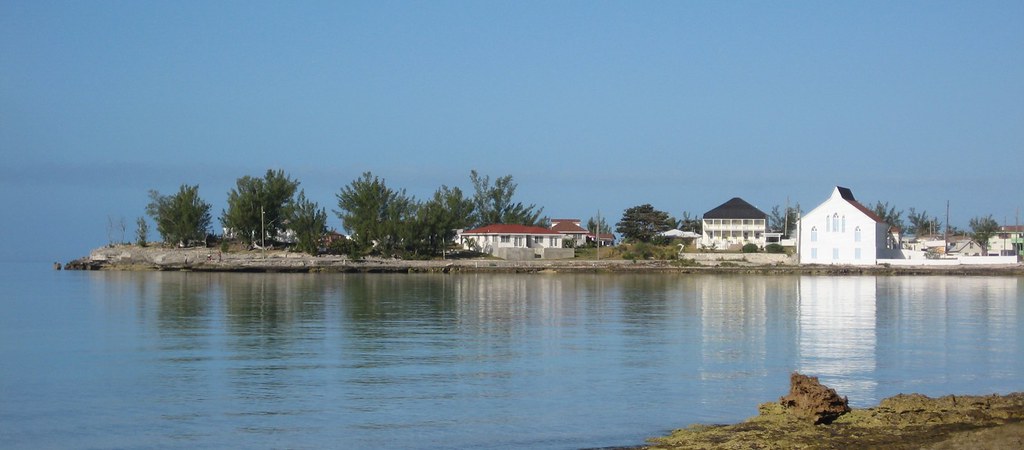
Photo: “Part of Governor’s Harbour, Across the Bay” by tylerkaraszewski is licensed under CC BY 2.0.

Light verse: RHL, ‘Question the Universe’

Odin wrote runey verse
Rumi wrote Sunni verse
Edward Lear? Loony verse.
Question the universe
with your buffoony verse.

*****

Sometimes you jot down a little light piece inspired more by wordplay than anything else, and the more you look at it the more it resonates. This is one such. The characters are diverse, coming from pre-literate Scandinavia, Renaissance-inspiring Islam, and Victorian England – they touch the roots of my cultural identity. They are from the past, but their searches are timeless, fully modern, quintessentially human. And I fully subscribe to the idea that we should question everything, and that the Fool‘s tools of succinct and enigmatic wordplay may be as good an approach as any in trying to formulate – let alone answer – all questions, physical and existential.

It further resonates for me in being published (which I find important); in being published just now in Light (which is a wonderfully reassuring place to be); in having been improved in response to Light’s editorial comments (meaning, yes, I am proud that sometimes I am open to criticism and it’s useful); and in being my 400th poem published (by one of my conflicting counts).

Nothing is definite, not the historical reality of historical and semi-historical figures, not the permanence of printed words, not the definition of a poem, not the count of things hard to define, not the nature of physical reality. So though we have to make prosaic choices based on appearances and best guesses, that should be balanced by questioning everything. Preferably in verse.

TL;DR: Even short poems can be unpacked.

Illustration: DALL-E by RHL, ‘Rumi, Odin and Edward Lear are writing poetry to question the universe’

Short poem: RHL, ‘Friendship, Not Passion’

I had a friendship, more than passionate love, for you;
we could have been so good, easy, together.
But there’s that issue of your strong religious thoughts,
whereas I let my thoughts change with the weather.

I… well, and who’s the I you think that you address?
I ramble, googly-eyed, my arms elastic.
There are so many sweet but sadly firm believers.
I’m – more than atheist – iconoclastic.

*****

If you’re used to iambic pentameter the meter of this poem feels just a little off, with its lines of alternating 12 and 11 syllables, i.e. alternating hexameters and feminine-ending pentameters… not quite comfortable. Which is perfectly in keeping with the relationship described. And I don’t remember precisely which long-ago not-quite-girlfriend I had in mind when I wrote it; I’ve been attracted to more than one charming female, wonderfully calm and sane except for some unfortunate religious orientation or other.

I’m reminded of the 19th century Punch cartoon of the two guests at a dinner party:
She: “And what is your religion, sir?”
He: “Madam, all men of sense are of the same religion.”
She: “And which religion is that, pray tell?”
He: “Madam, men of sense never say.”

Which is all very well for friendship, but hardly a solid basis for a deeper relationship. You’re better off if you hold out for someone philosophically compatible, unless you (and they) really don’t care. In which case, you’re philosophically compatible!

‘Friendship, Not Passion’ was originally published in Lighten Up Online, edited by Jerome Betts.

Illustration: “Friendship” by h.koppdelaney is licensed under CC BY-ND 2.0.

Sonnet: RHL, ‘Halloween’

I sing the changing seasons of the year
And, as leaves fall, I celebrate my death.
Each inhalation may be my last breath;
Each year I lose another near and dear.
So many people live life in Death’s fear,
The very word <cough> Dead’s a shibboleth –
Paint on false youth like old Elizabeth –
Yet half the planet’s Spring, while it’s Fall here.

Eternal life is ever to be felt,
For death, rebirth, are always intertwined
In pious hopes, in science still unseen.
The pagan in me – Viking, Druid, Celt –
All celebrate when Life’s return’s divined.
It’s Halloween, so I will dress in green.

*****

This sonnet with its Petrarchan rhyme scheme (ABBA ABBA CDE CDE) was originally published in The Lyric a couple of years ago. “Founded in 1921, The Lyric is the oldest magazine in North America in continuous publication devoted to traditional poetry.”

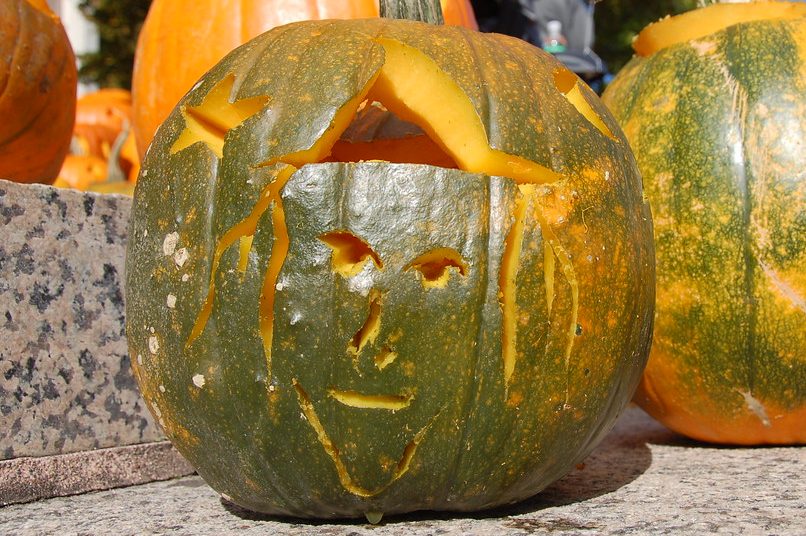
Green pumpkin carved into witch face jack-o-lantern” by Chris Devers is licensed under CC BY-NC-ND 2.0.

Poem: RHL, ‘On Doing Nothing’

Here where the royal poinciana’s blaze
pales to haze in the full midday craze
of light on shallows stiller than you can see
and all time stops, worn out from timeless sun
in a land and season where nothing’s to be done,
futility stretching to eternity,
and nothing is, except for heat and light…
accept the heat and light, the dazzling green and blue,
do nothing: for there’s nothing here to do.
Although elsewhere the world’s a ruin of smoke—
democracy and leadership a joke—
I unapologetically sit out the war
(whether on virus, climate change, or rich v. poor),
I’m Swede or Swiss to their corrupted plight.
A fish, a coconut—I don’t need more.
And so I sit and think, and read, and write.

*****

I should probably write a little about this poem’s form (iambic pentameter and rhyme, and could have had more shape if I had put more effort into it) or inspiration or whatever… but that would be work, and who needs that?

Published this month along with two others in Shot Glass Journal, anyway… thanks, Mary-Jane Grandinetti!

Photo: “Lazy Afternoon” by cybertoad is licensed under CC BY-NC-ND 2.0.

Non-traditional sonnet: RHL, ‘The Range of Change’

In times of no change, the advantage lies
with those who are receptive to being taught.
Parents and teachers may seem truly wise,
avoiding dangers with which life is fraught;
the stories of the old none would despise
when they hold all the answers that are sought.

In times of constant change, advantage shifts
to those who, hating school, go and explore.
Old answers fail. Fresh questions cause great rifts
with parents who are seen as wise no more;
questions now turn up unexpected gifts
in crossing unknown seas to virgin shores.

Remain alert that there’s a range of change
from none, to gradual, to fast, to strange.

*****

A sonnet, or not? 14 lines of iambic pentameter, rhyming regularly and with a final couplet. Though not in either of the standard English forms, it has the organised, compressed, reflective sense of the sonnet. Recently published in Shot Glass Journal, Online Journal of Short Poetry. Thanks, Mary-Jane Grandinetti!

Climate change icon” by Tommaso.sansone91 is marked with CC0 1.0.