Tag Archives: Seamus Heaney

R.S. (Sam) Gwynn, ‘Mr Heaney’

“This was Mr Heaney’s room. The peat’s
From off his boots. It got into the rug
And won’t be Hoovered out. Likewise the sheets
And pillow case.” Solemn, I nod and shrug,

Expecting little better, as I note
The sad brace of dried heads, the shards of flint,
The coprolites and drafts that Heaney wrote
Lying untidied here. “He liked his pint,

Did Mr Heaney, but you know the Irish.
That and a roasted spud. He didn’t pay
The last two weeks and more. You know the Irish.”
And so it is I lie where Heaney lay

And watch the twilight dripping with the murk
Lurking beyond short curtains. Left alone,
I ponder what she’d said: “He’d often work
My bit of bogland like it was his own–

He liked the muck and suck. But then one day
He got some kind of letter from the Swedes,
Got all excited and he went away.
Now the whole plot is given over to weeds.”

Such cause for wonderment: Did Heaney ask
No better than a spade or pen or hoe
To kill his time? Nothing to ease the task–
Girls, say? Or hurling pools? I just don’t know.

*****

R.S. (Sam) Gwynn writes: “It just came out of the similarity between the two names. With Heaney I always think of him out digging in a peat bog, etc.”

*****

The poem plays off Philip Larkin‘s description of himself moving into a boarding house, renting a room formerly lived in by ‘Mr Bleaney‘:

‘This was Mr Bleaney’s room. He stayed
The whole time he was at the Bodies, till
They moved him.’ Flowered curtains, thin and frayed,
Fall to within five inches of the sill,

Whose window shows a strip of building land,
Tussocky, littered. ‘Mr Bleaney took
My bit of garden properly in hand.’
(…)

(But if) at his age having no more to show
Than one hired box should make him pretty sure
He warranted no better, I don’t know.

What happened to Bleaney? He stayed there “till they moved him”. As for Heaney, he got that letter from the Swedes and went off to collect his Nobel Prize. – Editor

*****

R. S. (Sam) Gwynn was born in Leaksville (now Eden), North Carolina, in 1948. After attending Davidson College, he entered the graduate program at the University of Arkansas, where he earned his M. F. A. From 1976, he taught at Lamar University, where he was Poet-in-Residence and University Professor of English. He retired in 2016. His first two collections were chapbooks, Bearing & Distance (1977) and The Narcissiad (1980). These were followed by The Drive-In (1986) and No Word of Farewell: New and Selected Poems 1970-2000. His latest collection is Dogwatch (2014) from Measure Press (which includes this poem). His criticism appeared regularly in the Hudson Review and other publications, and he was editor of the Pocket Anthology Series from Pearson-Longman. He lives in Beaumont, Texas, with his wife, Donna. They have three sons and seven grandchildren.

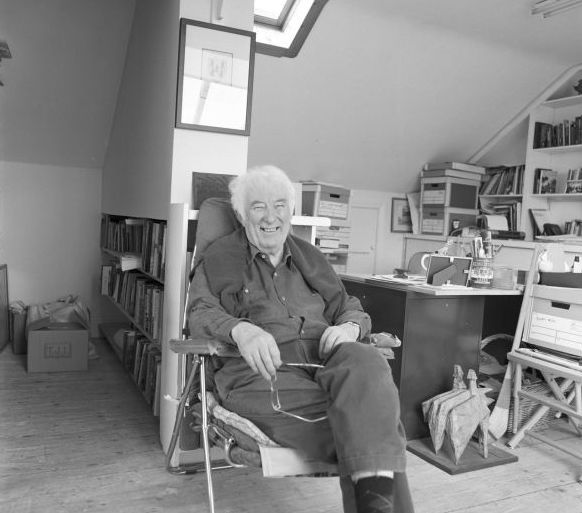
Photo with thanks to the Bobbie Hanvey Photographic Archive/Boston College.
Joe Biden’s favourite poem: Seamus Heaney, ‘The Cure of Troy’

Human beings suffer
They torture one another,
They get hurt and get hard.
No poem or play or song
Can fully right a wrong
Inflicted and endured.

The innocent in gaols
Beat on their bars together.
A hunger-striker’s father
Stands in the graveyard dumb.
The police widow in veils
Faints at the funeral home.

History says, Don’t hope
On this side of the grave…
But then, once in a lifetime
The longed-for tidal wave
Of justice can rise up,
And hope and history rhyme.

So hope for a great sea-change
On the far side of revenge.
Believe that a further shore
Is reachable from here.
Believe in miracles
And cures and healing wells.

Call miracle self-healing:
The utter, self-revealing
Double-take of feeling.
If there’s fire on the mountain
Or lightning and storm
And a god speaks from the sky

That means someone is hearing
The outcry and the birth-cry
Of new life at its term.
It means once in a lifetime
That justice can rise up
And hope and history rhyme.

*****

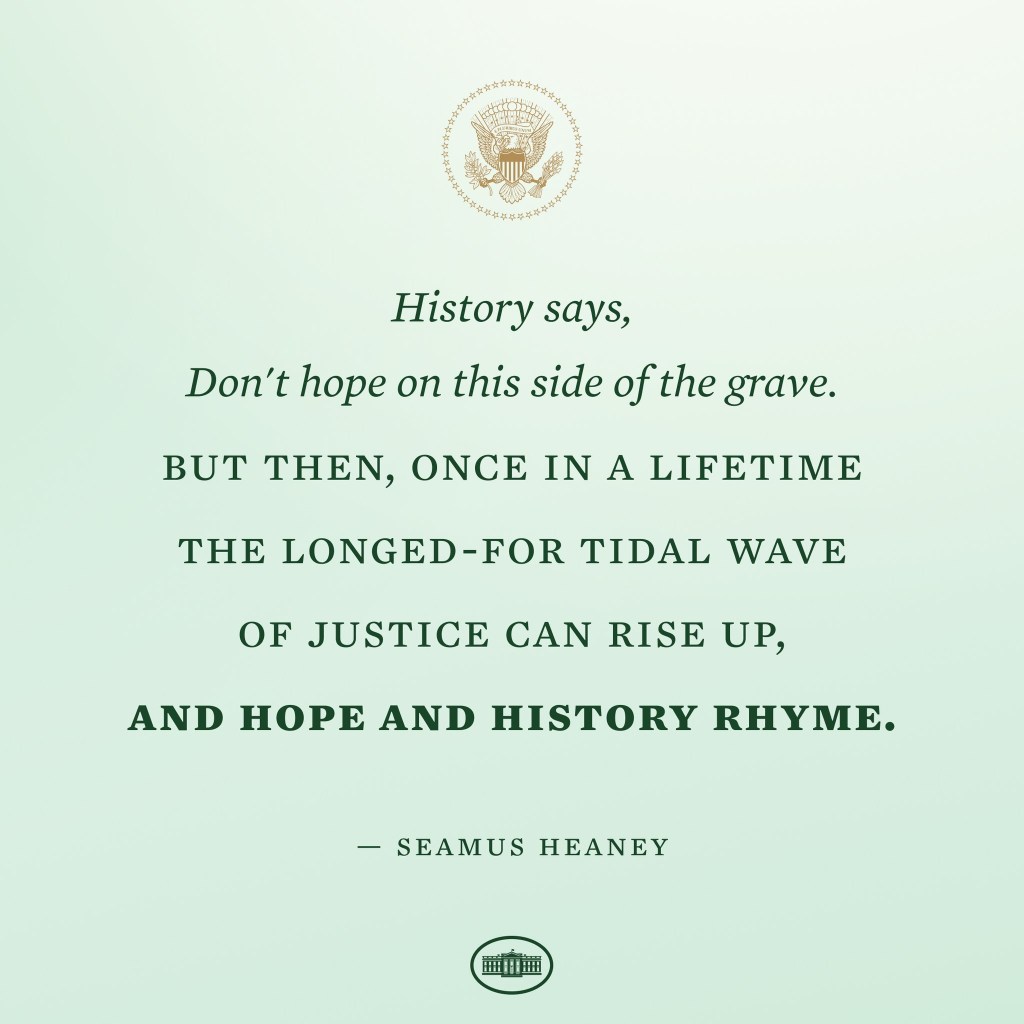
US President Joe Biden frequently quotes poets: Yeats and, especially, Heaney; often with the disclaimer that he doesn’t quote Irish poets because of his Irish heritage, but because Ireland has the best poets. And from the poem above, the verse that particularly resonates with him is:
History says, Don’t hope
On this side of the grave…
But then, once in a lifetime
The longed-for tidal wave
Of justice can rise up,
And hope and history rhyme.

Joe Biden may not be perfect, but it is reassuring to have an American President with at least some commitment to Justice… and the sensibility of reinforcing it through the memorisation of poetry.

Photo: Joe Biden’s White House Facebook post for St. Patrick’s Day 2022.

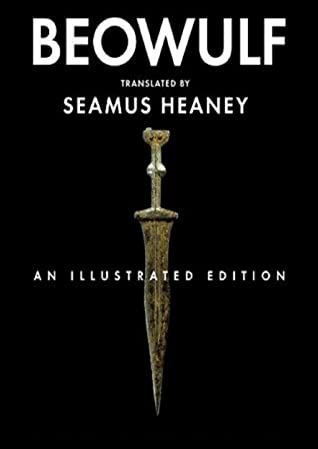
Review: ‘Beowulf’, translated by Seamus Heaney

I can’t imagine a better version of Beowulf than this brilliant rendition into appropriately alliterative verse by Nobel prizewinning poet Seamus Heaney, with full colour photographs on alternating pages of the massive 3,000-line poem. It has the rhythm of the original, it is essentially faithful to the original, and the illustrations (even more than the notes) give a sense of landscape, ships, weapons, jewelry, halls, etc that helps bring the entire story to life.

The story itself is in three parts: Beowulf travels from what is now Sweden to help the king of the Danes against a monster, Grendel, that is attacking and devouring his people, and Beowulf defeats Grendel by tearing an arm off. Gifts are given, and everyone relaxes. However Grendel’s mother comes the next night seeking revenge, and Beowulf goes after her the next day, diving into her murky pool and killing her with a sword. More gifts are given, and Beowulf returns home. Fifty years later Beowulf, now himself a king, goes to fight a dragon that has been roused and is pillaging the countryside; he fights the dragon and they kill each other; the dragon’s hoard is buried with Beowulf in the tomb that is built for him.

The historical persons in the tale, and the Danish king’s hall at Lejre, date to the mid-6th century. Then and for the next 500 years Scandinavia was innocent of Christianity, and the warrior society and the constant blood-feuds are a part of the story. But the poem as we have it have it was apparently composed in the 9th century in Christiansed England, and the will of a very Old Testament God is referenced throughout as overruling the abilities of humans. This feels like no more than an unimportant veneer of a modern religion over a Scandinavian sense of weird, wyrd, or destiny.

The poem is important as the beginning of English poetry, and its place and relevance is heightened by Heaney’s long and delightful introduction in which he details how he, as a Northern Ireland Catholic who felt deprived of his Gaelic birthright, came to fuse Gaelic, Old English and modern English into a sense of community and identity.

So because of the Introduction and the photos and illustrations as well as the superbly rhythmic and semi-alliterative translation, this is the Beowulf if you want a Beowulf!