Tag Archives: sleep

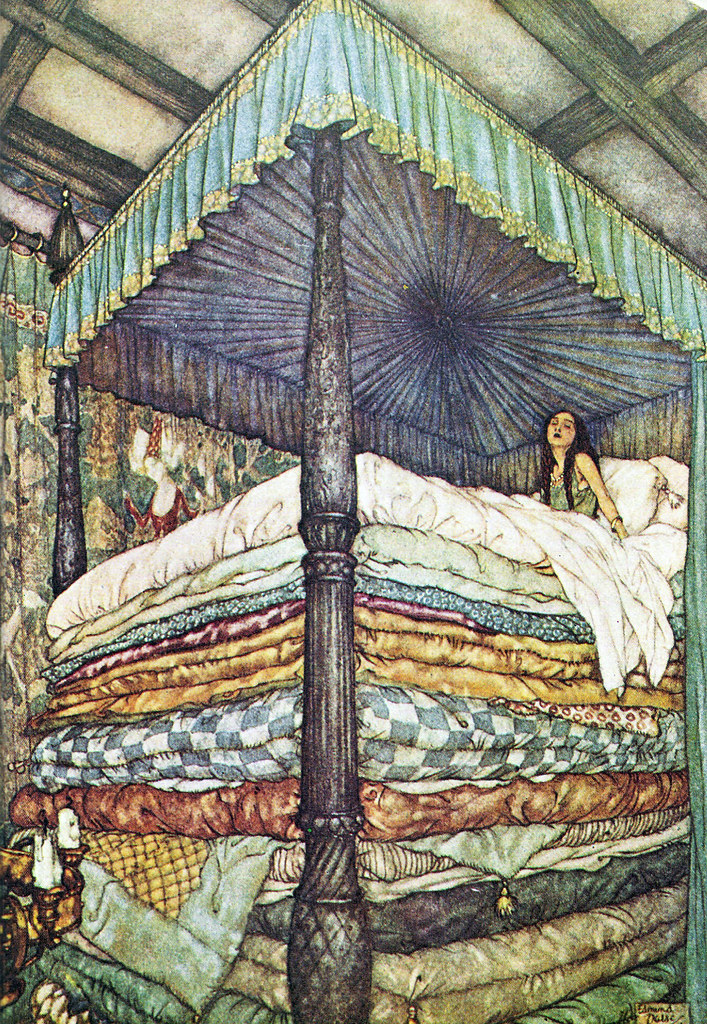
Max Gutmann, ‘The Princess and the Pea’

Once a devious queen lodged just one tiny pea
Under twenty soft mattresses, wanting to see
Out of many young princesses which was the one
Who deserved to be matched with the prince, her fine son.

For she knew a true princess was dainty and fine,
And that little legume underneath the frail spine
Would prevent her enjoying the tiniest rest,
And by this all would know she had passed the queen’s test.

But you see, a true princess is also polite,
So when, bleary-eyed after a long, sleepless night,
Each was asked how she’d slept by the queen the next day,
She replied, “Very well,” and was sent on her way,

Till one morning a girl hollered, “What is this lump?
Do you call this a bed? Who can sleep in this dump?”
So the queen said okay. The prince married her straight.
And the moral is: don’t let your mom choose your mate.

*****

Max Gutmann writes: “It always frustrated me that the fairy tale couldn’t seem to see the flaw in the queen’s thinking.”

This poem was first published in Snakeskin.

Max Gutmann has contributed to New StatesmanAble MuseCricket, and other publications. His plays have appeared throughout the U.S. (see maxgutmann.com). His book There Was a Young Girl from Verona sold several copies.

Illustration: ‘The Princess and the Pea’ by Edmund Dulac. Dulac illustrated several of H.C. Andersen’s fairy tales, many of which include sarcastic social commentary on pretentiousness.
Semi-formal verse: Barbara Loots, ‘The State of Absolute Nap’

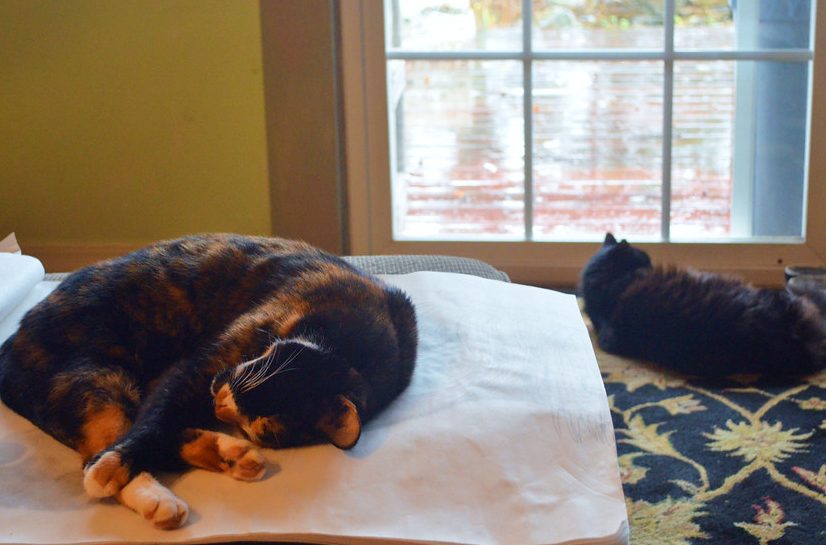
Its conditions are rare. You must be free
of all desires but one: to sleep. You must be alone,
completely isolated from the compelling hum
of traffic or tv. There must be no phone,
unfinished book, or business left undone,
no guilt about neglecting anyone,
and nowhere to go too soon.
Let there be rain on a long afternoon
in the deep woods, at the end
of a long path, where no one will come,
after the last word with a listening friend.

*****

Barbara Loots writes: “Far from the original location of this poem, on a tiny island off the grid in Ontario, I discover that the state of absolute nap is nearly a sure thing any day. I acknowledge with gratitude that ‘Nap’ was first published by poet and editor Jane Greer, who kept the flame of formal poetry alight in the Plains Poetry Journal for many years.”

After decades of publishing her poems, Barbara Loots has laurels to rest on, but keeps climbing. The recent gathering at Poetry by the Sea in Connecticut inspired fresh enthusiasm. Residing in Kansas City, Missouri, Barbara and her husband Bill Dickinson are pleased to welcome into the household a charming tuxedo kitty named Miss Jane Austen, in honor of the 250th birthday year of that immortal. She has new work coming in The Lyric, in the anthology The Shining Years II, and elsewhere. She serves as the Review editor for Light Poetry Magazine.

Photo: “331 of 365” by Leah.Markum is licensed under CC BY-NC-SA 2.0.

Sonnet variation: J.D. Smith, ‘Lullaby for the Bereaved’

Your hours of tears won’t let you follow
Those who’ve left you alone.
Tonight your head lies on a pillow,
Not beneath earth and stone.

The dead won’t be returning,
Not for all of your pleas,
Not for all your candles burning.
Get up off your knees.

The deceased, removed from their rest
Can take up all your hours
Until your mind, denied a fair rest,
Is deprived of its powers.

The road set before you is rocky and steep,
So seize the night’s respite and drift off to sleep.

*****

J.D. Smith writes: “Though I do not sing, play an instrument or read music, I had Brahms’ Lullaby in the back of my mind while attempting to deal with various losses, and the poem roughly follows its tune. In adjusting to a new reality (I hesitate to say “move on” or “get over,” phrases that smack of empathic failure), sometimes all one can do is rest.”

J.D. Smith has published six books of poetry, most recently the light verse collection Catalogs for Food Loversand he has received a Fellowship in Poetry from the United States National Endowment for the Arts. This poem is from The Killing Tree (Finishing Line Press, 2016). Smith’s first fiction collection, Transit, was published in December 2022. His other books include the essay collection Dowsing and Science, and his seventh collection, The Place That Is Coming to Us, will be published by Broadstone Books in 2025. Smith works in Washington, DC, where he lives with his wife Paula Van Lare and their rescue animals.
X: @Smitroverse

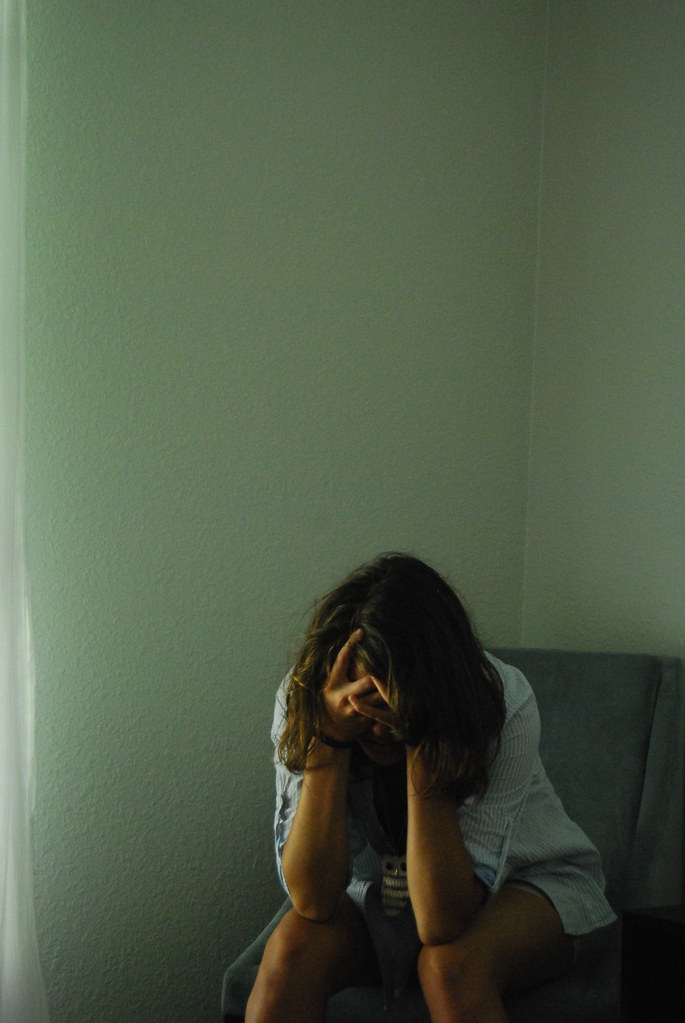
Photo: “Grief” by That One Chick Mary is licensed under CC BY-NC-ND 2.0.

Weekend read: Quincy R. Lehr, ‘Thud!’

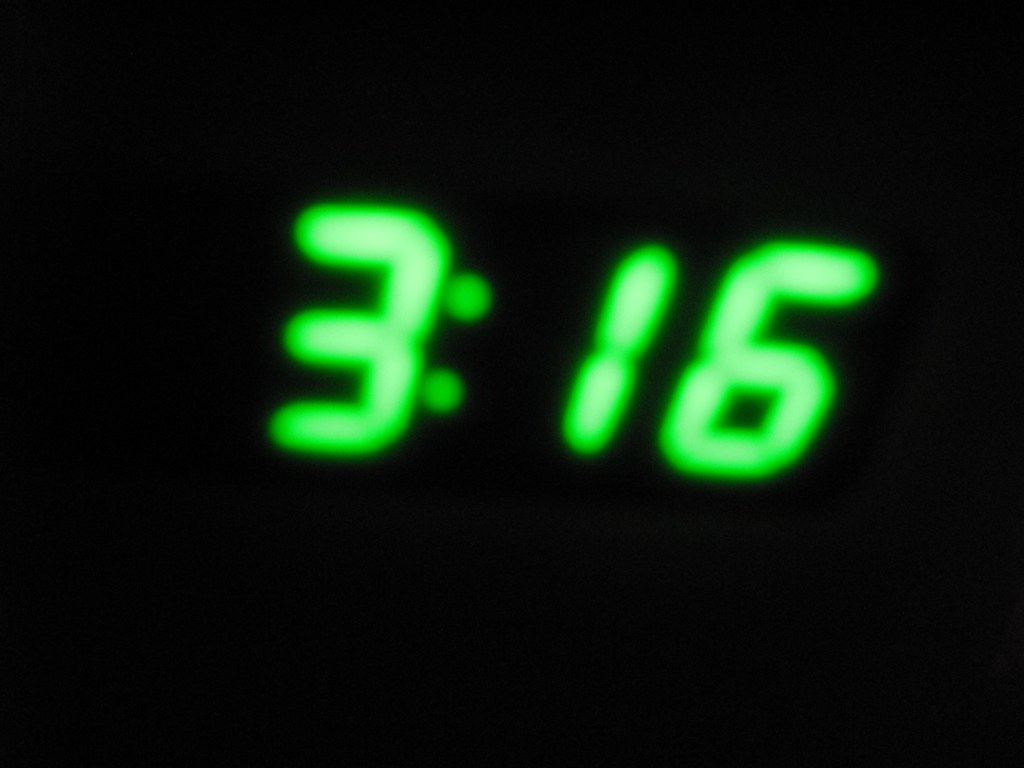
There’s thudding from the floor above that never seems to stop.
I’m trying to sleep, or waiting for the other shoe to drop
as midnight clomps toward 2 AM and hours of darkness dwindle
into the gray of going to work. This rent’s a fucking swindle.

Where’s my damn connection gone? The internet’s too slow.
Get me Jobs or get me Gates. Those bastards need to know.

I called her on a Friday, and we swore that we would meet.
I hailed a taxi, ended up along a different street —
similarly named, but swathed in layers of graffiti.
A drip of sweat ran down my neck; the air was cold and sleety.

Where’s that old-time romance gone? Who will sigh and blubber
over at hers at 3 AM with a lavatory rubber?

I saw a TV talking head while ordering a bagel
who talked about the budget mess — but then he quoted Hegel
about the end of history. Some Weltschmerz is okay,
but save it for the pop songs, man, and don’t get in the way.

Where’s my hometown paper gone? The owner’s on the run
from ranters on the blogosphere. Something must be done.

He met my eyes and shook my hand, and though you wouldn’t know it,
that jerk-off in a business suit calls himself a poet/
critic/impresario and manages quite well.
He smiled and quoted Dante, but I only thought of Hell.

Where’ve our tortured artists gone, Catullus or Syd Barrett?
Chasing after the latest grant and following the carrot.

The upstairs stomps are quicker now and spreading to the hall.
My head’s beneath the pillow. Damn it — won’t she ever call?
I half hope that she’s safe in bed and blithely fast asleep,
but fantasize her all alone and looking up mid-weep.

Where’s the just comeuppance gone? What happened to bad karma?
It got renamed and bottled up and bought out by Big Pharma.

There’s violence in the movies, and there’s violence on TV;
there’s violence on the city streets…. Fuck off! Don’t talk to me!
There’s anger in the headlines, and there’s fury in the verse
spat out at downtown open mikes. I don’t know whom to curse.

Where’ve the old-time standards gone? The censors look forlorn
from hip hop, emo, techno, goth. What happened to the porn?

Times Square’s gone all Disneyfied. The red-light district’s blue.
Godspeed to all you chicks with dicks, and hello, Scooby-Doo.
Farewell, Adult Emporium! You’re now a clothing store,
maybe a Planet Hollywood — and God knows which sucks more.

Where’s my filthy city gone? They smothered it in bleach,
hired a doorman, raised the rent, and placed it out of reach.

What’s to blame? Is it our greed or lack of common sense?
Is it violence in our past, or just incompetence?
Perhaps it’s economic or the crush of circumstance.
Or was it just a thwarted wish to get into her pants?

Where’s that upstairs thumping gone? The silence settles deep
into the still and humid air. I still can’t get to sleep.

*****

Quincy R. Lehr writes: “Thud! is a New York City madsong, with gentrification, insomnia, political decay, and urban loneliness mixing together in a sort of minestrone soup of misery that is also, I think, pretty funny.”

Born in Oklahoma, Quincy R. Lehr is the author of several books of poetry, and his poems and criticism appear widely in venues in North America, Europe, and Australia. ‘Thud!‘ was first published in Measure and was reprinted in the Potcake Chapbook ‘City! Oh City!‘ His book-length poem ‘Heimat‘ was published in 2014. His most recent books are ‘The Dark Lord of the Tiki Bar‘ (2015) and ‘Near Hits and Lost Classics‘ (2021), a selection of early poems. He lives in Los Angeles.
https://www.amazon.com/Quincy-R.-Lehr/e/B003VMY9AG

Photo: “sleepless” by ebrkut is licensed under CC BY-ND 2.0.

Melissa Balmain, ‘The Marital Bed’

You always hog the blankets
and steal my magazines.
No need to ask what smells so rank–
it’s you, the king of beans.

Your toenails cut my shin.
You blow your nose: I jump.
I’m sanded by your bristly chin,
then bulldozed by your rump.

You scratch your back and sigh,
you grunt, harrumph and bray.
And yet the crazy truth is I
can’t sleep when you’re away.

*****

From Walking in on People © Melissa Balmain, 2014. Used by permission of Able Muse Press.

Melissa Balmain writes: “As with many of my poems, I owe my husband for being a good sport about seeing such things in print.  And I owe Light‘s founding editor, John Mella, who advised adding a foot to the third line of each stanza, for a 3-3-4-3 pattern. (That pattern has a name that I don’t recall. Could someone please remind me?)”

Melissa Balmain’s third poetry collection, Satan Talks to His Therapist, is available from Paul Dry Books (and from all the usual retail empires). Balmain is the editor-in-chief of Light, America’s longest-running journal of light verse, and has been a member of the University of Rochester’s English Department since 2010. She will teach a three-day workshop on comic poetry at the Poetry by the Sea conference in Madison, CT, in May 2024.

Photo: “#oneperson #AdultsOnly #onlywomen #onewomanonly #people #Adult !indoors #humanbodypart #Bed #realpeople #BlackBackground #closeup #day #awakenings” by nikdanna is licensed under CC BY-NC-ND 2.0.

Irregular Sonnet: ‘Where Do They Go?’

Where do they go, those children asleep?
Do they roost, or do angels put them on shelves?
Or do they go home, to some place they keep
locked far away from us and themselves,
Or an alternate universe? In, out, up, down?
Into a not-place, past care and past fear?
Past love and past tired, past smile, yawn and frown
into subtracted space, full of not here?

And where do they go, the dead?
We say we can’t know where they go,
just that they’re gone. But the crow
says, There is more to know that you don’t know –
says, Better ask instead
where do we go, when dead?

*****

This almost-regular sonnet was originally published in Bewildering Stories (thanks Don Webb). I thought it might be nice to emphasise (after some of irreligious poems) that I am not an atheist (except in the eyes of the organisedly religious). I am a Militant Agnostic: “I don’t know, and neither do you.”

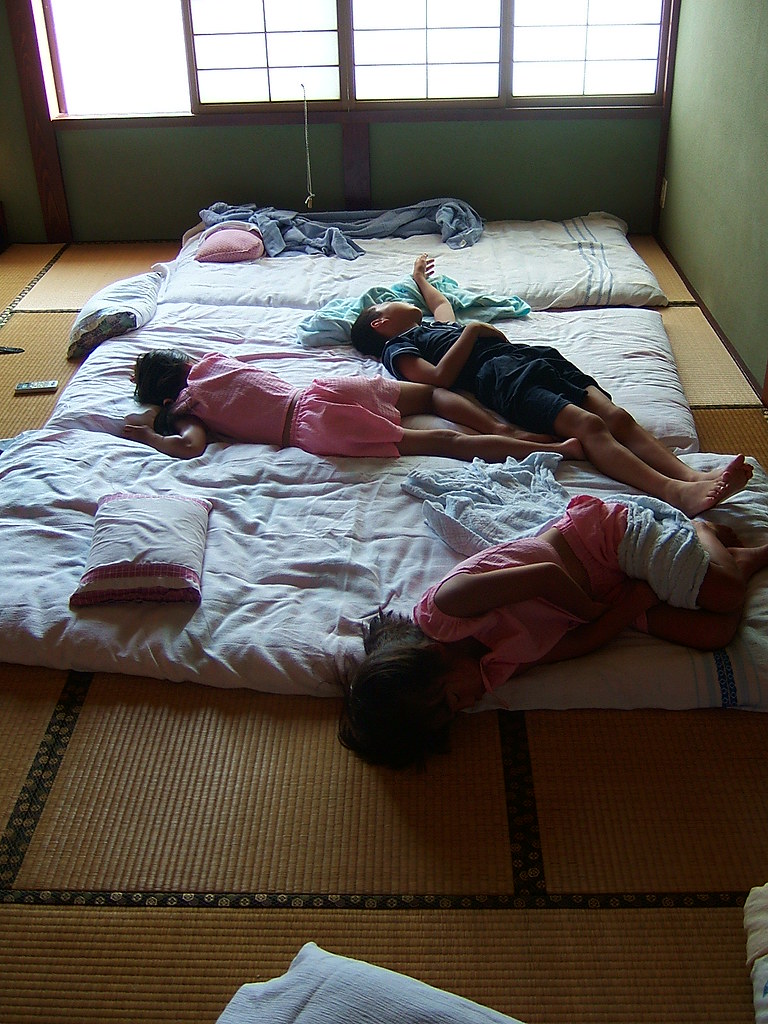
Photo: “Good sleeping children in the morning” by michibanban is licensed under CC BY-NC-ND 2.0.

Sonnet (?): ‘Sleep is Like’

Sleep is like heading to the locker room at halftime
Sleep is like stepping into the wings between acts
Sleep is like going outside for a cigarette.

And then you go back to work
Back to the performance
Back to the game.

The game that may go thirty thousand rounds;
But who you really are is when you’re on break;
The rest is just your job, performance, game, not you.

And when at last it ends, and you go home,
Back to where you came from,
Who are you? and where do you go?

Perhaps you know this while you’re deep
Asleep…

This poem–if it is a poem–on (one of) the mysteries of the universe was just published in Snakeskin. I suppose you could call it a sonnet if you want… it has 14 lines. With four thoughts in four sets of three lines and a concluding sort of rhymed couplet, it has an organised form. Sonnetish. But it’s not elegant, it’s coarse–like life and death, consciousness and sleep.

It has no regular beat, let alone formal metre. And it’s not reasonable to claim that ABC DEF GHI JKL MM is a rhyme scheme. The piece simply doesn’t have the carefully balanced exposition of a sonnet, the flow of rhythm, the inevitability of rhyme.

If I put together a collection of my sonnets, I wouldn’t include it.

Probably.

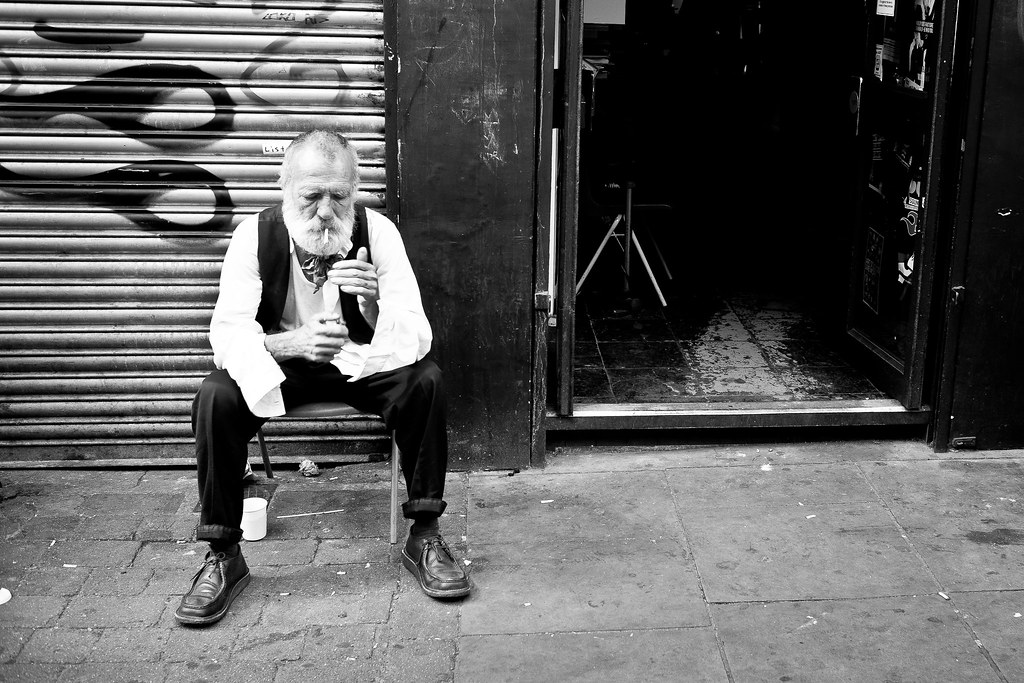
“Smoking outside London Bar” by macabrephotographer is licensed under CC BY-SA 2.0

Potcake Poet’s Choice: Ann Drysdale, ‘Sleeping in Tongues’

Three of us breathing; me and dog and cat.
Awoken by a faint and plaintive mew,
I hold my own breath, ascertaining that
the sound comes from one of the other two.
I act upon an educated guess
and lay a hand on cat, who quickly twists
into a different pose of idleness
and settles, silent. But the sound persists.
So dog it is, who wheezes in a dream
that has bestowed on him the gift of tongues
and things both are, and are not, what they seem.
I let the captive air out of my lungs.
Three of us breathing, dog and cat and me;
companionable synchronicity.

Ann Drysdale writes: “This poem emerged from a situation that took a minute to happen and evolved into a sonnet that takes a minute to read. I can almost believe that it sprang fully-formed from my fingertips, now that the pile of sawdust, chippings and paintflakes generated by the making of one into the other has been swept under the carpet and forgotten.”

Ann Drysdale now lives in South Wales and has been a hill farmer, water-gypsy, newspaper columnist and single parent – not necessarily in that order. Her most recent volume of poetry, Vanitas, joined a mixed list of published writing, including memoir, essays and a gonzo guidebook to the City of Newport. Another collection is accreting nicely and is due to be published next year.

Her poems have been published in several of the Potcake Chapbooks:
Tourists and Cannibals
Rogues and Roses
Careers and Other Catastrophes
Families and Other Fiascoes
Houses and Homes Forever
… all available from Sampson Low for the price of a coffee.

Sonnet: ‘The Thief’

More than the actual loss, it’s helplessness
That we most loathe when suffering a theft:
The arbitrary way one daring, deft,
Brass act leaves careful order in a mess;
The knowledge the thief’s wilder and cares less;
The easy way he tears the warp and weft
Of dull security; the insight left
The cosmos can as quickly curse as bless.

Therefore the fears are mostly overblown-–
The thief himself causes no loss or strife
More than insurance or day’s work redeems.
But there’s a greater thief, and more unknown,
Who comes each night and steals one third your life,
Leaving no more than fingerprints, your dreams.

Sleep and dreams are so large a part of our existence that they seem to merit more attention than most people pay them. Sure, we need some rest, but we can get physical rest while awake during the day. So do we really need seven or eight hours every night to defrag our minds and delete unnecessary memories?

I like to think (this is close to “I believe”, but it isn’t belief) that there is something crucial going on that we are missing. The occasional “big dream” that resonates life-changingly. The dream of a distant loved one saying goodbye, before you get the news the next day of their death. The awareness that your unconscious is actually running your show, and that you better pay attention and assist where you can. All these reduce the apparent dominance of the waking mind, and open cans of existential worms. There are no certain answers. We are nowhere near understanding how our bodies, our minds or the universe works.

It’s all wonderful; but I still resent the amount of time I have to sleep. (And to those who say “It’s possible to sleep a lot less” I say “Yes, but at what cost? We have no idea.”)

I’m proud of this sonnet on a technical level. It is a true Petrarchan sonnet (iambic pentameter, and rhyming ABBAABBA CDECDE); the flow of words finds natural tiny pauses at the line breaks; only the volta, the twist to the exposition, is arguably in the wrong place, being strongest after the 11th line rather than after the eighth. But I feel it is all redeemed by a strong last line.

‘The Thief’ was originally published in ‘Candelabrum‘ – a magazine stolen by time.

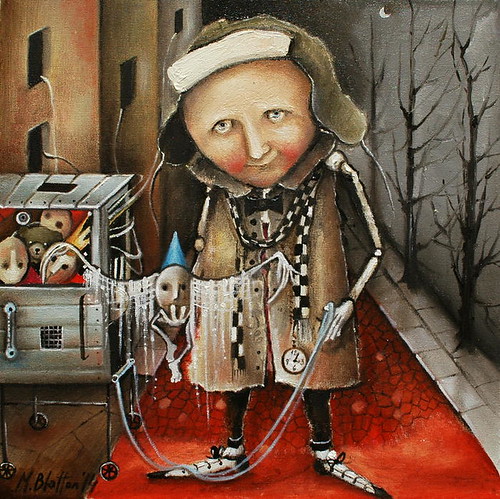
Photo: “Thief Of Dreams” by Monica Blatton is licensed under CC BY-NC-ND 2.0