Tag Archives: sonnet

Sonnet: Martin Elster, ‘Axis Denied’

Earth, always the same distance from her star,
induced no crane to migrate, lark to sing,
chorus frog to trill, violet to spring,
nor leaves to turn. The solstice was as far
as the edge where galaxies all disappear.
The sun kept glaring down, as on that shore
where, from your tower, you chose to ignore
the thing I most desired. Wasn’t it clear?
Earth didn’t tilt. Her poles were locked in glaze,
sea level never changed, and when I walked
forever round your roost, you never talked
of waves, or even sensed the sun-launched rays
till yesterday when, with a sudden lurch,
Earth tipped and threw you off your chilly perch.

*****

Martin Elster writes: “The title “Axis Denied” works in two ways. Literally, it refers to a world without axial tilt, and therefore without seasons or change. Phonetically, “axis” echoes “access”—suggesting denied emotional entry or withheld intimacy—until a sudden shift finally breaks the stasis.”

Martin Elster, who never misses a beat, was for many years a percussionist with the Hartford Symphony Orchestra. He finds contentment in long woodland walks and writing poetry that often draws on the natural world and on scientific ideas, from animal life to larger planetary and cosmic patterns. His honors include Rhymezone’s Poetry Contest (2016) co-winner, the Thomas Gray Anniversary Poetry Competition (2014) winner, the Science Fiction Poetry Association’s Poetry Contest (2015) third place, five Pushcart Prize nominations, and a Best of the Net nomination. His latest collection is From Pawprints to Flight Paths: Animal Lives in Verse (Kelsay Books).

This poem appears in Bewildering Stories #1122. His work has also appeared in the anthology Outer Space: 100 Poems (Cambridge University Press) and in the Potcake Chapbooks Careers and Other Catastrophes, Robots and Rockets, and City! Oh City!

Image: “‘SNOWBALL EARTH’ – 640 million years ago” by guano is licensed under CC BY-SA 2.0.
Susan McLean, ‘The Other Woman’

What makes you think your husband’s what I want?
Does he think that? He’s dumb as mud, if so.
To me, a man’s a fast-food restaurant,
just grab and go. Maybe that hurts to know,
but joints like that are everywhere—and packed.
It’s not a lifetime contract; it’s a meal.
I don’t do long-term. Obstinates attract.
I’m bad for him. He knows. Big fucking deal.

Nobody has a long attention span
these days. So, what do you do when you’re bored?
Binge-watch TV, drink white wine, find a man?
You want security, but feel ignored
and miss that fizz of come what may. Guess what:
we all end up alone. You think you’re not?

*****

Susan McLean writes: “This poem got its start as an entry to a sonnet contest held by the online journal Better Than Starbucks in 2019. It won the contest, appeared in the journal, and was later reprinted in Extreme Sonnets II. I like the dramatic monologue form, and once I thought of the situation, an “other woman” being confronted by the outraged wife of the man she has slept with, the voice of a woman with an attitude just came to me.

“Ironically, the poem’s content was influenced by my experience of teaching students to write essays in a college composition class. One of the subjects I typically had them write about was the obesity epidemic in America, what was causing it, and how the situation might be improved. I was surprised to learn that my students were often angry on being told that fast food might be hurting them. Many of them had been raised on it, loved it, and depended on it because it was what they could afford. They did not want to be informed of how many calories it contained or what it might be doing to their health. But the other influence on the poem was my sympathy for anyone trying to start a relationship in an era of short attention spans, instant gratification, and online dating sites. There’s a lot of loneliness out there, and not just among single people.

“Finally, for me what makes this sonnet work is the underlying humor in what is a very uncomfortable situation. The wife, who initiates the confrontation, seems to want the other woman to back off, but finds that the woman has no particular interest in the husband, and that the husband is only pursuing her because she is not interested in him. The wife is further thrown off balance when the other woman suggests that the two women have more in common than the wife may want to believe. When a clichéd situation doesn’t turn out the way you expect it to, the element of surprise contributes to the humor.”

Susan McLean has two books of poetry, The Best Disguise and The Whetstone Misses the Knife, and one book of translations of Martial, Selected Epigrams. Her poems have appeared in Light, Lighten Up Online, Measure, Able Muse, and elsewhere. She lives in Iowa City, Iowa.
https://www.pw.org/content/susan_mclean

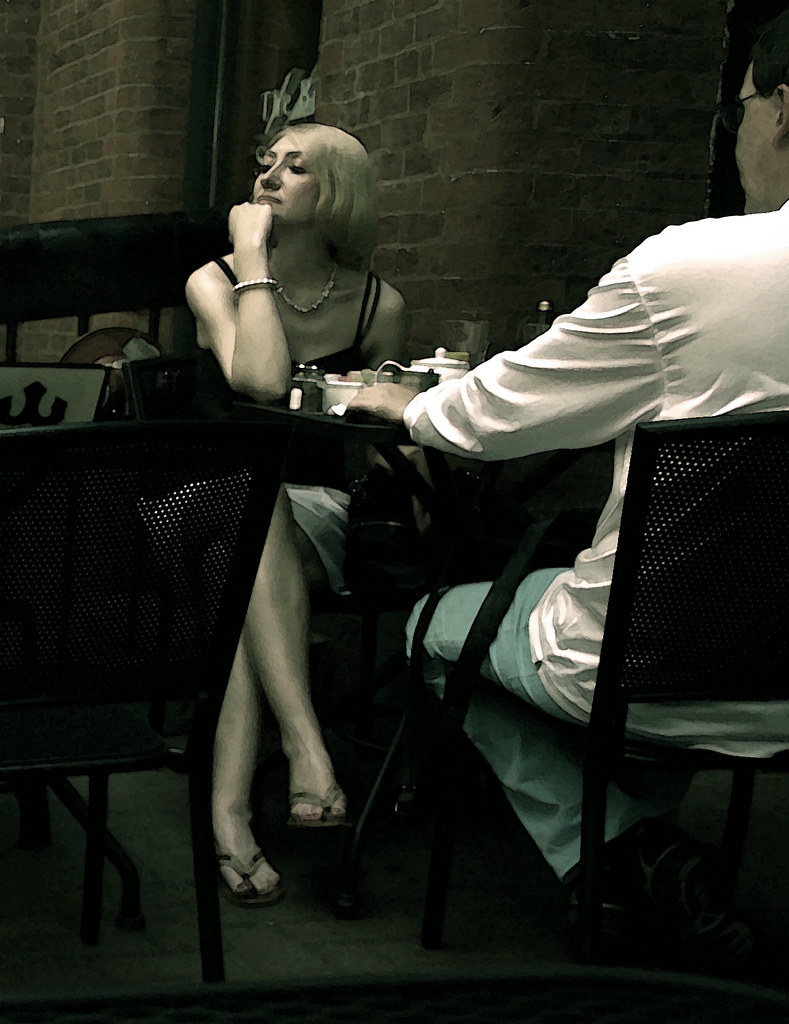
Photo: “The Other Woman” by Professor Bop is licensed under CC BY-NC-ND 2.0.

Sonnet: Amit Majmudar, ‘Homing’

My parents stacked the best years of their youth as
Bricks to build me. Taught me words I taught
Myself to shout them down with when we fought.
My parents loved me, though I could be ruthless
Hurting myself with things I poured or burned
And those who loved me with the things I said.
My parents never gloated once I learned,
Just held me through my sobs, and kissed my head.

Now, in the living room I stormed out of,
They tell me I can stay the month, or year,
Because my room will never not be here
No matter where I go, or who I love.
I am their blood, they tell me. I depart
From them as blood does from a beating heart.

*****

Amit Majmudar writes: “A homing pigeon knows where its home is by training, as the falcon knows the falconer’s arm. But there are deeper instincts at work in nature that science still struggles to explain fully, like the way birds know how to migrate by looking at the stars, and the way monarch butterflies find their way to the same vast swath of oyamel trees in Mexico every year. Human beings have something of that in them. Not just for the neighborhoods where we grew up, but for the people, the family, who were there with us. This poem is about that. I distinctly recall its writing; I woke up at the “witching hour,” as I often do, while visiting my sister-in-law’s house in Texas over Christmas break. Ten family members were asleep in the same house, and, unable to fall back asleep, I picked up my phone and found an invitation to submit to a new sonnet journal in my inbox. Immediately, still in the awoken, excited, “witching hour” state (which the Indian tradition calls the Hour of Brahma, the time of peak creativity), I wrote this poem about the bond between the far-afield child and the fixed star of family, first line to last.”

‘Homing’ was just published in The Sonneteer which can be accessed at thesonneteer@substack.com. It offers a free, partial service as well as an upgraded paid subscription.

Amit Majmudar’s recent books include Twin A: A Memoir (Slant Books, 2023), The Great Game: Essays on Poetics (Acre Books, 2024), and the hybrid work Three Metamorphoses (Orison Books, 2025). More information about his novels and poetry collections can be found at www.amitmajmudar.com.

“There are many things in life that will catch your eye, but only a few will catch your heart…pursue those.”~Michael Nolan” by katerha is licensed under CC BY 2.0.

My own favourites: Sonnet: RHL, ‘Death Will Be Harsher Now’

Death will be harsher now, as, year by year,
we solve the clues of immortality:
emotions sink to animality
as false hopes tighten screws of desperate fear.
Hormone control will make age disappear—
after false starts, most horrible to see—
but those already old must beg to be
frozen for the genetic engineer.
While war, starvation, pipe Earth’s gruesome jigs,
successful businessmen will fight to gain
some dead teen’s body, to transplant their brain,
the already-old beg to be guinea-pigs.
Children, look back, hear our despairing cry:
we bred immortals, but we had to die!

*****

I wrote this poem on 3 January 1982 – twenty years before I began to get poems published. (Formal verse was an almost absolute no-no in late 20th century magazines… although consistently taught and highly praised in schools and universities, of course.) It was finally published in Ambit in October 2007 – the magazine started and managed for 50 years by Martin Bax and the stomping ground of J.G. Ballard, Ralph Steadman, Carol Ann Duffy, etc.

In April 2018 the poem was reprinted in Bewildering Stories, an online weekly headquartered in Guelph, Ontario; and in 2024 I accepted Maryann Corbett‘s suggestion to change the title and first line and instead of “harder” use the word “harsher”… the earlier word incorrectly suggesting that we might be finding it more difficult to achieve death.

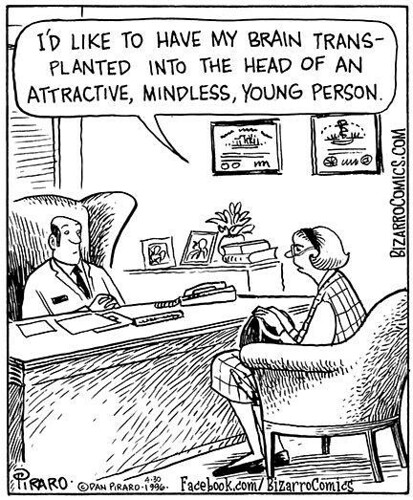
The ideas behind the poem were not new to science fiction, but were less common in formal verse. The ideas continue to inch their way towards reality; continue to be explored in popular culture (Piraro, Futurama…); and in the last 44 years I have continued to explore SF and existential themes in verse.


Cartoon: “piraro brain transplant” by Dreaming in the deep south is licensed under CC BY 2.0.

Sonnet: Barbara Loots, ‘An Old Man Makes Chili for Lunch’

Do you have a poem for an old man making chili for lunch? Like watery eyes from onion crunching–sneezing from pepper thrown… email from Dad 5/5/05

He shoves the onion pieces in a pile
to one side as he chops and chops some more.
This cutting board has lasted quite a while
through salty tears of choppers gone before,
but no use buying new equipment now.
Sometimes there’s comfort in a kitchenette
that holds what downsized spaces will allow
of former habits. He will not forget
those other hands that held this knife and chopped
for slaw and meatloaf, casseroles and stew,
and apple walnut salad. When they stopped,
he stepped up, making chili, making do,
sneezing on pepper, living on his own.
He cooks for one, but never eats alone.

*****

Barbara Loots writes: “Almost any story can be told in the compass of a sonnet. This one became an elegy cooked up in the mundane of a real moment.”

This sonnet was collected in ‘Road Trip’ (Kelsay Books, 2014)

After decades of publishing her poems, Barbara Loots has laurels to rest on, but keeps climbing.  The recent gathering at Poetry by the Sea in Connecticut inspired fresh enthusiasm. Residing in Kansas City, Missouri, Barbara and her husband Bill Dickinson are pleased to welcome into the household a charming tuxedo kitty named Miss Jane Austen, in honor of the 250th birthday year of that immortal. She has new work coming in The Lyric, in the anthology The Shining Years II, and elsewhere. She serves as the Review editor for Light Poetry Magazine (see the Guidelines at  lightpoetrymagazine.com)

Photo: “Chopping Onions” by TheDarkThing is licensed under CC BY 2.0.

Sonnet: RHL, ‘Last Building Standing’

When The End came, it was not the end–
it never is; the universe continues.
The millions died; I stand alone, no friend;
alone, but healthy in my bones and sinews.
One keeps on, staunchly, soldierly at post,
your day-to-day as other days have been…
though the past world (or you) is just a ghost,
a relic, fragment, hint, more felt than seen.
I’ve lived beyond my time; my world has gone,
my car-charged streets, my teeming meeting rooms,
the close-packed skyline-scrapers now redrawn
as nascent forest, trees standing as tombs
where flocks of birds replace friends whose lives fled,
with ghostly unseen me alone not dead.

*****

‘Last Building Standing’ is a Shakespearean sonnet, first published by The Orchards Poetry Journal. The Winter 2025 issue is now live on Amazon, as well as the Kelsay Books website.

Image: ‘Abandoned Skyscraper’ by RHL and ChatGPT

Sonnet: RHL, ‘Mirror Shades’

Trust’s been essential to our global rise,
and humans have a unique way to build trust:
we’ve left all other primates in the dust
because, alone, we have whites to our eyes.

With dark eyes, what they look at they disguise,
whether they see it with disgust or lust.
Why we look may leave other folks nonplussed,
but that they know what we’ve seen stops some lies.

We’ve sacrificed a natural secrecy
to raise our social aspects several grades.
Hiding your eyes now means active deceit.
So, those upholding laws and decency
can’t be allowed sunglasses; mirror shades,
especially, alienate and self-defeat.

*****

I guess this isn’t a good example of a sonnet. There’s no real turn, it’s just an essay beating on the same point over and over: the eyes being the windows of the soul (even to an agnostic), if you are trying to build trust and community you have to be able to see each other’s eyes. If you are just trying to dominate, then sure, go ahead, hide behind shades and mirrors and blinds and curtains… but you’re giving up one of the greatest innovations that let our species of ape achieve social complexity.

The poem was recently published in the weekly ‘Bewildering Stories‘.

As for the photo, it appears to be a selfie by a young Chinese police officer, more concerned with style and image than with making his community safer. But who knows what is important in his life and for his career.

Cutie Police” by Beijing Patrol is licensed under CC BY 2.0.

Sonnet: Paul Burgess, ‘Reynadine’s Farm’

“The chickens should have been a tighter group,
and Farmer should have purchased stronger locks
instead of whining now about the coop
and getting mad at Reynardine, the fox.

The chickens didn’t mend defensive flaws
or try to get a gun or sharper beak.
Why blame the beast with wits and stronger jaws
for weeding out the losers and the weak?

The victim here, whose name they’ve tried to harm,
has suffered public shame and sad disgrace.
To make it right, he must receive the farm.
I thank Your Honors now and rest my case.”

The judges ruled in Reynardine’s support
because the fox had also bought the court.

*****

Paul Burgess writes: “The Elizabethan sonnet, which I love to adapt to many purposes, is a natural fit for the structure I like best: a setup, a volta, and a jolt at the end.  Many of my best poems succeed, and my worst fail, because of my persistent embrace of tonal ambiguity. This poem is no exception. I like the tension between a seemingly folksy and witty parable and a traditionally serious, elegant form. For me, there’s humor in darkness and darkness in humor. The balance shifts, but I don’t think I could ever completely separate the two and still be myself, as a person or as a writer.”

‘Reynadine’s Farm’ was first published in Snakeskin.

Paul Burgess, an emerging poet, is the sole proprietor of a business in Lexington, Kentucky that offers ESL classes in addition to English, Japanese, and Spanish-language translation and interpretation services. He has recently contributed work to Blue Unicorn, Light, The Orchards, The Ekphrastic Review, Pulsebeat, The New Verse News, Lighten Up On Line, The Asses of Parnassus, and several other publications.

About

Photo: “Ely Cathedral: Stained Glass Museum” by Phil McIver is licensed under CC BY-NC 2.0.

Sonnet: Amit Majmudar, “The Only Holy War”

Oh what a glorious war we waged on time,
you in your peacock pleats and jasmine braid
and ankle bells portraying a warrior goddess,
me at my laptop redeploying rhyme
like roving arrows on a map of fate.
We fought our Passchendaele, entrenched in bodies,
my dugout deep in yours. We woke up, ate,
went on our morning walks, we made love, played
old board games, ditched our iPhones, stormed the beachhead,
kamikazed straight into the sun
while knowing we would likely never reach it,
while knowing no Great War was ever won,
each night, each decade together one more mission
prolonging this timeline, this lifegiving war of attrition.

*****

Amit Majmudar writes: “My twin sons, so recently in diapers, just submitted their college applications. My beard has now more white hairs than black. How did this happen? At the cellular level, at the level of fast-twitch muscular contractions and verbal elan, time causes depletion, the radioactive decay of the youthfully glowing complexion, the degradation of collagen, the degradation of memory…. Sophocles, Goethe, and Yeats wrote beautifully into their later lives. Shakespeare stopped writing, voluntarily, when he was less than a decade older than my current age. Two things take me out of time: love, and the creative flow state. This poem represents (both in its subject matter, and as an example of my creativity) the intersection of the two. Yet time really doesn’t stop during that interval. I just cease to register it. The aging goes on, unchecked: the piecemeal conquest of the body, follicle by follicle, neuron by neuron; the tick-tock wastage of love’s remaining years together…. It demands a war effort, and total war at that, all one’s resources of spirit and body utilized to fight it: a Crusade to retake one’s youth, the war against time a Manhattan Project, a veritable Mahabharata: “the only holy war.”

‘The Only Holy War’ was originally published in the New Verse Review.

Amit Majmudar’s recent books include Twin A: A Memoir (Slant Books, 2023), The Great Game: Essays on Poetics (Acre Books, 2024), and the hybrid work Three Metamorphoses (Orison Books, 2025). More information about his novels and poetry collections can be found at www.amitmajmudar.com.

Illustration: RHL and ChatGPT

Sonnet: Felicity Teague, ‘Robot Dawn’

I sensed your rising in the paper years,
when I was sitting on the garden wall
to copy edit, through my teens. My fears
were few, back then, because the threat seemed small
and I still held the tools. My pencil case
contained my biros, red and royal blue,
my trusty ruler. And at quite a pace,
the work to trim and tidy would ensue,
just as required. But slowly, over time,
the paper-scape was lost to you, your screens,
your checks, your macros. Now, you’re in your prime,
you’re winning worlds of words with your machines,
while I am, we are, shrinking, dwindling, done,
deleted. Humans, zero; robots, one.

*****

Felicity Teague writes: “Due to the advance of the robots in my profession, I’m currently exploring other employment options. These are limited as I have severe and worsening autoimmune arthritis, but I really want to keep working for as long as I can.”

‘Robot Dawn’ was first published in Snakeskin.

Felicity Teague (Fliss) has featured in a number of poetry journals and has published two collections, From Pittville to Paradise (2022) and Interruptus: A Poetry Year (2025). Since April, she has put together the monthly metrical poetry showcase Well Met, and the November issue is here.

Photo: “Greenhouses – Castle Bromwich Hall Gardens – Silver robot potted man” by ell brown is licensed under CC BY-NC-SA 2.0.